
Meta Advertising
Meta Advertising Services for Facebook and Instagram Campaign Strategy, Lead Generation, and Growth
Meta advertising gives brands access to one of the most important paid media ecosystems in digital marketing. Through Facebook and Instagram, advertisers can reach highly specific audiences, test creative quickly, scale awareness, drive leads, support e-commerce, and build full-funnel campaigns that connect discovery, consideration, and conversion. Meta Ads Manager is built around six campaign objectives: awareness, traffic, engagement, leads, app promotion, and sales.
For many businesses, Meta is valuable because it combines broad reach with strong audience targeting, flexible placements, and creative formats that can support both brand-building and performance goals. A well-structured Meta campaign can help businesses increase visibility, generate website traffic, capture leads, retarget engaged users, and support other channels like paid search, SEO, email, and programmatic media. Meta also supports location targeting and custom audience strategies, which makes it one of the most adaptable platforms in the advertising landscape.
At Crosstide Media, we build Meta advertising campaigns around audience intelligence, account structure, creative strategy, tracking accuracy, and measurable performance. Whether the goal is local lead generation, national growth, retargeting, e-commerce support, awareness, or issue-based campaign communication, we help advertisers build Meta campaigns designed for stronger efficiency and better business outcomes.

Jump To
What Is Meta Advertising?
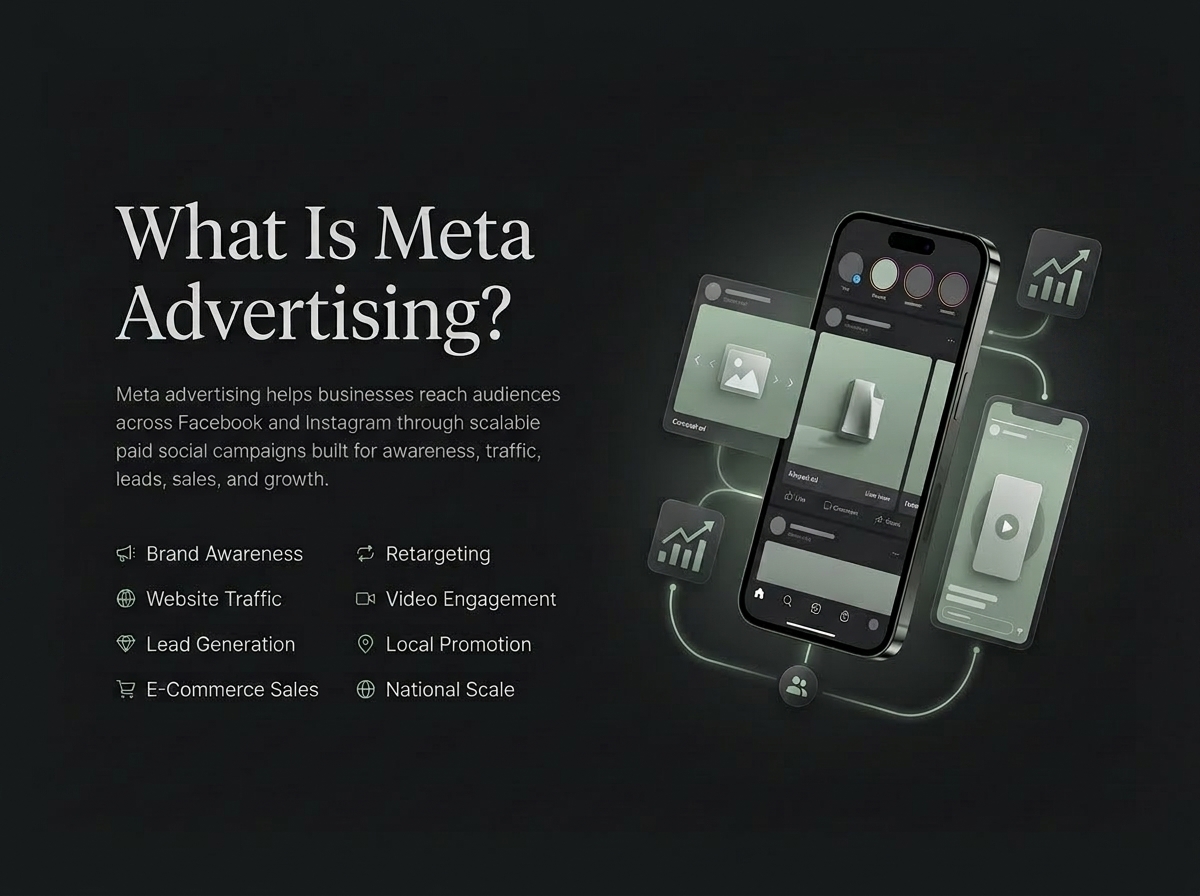
Meta advertising refers to paid media campaigns run through Meta’s advertising system across Facebook, Instagram, Messenger, and Audience Network placements. In practice, most advertisers focus primarily on Facebook and Instagram because of their scale, creative flexibility, and targeting capabilities. Meta Ads Manager allows advertisers to manage audiences, budgets, creative, placements, and optimization in one system.
Meta advertising can help businesses support:
- brand awareness
- website traffic
- lead generation
- e-commerce sales
- retargeting
- video engagement
- local promotion
- national scale
The main value of Meta advertising comes from its ability to combine audience targeting, creative testing, and cross-placement delivery across some of the most active digital environments in consumer media.
Why Meta Advertising Matters
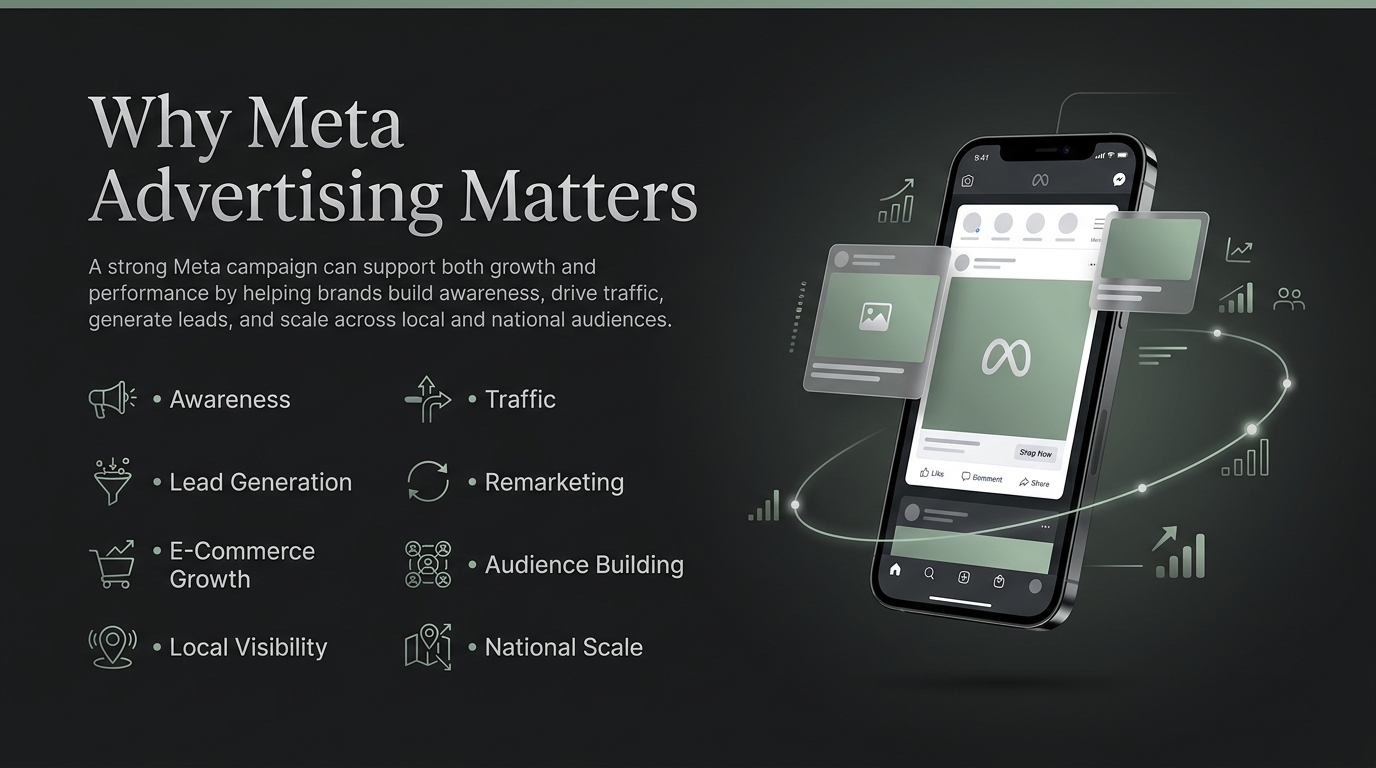
Meta matters because it reaches people where they already spend time. Facebook and Instagram remain major attention environments for browsing, discovery, comparison, content consumption, and direct response. That makes Meta useful for both demand creation and demand conversion, depending on campaign structure.
A strong Meta campaign can help support:
- awareness
- traffic
- lead generation
- remarketing
- e-commerce growth
- audience building
- local visibility
- national scale
Why advertisers invest in Meta advertising
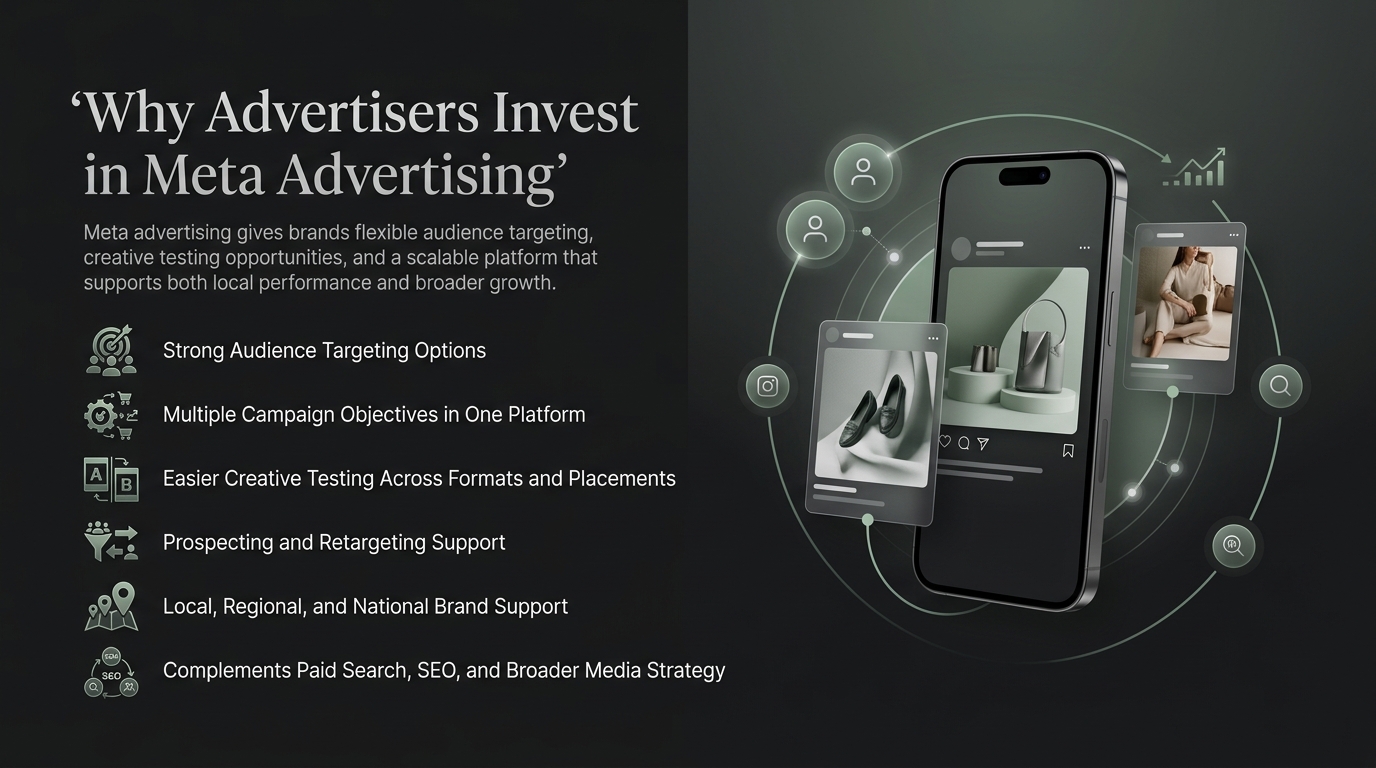
- It offers strong audience targeting options
- It supports multiple campaign objectives in one platform
- It makes creative testing easier across formats and placements
- It can support both prospecting and retargeting
- It works well for local businesses and broader regional or national brands
- It complements paid search, SEO, and broader media strategy
For Crosstide Media, Meta advertising is valuable because it combines scale, targeting flexibility, and performance measurement in one of the most active consumer ecosystems online.
Why advertisers invest in Meta advertising
- It offers strong audience targeting options
- It supports multiple campaign objectives in one platform
- It makes creative testing easier across formats and placements
- It can support both prospecting and retargeting
- It works well for local businesses and broader regional or national brands
- It complements paid search, SEO, and broader media strategy
For Crosstide Media, Meta advertising is valuable because it combines scale, targeting flexibility, and performance measurement in one of the most active consumer ecosystems online.
Where Meta Fits in the Advertising Landscape
Meta advertising plays a different role than channels like paid search, SEO, or programmatic display. Paid search captures active demand when someone is already looking. Meta often helps create interest, reinforce brand familiarity, and move audiences toward action before or between search moments.
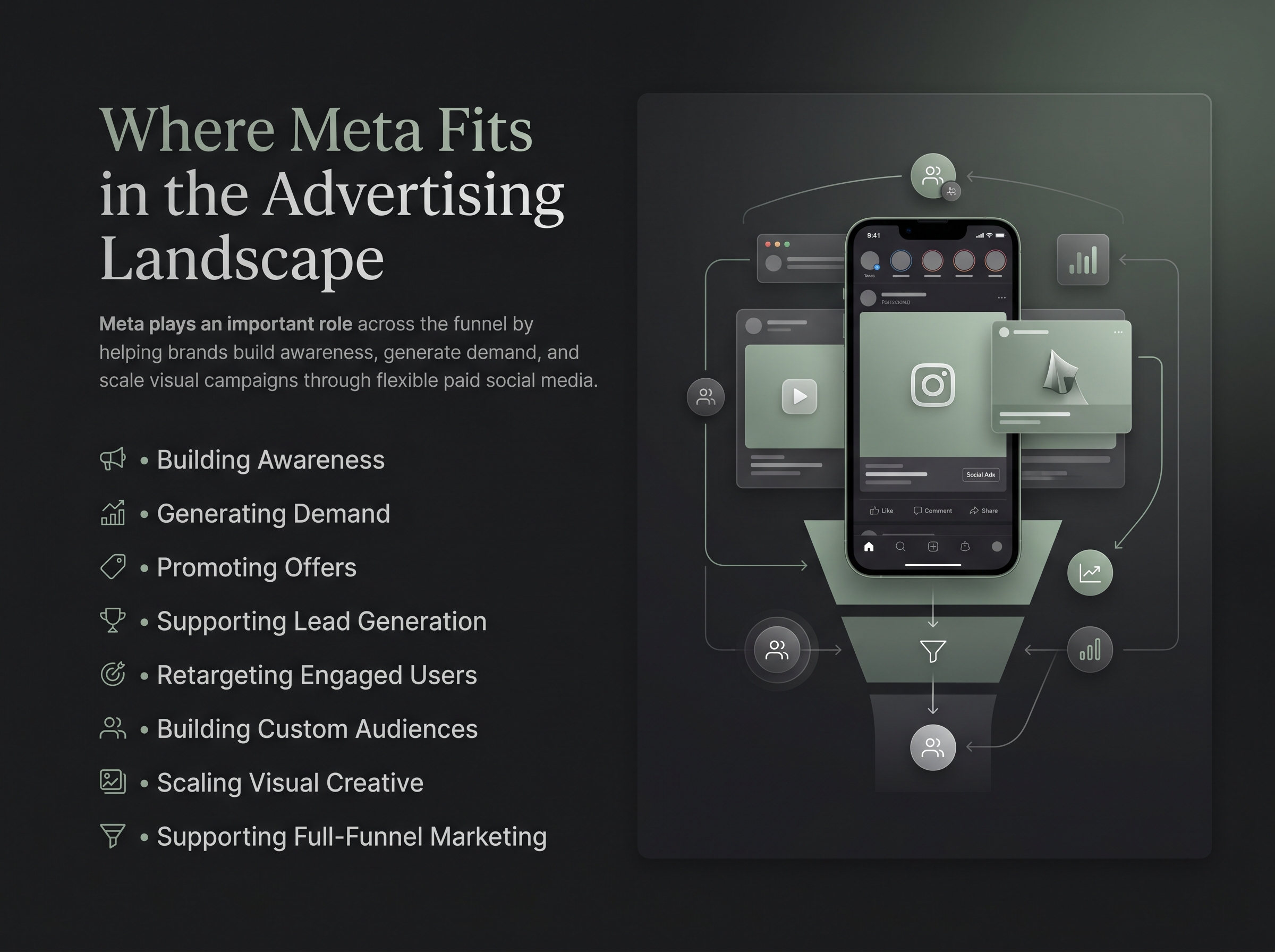
Meta is especially strong for
- building awareness
- generating demand
- promoting offers
- supporting lead generation
- retargeting engaged users
- building custom audiences
- scaling visual creative
- supporting full-funnel marketing
Meta is especially strong for
- building awareness
- generating demand
- promoting offers
- supporting lead generation
- retargeting engaged users
- building custom audiences
- scaling visual creative
- supporting full-funnel marketing
How Meta complements other channels
Meta and paid search
Meta can create demand and reinforce the brand before users search later on Google.
Meta and SEO
SEO builds long-term organic visibility, while Meta helps create immediate exposure and audience engagement.
Meta and programmatic
Meta supports platform-native attention and audience building, while programmatic extends reach across the wider web and connected media environments.
Meta and programmatic
Meta can support customer list targeting, retargeting, and re-engagement strategies.
That makes Meta one of the most important channels for brands that want to influence awareness, consideration, and conversion in one connected platform.
How Meta Advertising Works
Meta advertising works by using campaign objectives, platform signals, audience targeting, creative assets, placements, and optimization settings to deliver ads to the people most likely to take the action the advertiser wants. Objectives determine what the system is trying to optimize for, including awareness, traffic, leads, and sales.
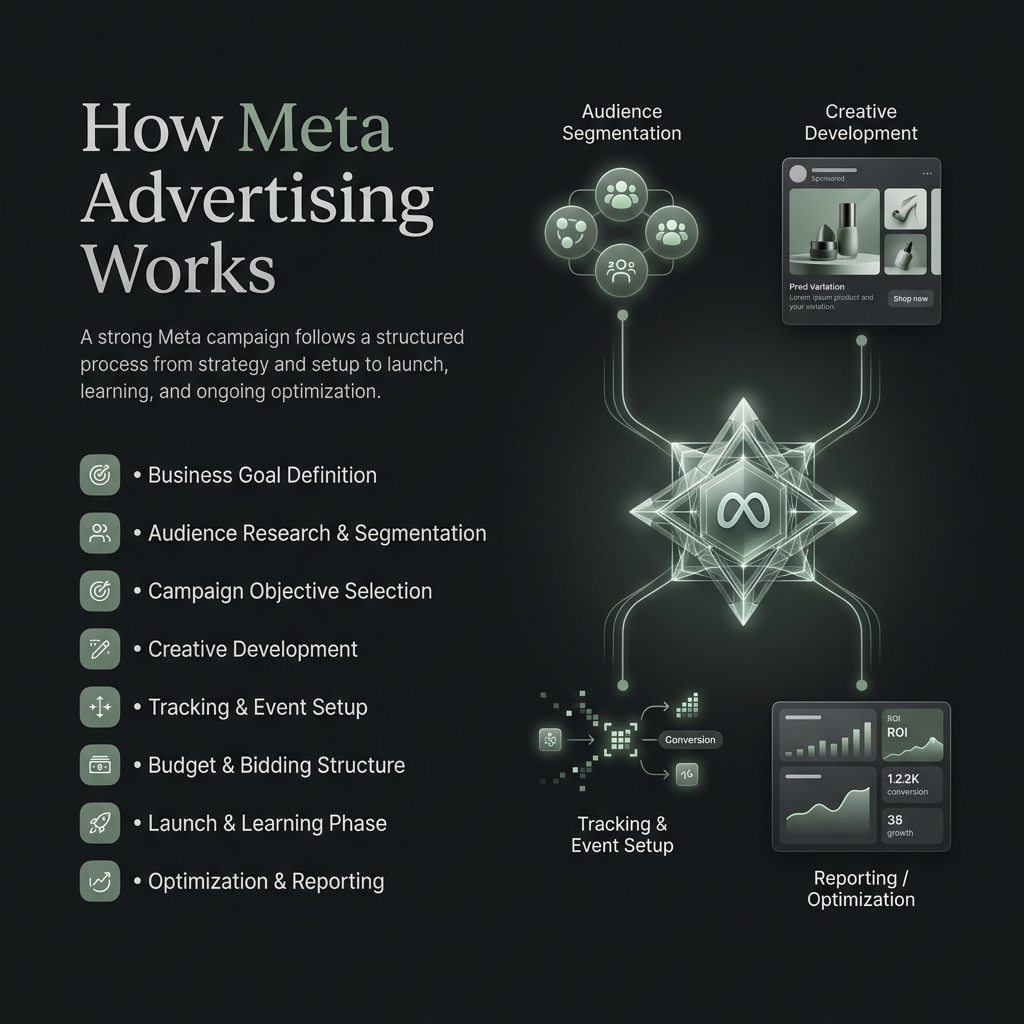
A strong Meta campaign usually includes:
- business goal definition
- audience research and segmentation
- campaign objective selection
- creative development
- tracking and event setup
- budget and bidding structure
- launch and learning phase
- optimization and reporting
The strength of Meta comes from the ability to test, learn, and improve campaigns over time using both audience data and real campaign behavior.
Facebook and Instagram Ad Formats
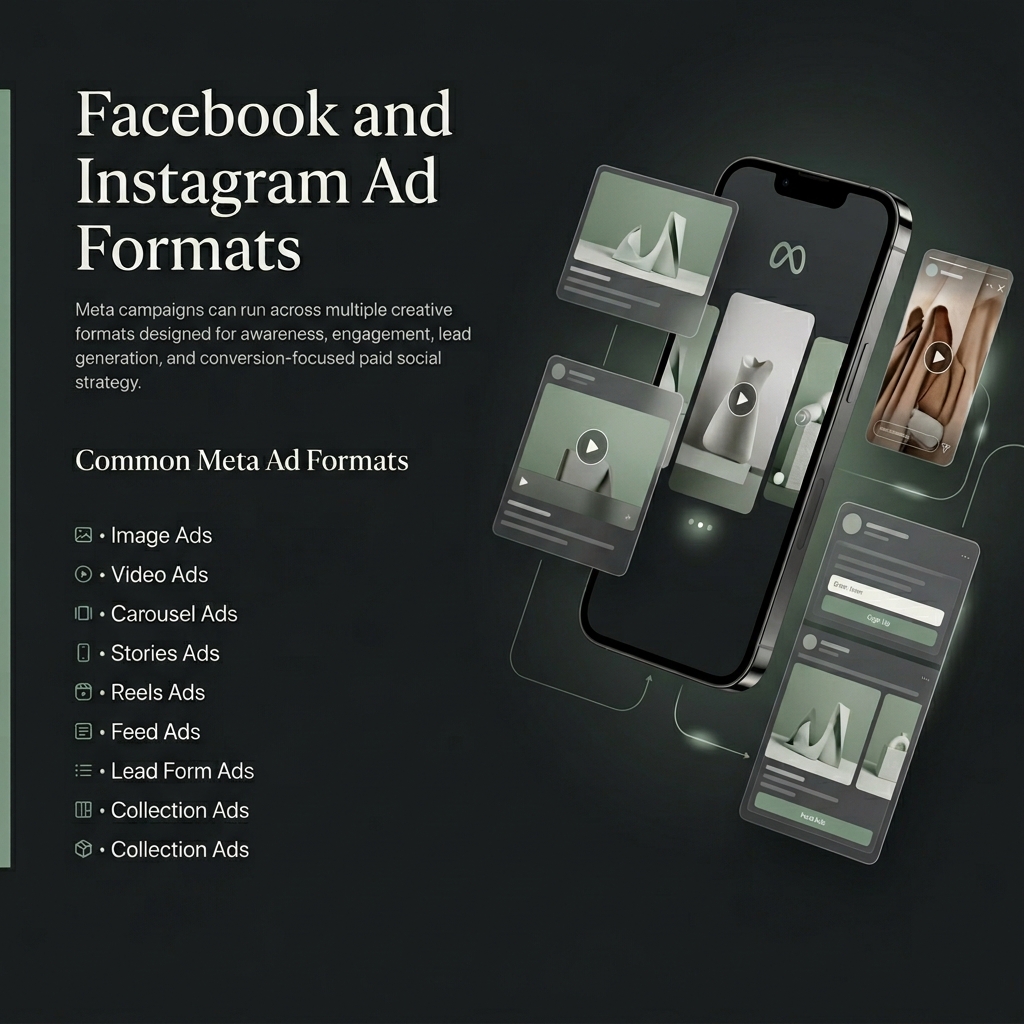
Facebook and Instagram support a wide range of ad formats and placements, which allows campaigns to be tailored to different goals and creative styles.
Common Meta ad formats
- image ads
- video ads
- carousel ads
- stories ads
- reels ads
- feed ads
- lead form ads
- collection ads
Facebook and Instagram Ad Formats
Facebook and Instagram support a wide range of ad formats and placements, which allows campaigns to be tailored to different goals and creative styles.
Common Meta ad formats
- image ads
- video ads
- carousel ads
- stories ads
- reels ads
- feed ads
- lead form ads
- collection ads

Why placement strategy matters
Different placements create different viewing conditions. Feeds often support broader visibility and click-through behavior. Stories and Reels tend to require more vertical, mobile-first creative. Creative that is built for the actual placement generally performs better than repurposed one-size-fits-all assets. Recent format guides commonly recommend 4:5 for feed images and 9:16 for Stories and Reels.
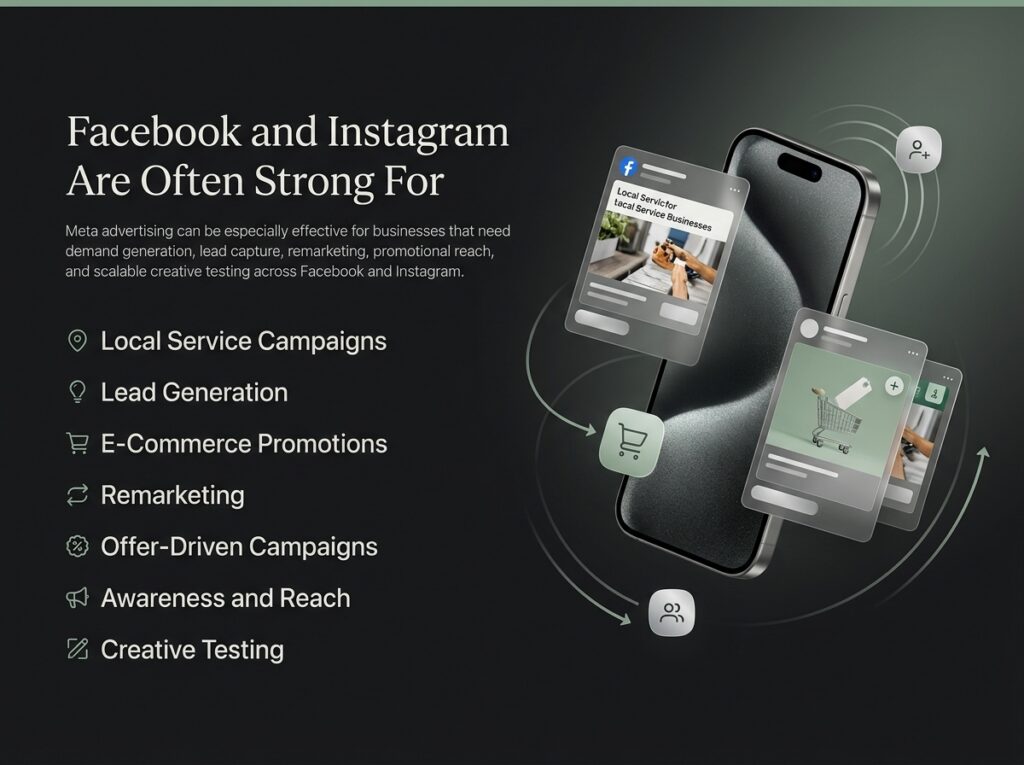
Facebook and Instagram are often strong for
- local service campaigns
- lead generation
- e-commerce promotions
- remarketing
- offer-driven campaigns
- awareness and reach
- creative testing
Facebook and Instagram are often strong for
- local service campaigns
- lead generation
- e-commerce promotions
- remarketing
- offer-driven campaigns
- awareness and reach
- creative testing
Meta Audience Targeting Strategy
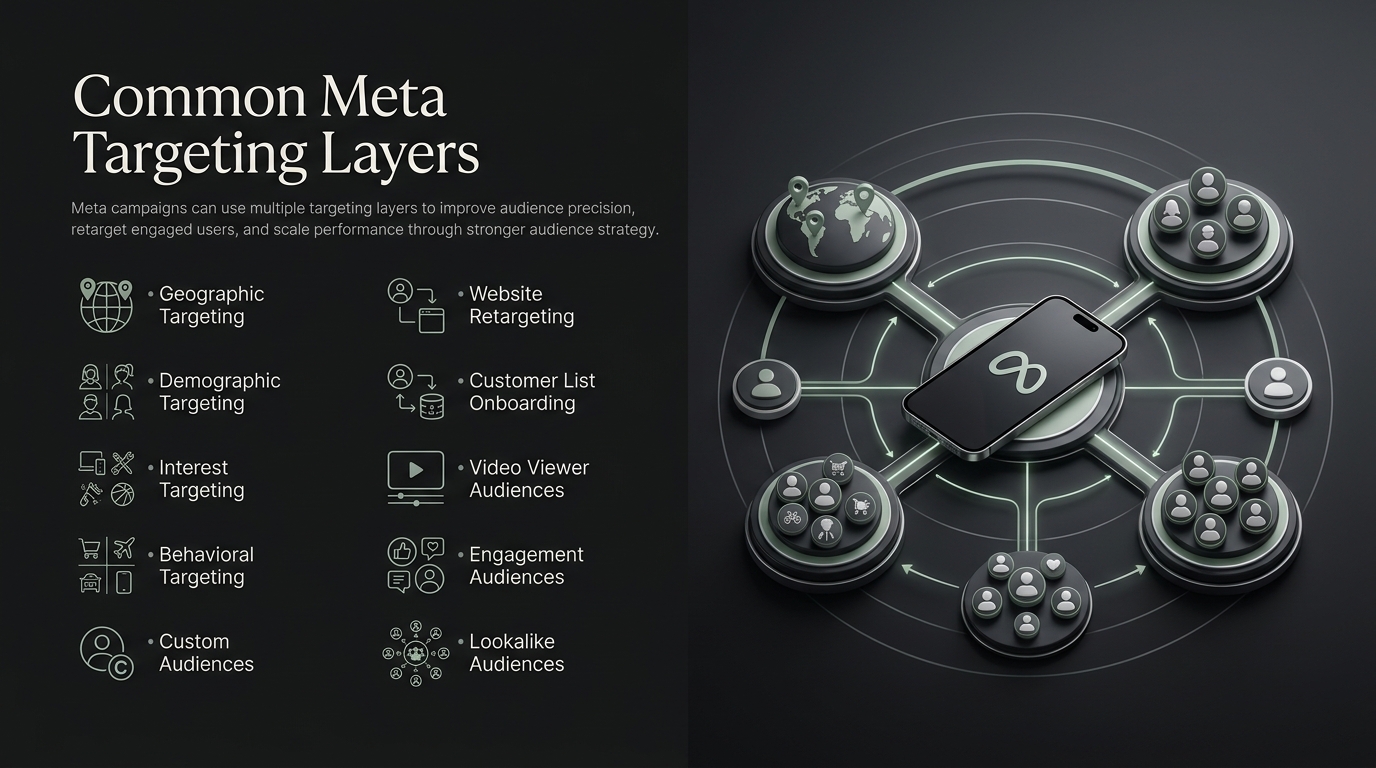
Audience targeting is one of the biggest strengths of Meta advertising. Campaigns can be built around interest, behavior, engagement, location, and first-party audience strategies.
Common Meta targeting layers
- geographic targeting
- demographic targeting
- interest targeting
- behavioral targeting
- custom audiences
- website retargeting
- customer list onboarding
- video viewer audiences
- engagement audiences
- lookalike audiences
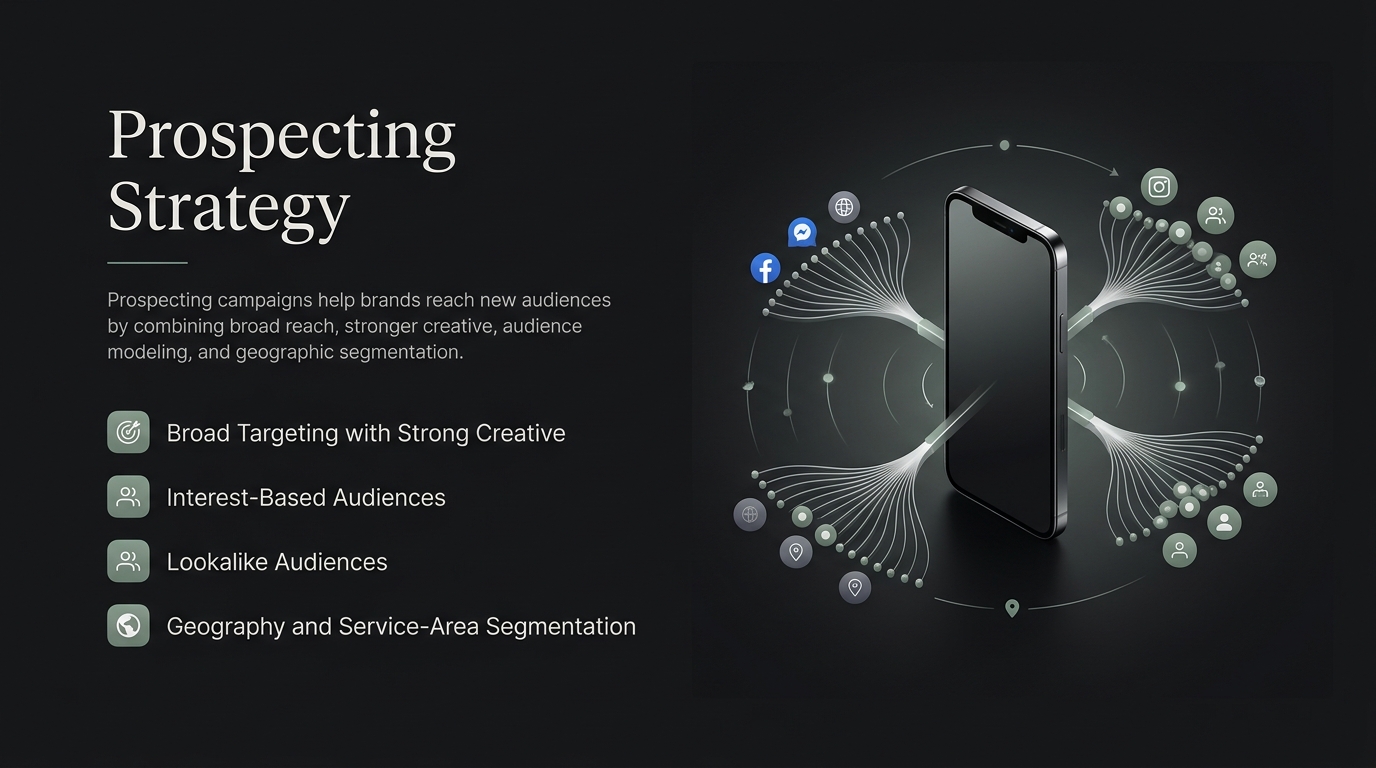
Prospecting strategy
Prospecting campaigns may use:
- broad targeting with strong creative
- interest-based audiences
- lookalike audiences
- geography and service-area segmentation
Prospecting strategy
Prospecting campaigns may use:
- broad targeting with strong creative
- interest-based audiences
- lookalike audiences
- geography and service-area segmentation
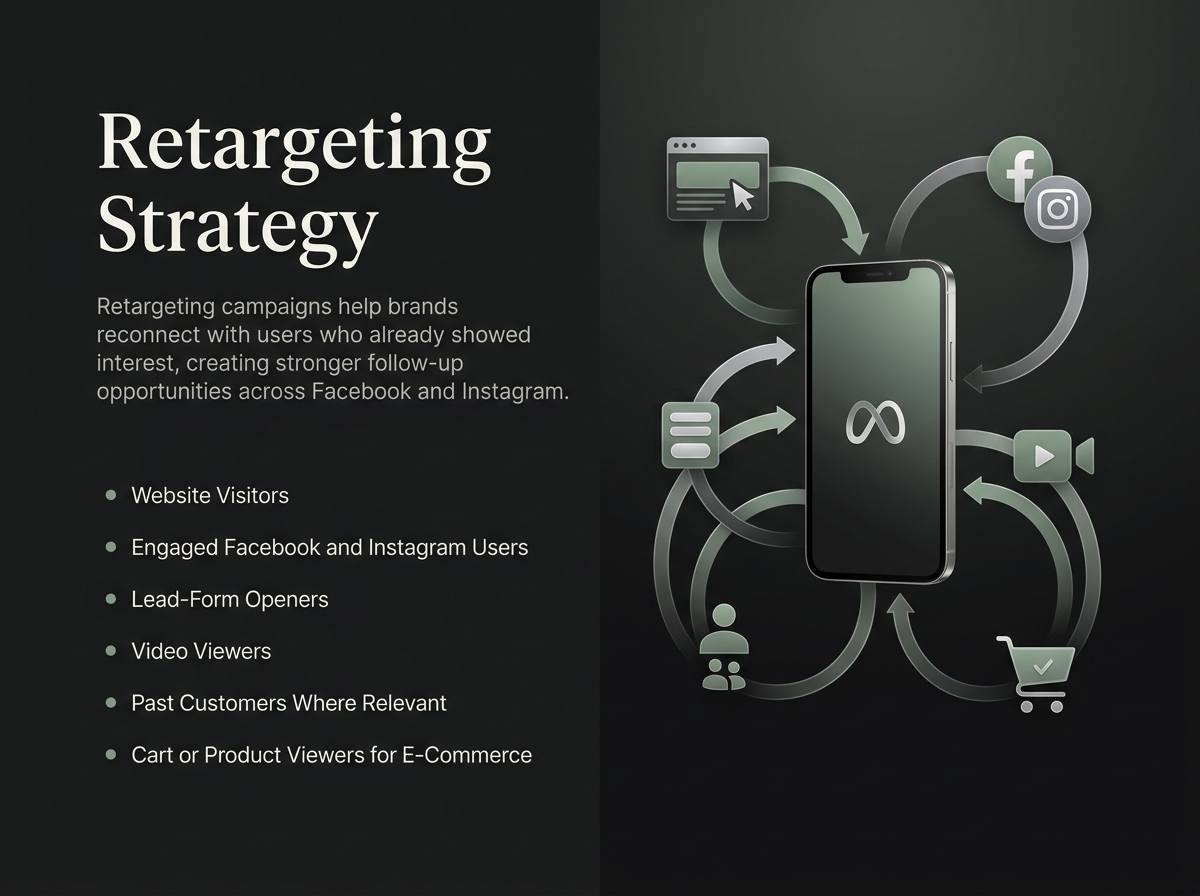
Retargeting strategy
Retargeting campaigns may use:
- website visitors
- engaged Facebook and Instagram users
- lead-form openers
- video viewers
- past customers where relevant
- cart or product viewers for e-commerce

Why segmentation matters
Not every user should receive the same message. Prospecting audiences often need awareness and education. Retargeting audiences may need a clearer offer, stronger proof, or a direct call to action. Strong segmentation improves relevance and usually improves efficiency.
Why segmentation matters
Not every user should receive the same message. Prospecting audiences often need awareness and education. Retargeting audiences may need a clearer offer, stronger proof, or a direct call to action. Strong segmentation improves relevance and usually improves efficiency.
Local vs National Meta Advertising Strategy
Meta can work for both local and national advertisers, but the strategy should change based on the size of the market and the type of audience the business needs to reach.
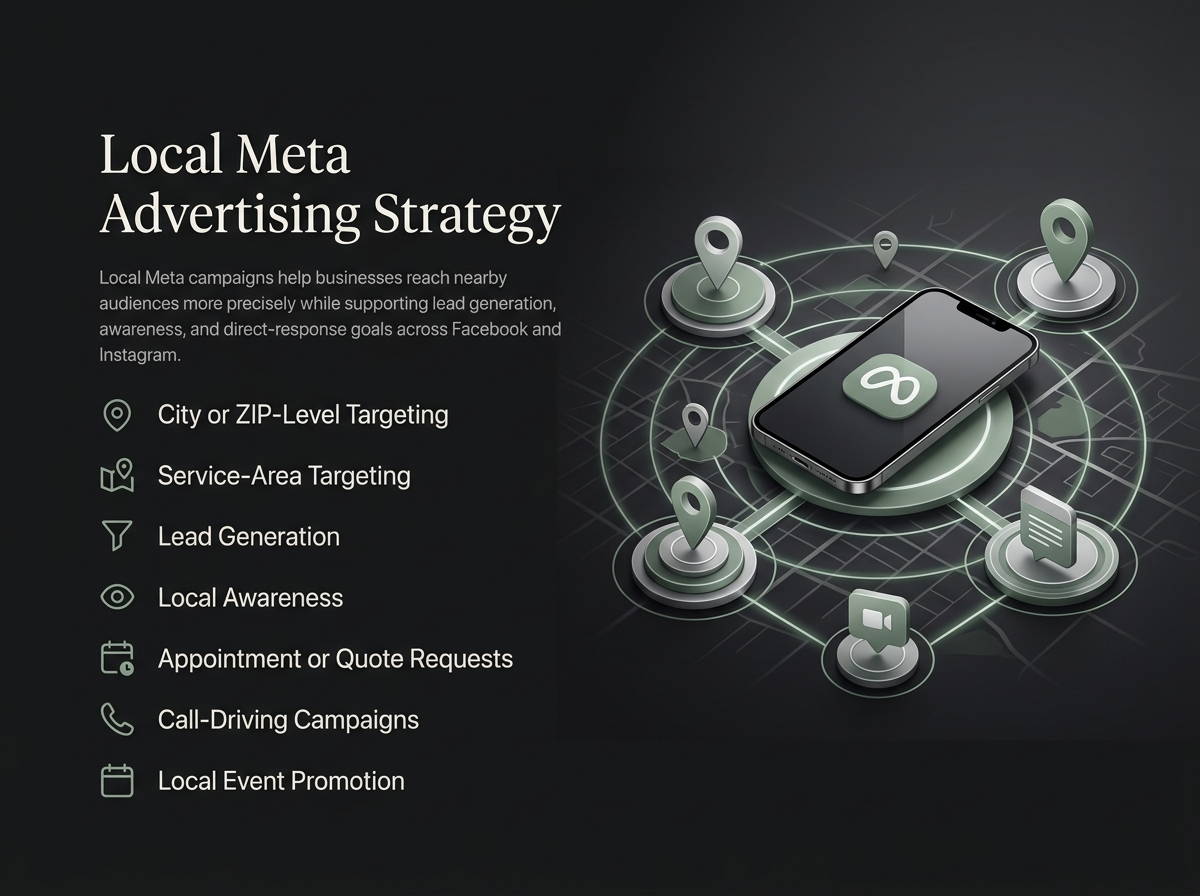
Local Meta advertising strategy
Local campaigns often focus on:
- city or ZIP-level targeting
- service-area targeting
- lead generation
- local awareness
- appointment or quote requests
- call-driving campaigns
- local event promotion
Meta’s location targeting tools support radius and geographic targeting options that are especially useful for local businesses and regional campaigns.
Local Meta advertising strategy
Local campaigns often focus on:
- city or ZIP-level targeting
- service-area targeting
- lead generation
- local awareness
- appointment or quote requests
- call-driving campaigns
- local event promotion
Meta’s location targeting tools support radius and geographic targeting options that are especially useful for local businesses and regional campaigns.
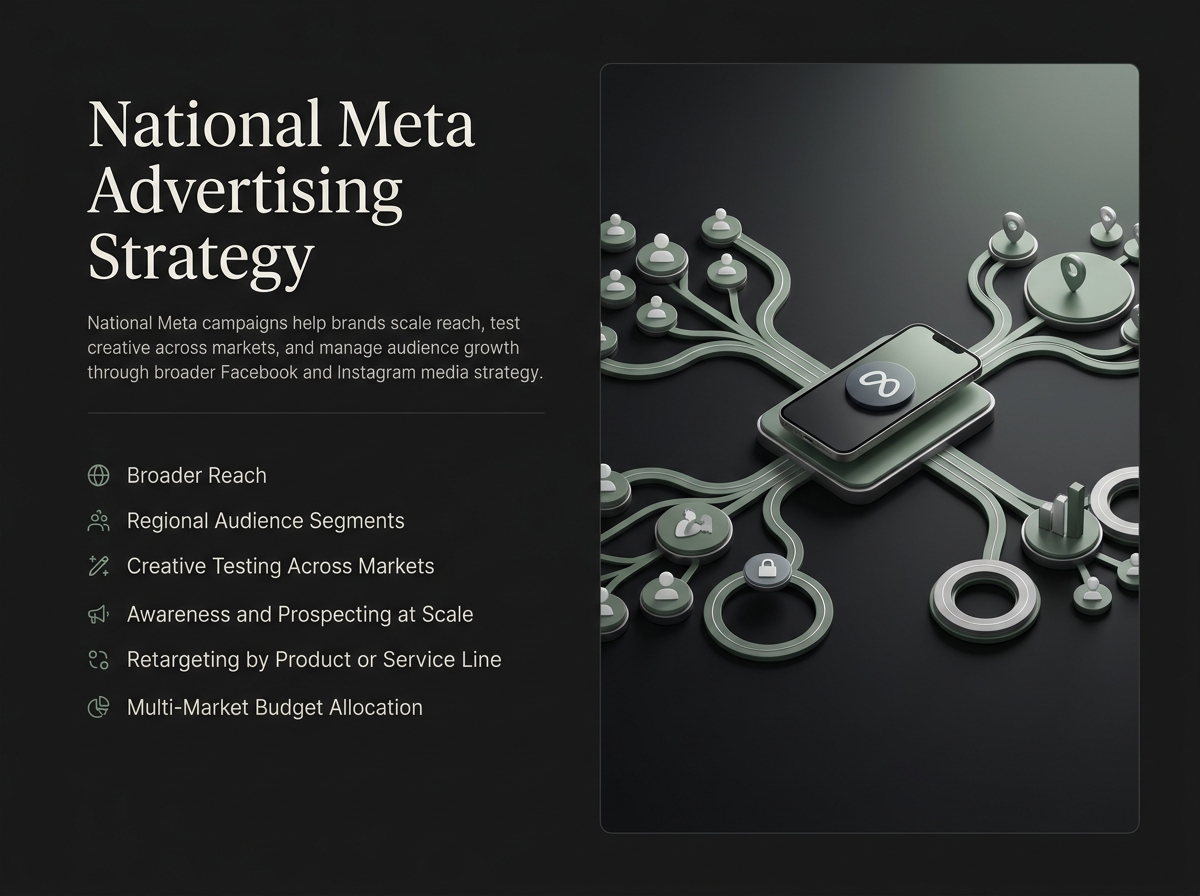
National Meta advertising strategy
National campaigns often focus on:
- broader reach
- regional audience segments
- creative testing across markets
- awareness and prospecting at scale
- retargeting by product or service line
- multi-market budget allocation

Why the distinction matters
Local campaigns usually require tighter geography, tighter budgets, and stronger conversion focus. National campaigns usually require more audience testing, more creative variation, and more structured budget distribution across markets or segments.
Why the distinction matters
Local campaigns usually require tighter geography, tighter budgets, and stronger conversion focus. National campaigns usually require more audience testing, more creative variation, and more structured budget distribution across markets or segments.
Political vs Non-Political Meta Campaigns
Meta treats political and issue-based campaigns differently from standard commercial campaigns. Non-political campaigns generally follow standard advertising setup and approval workflows. Political or social issue campaigns require additional compliance steps before ads can run.
Non-political Meta campaigns
These typically focus on:
- business promotion
- lead generation
- e-commerce
- service awareness
- event promotion
- remarketing
- brand growth
Political or issue-based Meta campaigns
Meta classifies ads about social issues, elections, or politics separately and requires authorization and disclaimers for those ads. Political advertisers must complete Meta’s authorization process and use a “Paid for by” disclaimer. These ads are also included in Meta’s Ad Library for transparency.
Why this distinction matters
A political or issue-based campaign should never be treated like a standard local-business campaign. The setup process, account readiness, approval timing, and compliance expectations are more demanding.
Political Campaign Requirements on Meta
Political campaigns on Meta require more preparation before launch. Meta’s Business Help Center states that advertisers running ads about social issues, elections, or politics must complete identity and eligibility steps and add disclaimers before those ads can run.
Key Meta political advertising requirements
Political and issue advertisers generally need:
- authorization to run ads about social issues, elections, or politics
- a confirmed identity process
- a “Paid for by” disclaimer
- a compliant business setup
- review lead time before launch
- creative and landing-page alignment with Meta policy
Why setup time matters
Because authorization and disclaimer setup can take time, political campaigns should not wait until the last minute. Election or advocacy advertisers should plan setup well before launch deadlines, especially if the campaign needs to go live quickly around a key date.
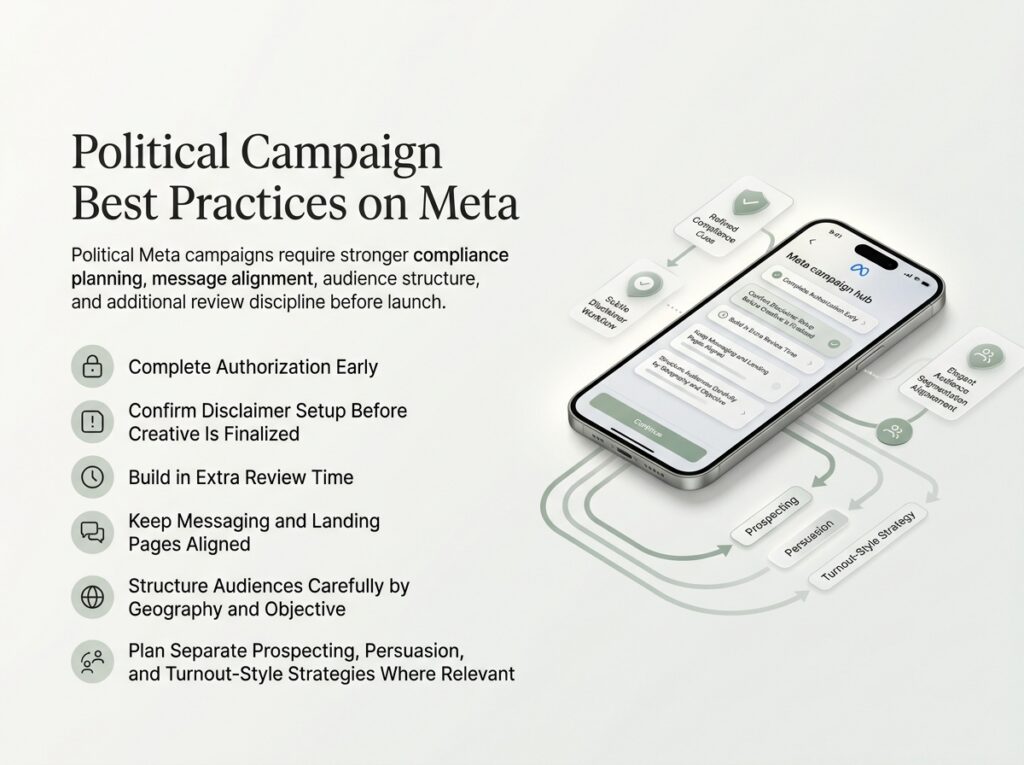
Political campaign best practices on Meta
- complete authorization early
- confirm disclaimer setup before creative is finalized
- build in extra review time
- keep messaging and landing pages aligned
- structure audiences carefully by geography and objective
- plan separate prospecting, persuasion, and turnout-style strategies where relevant
Meta has also published a 2026 midterms transparency and safeguards update emphasizing its policies and transparency systems for political and social issue advertising.
Meta Creative Strategy and Ad Specifications
Creative is one of the biggest variables in Meta performance. Facebook and Instagram campaigns often succeed or fail based on whether the creative captures attention quickly and fits the placement environment.
Why creative matters on Meta
Creative influences:
- scroll-stopping ability
- click-through rate
- lead efficiency
- video completion
- conversion behavior
- audience fatigue

Strong Meta creative should do the following
- capture attention quickly
- communicate the message early
- stay visually clear on mobile
- match feed, story, or reel behavior
- make the next step obvious
- align with the campaign goal
Strong Meta creative should do the following
- capture attention quickly
- communicate the message early
- stay visually clear on mobile
- match feed, story, or reel behavior
- make the next step obvious
- align with the campaign goal
Common Meta creative specifications and best practices
Feed creative
- often performs well in 4:5 or square formats
- should be easy to understand quickly
- should keep text readable on mobile
Stories and Reels creative
- usually works best in vertical 9:16
- should use fast pacing and clear mobile-first design
- should introduce the brand or message early
Video creative
- should hook attention quickly
- should use captions or text overlays where useful
- should be designed for sound-on and sound-off viewing
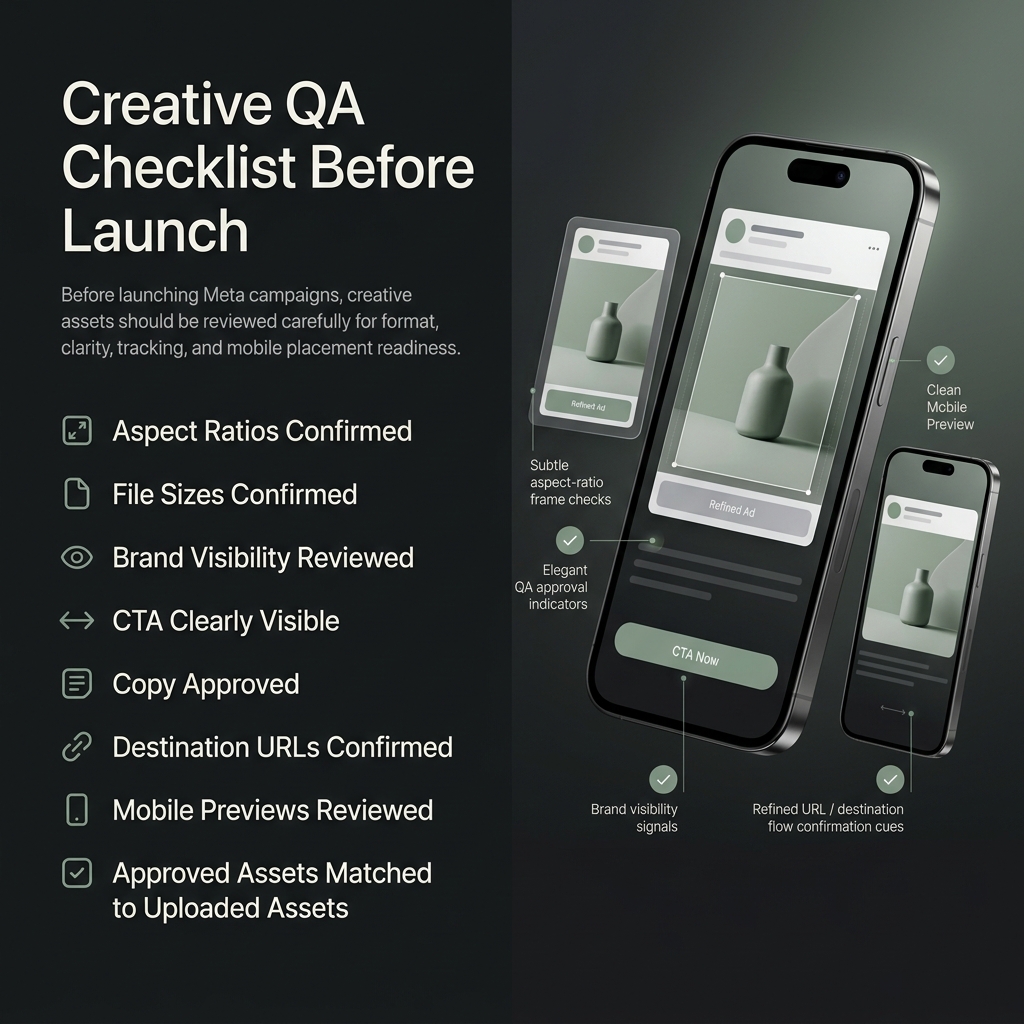
Creative QA checklist before launch
- aspect ratios confirmed
- file sizes confirmed
- brand visibility reviewed
- CTA clearly visible
- copy approved
- destination URLs confirmed
- mobile previews reviewed
- approved assets matched to uploaded assets
For Crosstide Media, creative strategy is not a separate task from media buying. It is one of the biggest drivers of Meta campaign performance.
Meta Account Setup and Campaign Structure
Strong Meta performance usually starts with clean structure. Campaigns should be organized in a way that supports testing, reporting clarity, budget control, and audience relevance.
A strong Meta setup may include
- campaign segmentation by objective
- prospecting vs retargeting separation
- audience segmentation by funnel stage
- creative separation by message or format
- geographic structure where needed
- conversion tracking and event setup
- lead form or landing-page alignment
- naming conventions for reporting clarity
Common structure approaches
Accounts may be segmented by:
- awareness vs leads vs sales
- local vs national
- prospecting vs retargeting
- service or product category
- audience type
- offer type
Why setup matters
Initial setup affects:
- testing quality
- budget control
- learning speed
- reporting visibility
- optimization efficiency
For Crosstide Media, setup is part of the strategic foundation, not just the technical start of the campaign.

Auditing and Optimization Process
A strong Meta strategy should include both a setup phase and an ongoing audit-and-optimization process. Many Meta ad accounts underperform because they carry weak structure, audience overlap, creative fatigue, poor tracking, or misaligned campaign objectives.
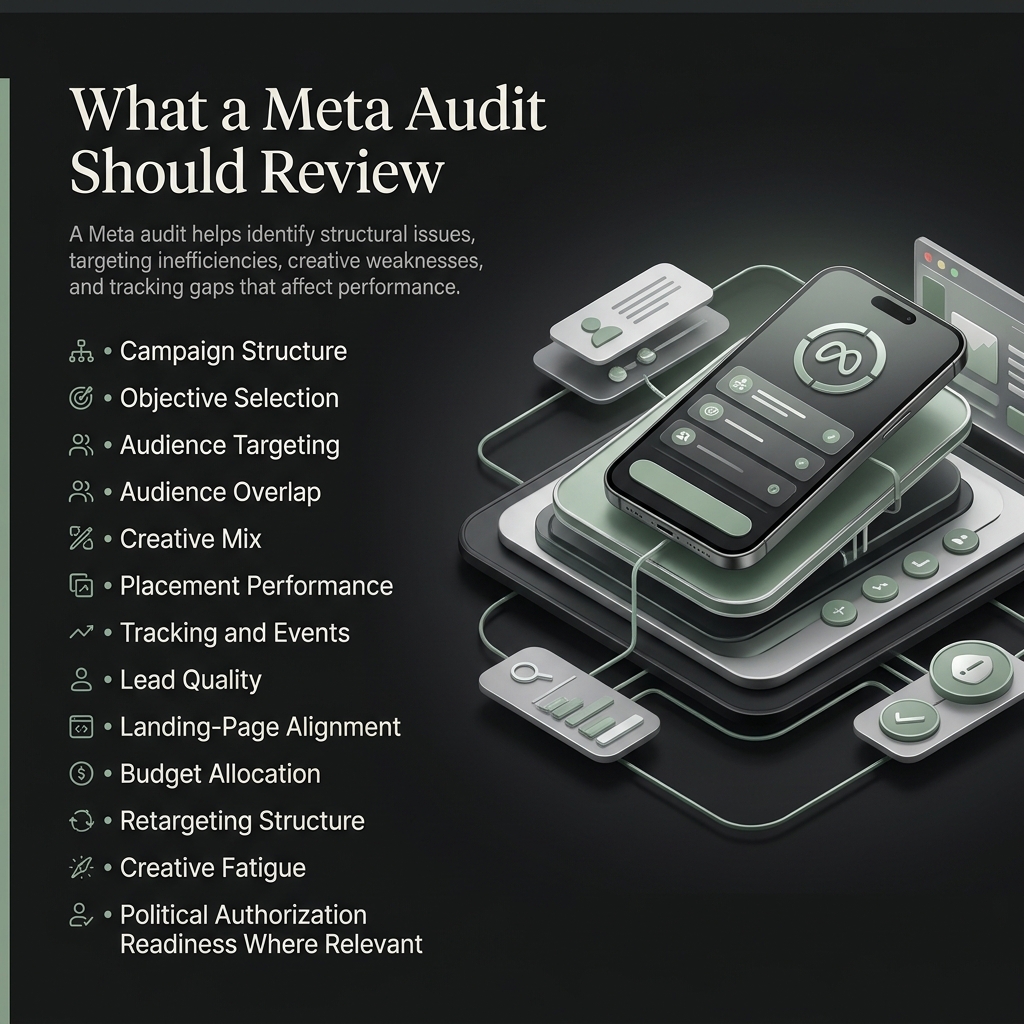
What a Meta audit should review
A Meta audit may evaluate:
- campaign structure
- objective selection
- audience targeting
- audience overlap
- creative mix
- placement performance
- tracking and events
- lead quality
- landing-page alignment
- budget allocation
- retargeting structure
- creative fatigue
- political authorization readiness where relevant
Launch and learning phase
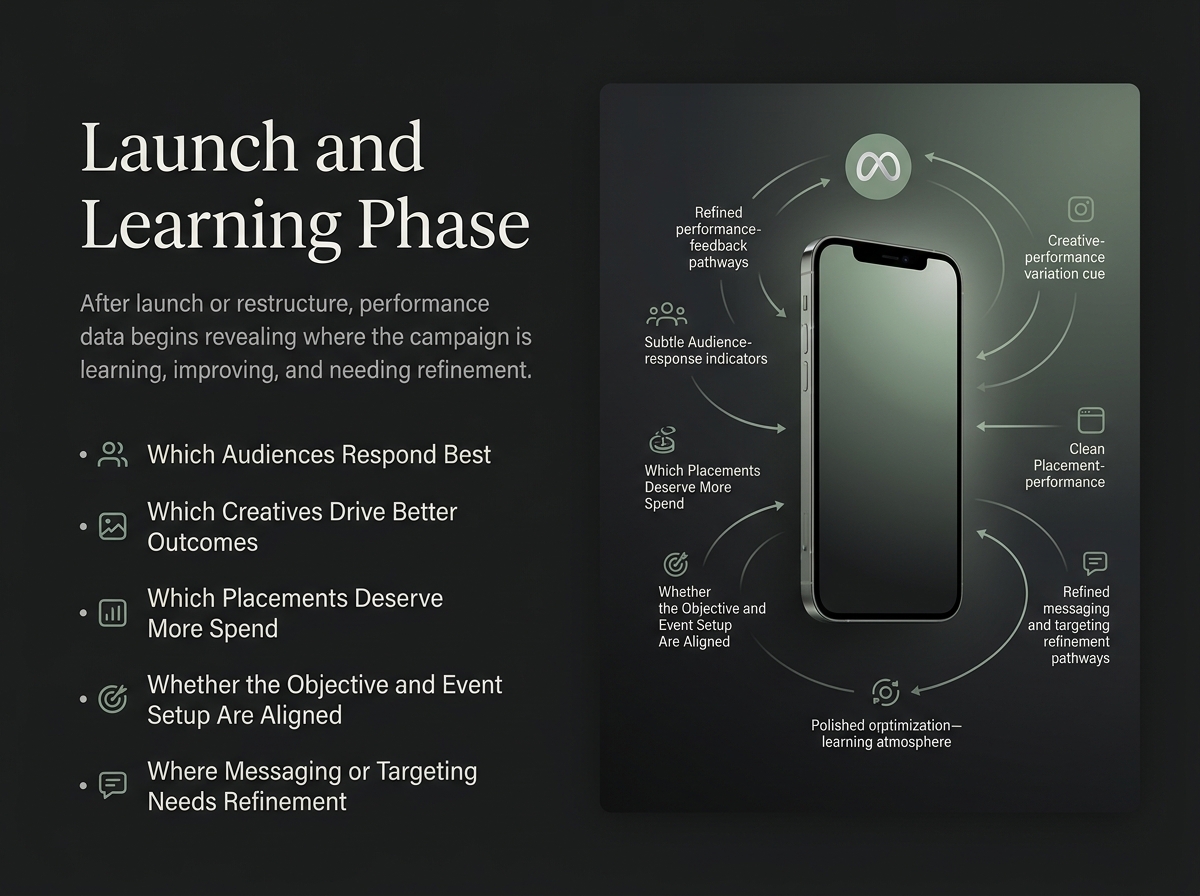
After launch or restructure, the campaign enters a learning period where performance data helps show:
- which audiences respond best
- which creatives drive better outcomes
- which placements deserve more spend
- whether the objective and event setup are aligned
- where messaging or targeting needs refinement
Launch and learning phase
After launch or restructure, the campaign enters a learning period where performance data helps show:
- which audiences respond best
- which creatives drive better outcomes
- which placements deserve more spend
- whether the objective and event setup are aligned
- where messaging or targeting needs refinement
Ongoing Meta optimization
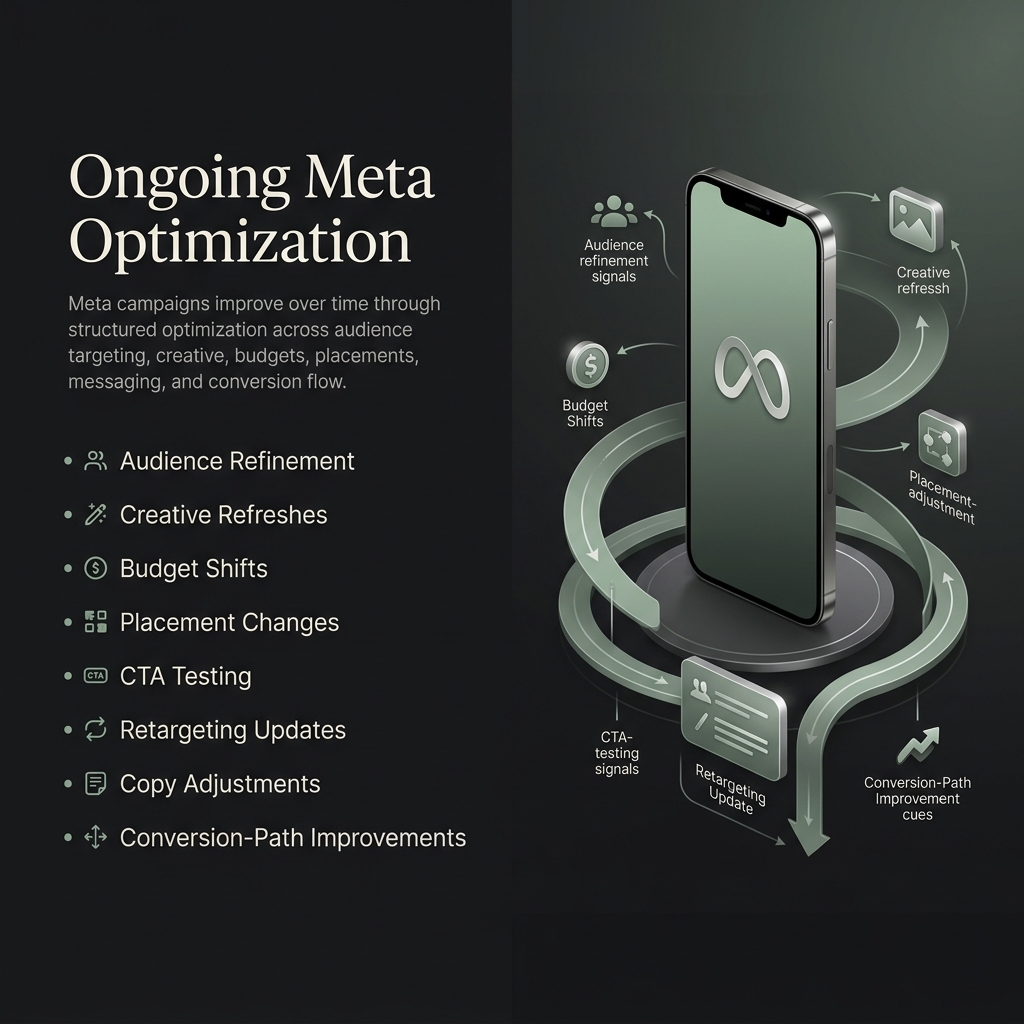
Optimization may include:
- audience refinement
- creative refreshes
- budget shifts
- placement changes
- CTA testing
- retargeting updates
- copy adjustments
- conversion-path improvements
This is where long-term performance gains are usually made.
Budgeting, Bidding, and Media Efficiency
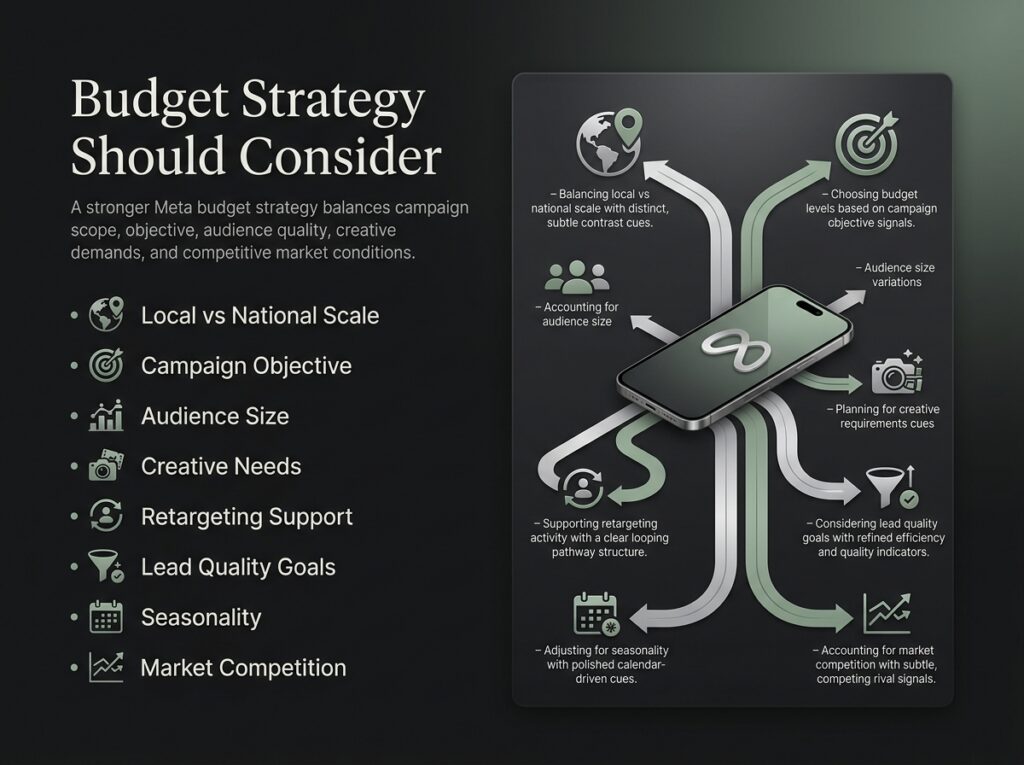
Meta budgets should be guided by campaign goal, audience size, market scope, and funnel role.
Budget strategy should consider
- local vs national scale
- campaign objective
- audience size
- creative needs
- retargeting support
- lead quality goals
- seasonality
- market competition
Budget strategy should consider
- premium inventory role
- local vs national scope
- audience value
- creative quality
- campaign objective
- cross-channel video support
- seasonality
- market competition
How to think about Meta cost
The more useful question is not only what the CPM, CPC, or CPL is, but also:
- Is the audience right?
- Is the creative strong enough?
- Is the campaign structured correctly?
- Is traffic engaged after the click?
- Are leads qualified?
- Is Meta serving the right role within the broader media mix?
A higher cost is not automatically a negative if it comes with stronger lead quality, better audience relevance, and better business outcomes.

Measurement, Attribution, and Reporting
Meta campaigns should be measured across both media performance and business outcomes.
Common Meta metrics include
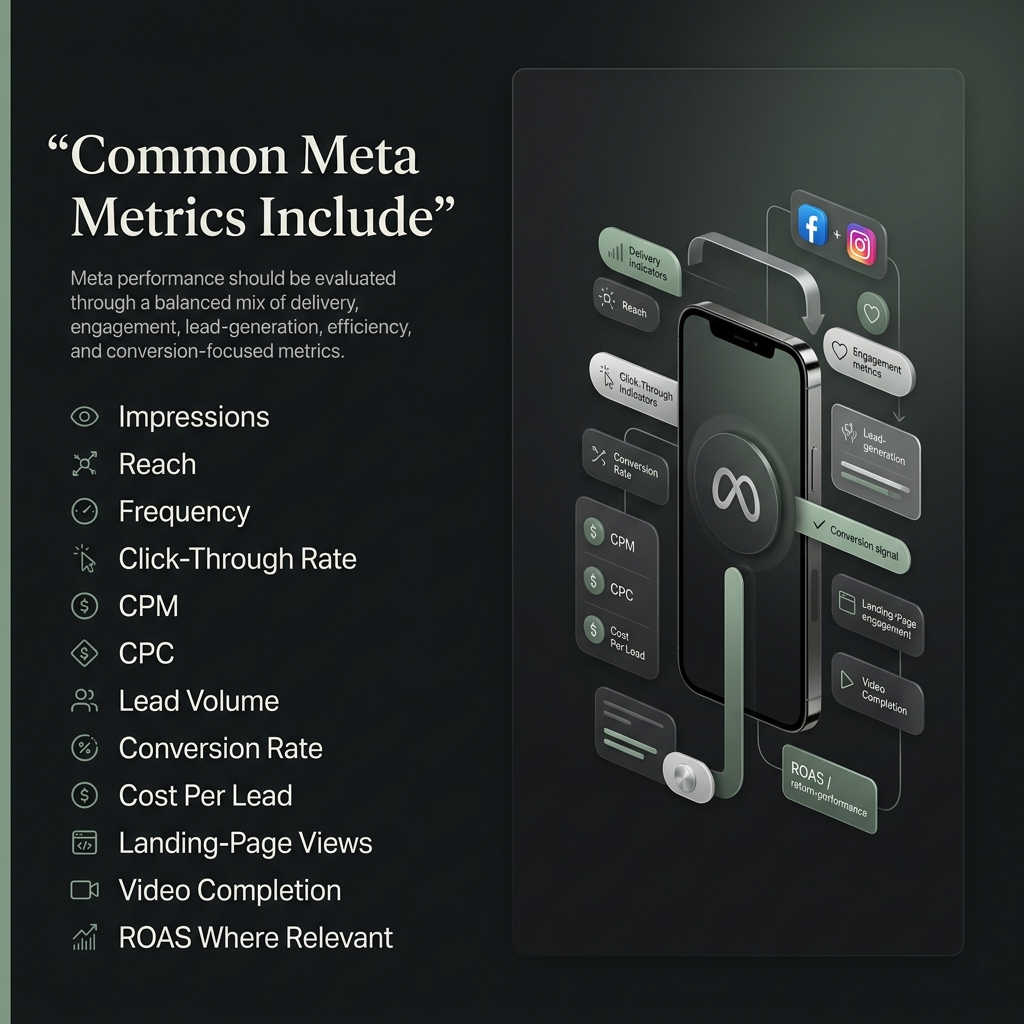
- impressions
- reach
- frequency
- click-through rate
- CPM
- CPC
- lead volume
- conversion rate
- cost per lead
- landing-page views
- video completion
- ROAS where relevant
Common Meta metrics include
- impressions
- reach
- frequency
- click-through rate
- CPM
- CPC
- lead volume
- conversion rate
- cost per lead
- landing-page views
- video completion
- ROAS where relevant
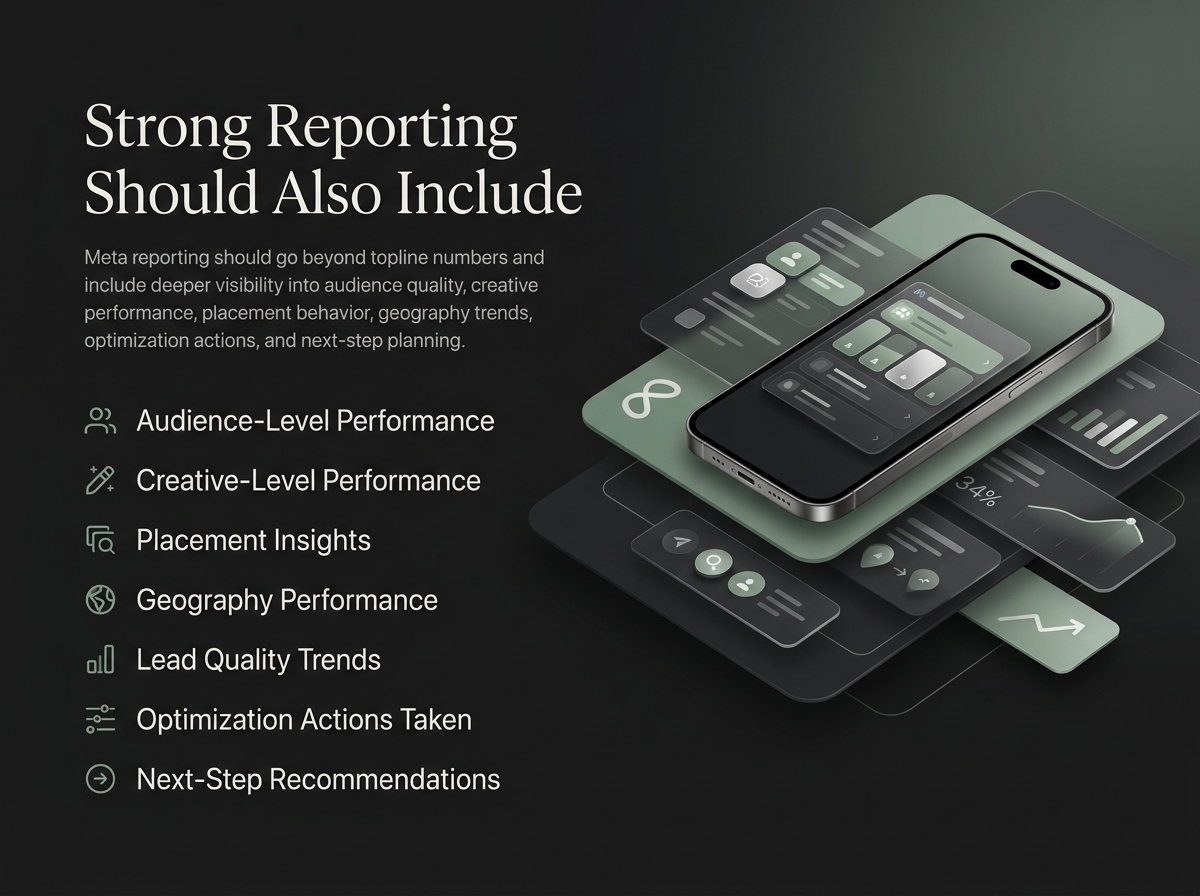
Strong reporting should also include
- audience-level performance
- creative-level performance
- placement insights
- geography performance
- lead quality trends
- optimization actions taken
- next-step recommendations

Why attribution matters
Meta often influences users before they convert later through another session or channel. Because of that, Meta should not be judged only by last-click logic. A stronger reporting framework combines engagement, conversion behavior, assisted performance, and broader funnel contribution.
Why attribution matters
Meta often influences users before they convert later through another session or channel. Because of that, Meta should not be judged only by last-click logic. A stronger reporting framework combines engagement, conversion behavior, assisted performance, and broader funnel contribution.
Why Work With Crosstide Media?
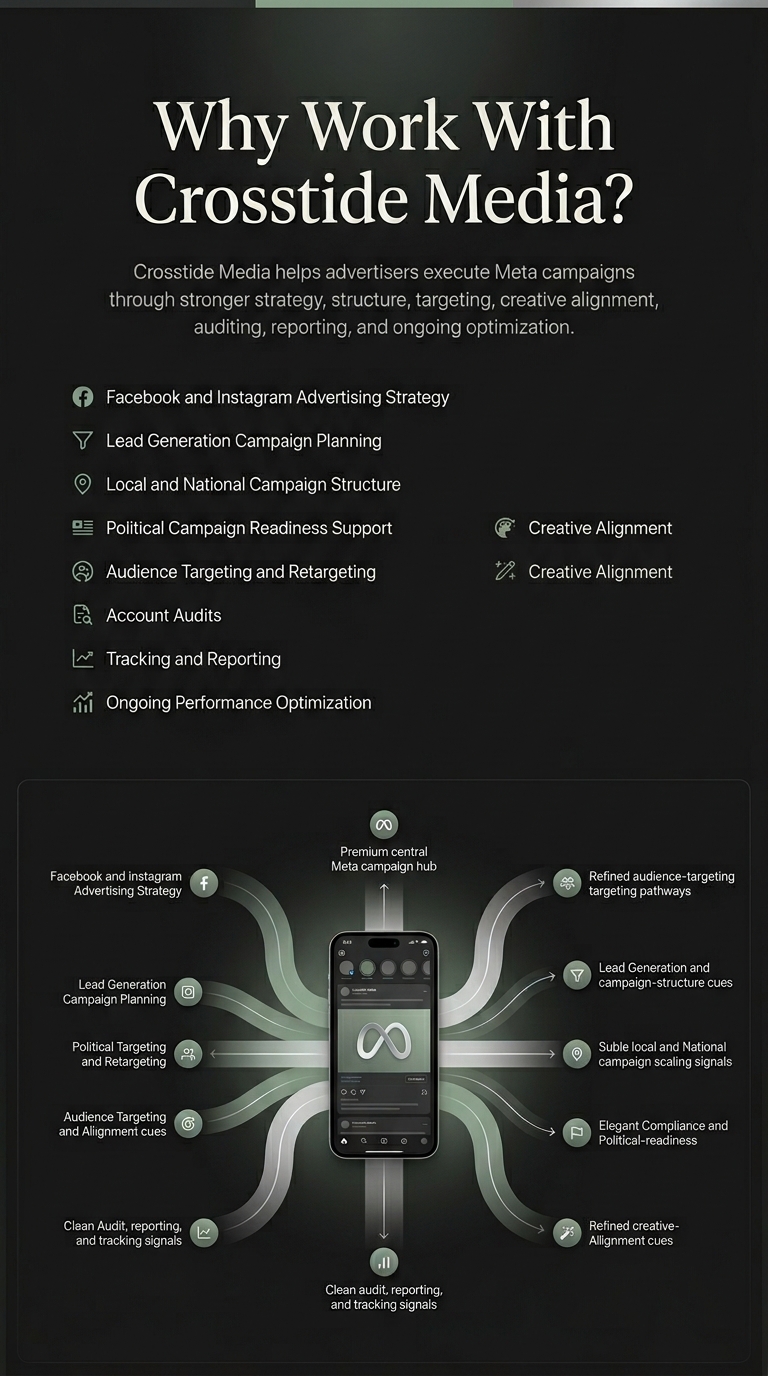
Effective Meta advertising requires more than launching ads in Ads Manager. It takes platform strategy, audience planning, campaign structure, creative discipline, tracking accuracy, and ongoing optimization.
Crosstide Media helps advertisers execute Meta campaigns with:
- Facebook and Instagram advertising strategy
- lead generation campaign planning
- local and national campaign structure
- political campaign readiness support
- audience targeting and retargeting
- creative alignment
- account audits
- tracking and reporting
- ongoing performance optimization
We approach Meta advertising as both a brand-building channel and a measurable performance investment. Our focus is on helping brands use Facebook and Instagram in a way that improves audience relevance, strengthens creative performance, and drives better results.
Whether the goal is awareness, traffic, lead generation, e-commerce growth, or issue-based campaign communication, Crosstide Media helps advertisers build Meta campaigns with the structure and discipline required for long-term performance.
Why Work With Crosstide Media?
Effective Meta advertising requires more than launching ads in Ads Manager. It takes platform strategy, audience planning, campaign structure, creative discipline, tracking accuracy, and ongoing optimization.
Crosstide Media helps advertisers execute Meta campaigns with:
- Facebook and Instagram advertising strategy
- lead generation campaign planning
- local and national campaign structure
- political campaign readiness support
- audience targeting and retargeting
- creative alignment
- account audits
- tracking and reporting
- ongoing performance optimization
We approach Meta advertising as both a brand-building channel and a measurable performance investment. Our focus is on helping brands use Facebook and Instagram in a way that improves audience relevance, strengthens creative performance, and drives better results.
Whether the goal is awareness, traffic, lead generation, e-commerce growth, or issue-based campaign communication, Crosstide Media helps advertisers build Meta campaigns with the structure and discipline required for long-term performance.
Frequently Asked Questions
What is Meta advertising?
What is the difference between Facebook ads and Instagram ads?
Is Meta advertising good for lead generation?
Can Meta advertising work for local businesses?
Can Meta advertising work for national campaigns?
What are Meta’s requirements for political ads?
What is a Meta ad audit?
What campaign objectives does Meta support?
Why is creative so important in Meta advertising?
Why work with a Meta advertising agency?
Build a Smarter Meta Advertising Strategy
If your business needs a more strategic Meta advertising approach, Crosstide Media can help you plan, launch, and optimize campaigns built around better audience targeting, stronger creative, cleaner account structure, and clearer reporting. Whether your goal is to increase awareness, generate more leads, improve Facebook and Instagram performance, or support a more efficient full-funnel strategy, we help brands use Meta advertising in a smarter, more results-focused way.
Why Brands Choose Crosstide Media
Brands choose Crosstide Media because effective Meta advertising requires more than simply turning on ads. Strong results come from the right mix of audience strategy, campaign structure, creative discipline, tracking accuracy, and ongoing optimization. Our approach is built to help advertisers improve lead efficiency, reduce waste, strengthen creative performance, and make better decisions through clearer reporting and more actionable campaign insights.
Talk to Crosstide Media About Meta Advertising
If you are looking for a Meta advertising partner that can help you improve Facebook and Instagram campaign performance, capture more qualified leads, and drive more measurable results, Crosstide Media can help. We build Meta advertising campaigns with the strategic planning, technical setup, creative alignment, compliance awareness, and optimization discipline needed to support long-term growth.