
YouTube TV Advertising
YouTube TV Advertising Built for Premium Reach, Large-Screen Visibility, and High-Impact Video Strategy
YouTube TV advertising gives brands access to a premium streaming television environment designed to reach viewers in live TV and connected TV settings. Unlike regular YouTube campaigns that often run across mobile, desktop, tablets, and connected devices within the broader YouTube ecosystem, YouTube TV inventory is positioned more like premium TV media. It gives advertisers the opportunity to place video messaging in front of highly engaged audiences watching live and on-demand television content in a more premium, large-screen environment.
For many advertisers, YouTube TV is important because it sits at the intersection of traditional television-style viewing and digital targeting. It brings together the premium viewing environment of streaming TV with the audience intelligence, measurement, and targeting flexibility of modern digital media buying. Compared with standard YouTube advertising, YouTube TV is often more premium, more expensive, and more selective, but it can also deliver stronger large-screen visibility and stronger contextual value depending on the campaign goal.
At Crosstide Media, we help brands understand where YouTube TV fits within a broader video strategy and how it differs from regular YouTube advertising. Whether the goal is premium awareness, connected TV reach, stronger household visibility, or a more advanced YouTube media plan, we help advertisers build campaigns around the right mix of pricing, inventory quality, audience targeting, creative structure, and measurable performance.

Jump To
What Is YouTube TV Advertising?
YouTube TV advertising refers to video ad placements that run within the YouTube TV streaming service rather than the broader regular YouTube platform. YouTube TV is a live TV streaming product with linear-style and video-on-demand content, and its advertising environment is generally treated as a premium, television-style video environment.
This makes YouTube TV different from standard YouTube campaigns that can run across a much larger mix of user-generated and premium content on mobile, desktop, tablet, and connected TV apps. Regular YouTube advertising is typically broader in scale, more flexible in pricing, and more accessible for a wider range of budgets. YouTube TV, on the other hand, is often used when advertisers want more premium streaming TV-style inventory and stronger large-screen viewing environments.

YouTube TV vs Regular YouTube Advertising
Understanding the difference between YouTube TV and regular YouTube is one of the most important parts of planning a strong video strategy.
YouTube TV
YouTube TV is a live TV streaming service. Advertising here is closer to streaming television or advanced TV buying than to open social video. The environment is more premium, the audience is narrower, the inventory is more selective, and the buying structure often leans more heavily toward reservation-style planning or premium connected TV strategy.


Regular YouTube
Regular YouTube includes ads running across the broader YouTube ecosystem, including user-generated content, premium video content, mobile viewing, desktop viewing, connected TV apps, Shorts, and other placements. This environment is much broader, typically more accessible from a budget standpoint, and often optimized through CPV, CPM, or broader performance-based bidding options.
Regular YouTube
Regular YouTube includes ads running across the broader YouTube ecosystem, including user-generated content, premium video content, mobile viewing, desktop viewing, connected TV apps, Shorts, and other placements. This environment is much broader, typically more accessible from a budget standpoint, and often optimized through CPV, CPM, or broader performance-based bidding options.
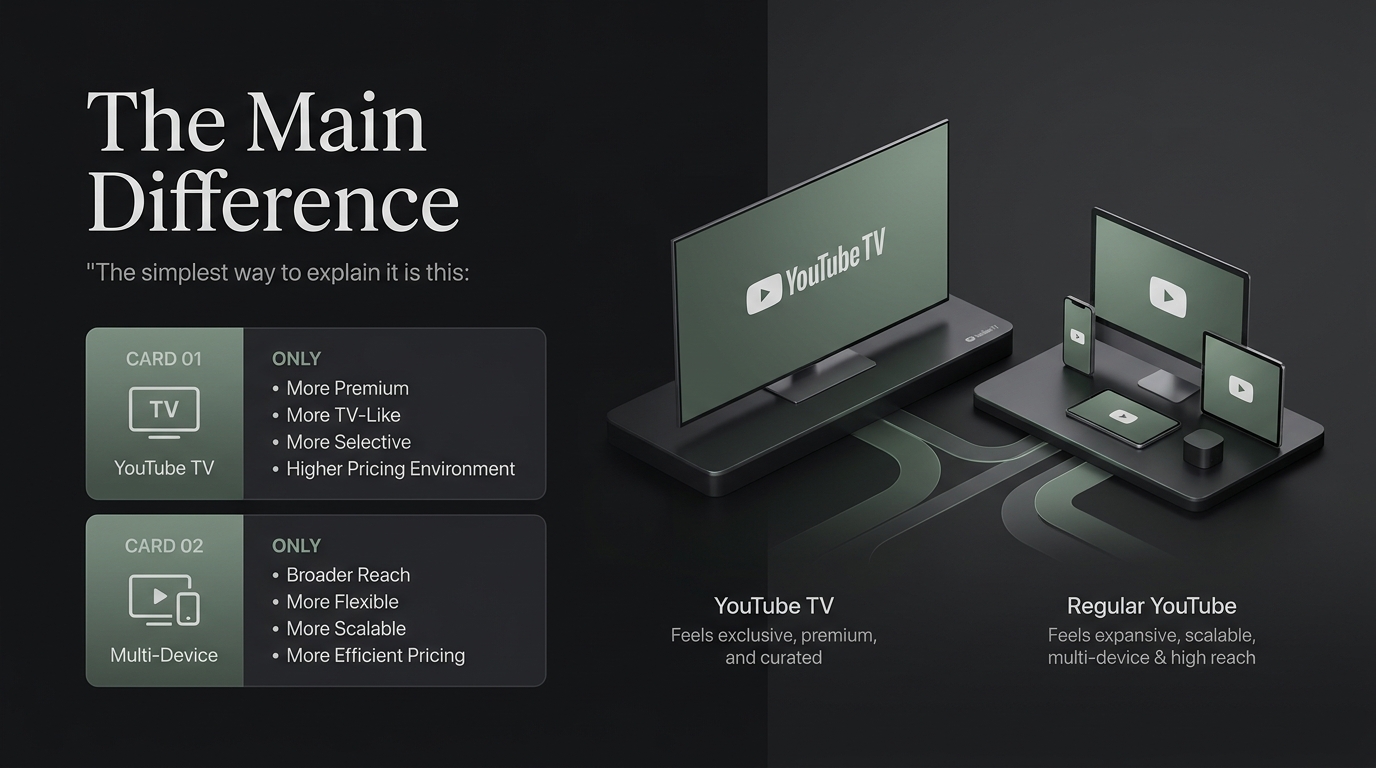
The main difference
The simplest way to explain it is this:
- YouTube TV is more premium, more TV-like, more selective, and often priced higher
- Regular YouTube is broader, more flexible, more scalable, and often priced more efficiently for general video advertising
For Crosstide Media, the right choice depends on whether the advertiser needs broad YouTube scale, premium streaming TV inventory, or a combination of both.
Why YouTube TV Matters
YouTube TV matters because it gives advertisers a way to reach audiences in a premium streaming television environment without relying only on traditional linear TV buying. It supports larger-screen viewing, stronger attention conditions, and more premium content alignment than many broader digital video environments.
A strong YouTube TV campaign can help support:
- premium awareness
- connected TV reach
- household visibility
- large-screen video presence
- message repetition in TV-style environments
- stronger contextual value in live and premium streaming content
Why advertisers use YouTube TV
- It offers premium streaming TV inventory
- It reaches viewers in a living-room style environment
- It supports non-skippable and TV-style ad formats
- It can complement broader YouTube strategy
- It adds premium reach beyond standard digital video alone
- It brings digital targeting into a live TV environment
YouTube TV is especially valuable when the advertiser wants to bridge the gap between traditional television-style impact and modern digital media buying discipline.
Where YouTube TV Fits in the Advertising Landscape
YouTube TV sits closer to CTV, OTT, and premium streaming video than to standard social or open-platform video advertising. It is usually not the first recommendation for every advertiser because it tends to require a more premium budget and a clearer awareness or reach role. But it can be very useful in the right media plan.
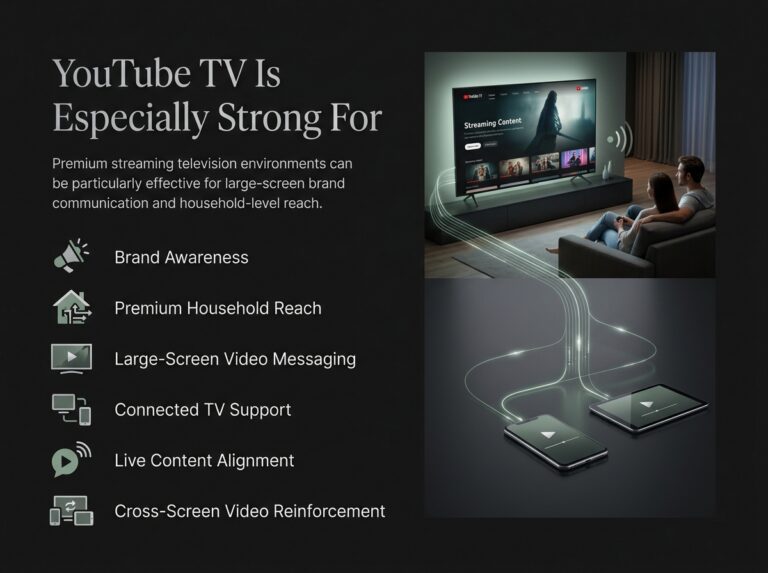
YouTube TV is especially strong for
- brand awareness
- premium household reach
- large-screen video messaging
- connected TV support
- live content alignment
- cross-screen video reinforcement
How YouTube TV complements other channels
YouTube TV and regular YouTube
YouTube TV provides premium streaming reach, while regular YouTube adds broader scale and more flexible inventory across devices.
YouTube TV and CTV / OTT
YouTube TV can act like a premium CTV extension within a broader streaming video plan.
YouTube TV and paid search
YouTube TV can build brand awareness that later turns into search demand.
YouTube TV and programmatic video
YouTube TV adds premium TV-style inventory, while programmatic video extends reach across more placements and devices.
This makes YouTube TV most effective when it has a clearly defined role inside a broader video or omnichannel media strategy.
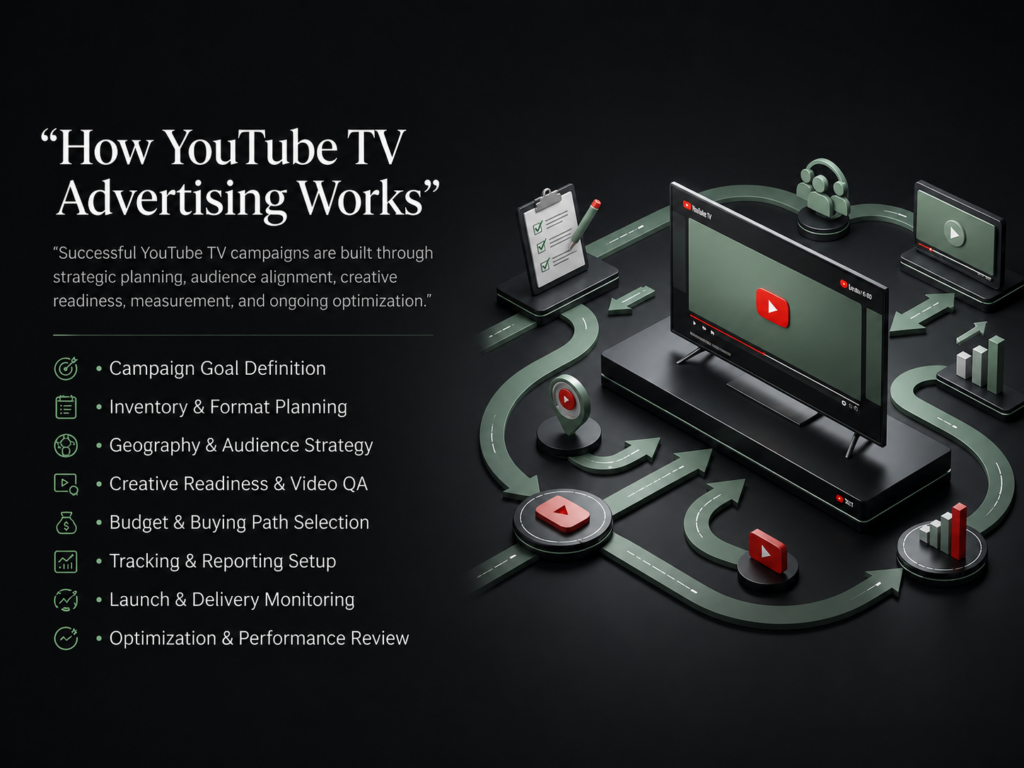
How YouTube TV Advertising Works
YouTube TV advertising works through Google’s video buying infrastructure and can be accessed through reservation-style and certain auction-based campaign structures depending on format and eligibility.
A strong YouTube TV campaign usually includes:
- campaign goal definition
- inventory and format planning
- geography and audience strategy
- creative readiness and video QA
- budget and buying path selection
- tracking and reporting setup
- launch and delivery monitoring
- optimization and performance review
How YouTube TV Advertising Works
YouTube TV advertising works through Google’s video buying infrastructure and can be accessed through reservation-style and certain auction-based campaign structures depending on format and eligibility.
A strong YouTube TV campaign usually includes:
- campaign goal definition
- inventory and format planning
- geography and audience strategy
- creative readiness and video QA
- budget and buying path selection
- tracking and reporting setup
- launch and delivery monitoring
- optimization and performance review
Why this matters
YouTube TV should not be treated exactly like a standard YouTube CPV campaign. It often requires more planning around inventory quality, pricing, creative fit, and audience reach expectations because the environment is more premium and more selective.

YouTube TV Pricing and CPM Strategy
YouTube TV is usually priced more like premium streaming television than general digital video. In most cases, advertisers should think in terms of CPM-based buying rather than low-cost CPV-style scaling.
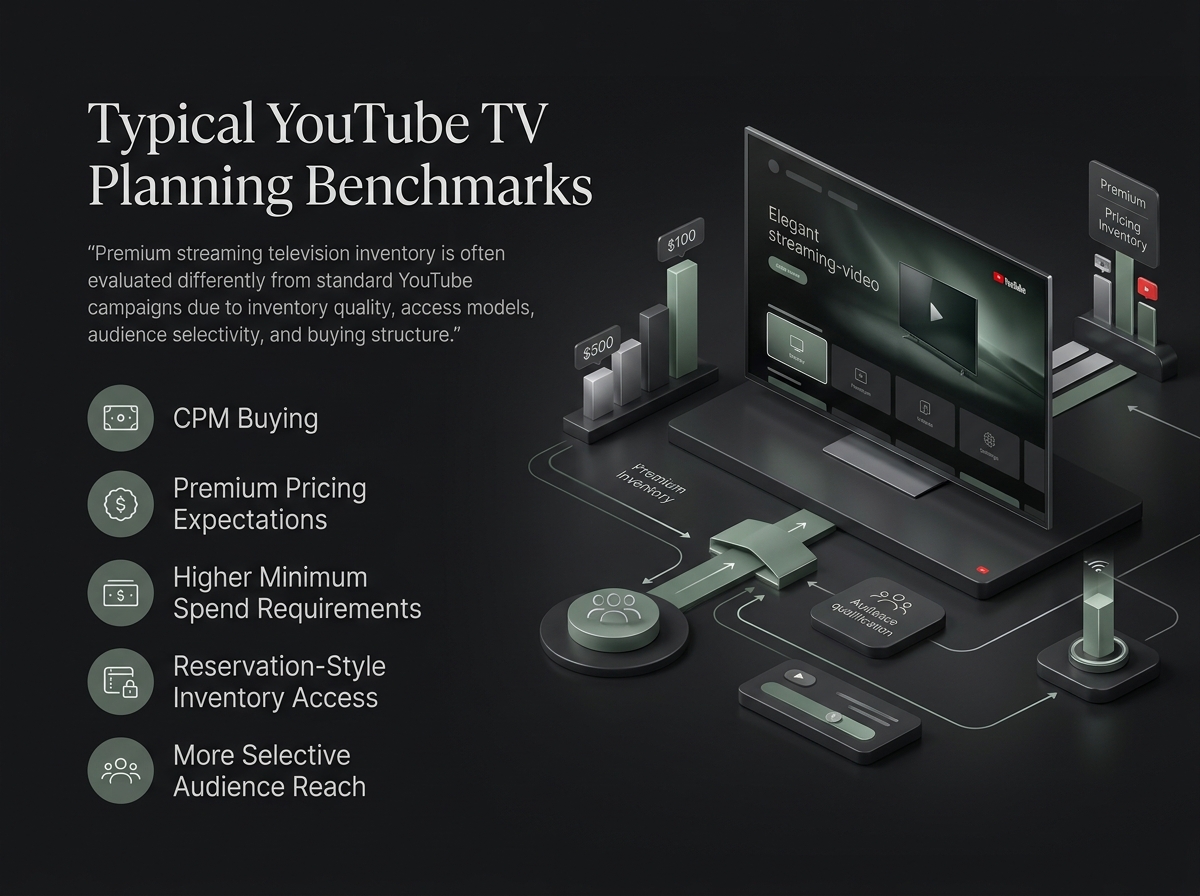
Typical YouTube TV planning benchmarks
For planning purposes, advertisers often evaluate YouTube TV with:
- CPM buying
- premium pricing expectations
- higher minimum spend requirements
- reservation-style inventory access in many cases
- more selective audience reach than regular YouTube
A practical working benchmark for YouTube TV is often a CPM in roughly the $35 to $65+ range, though actual pricing can move higher or lower based on market, audience targeting, seasonality, deal structure, and inventory availability. For many advertisers, YouTube TV also tends to require a more meaningful budget commitment, especially for reserved or highly curated buys.
Why CPM is higher on YouTube TV
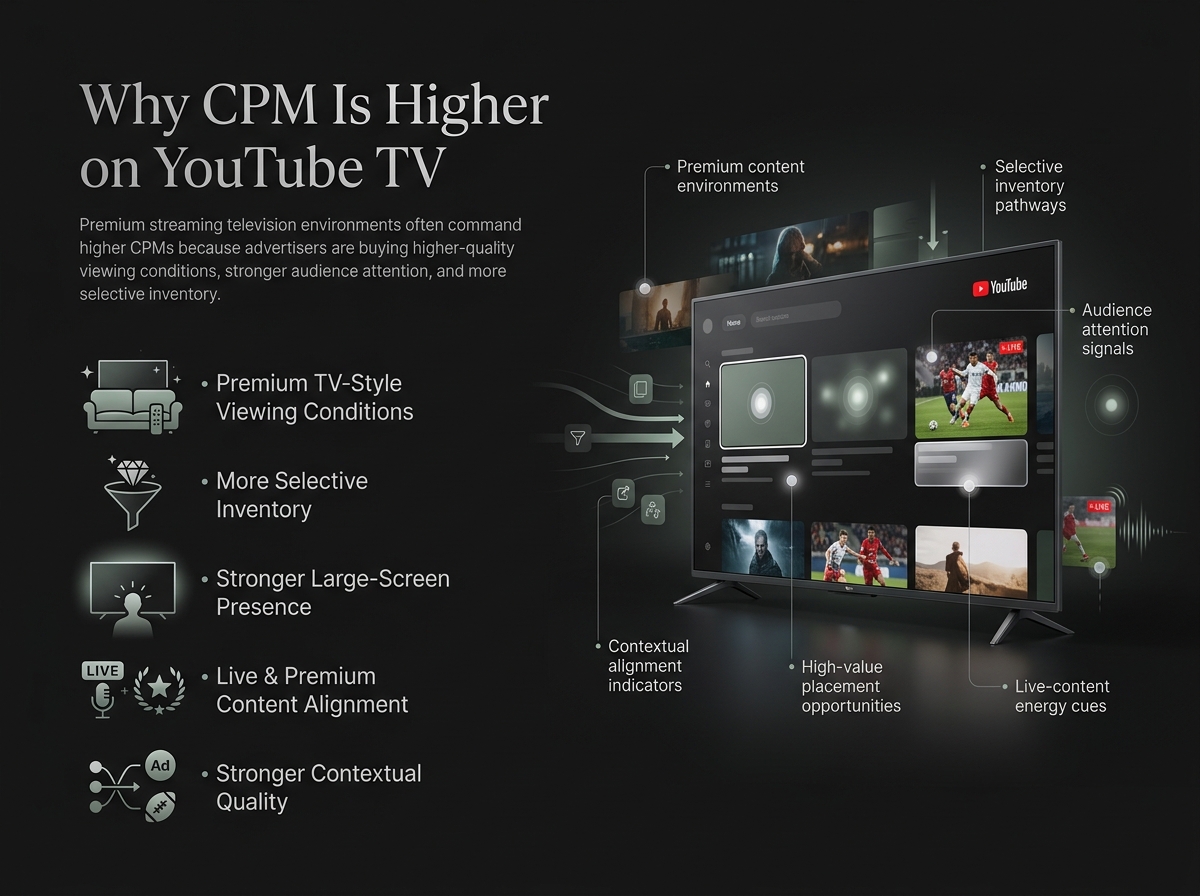
CPMs are typically higher because the inventory offers:
- premium TV-style viewing conditions
- more selective inventory
- stronger large-screen presence
- live and premium content alignment
- stronger contextual quality
For Crosstide Media, the right pricing conversation is not just whether YouTube TV costs more. It is whether the premium environment is worth the added cost for the campaign objective.
Why CPM is higher on YouTube TV
CPMs are typically higher because the inventory offers:
- premium TV-style viewing conditions
- more selective inventory
- stronger large-screen presence
- live and premium content alignment
- stronger contextual quality
For Crosstide Media, the right pricing conversation is not just whether YouTube TV costs more. It is whether the premium environment is worth the added cost for the campaign objective.
YouTube TV vs YouTube Pricing Differences
One of the most common client questions is how YouTube TV compares with regular YouTube in pricing.
YouTube TV
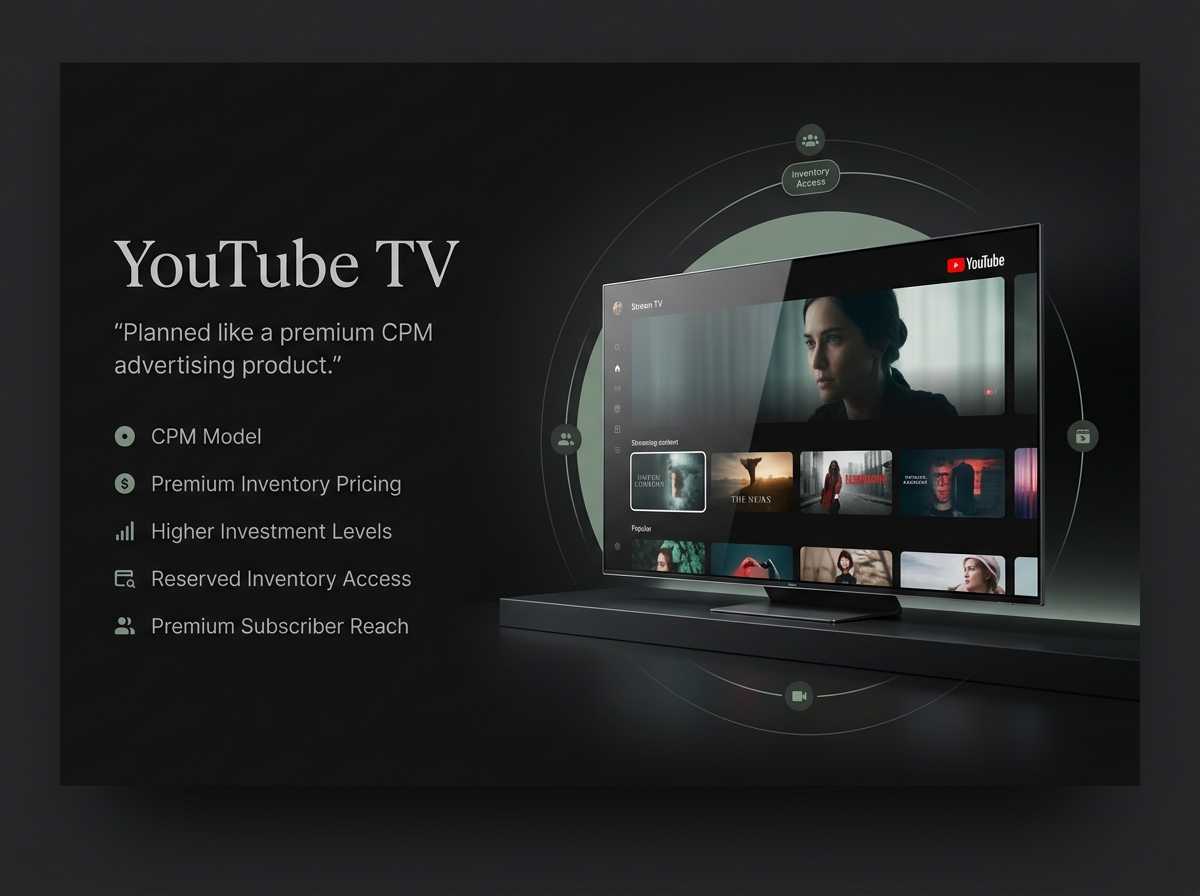
YouTube TV is usually planned more like a premium CPM product.
Common expectations include:
- CPM model
- premium inventory pricing
- higher minimum investment levels
- more curated or reserved inventory access
- narrower but more premium subscriber-based reach
YouTube TV
YouTube TV is usually planned more like a premium CPM product.
Common expectations include:
- CPM model
- premium inventory pricing
- higher minimum investment levels
- more curated or reserved inventory access
- narrower but more premium subscriber-based reach
Regular YouTube
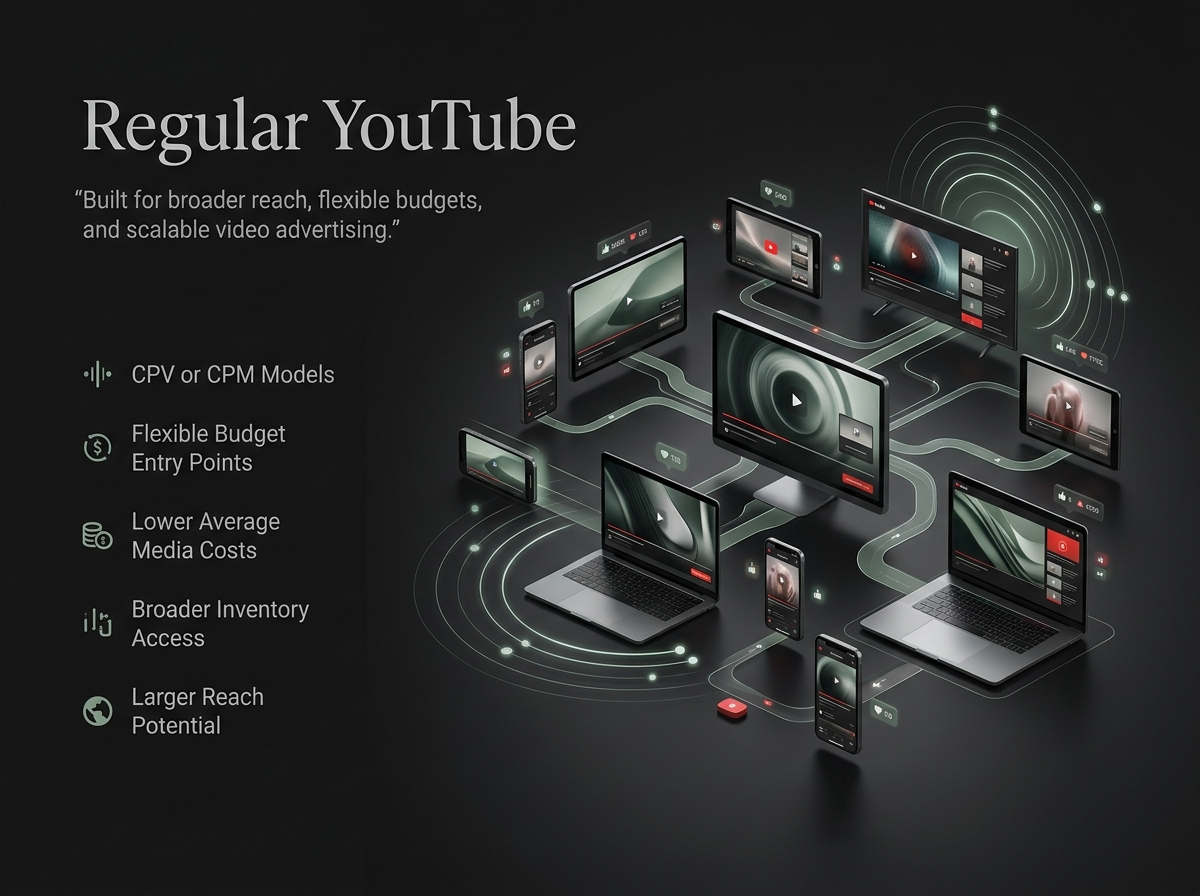
Regular YouTube is usually much more flexible. It can support multiple pricing approaches depending on campaign type and goal.
Common expectations include:
- CPV or CPM models
- more flexible budget entry points
- lower average media costs
- broader inventory access
- much larger overall reach potential
Practical working benchmark comparison
For planning conversations, a helpful simplified benchmark often looks like this:
YouTube TV
- Pricing model: usually CPM
- Typical CPM: roughly $35 to $65+
- Minimum spend: often significantly higher for premium or reserved buying
- Best use case: premium awareness, household reach, connected TV support
Regular YouTube
- Pricing model: usually CPV or CPM
- CPV can vary widely based on audience targeting, competition, campaign objective, and creative quality. In some campaigns, CPV may fall around $0.10 to $0.30, though actual costs can be lower or higher depending on strategy.
- Typical CPM: often around $5 to $25, though it can vary widely
- Minimum spend: much more flexible
- Best use case: scalable video reach, awareness, traffic, retargeting, broader cross-device delivery
These are not hard platform guarantees. They are useful planning ranges and strategic expectations.
Ad Formats and Inventory Types
The format mix available on YouTube TV is more limited and more premium than standard YouTube.
Common YouTube TV ad formats
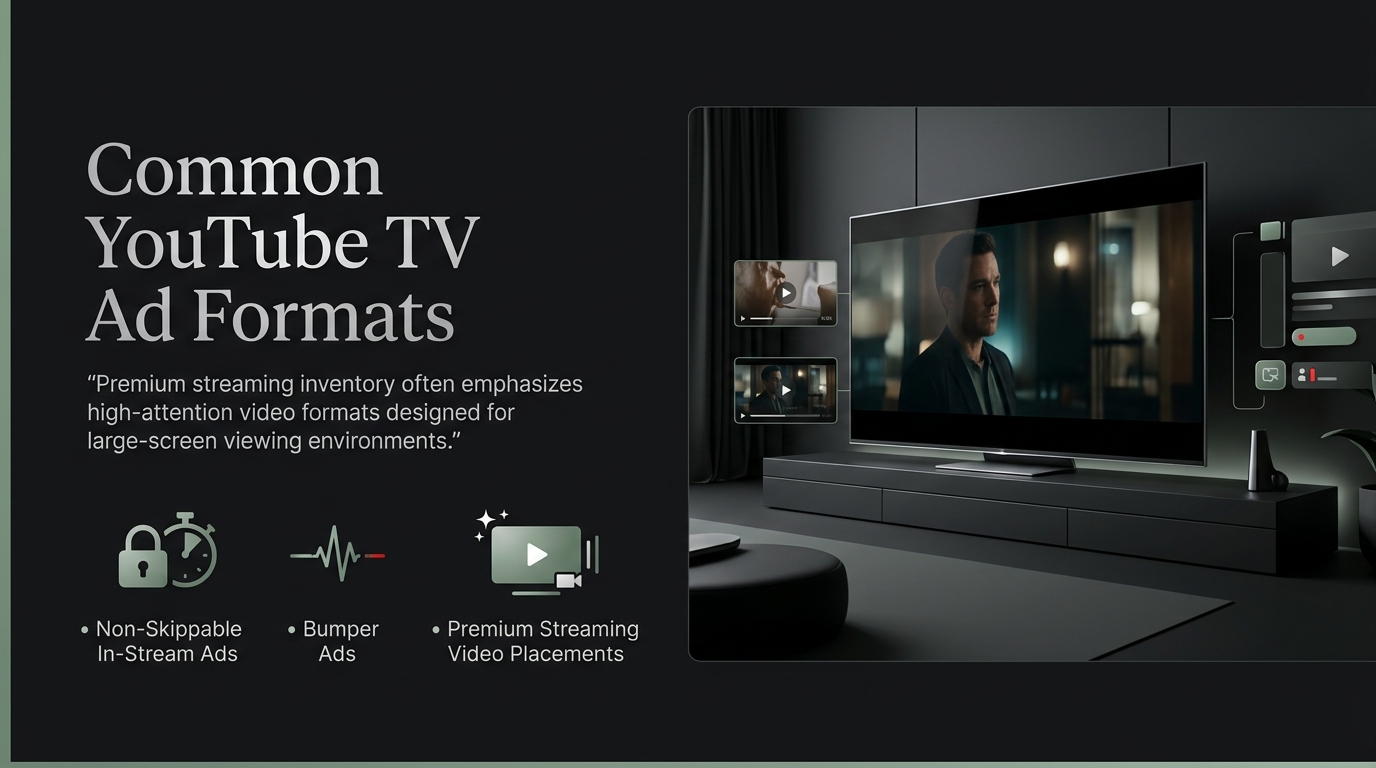
YouTube TV campaigns often emphasize:
- non-skippable in-stream ads
- bumper ads
- premium streaming-style video placements
Common YouTube TV ad formats
YouTube TV campaigns often emphasize:
- non-skippable in-stream ads
- bumper ads
- premium streaming-style video placements
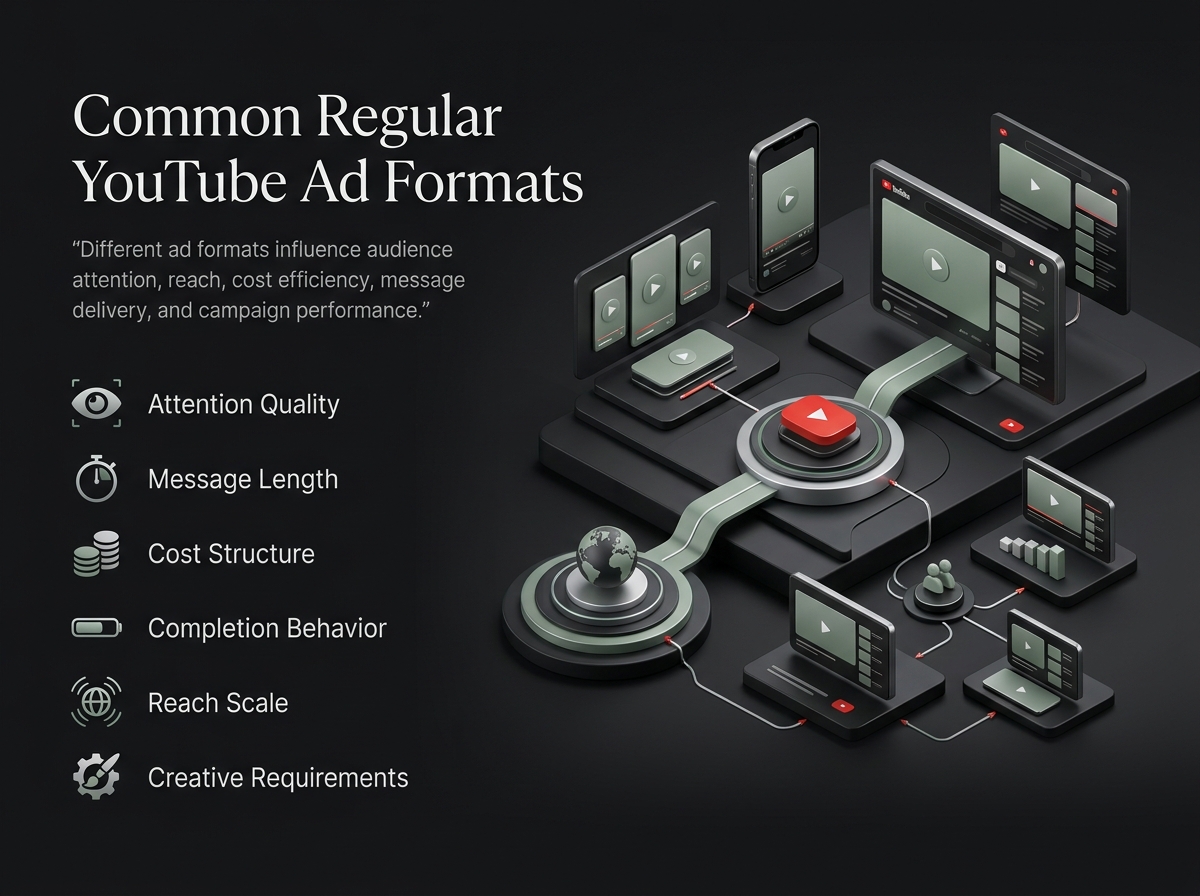
Common regular YouTube ad formats
Format affects:
- attention quality
- message length
- cost structure
- completion behavior
- reach scale
- creative requirements
For Crosstide Media, format strategy is a key part of deciding whether YouTube TV, regular YouTube, or a combination of both is the right solution.
Audience Targeting and Reach Strategy
One of the advantages of YouTube-based advertising is that it allows brands to combine video inventory with digital targeting. But the scale and role of that targeting differs between YouTube TV and regular YouTube.
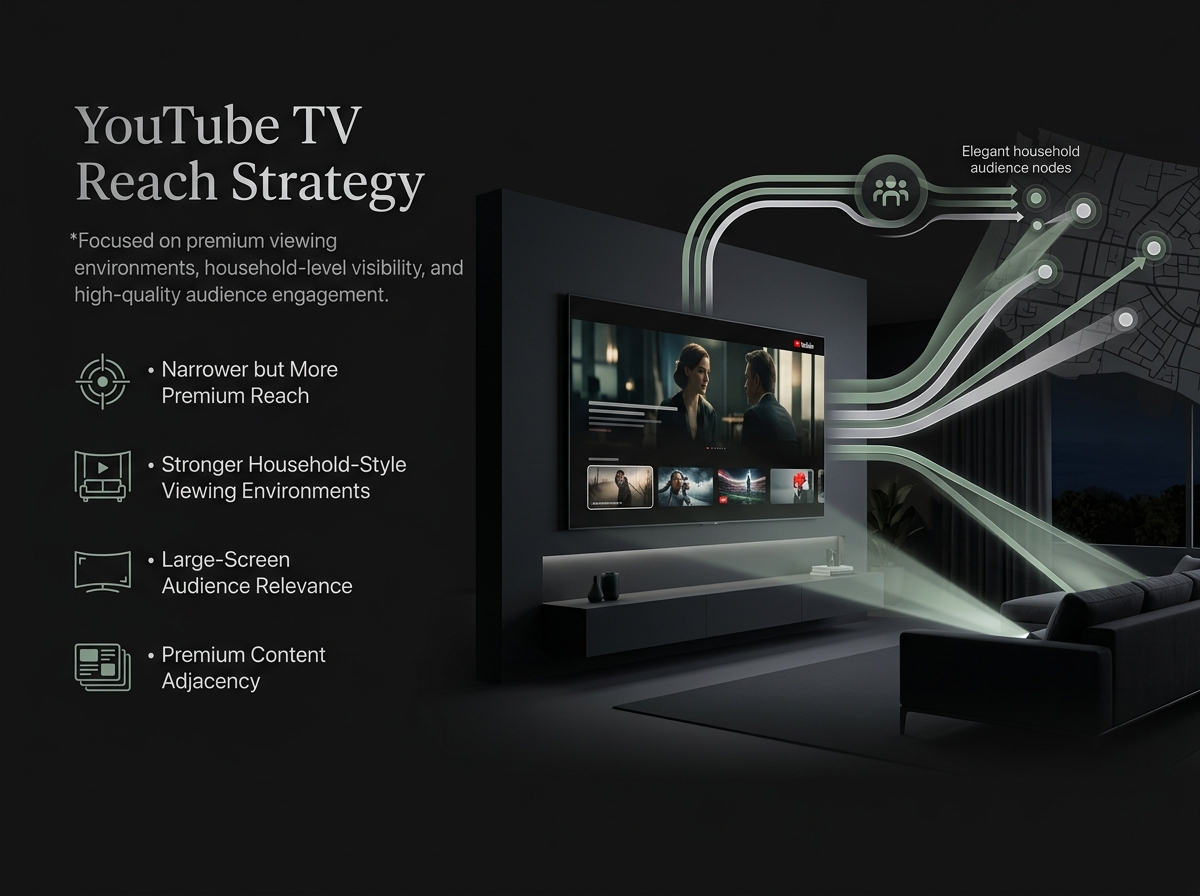
YouTube TV reach strategy
YouTube TV usually offers:
- narrower but more premium reach
- stronger household-style viewing environments
- large-screen audience relevance
- premium content adjacency
Regular YouTube reach strategy
Regular YouTube usually offers:
- much broader reach
- wider device mix
- larger audience scale
- more flexible campaign access
- stronger support for layered audience testing
Common targeting strategies
A strong YouTube or YouTube TV campaign may include:
- geographic targeting
- audience targeting
- household-relevant segmentation
- remarketing support
- topic or interest relevance
- campaign sequencing across awareness and follow-up video activity
For Crosstide Media, targeting should always match the role of the campaign. Premium reach is only valuable if it is aligned to the right audience and objective.
Local vs National YouTube TV Campaign Strategy
YouTube TV can work in both local and national contexts, but the budget and media strategy will look different depending on the scope of the campaign.
Local YouTube TV strategy
ocal campaigns may focus on:
- regional awareness
- local premium reach
- selected market concentration
- event or market-specific visibility
- stronger local storytelling in video format
Because YouTube TV tends to be more premium, local campaigns usually need tighter planning and a more intentional budget commitment.
National YouTube TV strategy
National campaigns may focus on:
- broader household reach
- premium streaming visibility
- brand awareness at scale
- complementing national CTV or video plans
- broader frequency and message consistency
Why this matters
Not every advertiser needs YouTube TV for every market. Sometimes regular YouTube is the more efficient choice. Sometimes YouTube TV adds the premium layer needed to strengthen the overall video mix. The right answer depends on market size, budget, audience, and campaign objective.

Creative Strategy and YouTube TV Ad Specifications
Creative matters heavily in YouTube TV because the inventory is premium and the screen environment is larger. Strong creative is necessary to justify the premium cost.
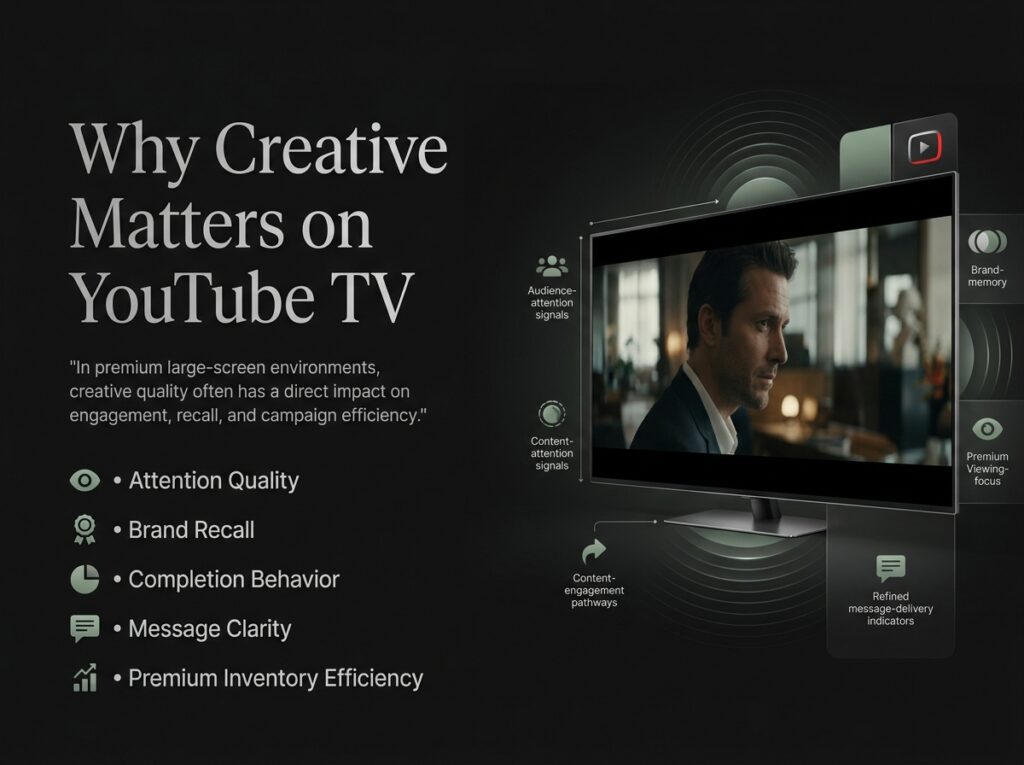
Why creative matters on YouTube TV
Creative affects:
- attention quality
- brand recall
- completion behavior
- message clarity
- premium inventory efficiency
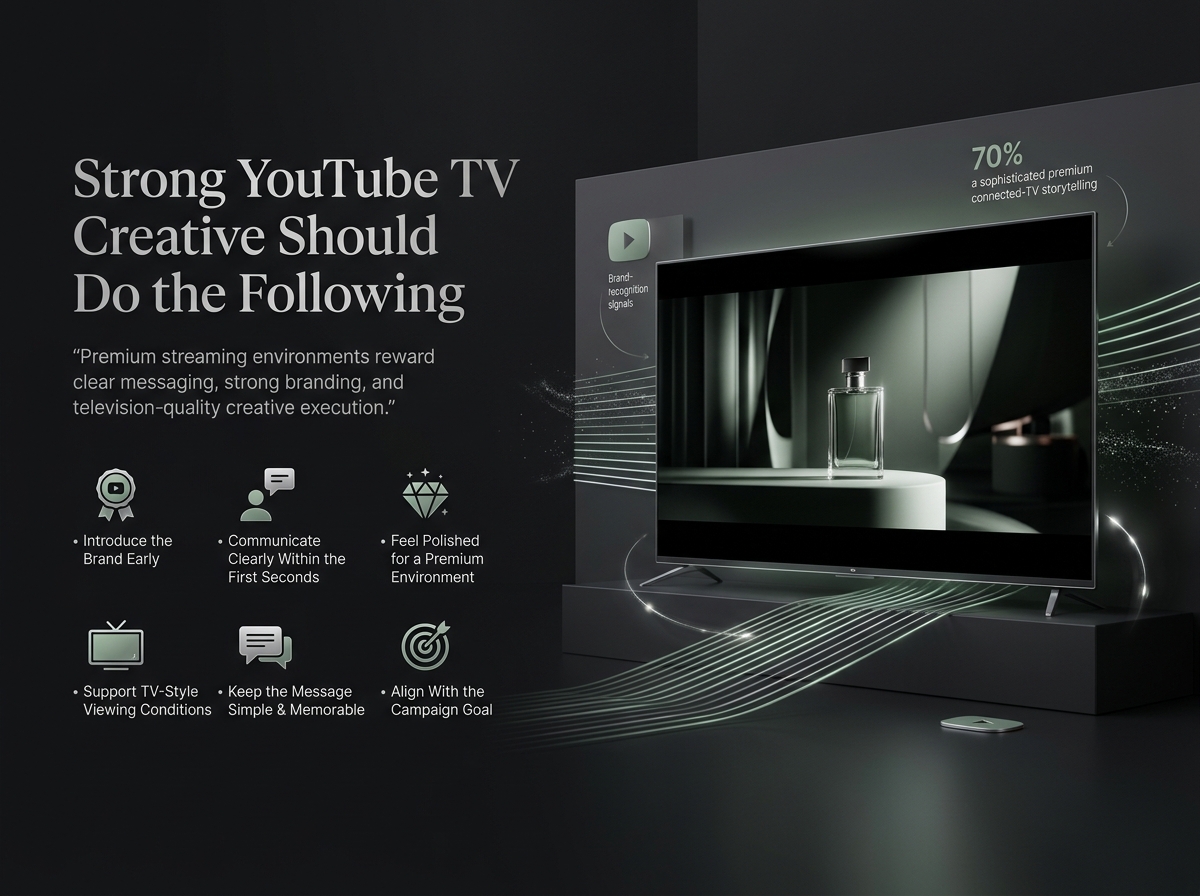
Strong YouTube TV creative should do the following
- introduce the brand early
- communicate clearly within the first seconds
- feel polished enough for a premium environment
- support TV-style viewing conditions
- keep the message simple and memorable
- align with the campaign goal
Strong YouTube TV creative should do the following
- introduce the brand early
- communicate clearly within the first seconds
- feel polished enough for a premium environment
- support TV-style viewing conditions
- keep the message simple and memorable
- align with the campaign goal
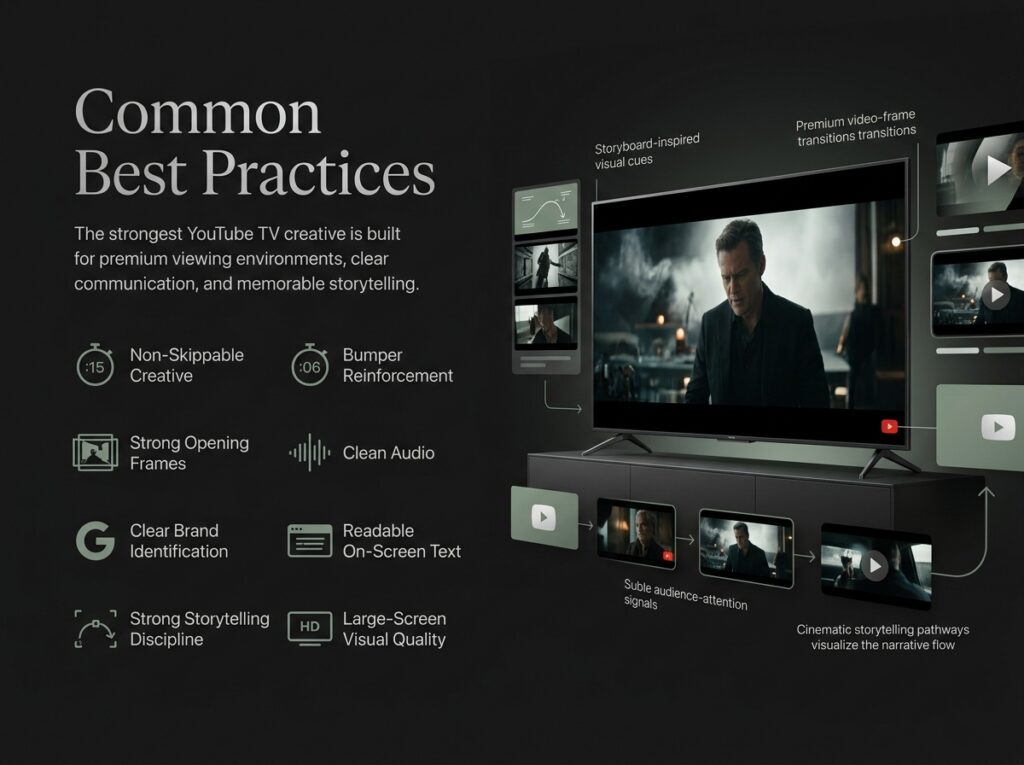
Common best practices
A strong YouTube TV creative approach usually includes:
- :15 non-skippable creative when supported
- :06 bumper creative for reinforcement
- strong opening frames
- clean audio
- clear brand identification
- readable on-screen text
- strong storytelling discipline
- larger-screen visual quality
Creative QA checklist before launch
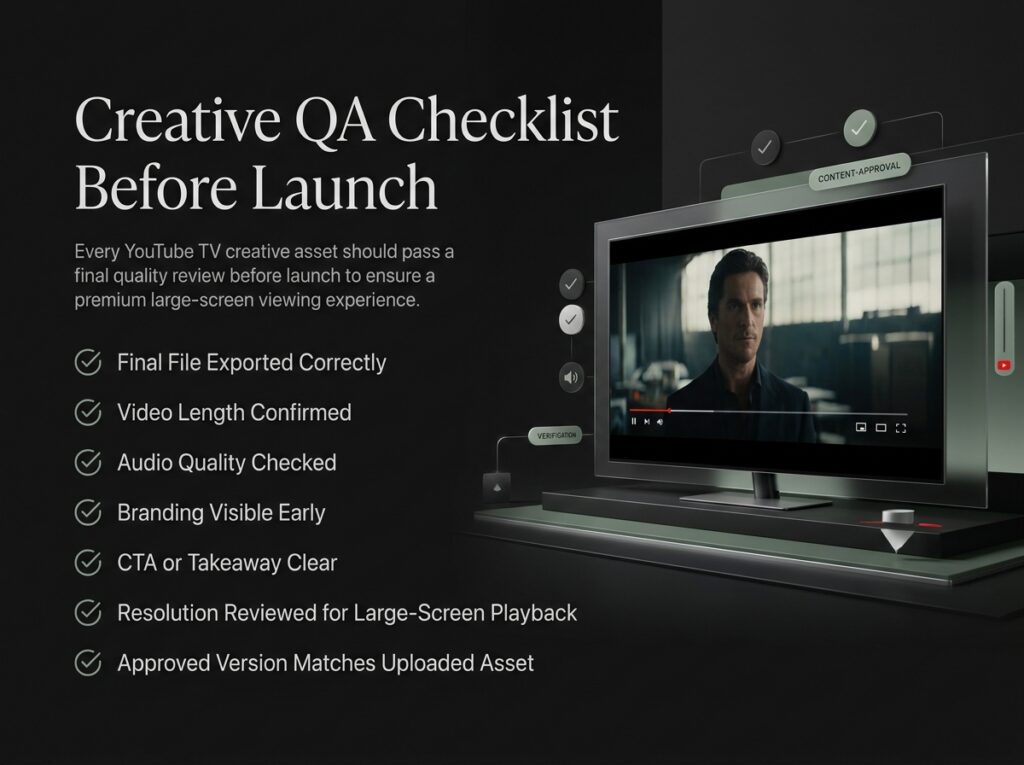
- final file exported correctly
- video length confirmed
- audio quality checked
- branding visible early
- CTA or takeaway clear
- resolution reviewed for large-screen playback
- approved version matches uploaded asset
For Crosstide Media, premium video inventory only works well when the creative is strong enough to take advantage of it.
Creative QA checklist before launch
- final file exported correctly
- video length confirmed
- audio quality checked
- branding visible early
- CTA or takeaway clear
- resolution reviewed for large-screen playback
- approved version matches uploaded asset
For Crosstide Media, premium video inventory only works well when the creative is strong enough to take advantage of it.
Account Setup, Buying Strategy, and Launch Process
A strong YouTube TV campaign requires more upfront planning than a standard YouTube auction campaign.
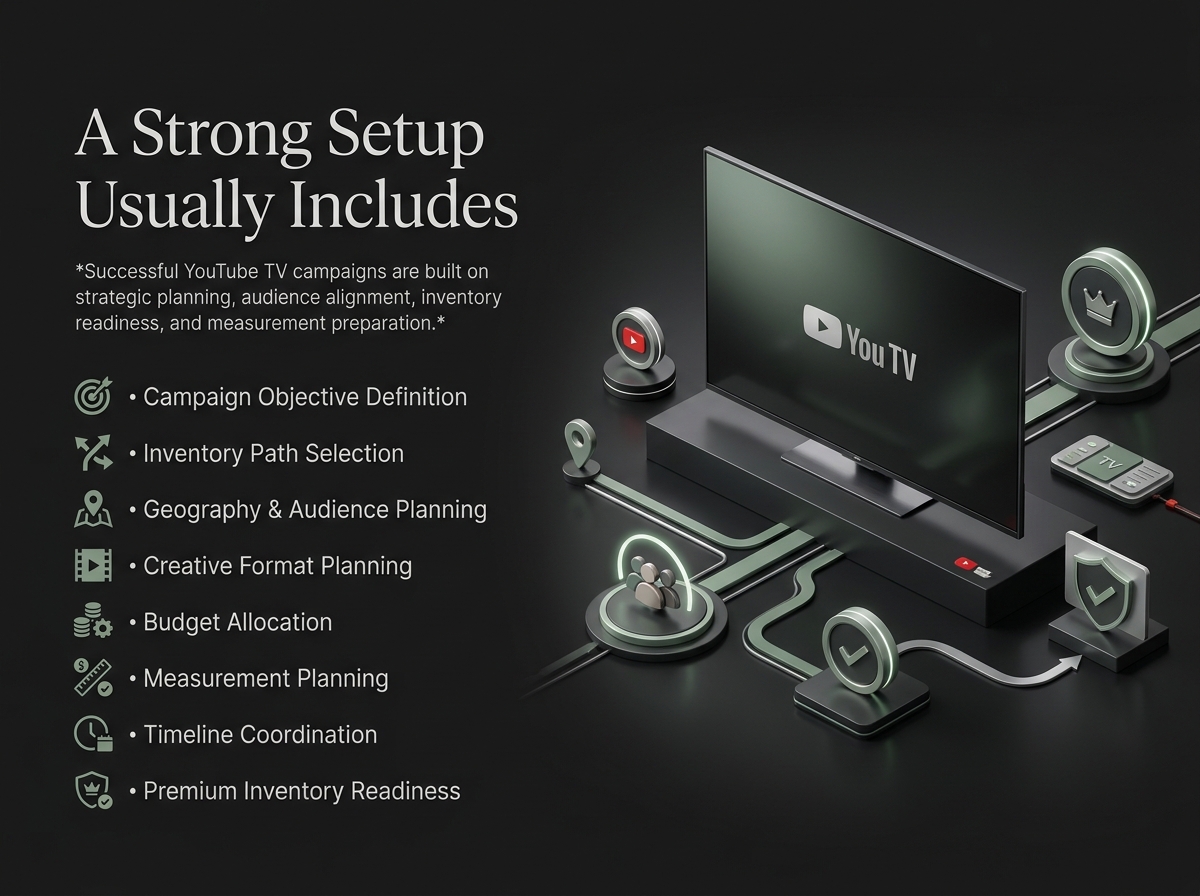
A strong setup usually includes
- campaign objective definition
- inventory path selection
- geography and audience planning
- creative format planning
- budget allocation
- measurement planning
- timeline coordination
- premium inventory readiness
A strong setup usually includes
- campaign objective definition
- inventory path selection
- geography and audience planning
- creative format planning
- budget allocation
- measurement planning
- timeline coordination
- premium inventory readiness
Why setup time matters
YouTube TV often requires more deliberate setup because the buying path, inventory availability, minimum spend expectations, and creative standards are more premium. It is not usually the kind of campaign advertisers launch casually with a low-budget test.
For Crosstide Media, setup is one of the most important parts of YouTube TV planning because it shapes whether the media investment is aligned with the actual goal.

Auditing and Optimization Process
A strong YouTube TV strategy should include both pre-launch planning and post-launch performance review.
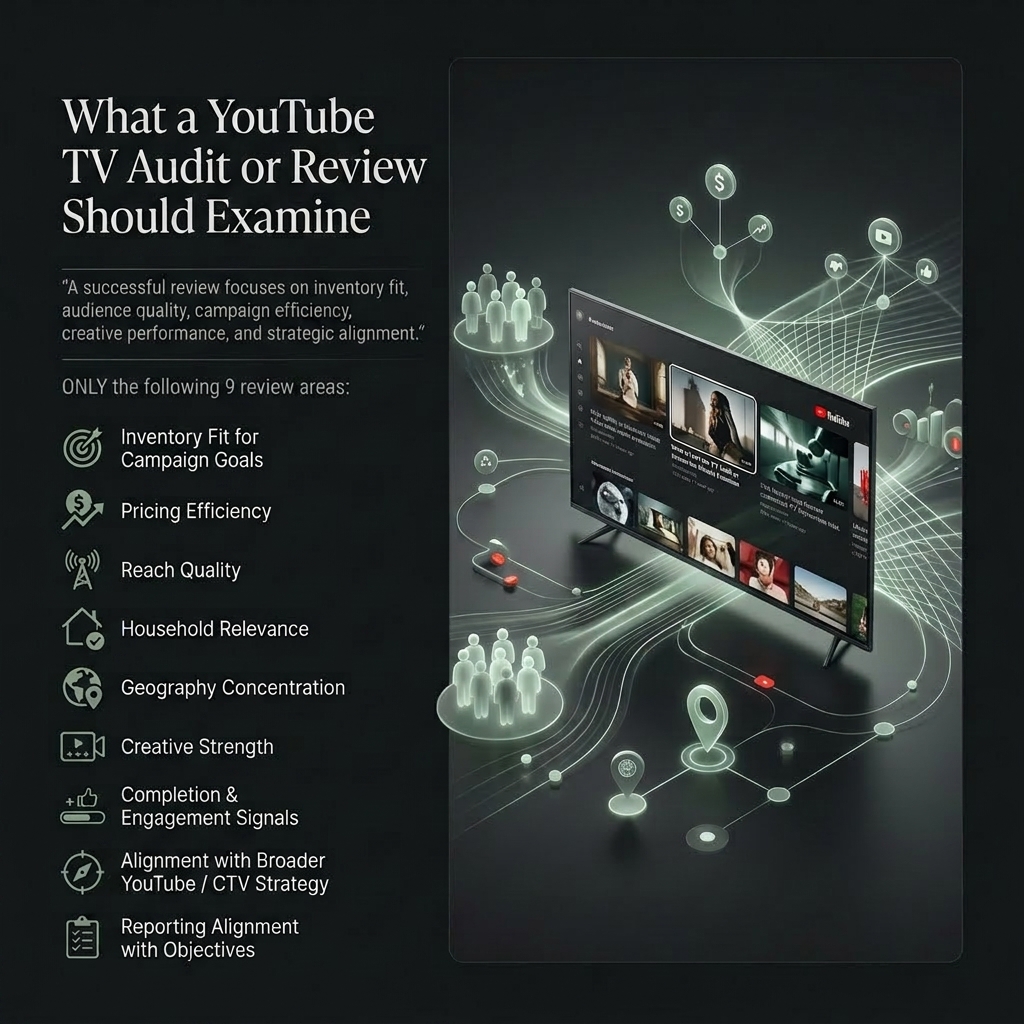
What a YouTube TV audit or review should examine
A campaign review may evaluate:
- whether YouTube TV is the right inventory for the objective
- pricing efficiency
- reach quality
- household relevance
- geography concentration
- creative strength
- completion and engagement signals
- overlap with broader YouTube or CTV strategy
- reporting alignment with campaign goals
What a YouTube TV audit or review should examine
A campaign review may evaluate:
- whether YouTube TV is the right inventory for the objective
- pricing efficiency
- reach quality
- household relevance
- geography concentration
- creative strength
- completion and engagement signals
- overlap with broader YouTube or CTV strategy
- reporting alignment with campaign goals

Ongoing optimization may include
- shifting budget between YouTube TV and standard YouTube
- refining geography
- improving creative mix
- strengthening message sequencing
- rebalancing premium reach vs broader scale
- adjusting the channel role inside the broader video plan
Optimization in YouTube TV is often more strategic than tactical because the inventory is premium and the campaign role is usually awareness-focused rather than direct-response only.
Ongoing optimization may include
- shifting budget between YouTube TV and standard YouTube
- refining geography
- improving creative mix
- strengthening message sequencing
- rebalancing premium reach vs broader scale
- adjusting the channel role inside the broader video plan
Optimization in YouTube TV is often more strategic than tactical because the inventory is premium and the campaign role is usually awareness-focused rather than direct-response only.
Measurement, Attribution, and Reporting
YouTube TV should be measured in a way that reflects its role as premium video inventory.
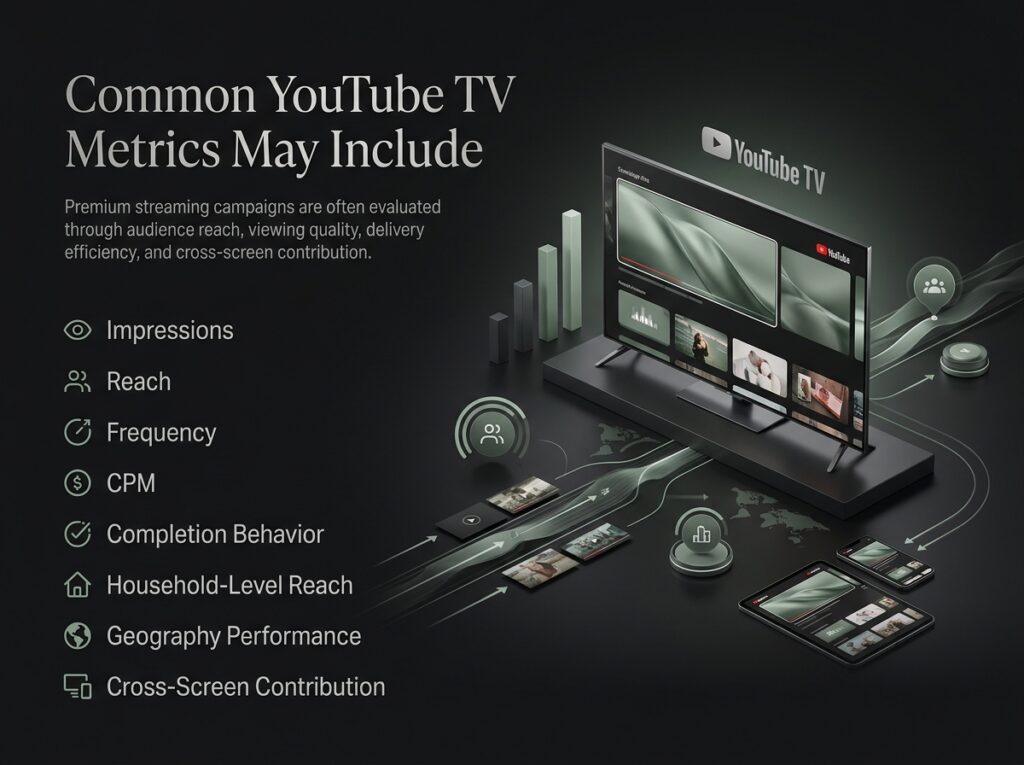
Common YouTube TV metrics may include
- impressions
- reach
- frequency
- CPM
- completion behavior
- household-level reach where relevant
- geography performance
- cross-screen contribution

Why attribution matters
YouTube TV often influences users before they search, click, or convert later through other channels. Because of that, it should not be judged only through last-click performance. A stronger reporting framework considers:
- awareness lift
- branded search movement
- cross-channel support
- site activity after exposure
- premium reach quality
- broader campaign contribution
For Crosstide Media, reporting should help answer whether YouTube TV is adding premium value to the media mix, not just whether it delivered impressions.
Why attribution matters
YouTube TV often influences users before they search, click, or convert later through other channels. Because of that, it should not be judged only through last-click performance. A stronger reporting framework considers:
- awareness lift
- branded search movement
- cross-channel support
- site activity after exposure
- premium reach quality
- broader campaign contribution
For Crosstide Media, reporting should help answer whether YouTube TV is adding premium value to the media mix, not just whether it delivered impressions.
Why Work With Crosstide Media?
Effective YouTube TV advertising requires more than comparing CPMs. It takes strategy, inventory planning, audience alignment, premium video creative, budget discipline, and a clear understanding of how YouTube TV fits into the broader media plan.
Crosstide Media helps advertisers execute YouTube TV campaigns with:
- premium video strategy
- YouTube TV vs YouTube planning guidance
- audience and geography strategy
- creative alignment
- buying-path planning
- measurement and reporting
- broader omnichannel video integration
We approach YouTube TV as a strategic premium media option, not just another video line item. Our focus is on helping brands use YouTube TV when it makes sense, combine it with regular YouTube when useful, and build a video plan that supports awareness, reach, and stronger long-term performance.
Whether the goal is premium household reach, connected TV reinforcement, stronger awareness, or a cleaner YouTube media strategy, Crosstide Media helps advertisers build campaigns with the structure and discipline required for high-value video execution.
Why Work With Crosstide Media?
Effective YouTube TV advertising requires more than comparing CPMs. It takes strategy, inventory planning, audience alignment, premium video creative, budget discipline, and a clear understanding of how YouTube TV fits into the broader media plan.
Crosstide Media helps advertisers execute YouTube TV campaigns with:
- premium video strategy
- YouTube TV vs YouTube planning guidance
- audience and geography strategy
- creative alignment
- buying-path planning
- measurement and reporting
- broader omnichannel video integration
We approach YouTube TV as a strategic premium media option, not just another video line item. Our focus is on helping brands use YouTube TV when it makes sense, combine it with regular YouTube when useful, and build a video plan that supports awareness, reach, and stronger long-term performance.
Whether the goal is premium household reach, connected TV reinforcement, stronger awareness, or a cleaner YouTube media strategy, Crosstide Media helps advertisers build campaigns with the structure and discipline required for high-value video execution.
Frequently Asked Questions
What is YouTube TV advertising?
What is the difference between YouTube TV and regular YouTube advertising?
Is YouTube TV advertising more expensive than regular YouTube?
What is the pricing model for YouTube TV ads?
What is a typical YouTube TV CPM?
What is a typical regular YouTube CPM or CPV?
What ad formats work on YouTube TV?
Is YouTube TV good for local campaigns?
When should a brand use YouTube TV instead of regular YouTube?
Why work with a YouTube TV advertising partner?
Build a Smarter YouTube TV Advertising Strategy
If your brand needs a more strategic premium video approach, Crosstide Media can help you plan, launch, and evaluate YouTube TV campaigns built around stronger inventory quality, premium reach, better video creative, and clearer reporting. Whether your goal is to improve connected TV visibility, strengthen awareness, compare YouTube TV against regular YouTube, or build a more effective video media strategy, we help brands use YouTube TV in a smarter, more results-focused way.
Why Brands Choose Crosstide Media
Brands choose Crosstide Media because YouTube TV advertising requires more than just knowing the CPM. Strong results come from the right mix of premium inventory strategy, audience planning, creative discipline, budget structure, and broader channel alignment. Our approach is built to help advertisers understand where YouTube TV fits, when it is worth the premium, how it compares to regular YouTube, and how to make better decisions through clearer reporting and more actionable campaign insights.
Talk to Crosstide Media About YouTube TV Advertising
If you are looking for a partner that can help you evaluate YouTube TV pricing, compare it with regular YouTube, and build a stronger premium video strategy, Crosstide Media can help. We build YouTube TV advertising strategies with the planning, media discipline, creative alignment, and optimization structure needed to support stronger premium video performance.