
Programmatic Audio Advertising
Strategic Audio Advertising Across Spotify, Premium Streaming Platforms, Podcasts, Internet Radio, and Digital Listening Environments
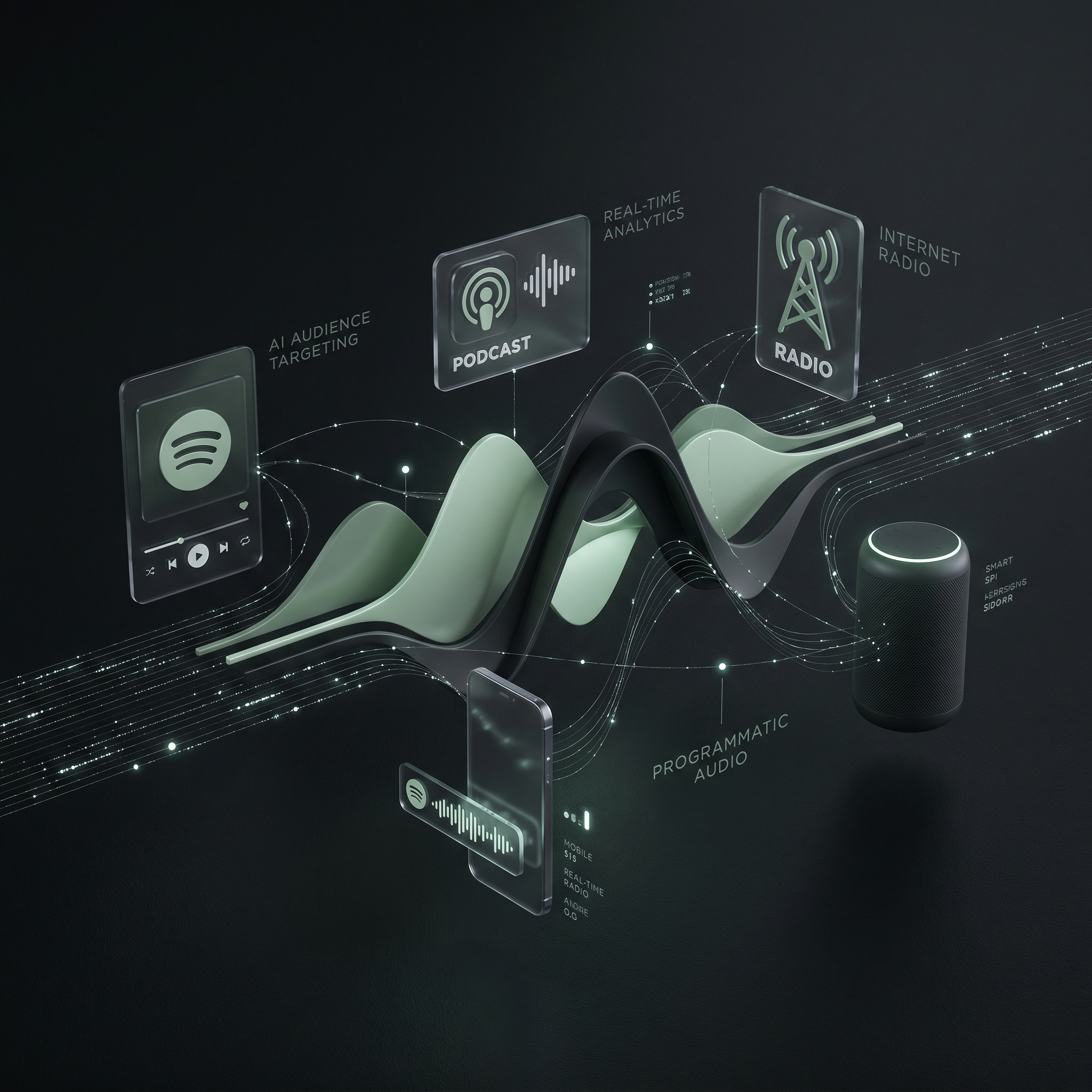
Programmatic audio advertising gives brands a way to reach listeners across Spotify, premium streaming platforms, podcasts, internet radio, and other digital audio environments through data-driven media buying and advanced audience targeting. Rather than relying on separate direct buys, advertisers can use programmatic technology to run audio campaigns across a wider mix of inventory sources, devices, and listening platforms with greater efficiency, flexibility, and control.
Audio is especially powerful because it reaches people during everyday moments like commuting, working, exercising, and multitasking, when visual channels may not have the same level of attention. When planned strategically, programmatic audio can help brands build awareness, reinforce messaging, support consideration, and stay present across high-quality listening environments throughout the day.
At Crosstide Media, we build programmatic audio campaigns around strong audience planning, premium inventory access, creative clarity, and measurable performance. Whether the goal is streaming scale, podcast reach, smarter targeting, or broader omnichannel support, we help brands execute audio campaigns designed to drive meaningful exposure and stronger media efficiency.

Jump To
What Is Programmatic Audio Advertising?
Programmatic audio advertising is the automated buying and delivery of digital audio ad inventory through advertising technology platforms rather than manual publisher-by-publisher buying. These campaigns can run across streaming music services, internet radio, digital broadcast extensions, podcast inventory, mobile audio apps, desktop listening environments, and connected devices depending on the media plan and available supply.
The main value of programmatic audio comes from its ability to combine:
- scalable reach
- audience-based targeting
- premium listening environments
- cross-device delivery
- flexible buying options
- measurable campaign reporting
This gives advertisers a more adaptable way to run audio campaigns while maintaining stronger control over who hears the message, where it runs, how often it plays, and how campaign performance is evaluated.
Why Programmatic Audio Matters
Programmatic audio matters because it allows brands to reach audiences in moments where attention often feels more personal and less visually crowded. Listeners consume audio while driving, working, exercising, cooking, traveling, and moving through daily routines, which gives advertisers a way to stay present even when users are not actively focused on a screen.
A strong programmatic audio campaign can help support:
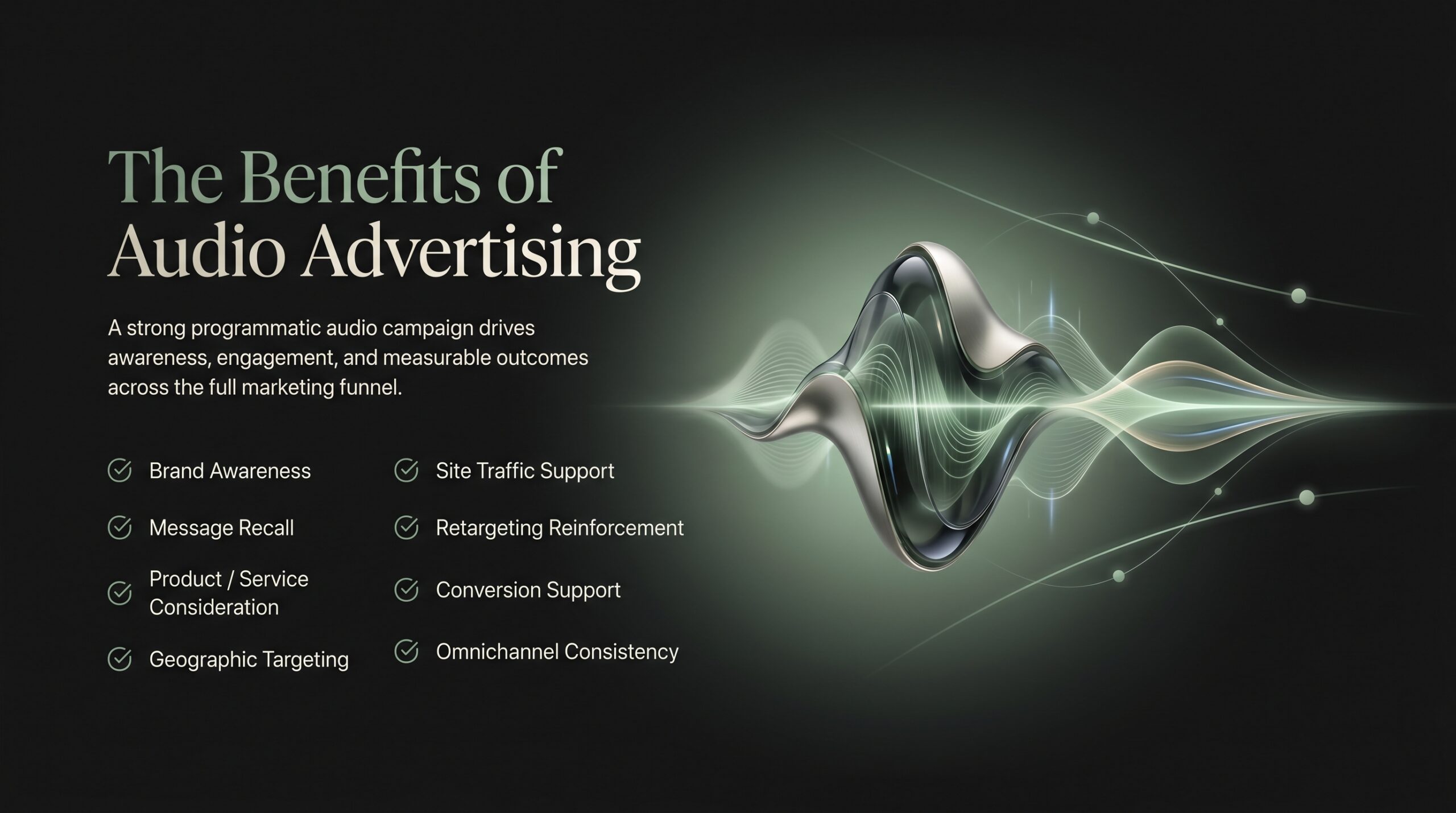
- Brand awareness
- Message recall
- Product or service consideration
- Geographic targeting
- Site traffic support
- Retargeting reinforcement
- Conversion support
- Omnichannel campaign consistency
Why advertisers use programmatic audio
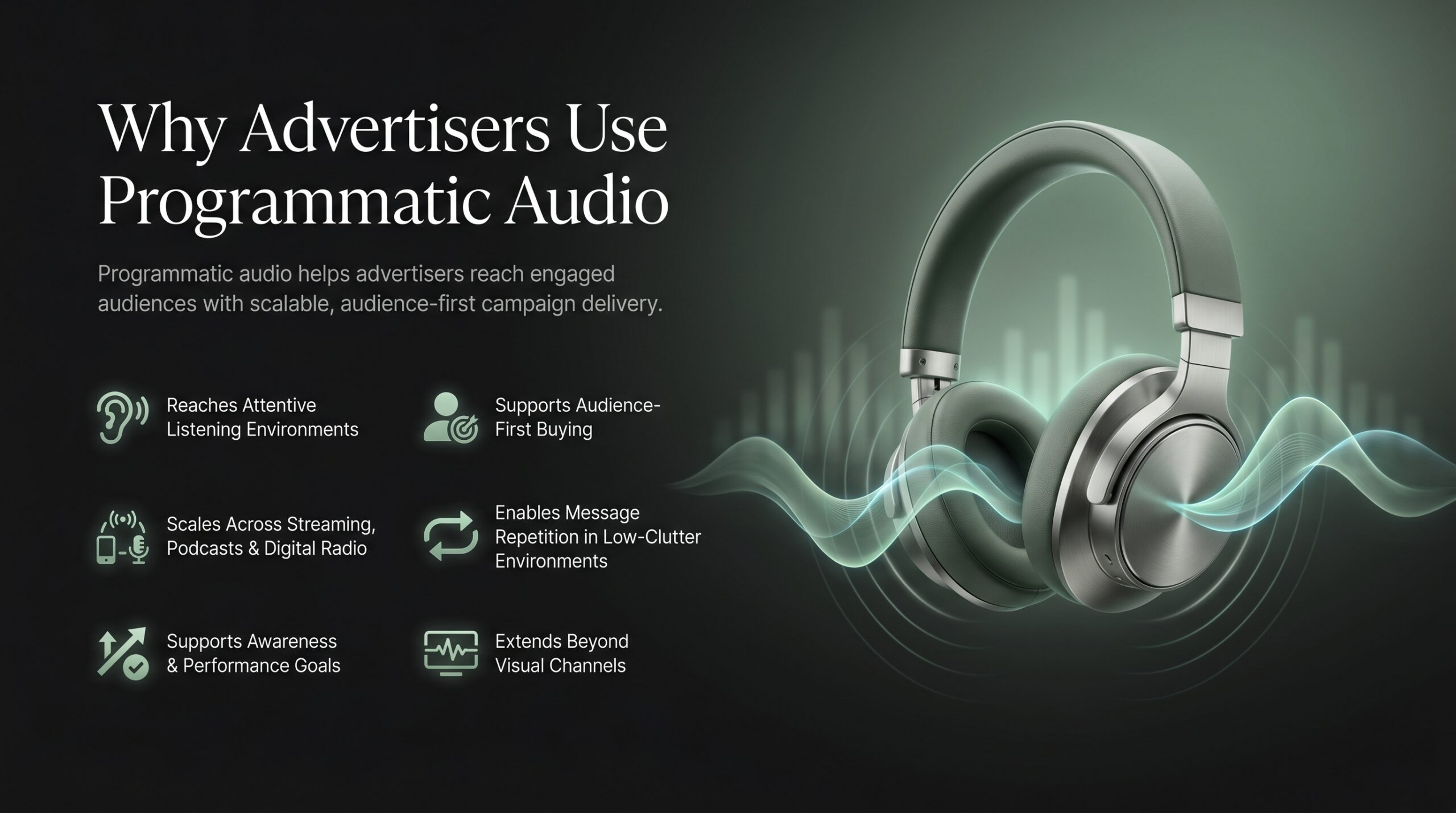
- It reaches users in attentive listening environments
- It supports audience-first buying instead of publisher-only buying
- It can scale across streaming, podcast, and digital radio inventory
- It creates message repetition in lower-clutter environments
- It can support both awareness and performance goals
- It extends campaigns beyond visual channels alone
For Crosstide Media, programmatic audio is valuable because it combines high-frequency listening moments with stronger targeting, broader inventory access, and more actionable reporting.
Why advertisers use programmatic audio
- It reaches users in attentive listening environments
- It supports audience-first buying instead of publisher-only buying
- It can scale across streaming, podcast, and digital radio inventory
- It creates message repetition in lower-clutter environments
- It can support both awareness and performance goals
- It extends campaigns beyond visual channels alone
For Crosstide Media, programmatic audio is valuable because it combines high-frequency listening moments with stronger targeting, broader inventory access, and more actionable reporting.

How Programmatic Audio Buying Works
Programmatic audio buying uses digital advertising platforms to connect advertisers with audio inventory made available through publishers, streaming services, podcast marketplaces, exchanges, and audio-focused ad technology. Campaigns are usually structured around audience targets, inventory preferences, devices, geography, budgets, pacing controls, frequency settings, creative assets, and campaign goals.
In practice, programmatic audio can include inventory from streaming music platforms, internet radio environments, podcast supply, mobile audio apps, connected listening devices, and larger digital audio ecosystems. That can include major names like Spotify, podcast networks, internet radio providers, iHeartRadio, AdsWizz-connected inventory, and other premium digital listening sources depending on campaign structure and supply access.
Typical programmatic audio workflow
A well-managed campaign usually includes:
- audience planning and segmentation
- inventory strategy by listening environment, publisher quality, and format
- creative setup, trafficking, and quality assurance
- bid and pacing controls
- frequency management
- brand safety and suitability review
- mid-flight optimization
- reporting and attribution analysis
Why this buying model is useful
Programmatic audio gives advertisers more control over:
- who hears the ad
- where the ad runs
- when the message is delivered
- how often listeners are exposed
- which audiences and inventory sources perform best
- how spend is adjusted while the campaign is live
That makes it more adaptable than direct-only audio buying, especially for advertisers who want stronger targeting, more optimization flexibility, and clearer campaign reporting.
Audio Formats and Inventory Types
Programmatic audio campaigns can run across several major listening environments and ad formats. The right mix depends on campaign goals, audience behavior, creative approach, and supply availability.
Streaming audio
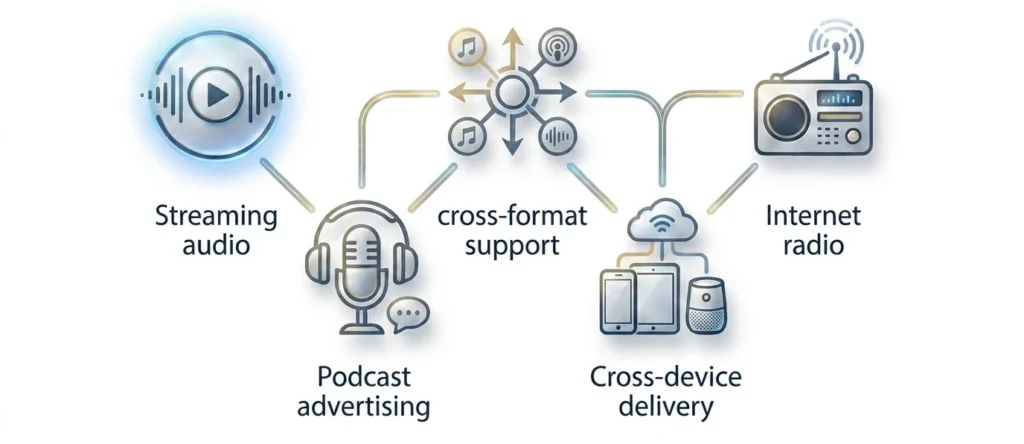
Streaming audio includes ad placements delivered within music streaming and digital listening environments. These placements can appear in mobile apps, desktop players, web listening environments, smart devices, and connected audio ecosystems.
Internet radio and digital radio
Internet radio and digital radio inventory can include online-only stations, streamed broadcast radio, and digital listening extensions tied to radio brands. These environments can help advertisers reach users during workdays, commutes, and routine listening windows.
Podcast advertising
Programmatic audio can also include podcast ad inventory depending on platform access, campaign setup, and supply path. Podcast advertising may run through marketplace inventory, network relationships, platform integrations, or broader audio buying infrastructure.
Companion and cross-format support
Some audio campaigns may also include companion display units, clickable formats, or supporting creative layers depending on the platform and device environment. This can help connect audio exposure to site traffic, retargeting pools, and landing-page activity.
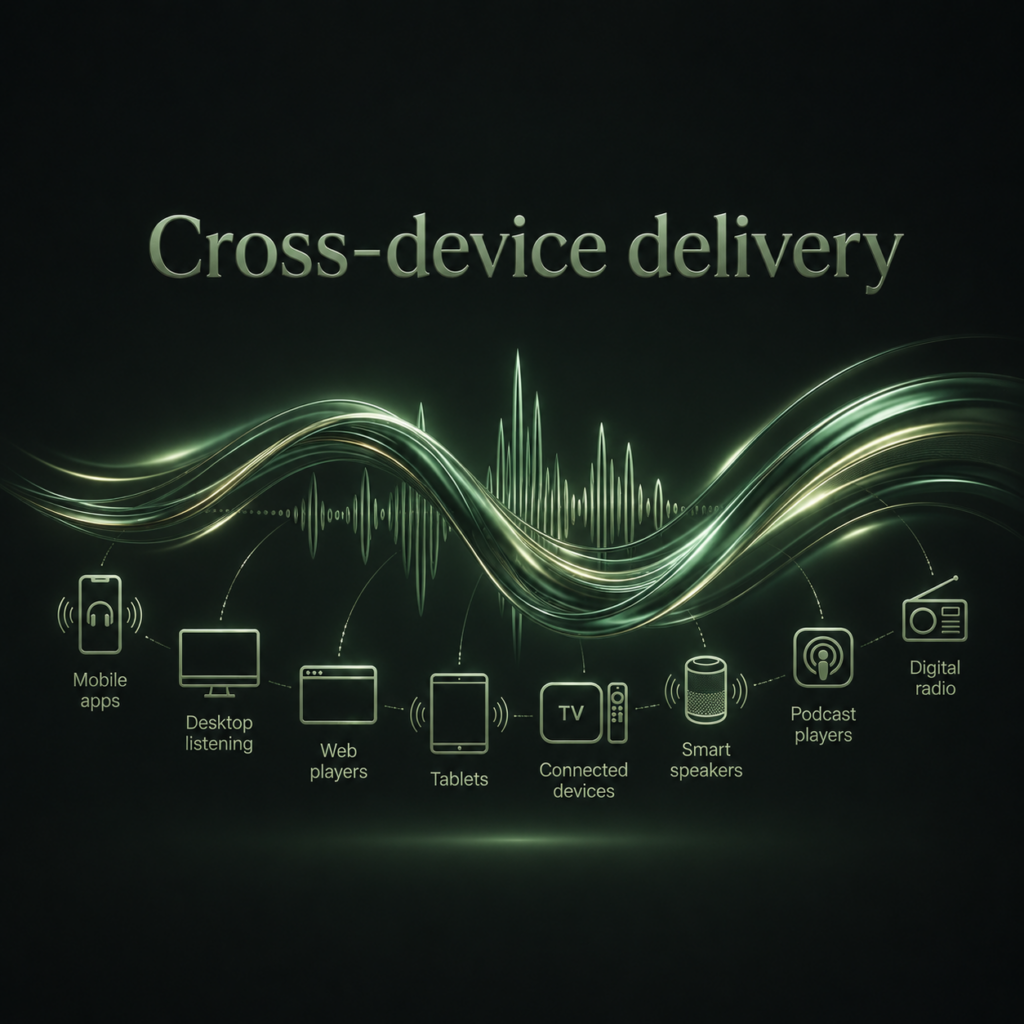
Cross-device delivery
Programmatic audio may run across:
- Mobile apps
- Desktop listening environments
- Web players
- Tablets
- Connected devices
- Smart speakers
- Podcast players
- Digital radio environments
Cross-device delivery
Programmatic audio may run across:
- Mobile apps
- Desktop listening environments
- Web players
- Tablets
- Connected devices
- Smart speakers
- Podcast players
- Digital radio environments
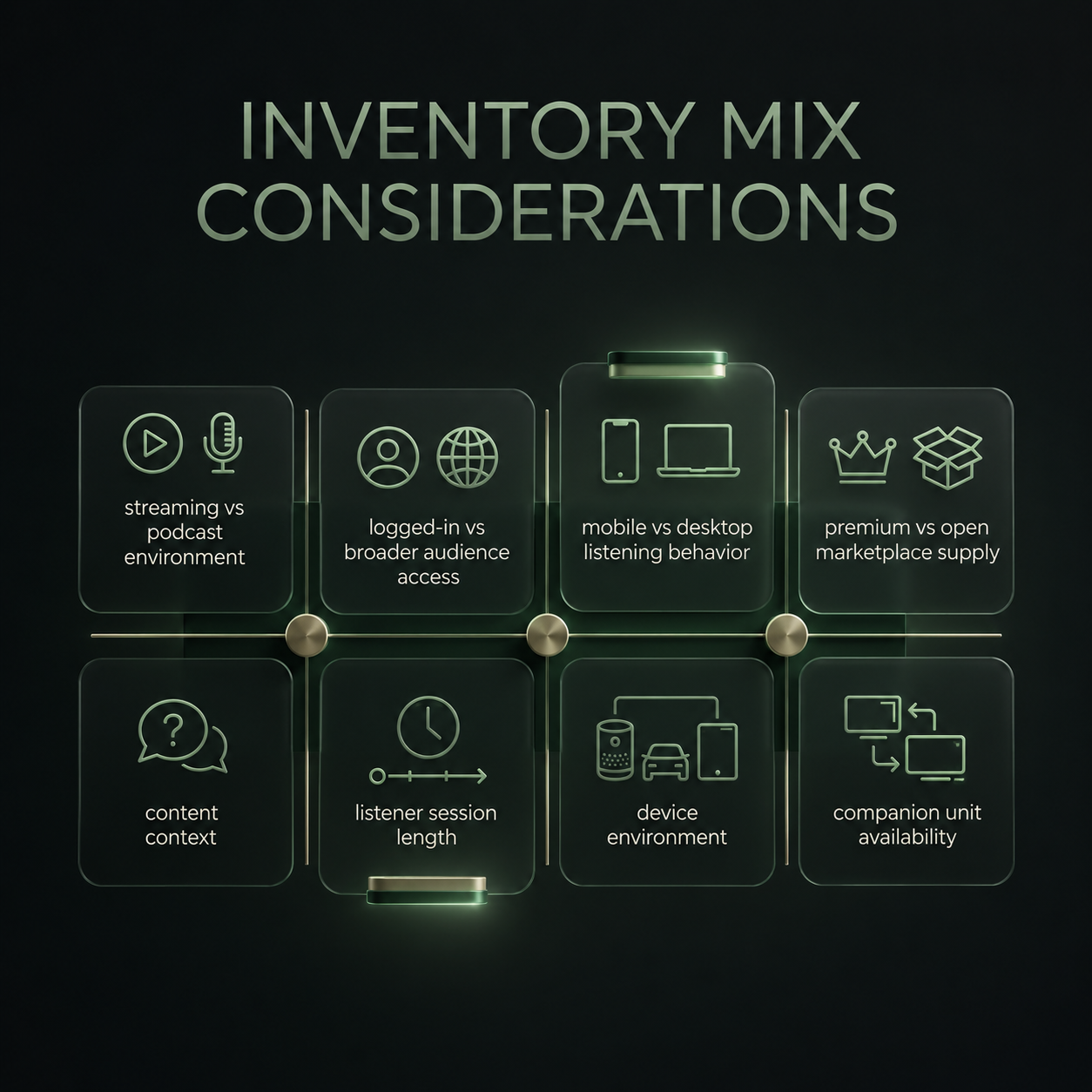
Inventory mix considerations
Performance can vary based on:
- Streaming vs podcast environment
- Logged-in vs broader audience access
- Mobile vs desktop listening behavior
- Premium vs open marketplace supply
- Content context
- Listener session length
- Device environment
- Companion unit availability
Premium Audio Inventory and Supply Strategy
Not all audio impressions deliver the same value. Two campaigns with similar CPMs can perform very differently depending on publisher quality, listening environment, user experience, inventory source, and audience relevance.
Common supply approaches
Programmatic audio campaigns may source inventory through:
- premium publisher relationships
- streaming platform access
- podcast marketplaces
- curated private deals
- programmatic audio platforms
- selective open-market buying
Why premium supply matters
Higher-quality inventory can improve:
- listener experience
- contextual alignment
- ad audibility
- campaign consistency
- brand presentation
- performance quality
Strong supply strategy should focus on
- publisher quality
- inventory transparency
- listening environment relevance
- cleaner supply paths
- cost control
- reduced exposure to low-quality resold inventory
- more stable delivery across selected platforms
For Crosstide Media, supply quality is both a media quality issue and a performance issue.
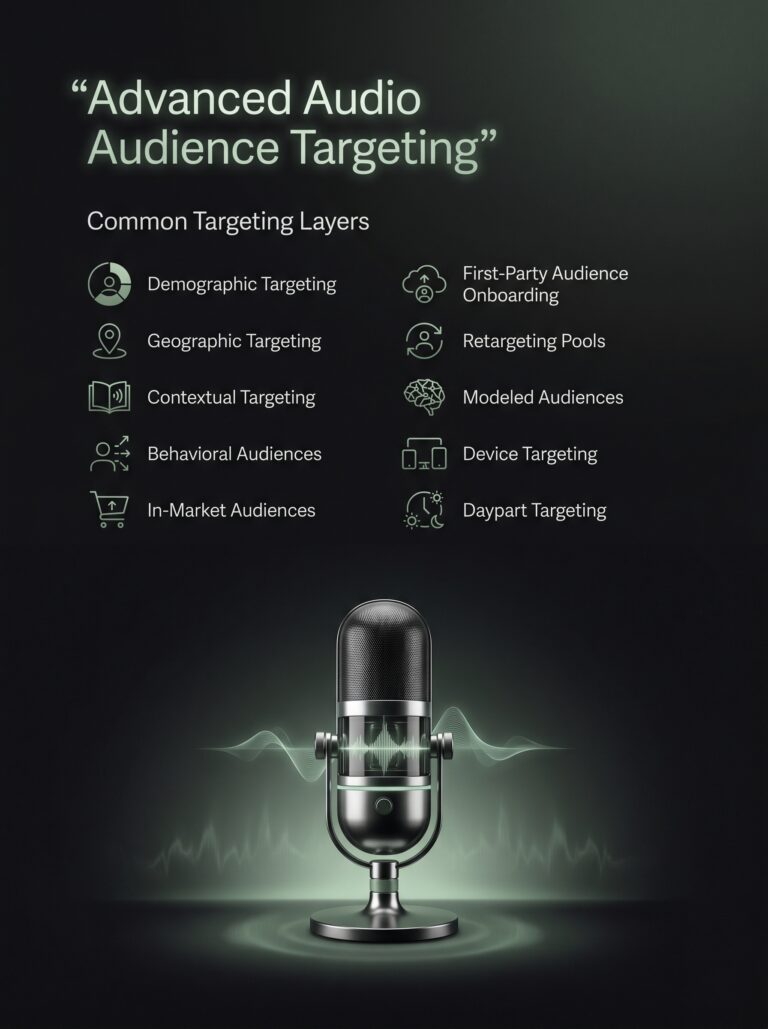
Advanced Audio Audience Targeting
Programmatic audio campaigns can be built using a mix of audience, contextual, geographic, device, and first-party signals.
Common targeting layers
Performance can vary based on:
- Demographic targeting
- Geographic targeting
- Contextual targeting
- Behavioral audiences
- In-market audiences
- First-party audience onboarding
- Retargeting pools
- Modeled audiences
- Device targeting
- Daypart targeting
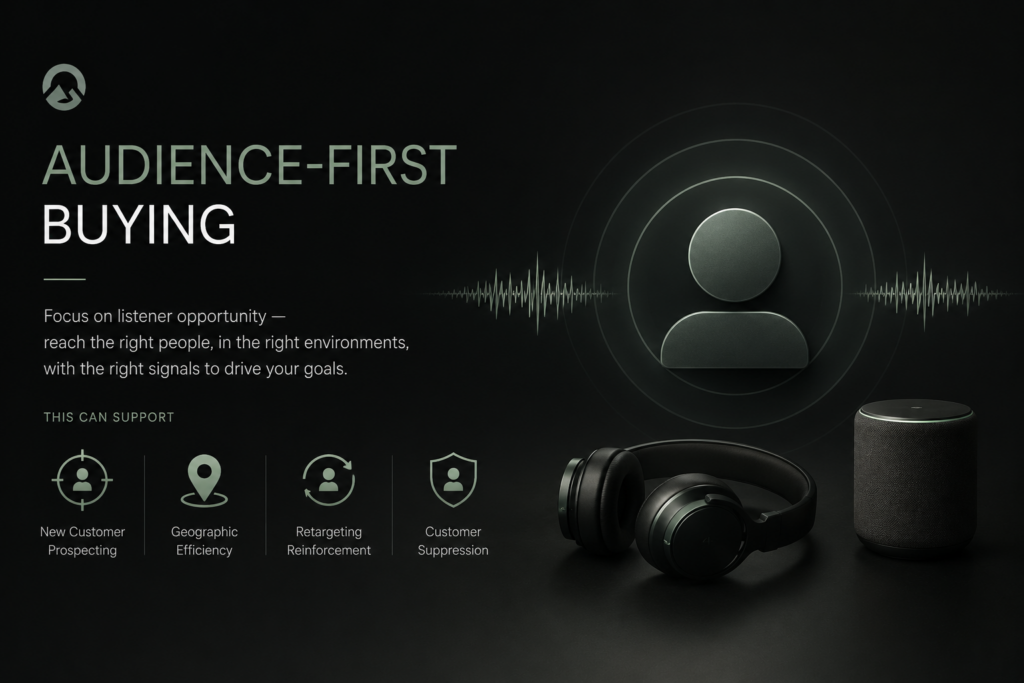
Audience-first buying
One of the most valuable benefits of programmatic audio is the ability to buy against listener opportunity instead of relying only on a narrow publisher list. Advertisers can focus on who they want to reach, what environments matter most, and which signals best support the campaign goal.
This can support:
- New customer prospecting
- Geographic efficiency
- Retargeting reinforcement
- Customer suppression
- Sequential messaging
- Omnichannel audience alignment
First-party data strategy
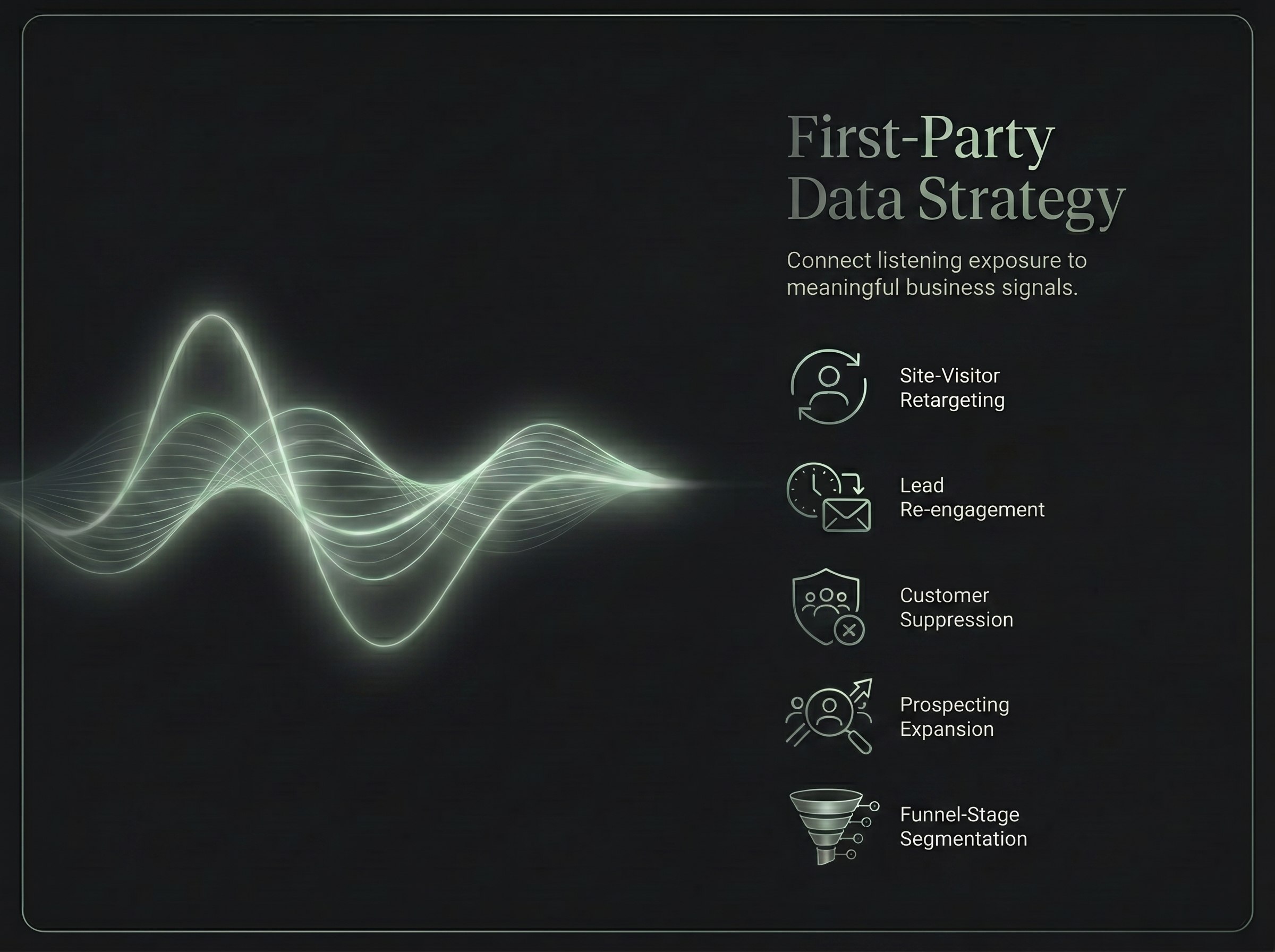
First-party data can be especially useful in programmatic audio when the objective is to connect listening exposure to real business signals. Depending on the campaign structure, it may support:
- Site-visitor retargeting
- Lead re-engagement
- Customer suppression
- Prospecting expansion from known converters
- Audience segmentation by funnel stage
First-party data strategy
First-party data can be especially useful in programmatic audio when the objective is to connect listening exposure to real business signals. Depending on the campaign structure, it may support:
- Site-visitor retargeting
- Lead re-engagement
- Customer suppression
- Prospecting expansion from known converters
- Audience segmentation by funnel stage
Geographic targeting options
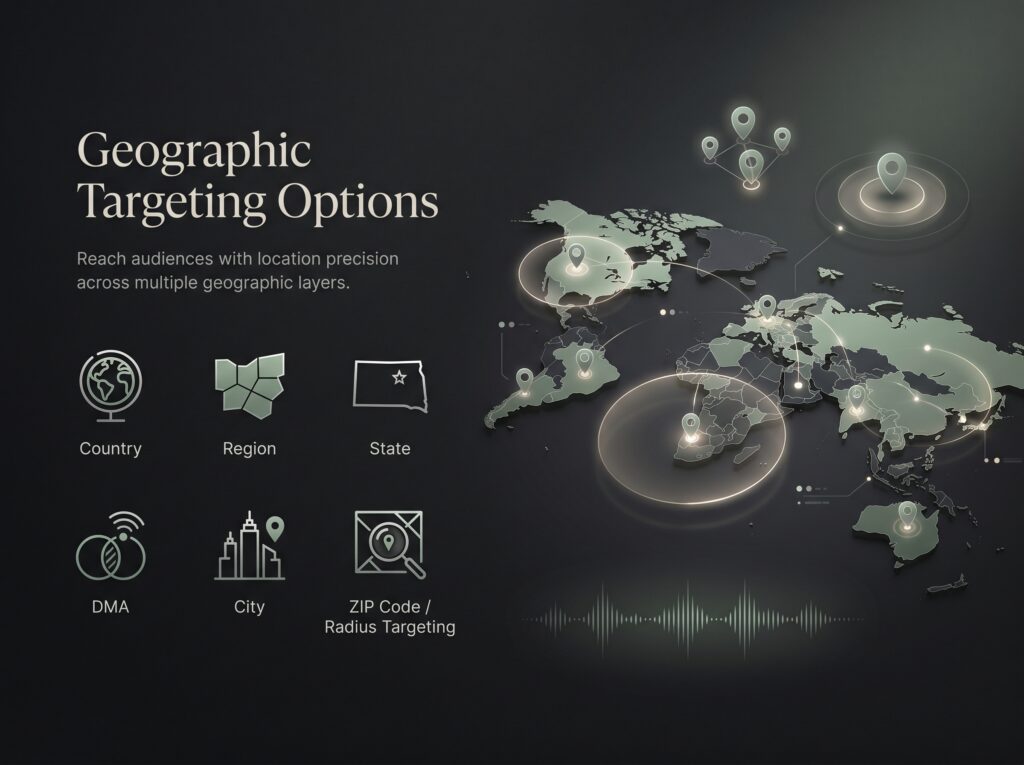
Geographic precision may include:
- Country
- Region
- State
- DMA
- City
- ZIP code
- Radius targeting depending on platform support
Targeting best practices
The strongest audio campaigns usually avoid overcomplicating the setup with too many stacked filters. Overly narrow targeting can reduce scale, increase costs, and limit learning. A better structure is to prioritize the highest-value audiences, organize campaigns clearly, and optimize using real delivery and outcome data after launch.
Creative Strategy and Audio Ad Specifications
Creative matters heavily in programmatic audio because the ad has to do its job through sound, pacing, clarity, and message structure rather than visual design alone. The listener has to understand the message quickly, remember the brand, and know what matters most without needing to look at a screen.
What strong audio creative should do
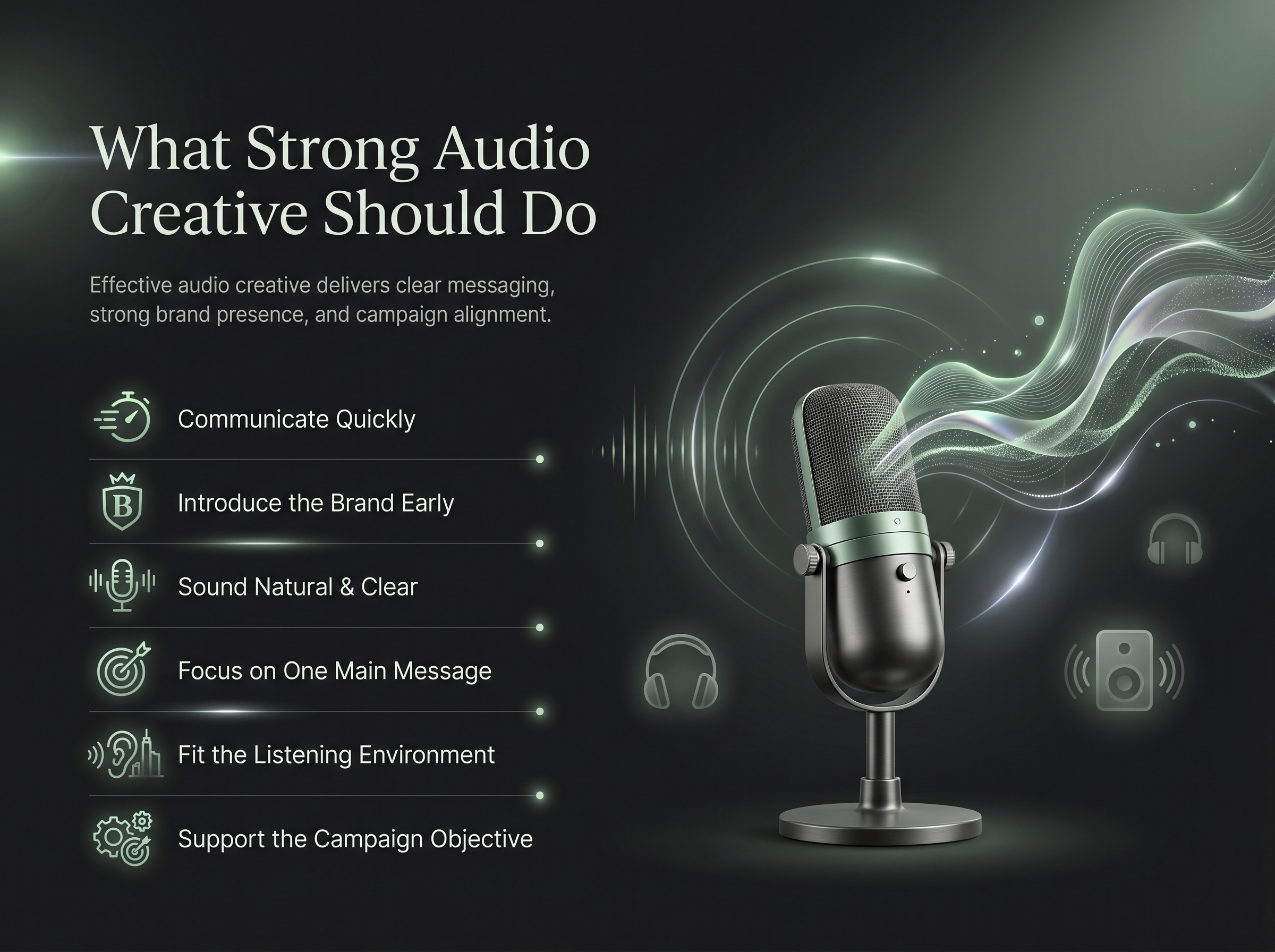
- Communicate quickly
- Introduce the brand early
- Sound natural and clear
- Focus on one main message
- Fit the listening environment
- Support the campaign objective
What strong audio creative should do
- Communicate quickly
- Introduce the brand early
- Sound natural and clear
- Focus on one main message
- Fit the listening environment
- Support the campaign objective
Performance-oriented audio creative approach
Strong audio creative usually includes:
- Early brand recognition
- Clear message hierarchy
- Natural voice delivery
- Concise copy
- A focused offer or value proposition
- A simple call to action
- Pacing that matches the spot length
Performance-oriented audio creative approach
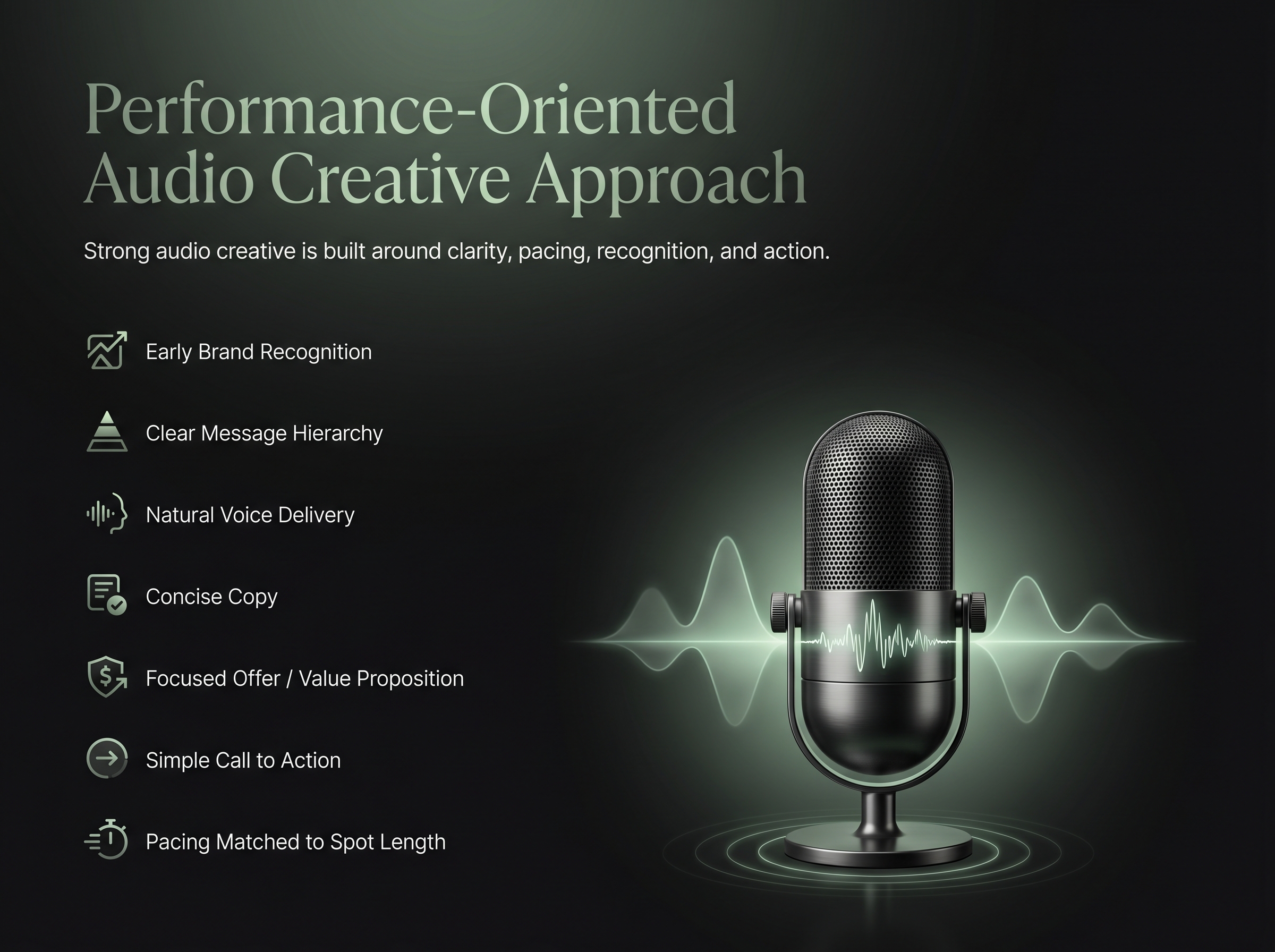
Strong audio creative usually includes:
- Early brand recognition
- Clear message hierarchy
- Natural voice delivery
- Concise copy
- A focused offer or value proposition
- A simple call to action
- Pacing that matches the spot length
Creative best practices by campaign goal
Awareness campaigns
- Lead with the brand
- Keep the message simple
- Focus on memorability and repetition
Consideration campaigns
- Highlight one or two differentiators
- Use a stronger value proposition
- Keep the structure easy to follow
Response-oriented campaigns
- Clarify the offer early
- Make the next step obvious
- Align messaging with landing pages and retargeting
For Crosstide Media, supply quality is both a media quality issue and a performance issue.
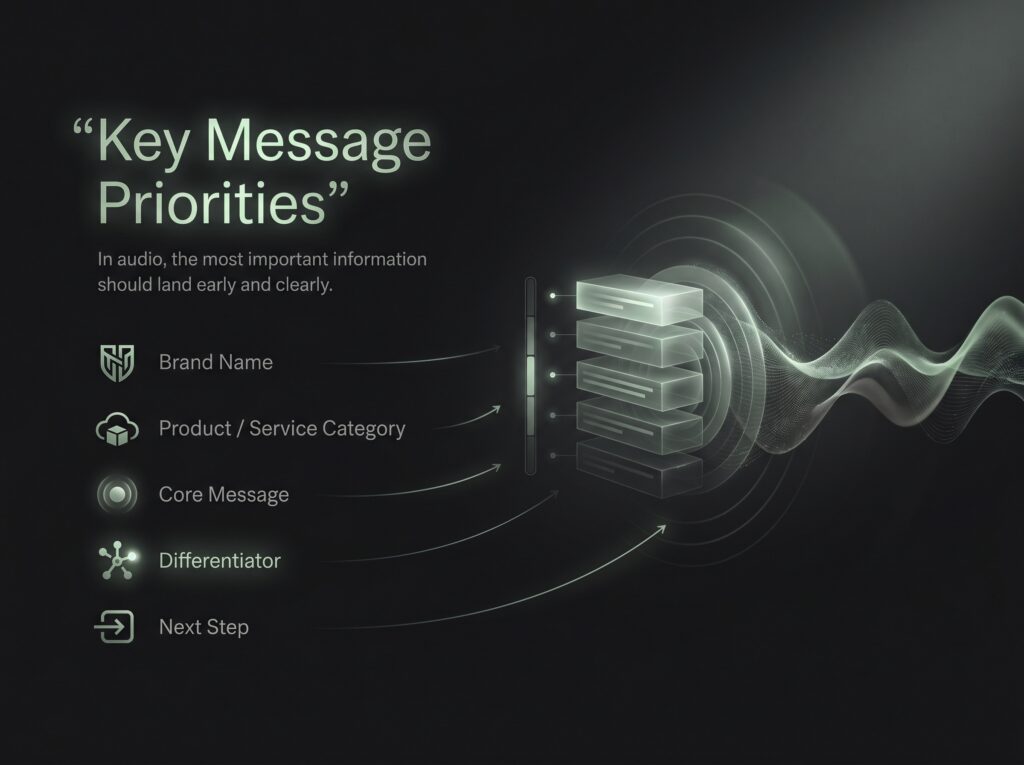
Key message priorities
In audio, the most important information should land early:
- Brand name
- Product or service category
- Core message
- Differentiator
- Next step
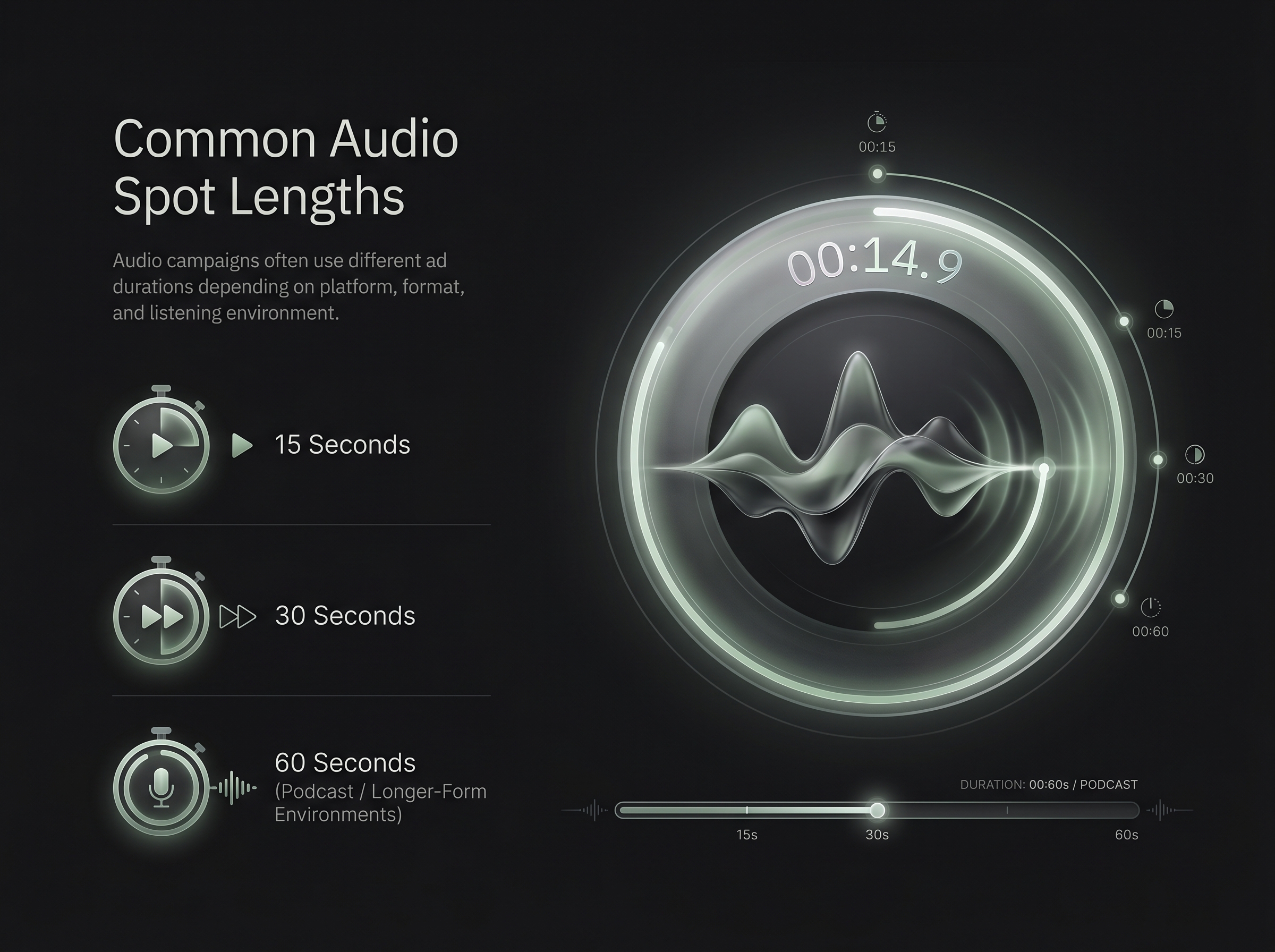
Common audio spot lengths
The most common audio ad durations often include:
- 15 seconds
- 30 seconds
- 60 seconds in certain podcast or longer-form environments
The right duration depends on the objective, inventory type, platform requirements, and how much explanation the message needs.
Common audio spot lengths
The most common audio ad durations often include:
- 15 seconds
- 30 seconds
- 60 seconds in certain podcast or longer-form environments
The right duration depends on the objective, inventory type, platform requirements, and how much explanation the message needs.
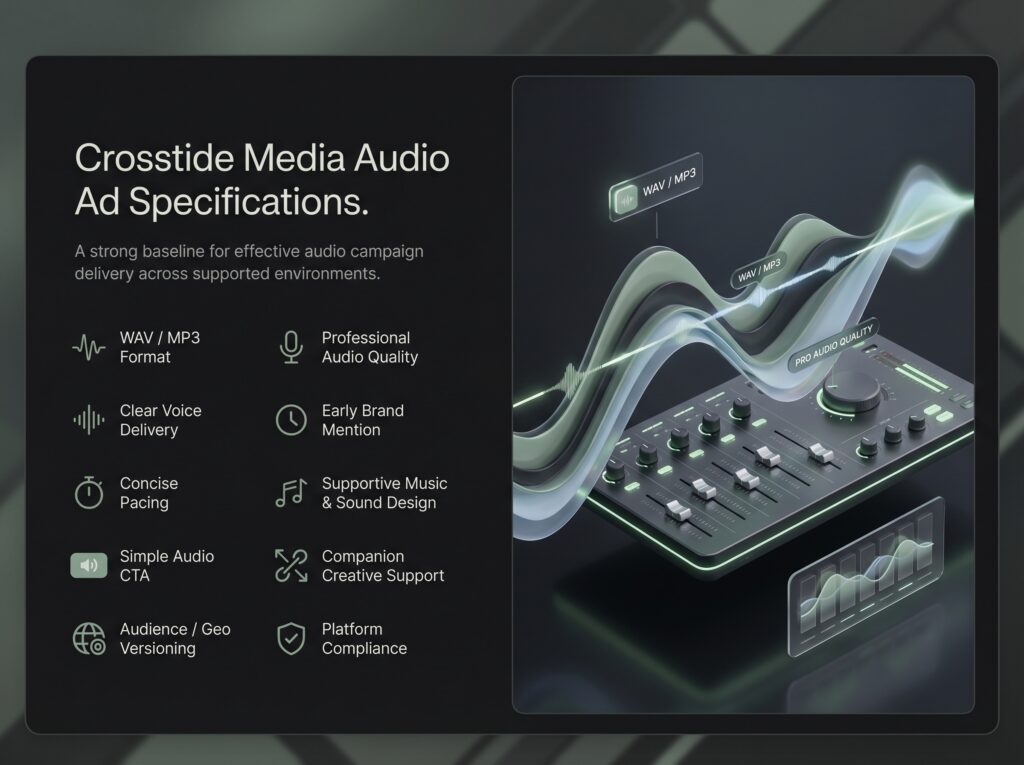
Crosstide Media audio ad specifications
Use the following as a strong baseline for most programmatic audio campaigns:
- File format: WAV or MP3 depending on platform acceptance
- Audio quality: clean, professionally mixed, and free of distortion
- Voice delivery: clear, natural, and easy to understand
- Brand mention: early in the script and repeated when appropriate
- Pacing: concise enough for the selected spot length
- Music and sound design: supportive, not distracting
- CTA: simple and realistic for an audio environment
- Companion creative: included when supported and useful
- Versioning: tailored by audience, geography, or offer when needed
- Compliance: confirm all platform-specific requirements before trafficking
Crosstide Media audio ad specifications
Use the following as a strong baseline for most programmatic audio campaigns:
- File format: WAV or MP3 depending on platform acceptance
- Audio quality: clean, professionally mixed, and free of distortion
- Voice delivery: clear, natural, and easy to understand
- Brand mention: early in the script and repeated when appropriate
- Pacing: concise enough for the selected spot length
- Music and sound design: supportive, not distracting
- CTA: simple and realistic for an audio environment
- Companion creative: included when supported and useful
- Versioning: tailored by audience, geography, or offer when needed
- Compliance: confirm all platform-specific requirements before trafficking
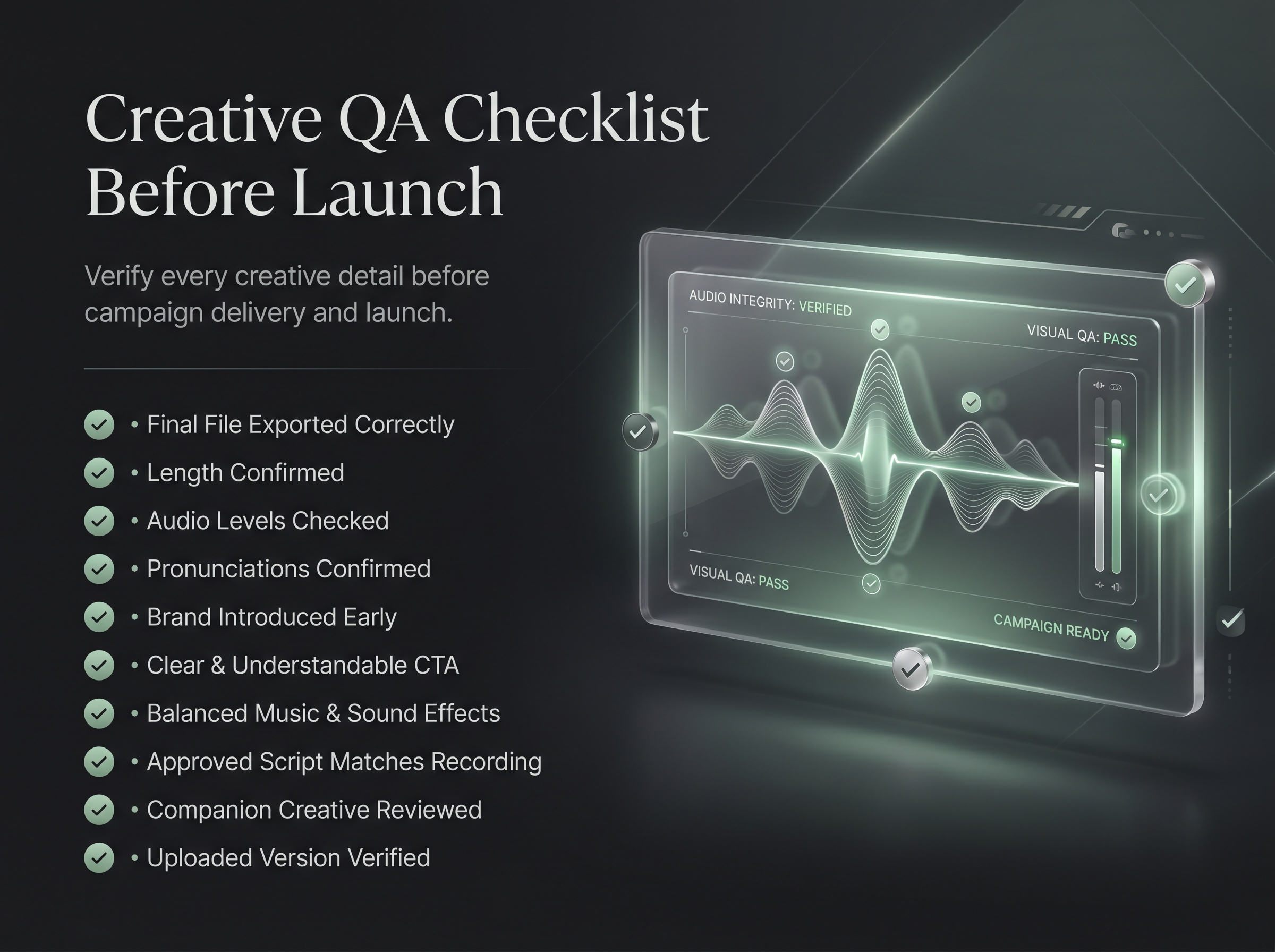
Creative QA checklist before launch
- Final file exported correctly
- Length confirmed
- Audio levels checked
- Pronunciations confirmed
- Brand introduced early
- CTA clearly understandable
- Music and sound effects balanced properly
- Approved script matches final recording
- Companion creative reviewed if included
- Uploaded version matches approved version
Creative QA checklist before launch
- Final file exported correctly
- Length confirmed
- Audio levels checked
- Pronunciations confirmed
- Brand introduced early
- CTA clearly understandable
- Music and sound effects balanced properly
- Approved script matches final recording
- Companion creative reviewed if included
- Uploaded version matches approved version
Programmatic Audio Pricing, CPMs, and Media Efficiency
Common pricing variables
- premium vs broader marketplace inventory
- streaming vs podcast environment
- audience layering
- geography
- device mix
- brand-safety settings
- campaign timing
- seasonality
- supply path efficiency
- publisher quality
Common pricing models
CPM is one of the most common pricing models in programmatic audio, though performance analysis should look beyond impression cost alone.
Advertisers may evaluate campaigns using:
- CPM
- completed listens or listen-through metrics when available
- Site traffic impact
- CPA
- ROAS
- Assisted conversion trends
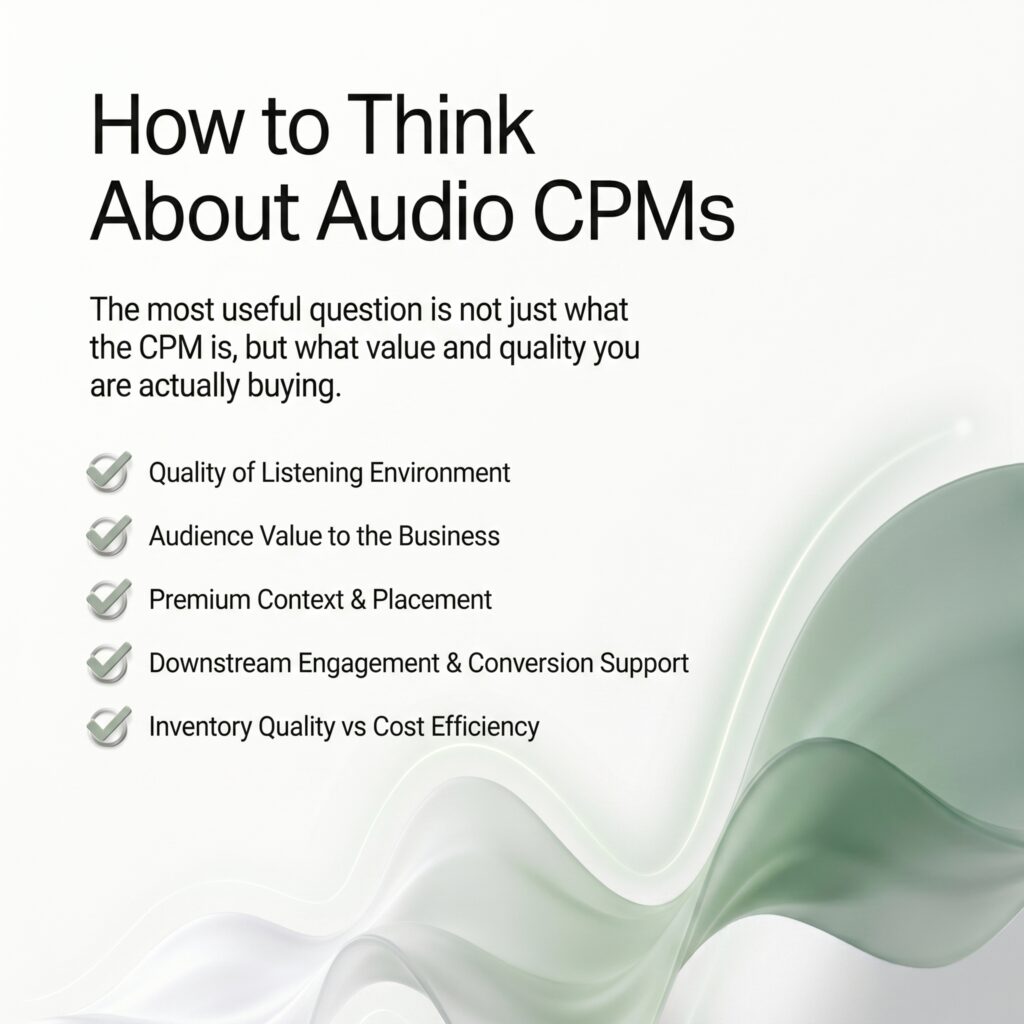
How to think about audio CPMs
The more useful question is not only what the CPM is, but also:
- What quality of listening environment am I buying?
- Is the audience valuable to the business?
- Is the message running in a premium context?
- Am I seeing downstream engagement or conversion support?
- Am I paying for stronger inventory quality or just higher cost?
A higher CPM is not automatically a negative if it comes with:
- stronger listener attention
- higher-quality inventory
- more consistent delivery
- better brand environment
- less wasted spend
The strongest pricing analysis looks at CPM alongside reach quality, audience fit, site activity, conversion behavior, and broader media efficiency.
Budget Planning and Frequency Strategy
Programmatic audio campaigns need enough budget to generate meaningful reach, useful frequency, and enough delivery volume to evaluate audiences, creative, and inventory quality with confidence.
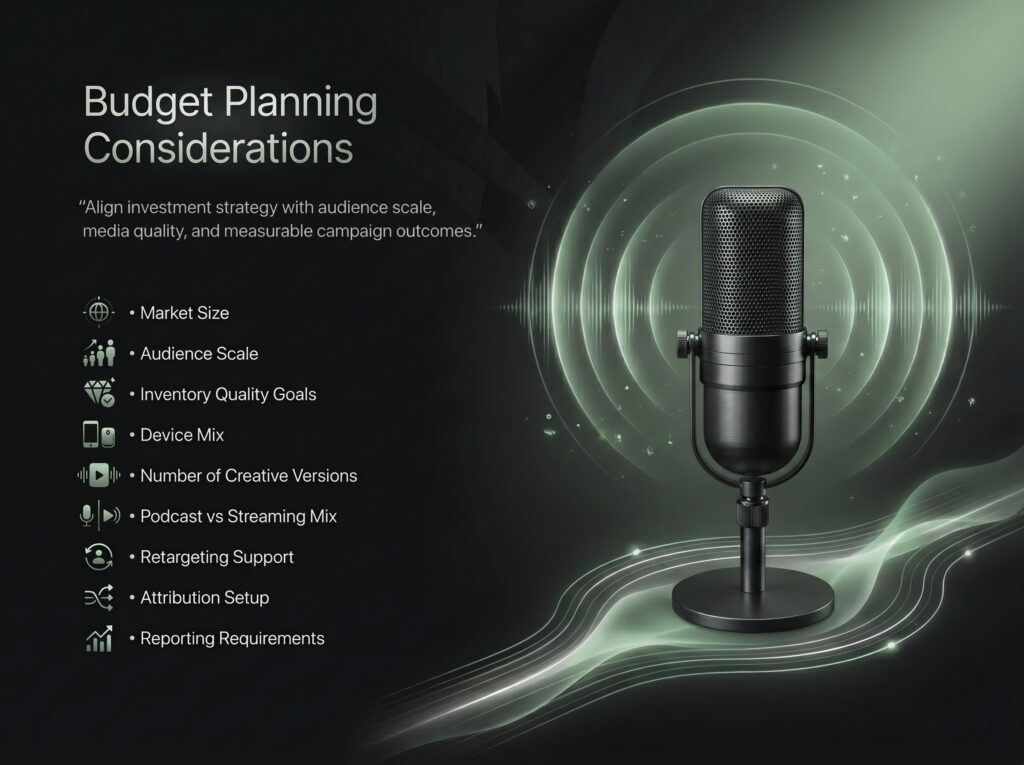
Budget planning considerations
- Market size
- Audience scale
- Inventory quality goals
- Device mix
- Number of creative versions
- Podcast vs streaming mix
- Retargeting support
- Attribution setup
- Reporting requirements
A budget that is too small can limit scale, reduce learning, and make it harder to understand whether the campaign is working across different listening environments.
Frequency strategy
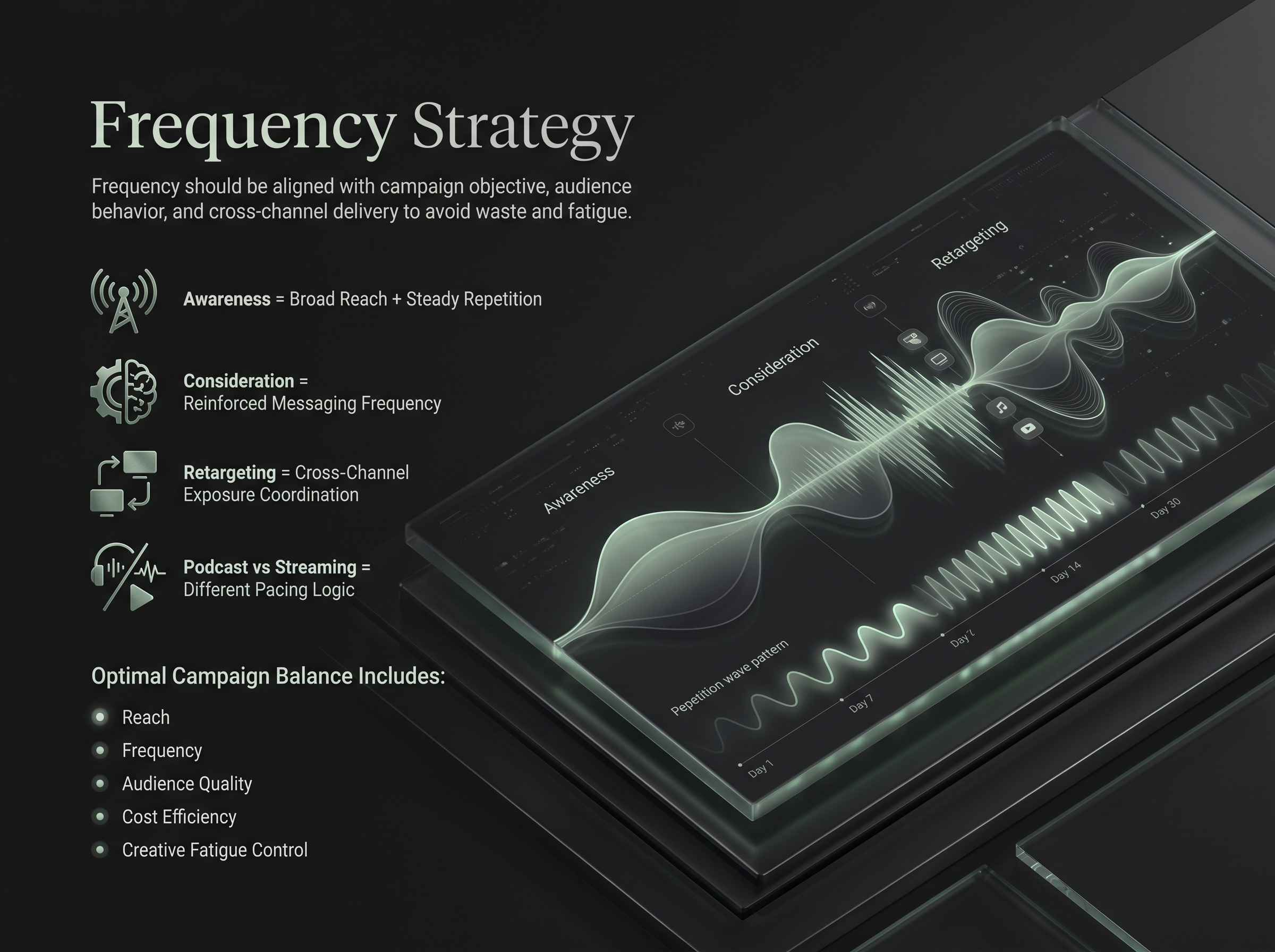
Frequency should be managed differently depending on the campaign objective:
- Awareness campaigns may prioritize broader reach with steady repetition
- Consideration campaigns may need more reinforcement
- Retargeting support may benefit from coordinated cross-channel exposure
- Podcast and streaming environments may require different pacing logic
A strong campaign structure usually balances:
- reach
- frequency
- audience quality
- cost efficiency
- creative fatigue risk
Frequency strategy
Frequency should be managed differently depending on the campaign objective:
- Awareness campaigns may prioritize broader reach with steady repetition
- Consideration campaigns may need more reinforcement
- Retargeting support may benefit from coordinated cross-channel exposure
- Podcast and streaming environments may require different pacing logic
A strong campaign structure usually balances:
- reach
- frequency
- audience quality
- cost efficiency
- creative fatigue risk
Measurement and Attribution
Programmatic audio can be measured across campaign delivery metrics and broader business outcomes, depending on platform access and attribution setup.
Common campaign metrics
- impressions
- reach
- frequency
- completed listens or audio completion signals when available
- device distribution
- geographic delivery
- companion click activity
- pacing and spend distribution
Broader business outcome metrics
- website traffic
- landing-page engagement
- lead volume
- conversion rate
- CPA
- ROAS
- assisted conversions
- revenue contribution
Advanced measurement approaches
- cross-device attribution
- audience-quality analysis
- incrementality testing
- time-to-conversion review
- inventory-source comparison
- platform-level performance review
- podcast vs streaming analysis
Attribution reality
Audio often influences behavior that happens later on another device or through another channel. Because of that, programmatic audio should not be judged only through last-click reporting. A stronger framework combines delivery quality, site activity, conversion patterns, and incremental impact wherever possible.
What strong reporting should include
- delivery by inventory type or platform grouping
- reach and frequency by audience or geography
- streaming vs podcast vs radio-style performance comparisons
- site activity and conversion behavior
- optimization actions taken during flight
- key findings and recommended next steps
That makes reporting more useful than a simple export. It turns campaign data into a media decision tool.
Brand Safety, Inventory Quality, and Listening Environment Standards
Brand safety in programmatic audio depends on inventory quality, platform standards, content suitability, supply transparency, and the overall listener experience.
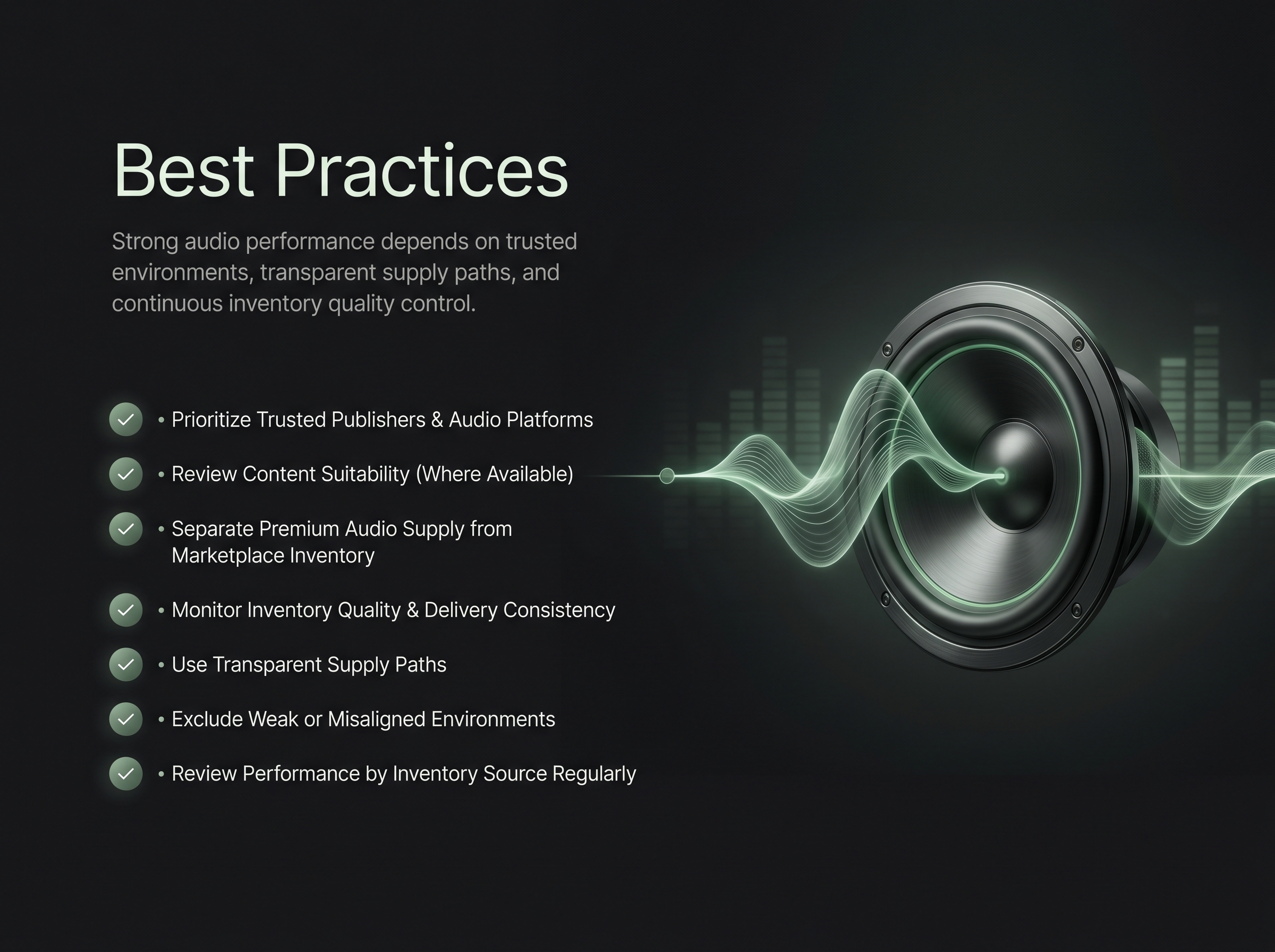
Best practices
- Prioritize trusted publishers and audio platforms
- Review content suitability where available
- Separate premium audio supply from broader marketplace inventory
- Monitor inventory quality and delivery consistency
- Use transparent supply paths
- Exclude weak or misaligned environments
- Review performance trends by inventory source regularly
For Crosstide Media, inventory quality is not just a compliance issue. It directly affects campaign value, message reception, and performance potential.
Why Work With Crosstide Media?
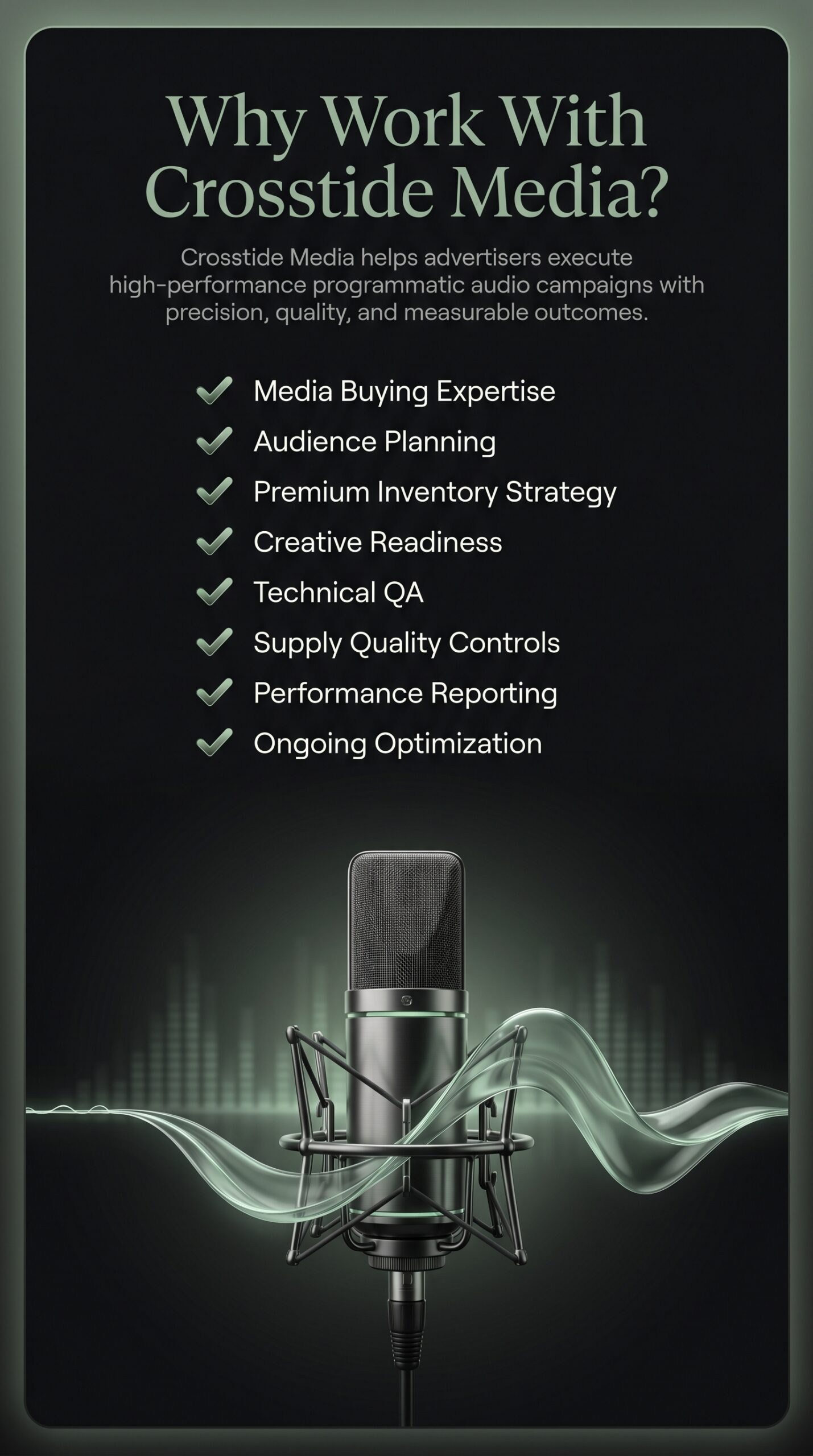
Effective programmatic audio execution requires more than simply uploading a spot and turning on targeting. It takes audience planning, inventory strategy, creative discipline, technical setup, supply quality review, measurement logic, and ongoing optimization.
Crosstide Media helps advertisers execute programmatic audio campaigns with:
- Media buying expertise
- Audience planning
- Premium inventory strategy
- Creative readiness
- Technical QA
- Supply quality controls
- Performance reporting
- Ongoing optimization
We approach programmatic audio as both a scalable awareness channel and a measurable media investment. Our focus is on building campaigns that combine premium listening environments, strong creative clarity, smart targeting, and actionable reporting so brands can grow with more confidence.
Whether the goal is streaming scale, podcast reach, digital radio support, geographic efficiency, or omnichannel reinforcement, Crosstide Media helps brands build audio campaigns with the structure and discipline required for modern media buying.
Why Work With Crosstide Media?
Effective programmatic audio execution requires more than simply uploading a spot and turning on targeting. It takes audience planning, inventory strategy, creative discipline, technical setup, supply quality review, measurement logic, and ongoing optimization.
Crosstide Media helps advertisers execute programmatic audio campaigns with:
- Media buying expertise
- Audience planning
- Premium inventory strategy
- Creative readiness
- Technical QA
- Supply quality controls
- Performance reporting
- Ongoing optimization
We approach programmatic audio as both a scalable awareness channel and a measurable media investment. Our focus is on building campaigns that combine premium listening environments, strong creative clarity, smart targeting, and actionable reporting so brands can grow with more confidence.
Whether the goal is streaming scale, podcast reach, digital radio support, geographic efficiency, or omnichannel reinforcement, Crosstide Media helps brands build audio campaigns with the structure and discipline required for modern media buying.
Frequently Asked Questions
What is programmatic audio advertising?
What platforms can be included in programmatic audio?
Is podcast advertising part of programmatic audio?
What is AdsWizz?
Is Spotify part of programmatic audio advertising?
Can programmatic audio support performance marketing?
Yes. Depending on the setup, programmatic audio can support awareness, site traffic, retargeting, lead generation support, conversion assistance, and broader omnichannel performance goals.
What are common audio ad lengths?
How is programmatic audio measured?
What affects audio CPMs?
Why work with a managed programmatic audio partner?
Build a Smarter Programmatic Audio Campaign
If your brand needs a more strategic audio advertising approach, Crosstide Media can help you plan, launch, and optimize campaigns built around audience quality, premium listening environments, stronger creative execution, and clearer reporting. Whether your goal is to increase awareness, expand streaming reach, build podcast presence, support internet radio campaigns, or improve omnichannel media performance, we help brands build programmatic audio campaigns designed to work more efficiently across today’s digital listening landscape.
Why Brands Choose Crosstide Media
Brands work with Crosstide Media because effective programmatic audio advertising requires more than just placing a spot into market. Strong results come from the right mix of audience strategy, inventory quality, creative discipline, campaign structure, and ongoing optimization. Our approach is built to help advertisers improve reach, reduce waste, maintain stronger media quality, and make better decisions through clearer reporting and more actionable campaign insights.
Talk to Crosstide Media About Programmatic Audio Advertising
If you are looking for a programmatic audio partner that can help you reach the right audience, improve campaign efficiency, and deliver more measurable results, Crosstide Media can help. We build programmatic audio campaigns with the strategic planning, technical setup, inventory quality controls, creative alignment, and optimization discipline needed to support long-term growth.