
Cookieless Targeting
Cookieless Targeting Strategy for Privacy-First Audience Reach, Stronger Programmatic Performance, and Long-Term Addressability
Cookieless targeting has become one of the most important topics in modern digital advertising. As third-party cookies become less dependable and privacy expectations continue to rise, advertisers need smarter ways to reach relevant audiences without relying on older tracking methods. The market has shifted toward a mix of first-party data, contextual targeting, identity solutions, privacy-aware activation methods, and new addressability frameworks that help brands stay effective in a changing environment.
That matters because programmatic advertising still depends on audience strategy, media efficiency, measurement, and relevance. Brands still need to prospect, suppress existing customers, retarget where possible, manage frequency, and understand campaign performance across channels. What has changed is the way those goals are achieved. Instead of depending heavily on legacy cookie-based targeting, advertisers now need stronger first-party data, smarter contextual strategy, better identity resolution, and more privacy-aware activation methods.
At Crosstide Media, cookieless targeting is not treated like a workaround. It is part of how we build smarter, more durable audience strategy for the future of digital advertising. We use first-party data planning, contextual targeting, identity activation, audience onboarding, custom partnerships, and cross-channel media structure to help advertisers stay effective in a privacy-first market. What separates strong cookieless strategy from weak execution is not just access to tools. It is knowing how to combine them in a way that protects scale, preserves relevance, and improves performance.

Jump To
What Is Cookieless Targeting?
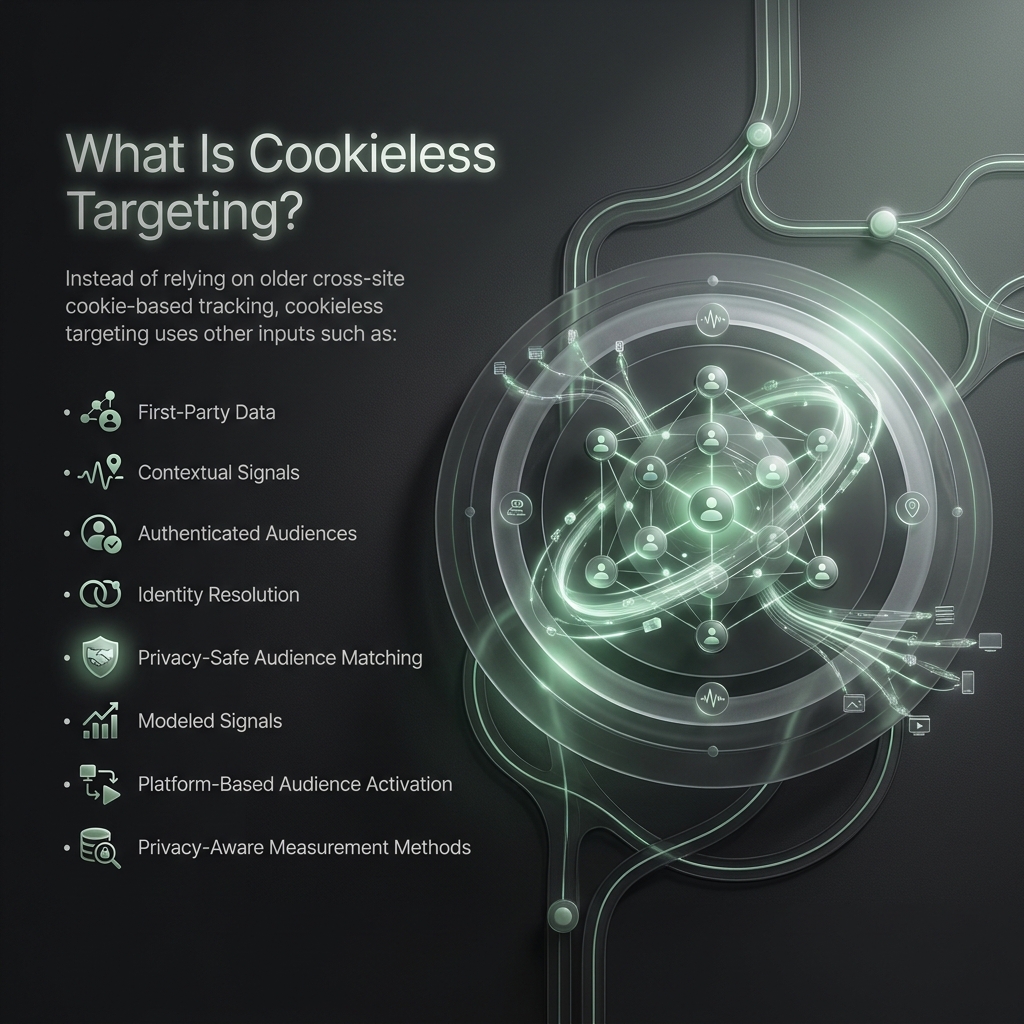
Cookieless targeting refers to digital advertising methods that do not depend on third-party cookies for audience targeting, activation, or measurement.
Instead of relying on older cross-site cookie-based tracking, cookieless targeting uses other inputs such as:
- first-party data
- contextual signals
- authenticated audiences
- identity resolution
- privacy-safe audience matching
- modeled signals
- platform-based audience activation
- privacy-aware measurement methods
This makes cookieless targeting a broader strategic shift, not just a technical change inside an ad platform.
Why Cookieless Targeting Matters
Cookieless targeting matters because advertisers still need audience strategy even as the rules, identifiers, and privacy standards continue to evolve. Businesses still need to find new customers, reach known audiences, suppress existing customers when needed, and measure campaign performance. The challenge is doing that with less reliance on broad cross-site tracking.
A strong cookieless targeting strategy can help support:
- more durable audience planning
- stronger first-party data use
- privacy-aware addressability
- better contextual relevance
- smarter programmatic activation
- cleaner data workflows
- stronger long-term media resilience
For Crosstide Media, cookieless targeting is valuable because it helps advertisers prepare for the future instead of building campaigns around signals that are becoming less reliable.

What Happened to Third-Party Cookies?
Third-party cookies were long used to support cross-site audience targeting, retargeting, attribution, and other advertising functions. Over time, the market began shifting because of consumer privacy expectations, browser restrictions, platform-level changes, and broader pressure for more privacy-aware advertising.

Why this matters
The practical point is simple: advertisers can no longer assume that older cookie-dependent tactics will remain the best foundation for long-term audience strategy. The market has already shifted toward more privacy-first methods, and brands that adapt more intelligently are in a stronger position over time.
How Cookieless Targeting Works
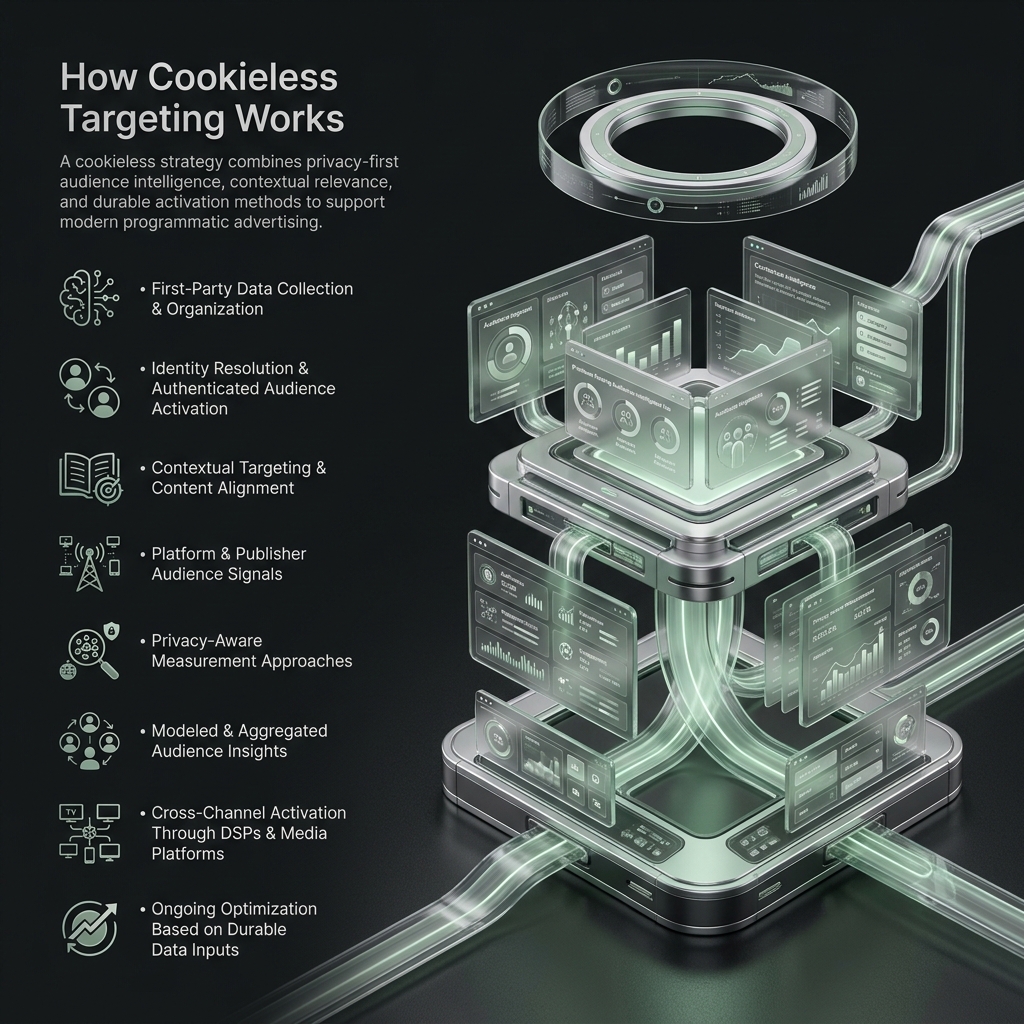
Cookieless targeting works by combining different forms of privacy-first audience intelligence rather than depending on a single identifier.
A cookieless strategy may include:
- first-party data collection and organization
- identity resolution or authenticated audience activation
- contextual targeting and content alignment
- platform or publisher-based audience signals
- privacy-aware measurement approaches
- modeled or aggregated audience insights
- cross-channel activation through DSPs and media platforms
- ongoing optimization based on durable data inputs
This means the cookieless future is not one replacement technology. It is a stack of strategies working together.
First-Party Data Strategy
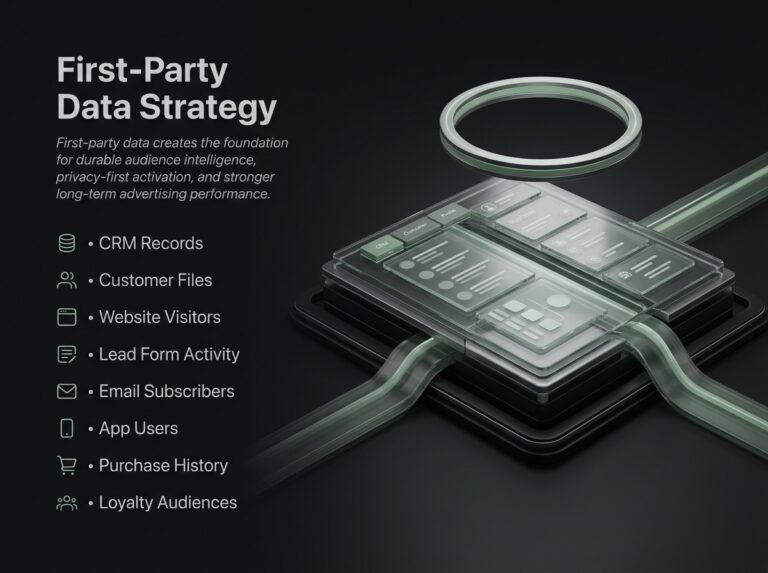
First-party data is one of the most important pillars of cookieless targeting because it comes directly from the advertiser’s own audience relationships. This can include:
- CRM records
- customer files
- website visitors
- lead form activity
- email subscribers
- app users
- purchase history
- loyalty audiences
Why first-party data matters
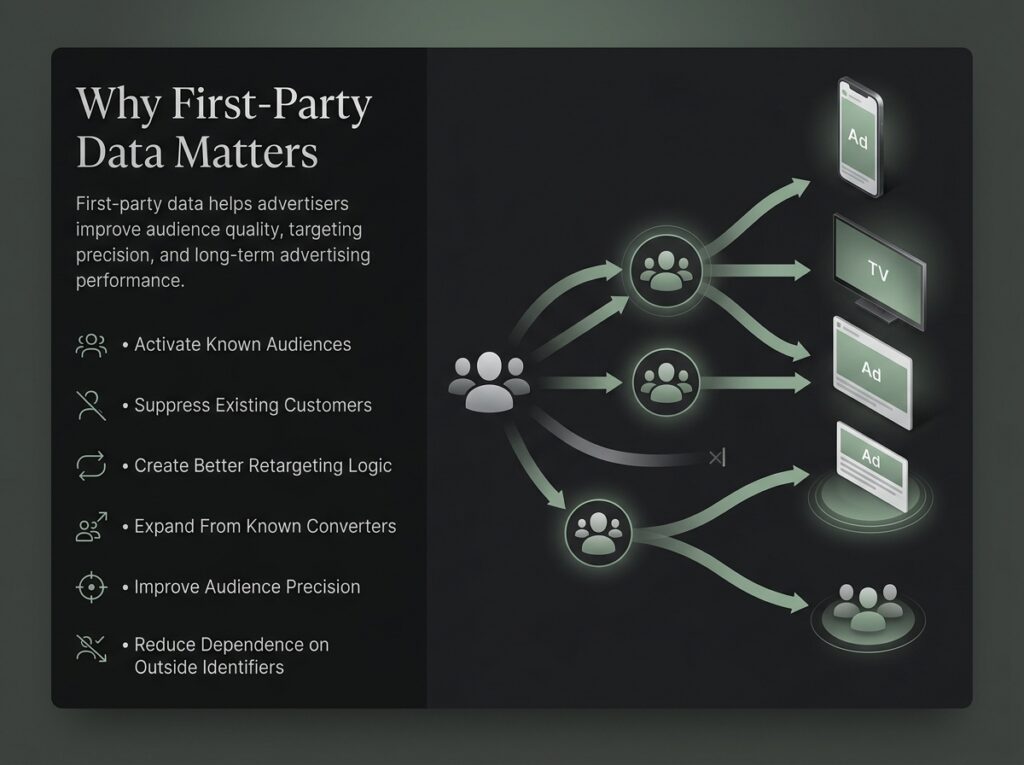
First-party data can help advertisers:
- activate known audiences
- suppress existing customers
- create better retargeting logic
- expand from known converters
- improve audience precision
- reduce dependence on outside identifiers
For Crosstide Media, first-party data is often the foundation of a stronger cookieless strategy because it connects media buying to real business data.
Why first-party data matters
First-party data can help advertisers:
- activate known audiences
- suppress existing customers
- create better retargeting logic
- expand from known converters
- improve audience precision
- reduce dependence on outside identifiers
For Crosstide Media, first-party data is often the foundation of a stronger cookieless strategy because it connects media buying to real business data.
Contextual Targeting
Contextual targeting places ads based on the content or environment where the ad appears rather than relying only on identity-based tracking. This has become increasingly important in privacy-first advertising because it allows brands to align with relevant content without depending on third-party cookies.
Contextual targeting can help support:
- topic-based placement strategy
- brand suitability
- content relevance
- publisher alignment
- privacy-aware prospecting
- stronger contextual message fit


Why contextual matters now
As identity signals become more limited in some environments, contextual targeting becomes more valuable. It is especially useful when advertisers want to reach relevant audiences based on what they are consuming in the moment rather than who they were tracked as across sites.
For Crosstide Media, contextual targeting is not a fallback. It is often a smart strategic layer in its own right.
Why contextual matters now
As identity signals become more limited in some environments, contextual targeting becomes more valuable. It is especially useful when advertisers want to reach relevant audiences based on what they are consuming in the moment rather than who they were tracked as across sites.
For Crosstide Media, contextual targeting is not a fallback. It is often a smart strategic layer in its own right.
Identity Resolution and Authenticated Audiences
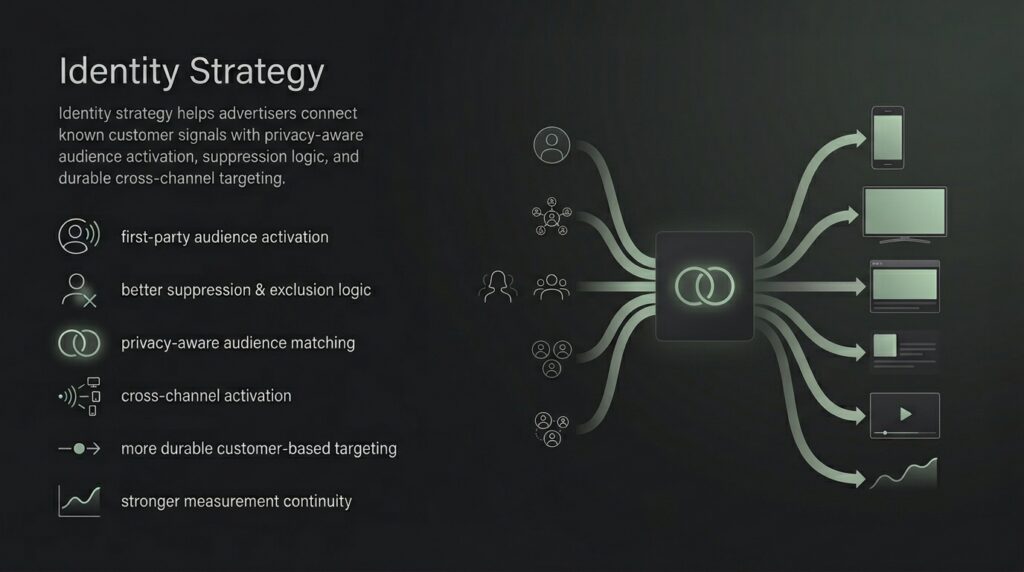
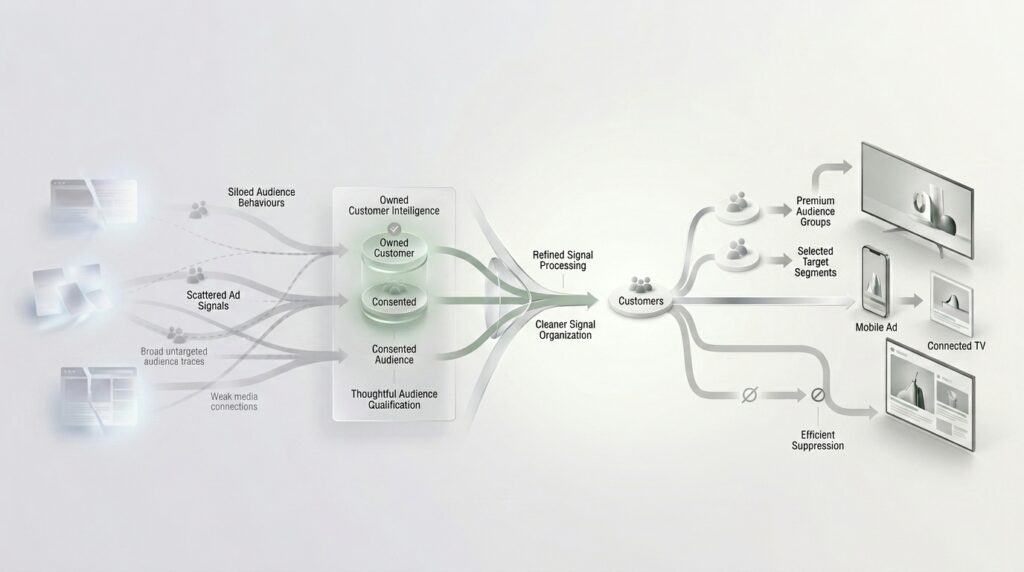
Identity resolution helps advertisers connect customer and audience signals across platforms, devices, and environments in a privacy-aware way. In a cookieless environment, this matters because raw first-party data is not enough on its own. It needs to be structured, resolved, and activated in ways that media platforms can use.
Authenticated audiences are also important because logged-in, consented, or otherwise authenticated user relationships can create more durable forms of addressability than traditional third-party cookies.
Identity strategy can help support
- first-party audience activation
- better suppression and exclusion logic
- privacy-aware audience matching
- cross-channel activation
- more durable customer-based targeting
- stronger measurement continuity
For Crosstide Media, identity strategy is most valuable when it helps make first-party data more usable across real campaign environments.
Privacy-First Addressability
One of the biggest themes in cookieless advertising is addressability. Advertisers still need ways to reach relevant audiences, but the methods now have to work within tighter privacy expectations and a more fragmented signal landscape.
Strong privacy-first addressability may include
- first-party data activation
- identity resolution
- contextual planning
- authenticated audience strategy
- platform-native audience tools
- modeled expansion from known audiences
- stronger publisher and platform relationships
- privacy-aware measurement frameworks
At Crosstide Media, cookieless targeting is really about building an addressability strategy that can last.
Retargeting in a Cookieless Environment
Retargeting still matters, but the way it works is evolving. In a cookieless environment, retargeting may rely more heavily on:
- first-party site visitor data
- authenticated audiences
- CRM onboarding
- publisher or platform audience relationships
- privacy-safe activation methods
- aggregated or modeled signals where appropriate
Why this is different
Older cookie-based retargeting often depended on broad cross-site tracking. Newer approaches depend more on owned data, consented relationships, or privacy-aware platform frameworks.
For Crosstide Media, this means retargeting strategy has to be more disciplined, more integrated with first-party data, and more thoughtful about where activation is actually possible.
Measurement Without Third-Party Cookies
Measurement is one of the biggest challenges in cookieless advertising. Advertisers still need to understand campaign performance, audience quality, and conversion outcomes, but they increasingly need to do so with more privacy-aware frameworks.
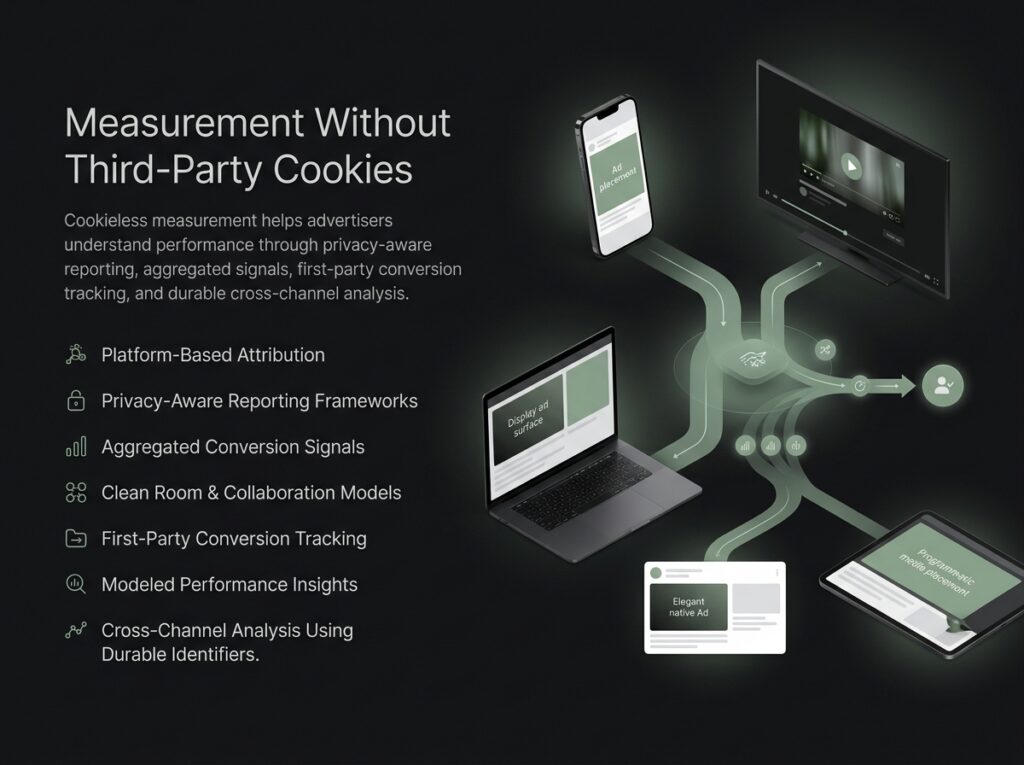
Cookieless measurement may include:
- platform-based attribution
- privacy-aware reporting frameworks
- aggregated conversion signals
- clean room or collaboration models
- first-party conversion tracking
- modeled performance insights
- cross-channel analysis using more durable identifiers
Cookieless measurement may include:
- platform-based attribution
- privacy-aware reporting frameworks
- aggregated conversion signals
- clean room or collaboration models
- first-party conversion tracking
- modeled performance insights
- cross-channel analysis using more durable identifiers
Why this matters
Measurement without third-party cookies requires better planning. It often demands stronger tagging, better first-party data discipline, more realistic attribution frameworks, and smarter interpretation of results.
For Crosstide Media, strong measurement strategy is what helps keep privacy-first targeting accountable and performance-oriented.

DSPs, SSPs, and Cookieless Activation
Cookieless targeting does not remove the need for DSPs, SSPs, and programmatic media. Instead, it changes how those systems use data.
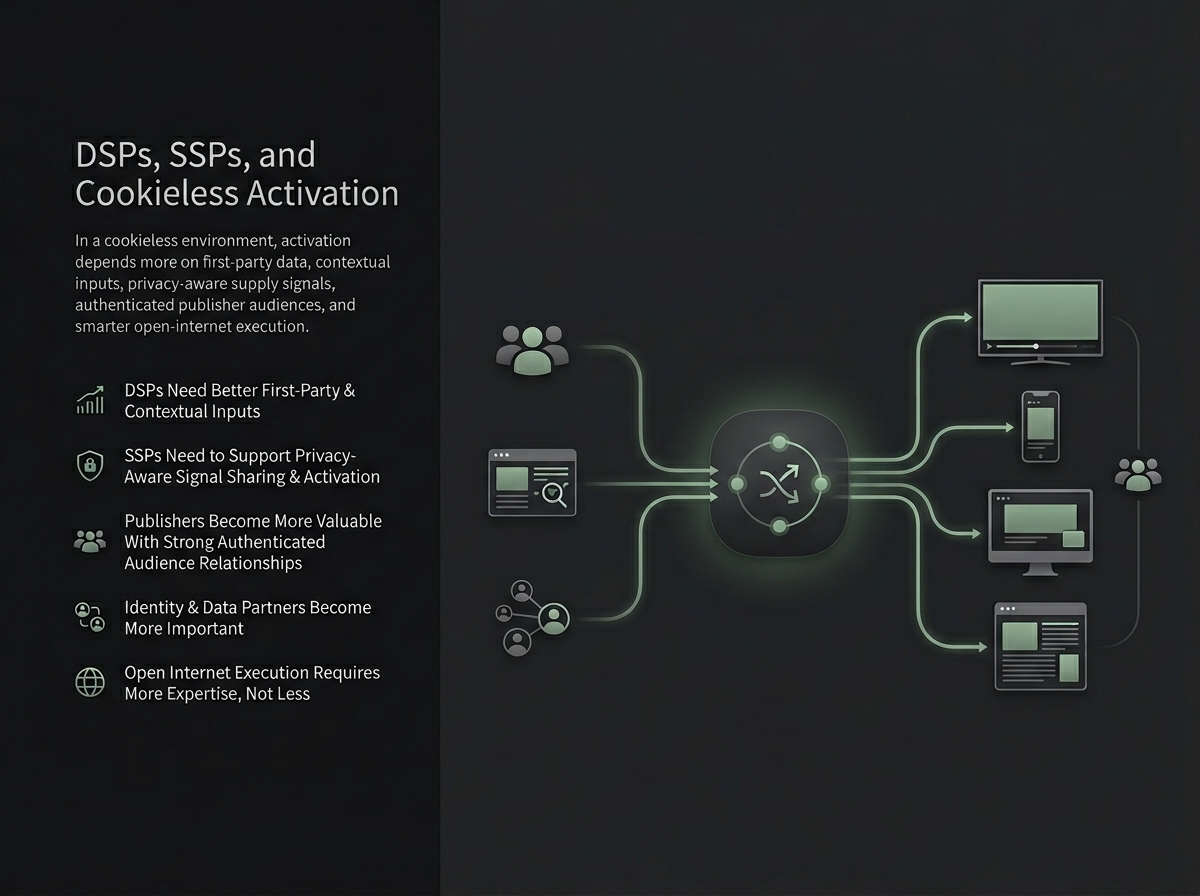
In a cookieless environment
- DSPs need better first-party and contextual inputs
- SSPs need to support privacy-aware signal sharing and activation
- publishers become more valuable when they have strong authenticated audience relationships
- identity and data partners become more important
- open internet execution requires more expertise, not less
For Crosstide Media, this is one of the biggest reasons cookieless strategy needs experienced programmatic planning. The media infrastructure still matters, but the signal mix has changed.
In a cookieless environment
- DSPs need better first-party and contextual inputs
- SSPs need to support privacy-aware signal sharing and activation
- publishers become more valuable when they have strong authenticated audience relationships
- identity and data partners become more important
- open internet execution requires more expertise, not less
For Crosstide Media, this is one of the biggest reasons cookieless strategy needs experienced programmatic planning. The media infrastructure still matters, but the signal mix has changed.
LiveRamp and First-Party Data Activation
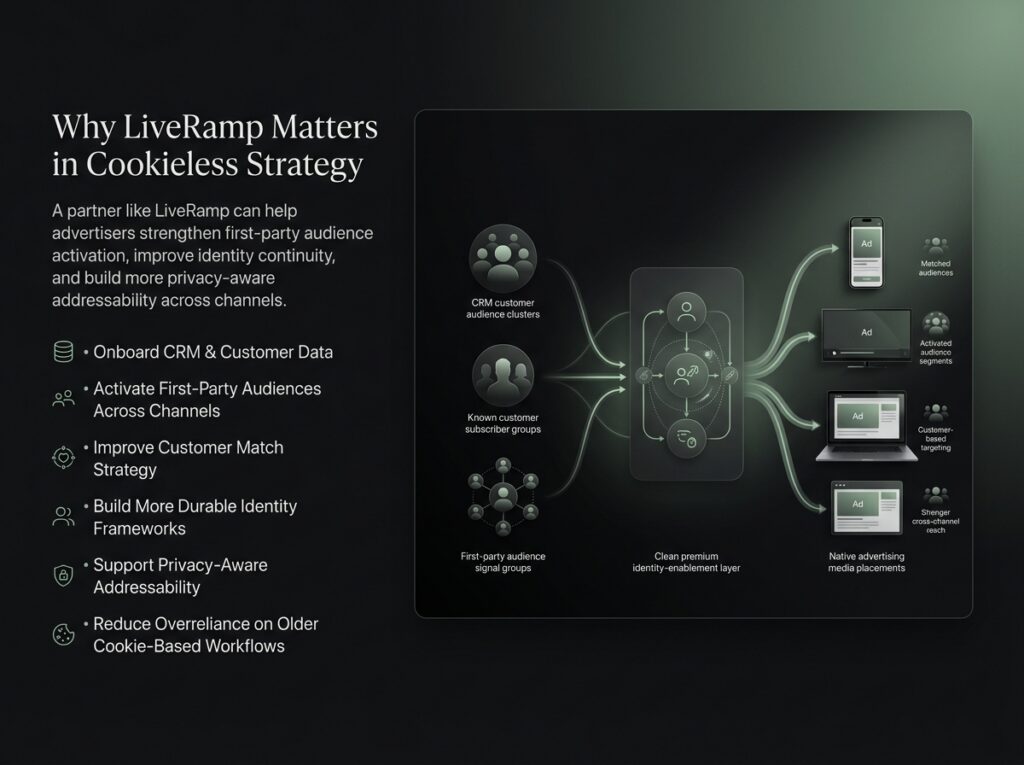
LiveRamp is one of the most recognized names in first-party data activation and identity strategy. It is often relevant when advertisers want to turn owned customer data into usable media audiences across multiple platforms and environments.
Why LiveRamp matters in cookieless strategy
A partner like LiveRamp can help advertisers:
- onboard CRM and customer data
- activate first-party audiences across channels
- improve customer match strategy
- build more durable identity frameworks
- support privacy-aware addressability
- reduce overreliance on older cookie-based workflows
For Crosstide Media, a partner like LiveRamp becomes especially valuable when a client has meaningful first-party data and wants to turn it into real media advantage.
Addressability, Privacy, and Programmatic Strategy
The cookieless future is often described in terms of addressability. That word matters because advertisers still need ways to reach audiences with relevance, even as privacy rules evolve.
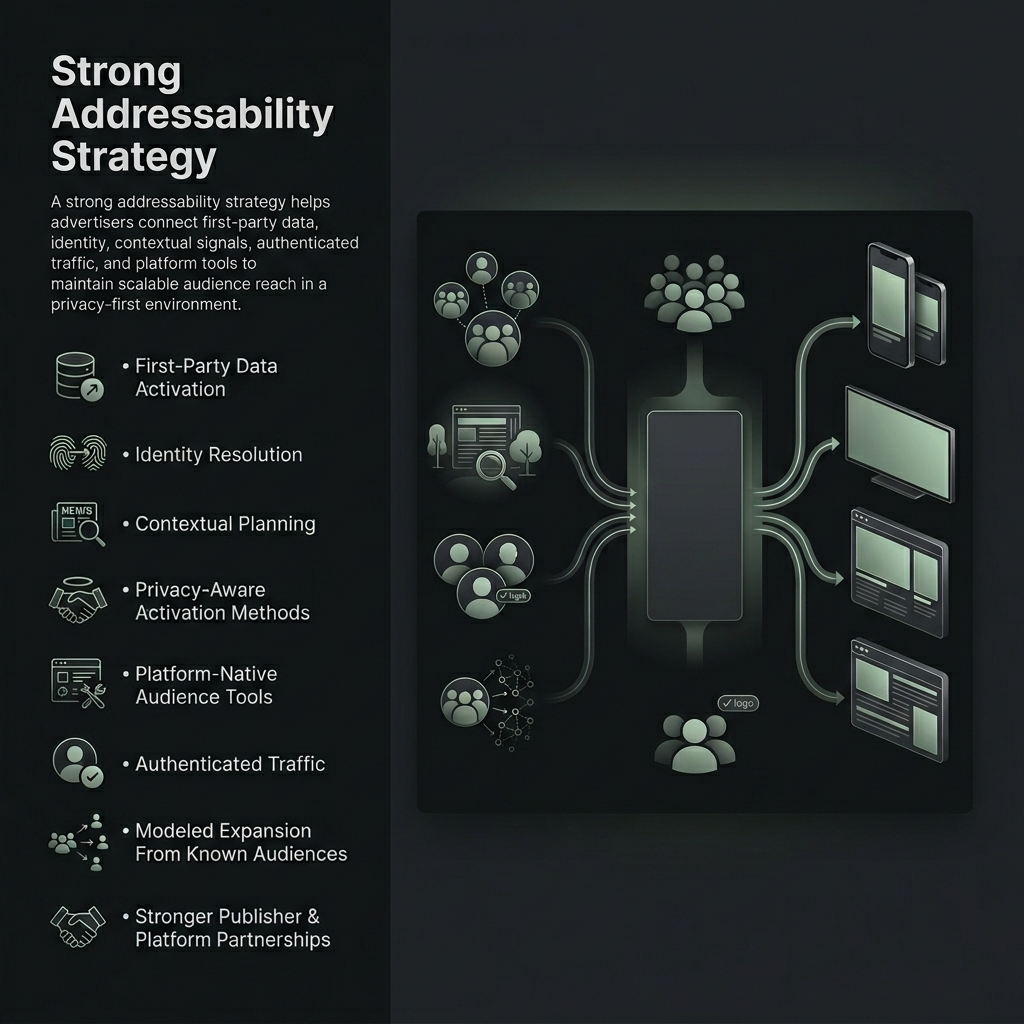
Strong addressability strategy may include
- first-party data activation
- identity resolution
- contextual planning
- privacy-aware activation methods
- platform-native audience tools
- authenticated traffic
- modeled expansion from known audiences
- stronger publisher and platform partnerships
At Crosstide Media, cookieless targeting is not about chasing one trend or one acronym. It is about building a programmatic strategy that can continue working as the market changes.
Strong addressability strategy may include
- first-party data activation
- identity resolution
- contextual planning
- privacy-aware activation methods
- platform-native audience tools
- authenticated traffic
- modeled expansion from known audiences
- stronger publisher and platform partnerships
At Crosstide Media, cookieless targeting is not about chasing one trend or one acronym. It is about building a programmatic strategy that can continue working as the market changes.
Why Cookieless Targeting Is Difficult
Cookieless targeting is powerful, but it is not simple. That is one of the most important things to understand.
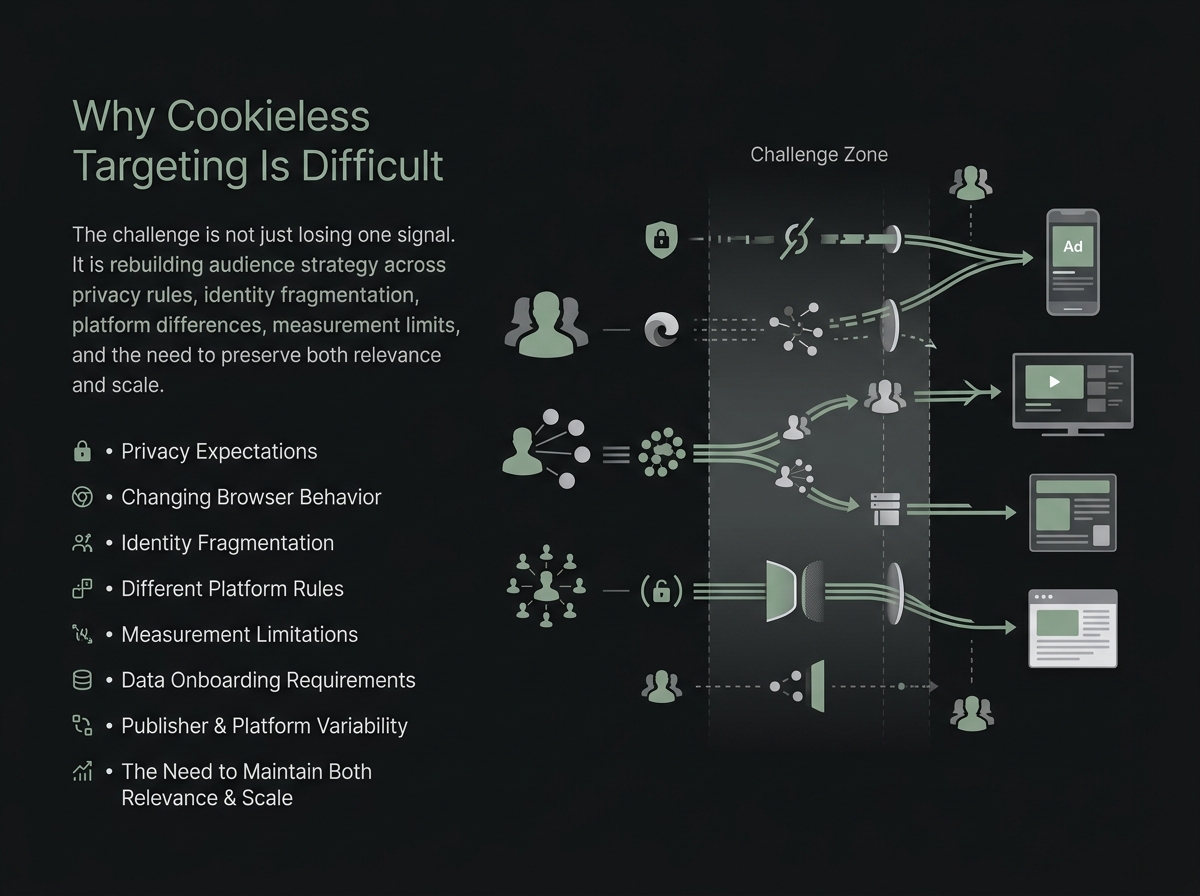
The challenge is not just losing one signal. The challenge is rebuilding audience strategy across:
- privacy expectations
- changing browser behavior
- identity fragmentation
- different platform rules
- measurement limitations
- data onboarding requirements
- publisher and platform variability
- the need to maintain both relevance and scale
The challenge is not just losing one signal. The challenge is rebuilding audience strategy across:
- privacy expectations
- changing browser behavior
- identity fragmentation
- different platform rules
- measurement limitations
- data onboarding requirements
- publisher and platform variability
- the need to maintain both relevance and scale
Why expertise matters
Without experience, it is easy to:
- overstate what is still targetable
- underuse first-party data
- misapply contextual strategy
- build weak identity workflows
- lose scale through over-restriction
- misunderstand privacy-aware measurement
- rely too heavily on one platform solution
- create campaigns that sound advanced but are operationally weak
For Crosstide Media, this is exactly where premium media knowledge matters. Strong cookieless strategy is not about buzzwords. It is about making privacy-first audience targeting actually work.

Why Work With Crosstide Media?
Effective cookieless targeting requires more than replacing one tactic with another. It takes first-party data strategy, identity planning, contextual intelligence, addressability frameworks, measurement discipline, and real programmatic expertise.
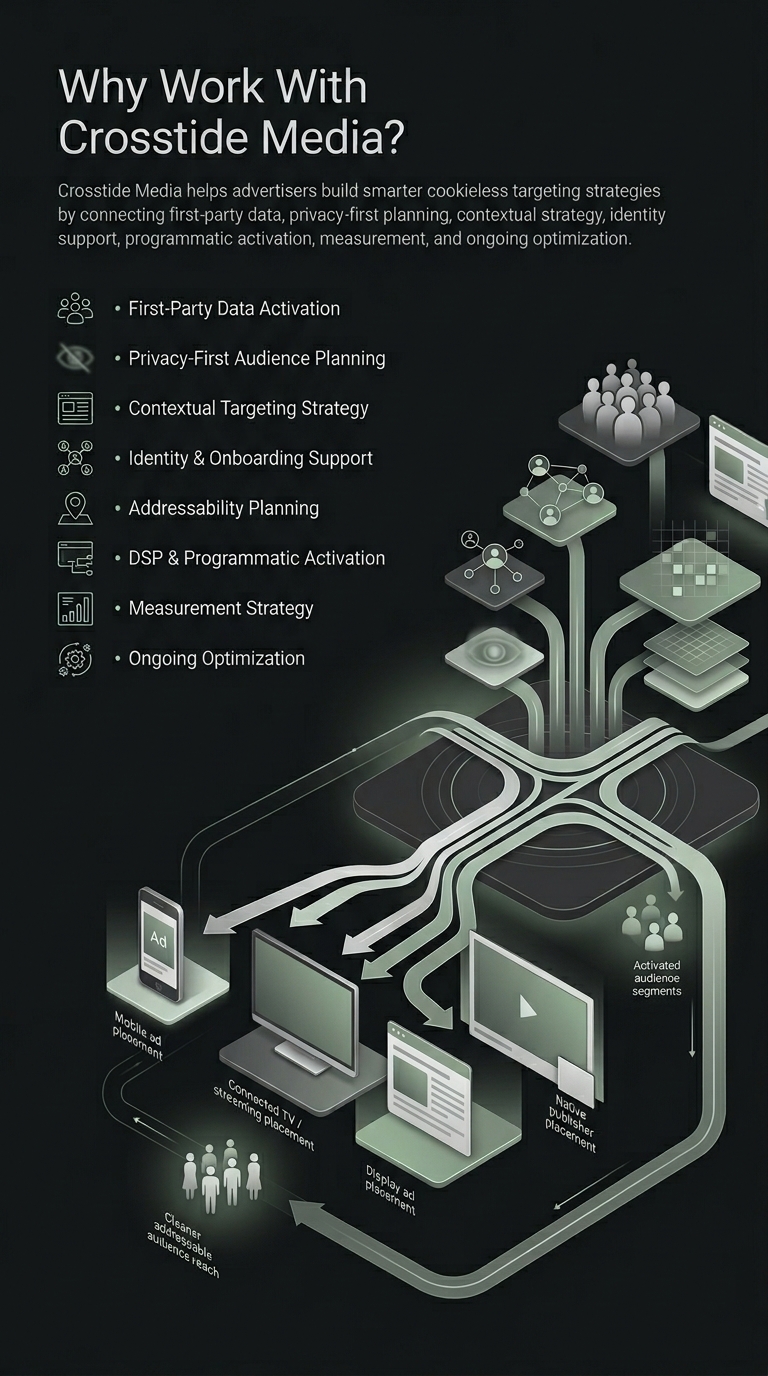
Crosstide Media helps advertisers build cookieless targeting strategies with:
- first-party data activation
- privacy-first audience planning
- contextual targeting strategy
- identity and onboarding support
- addressability planning
- DSP and programmatic activation
- measurement strategy
- ongoing optimization
We approach cookieless targeting as a long-term strategic transition, not just a technical adjustment. Our focus is on helping advertisers preserve audience relevance, reduce dependence on unstable signals, and create stronger programmatic performance in a privacy-first market.
Whether the goal is better first-party activation, stronger contextual reach, smarter retargeting, or more durable programmatic strategy, Crosstide Media helps brands build cookieless targeting systems with the structure and expertise required for long-term success.
Why Work With Crosstide Media?
Effective cookieless targeting requires more than replacing one tactic with another. It takes first-party data strategy, identity planning, contextual intelligence, addressability frameworks, measurement discipline, and real programmatic expertise.
Crosstide Media helps advertisers build cookieless targeting strategies with:
- first-party data activation
- privacy-first audience planning
- contextual targeting strategy
- identity and onboarding support
- addressability planning
- DSP and programmatic activation
- measurement strategy
- ongoing optimization
We approach cookieless targeting as a long-term strategic transition, not just a technical adjustment. Our focus is on helping advertisers preserve audience relevance, reduce dependence on unstable signals, and create stronger programmatic performance in a privacy-first market.
Whether the goal is better first-party activation, stronger contextual reach, smarter retargeting, or more durable programmatic strategy, Crosstide Media helps brands build cookieless targeting systems with the structure and expertise required for long-term success.
Frequently Asked Questions
What is cookieless targeting?
Why is cookieless targeting important?
What is the difference between first-party data and third-party cookies?
Can you still retarget without third-party cookies?
What is contextual targeting?
Why is LiveRamp important in cookieless targeting?
Is cookieless targeting only about contextual advertising?
Is cookieless targeting harder than older audience targeting methods?
Why work with a cookieless targeting partner?
Build a Smarter Cookieless Targeting Strategy
If your business needs a more durable, privacy-first audience strategy, Crosstide Media can help you plan, activate, and optimize cookieless targeting built around stronger first-party data use, smarter contextual planning, better identity activation, and clearer measurement. Whether your goal is to reduce dependence on third-party cookies, improve addressability, strengthen retargeting, or build a more future-ready programmatic strategy, we help brands use cookieless targeting in a smarter, more results-focused way.
Why Brands Choose Crosstide Media
Brands choose Crosstide Media because cookieless targeting requires more than surface-level privacy messaging. Strong results come from the right mix of first-party data activation, contextual strategy, identity planning, measurement discipline, and real programmatic expertise. Our approach is built to help advertisers improve durability, preserve audience relevance, reduce wasted spend, and make better decisions through stronger privacy-first media strategy.
Talk to Crosstide Media About Cookieless Targeting
If you are looking for a partner that can help you navigate cookieless targeting, activate first-party data, and build a stronger privacy-first programmatic strategy, Crosstide Media can help. We build cookieless targeting strategies with the planning, platform knowledge, audience discipline, and optimization focus needed to support stronger long-term performance.