
Programmatic video Advertising
Programmatic Video Advertising
The Definitive Guide to Digital Video Media Buying, Cross-Screen Inventory, Targeting, Creative Specs, Measurement & Pricing Strategy
Programmatic video advertising gives brands the ability to run video campaigns across premium digital environments using automated media buying, audience targeting, real-time optimization, and measurable reporting. Instead of buying placements manually one publisher at a time, advertisers can use programmatic infrastructure to access video inventory across mobile, desktop, apps, streaming environments, and other premium publisher ecosystems.
Today, programmatic video is no longer limited to upper-funnel awareness. It is used across the full funnel to support reach, consideration, website traffic, lead generation, conversion efficiency, and revenue growth depending on campaign design, targeting strategy, and attribution setup.
At Crosstide Media, we help brands build measurable programmatic video campaigns designed to reach the right audience, deliver high-quality creative across screens, and drive performance with smarter targeting, cleaner supply, and more actionable reporting.

Jump To
What Is Programmatic Video Advertising?
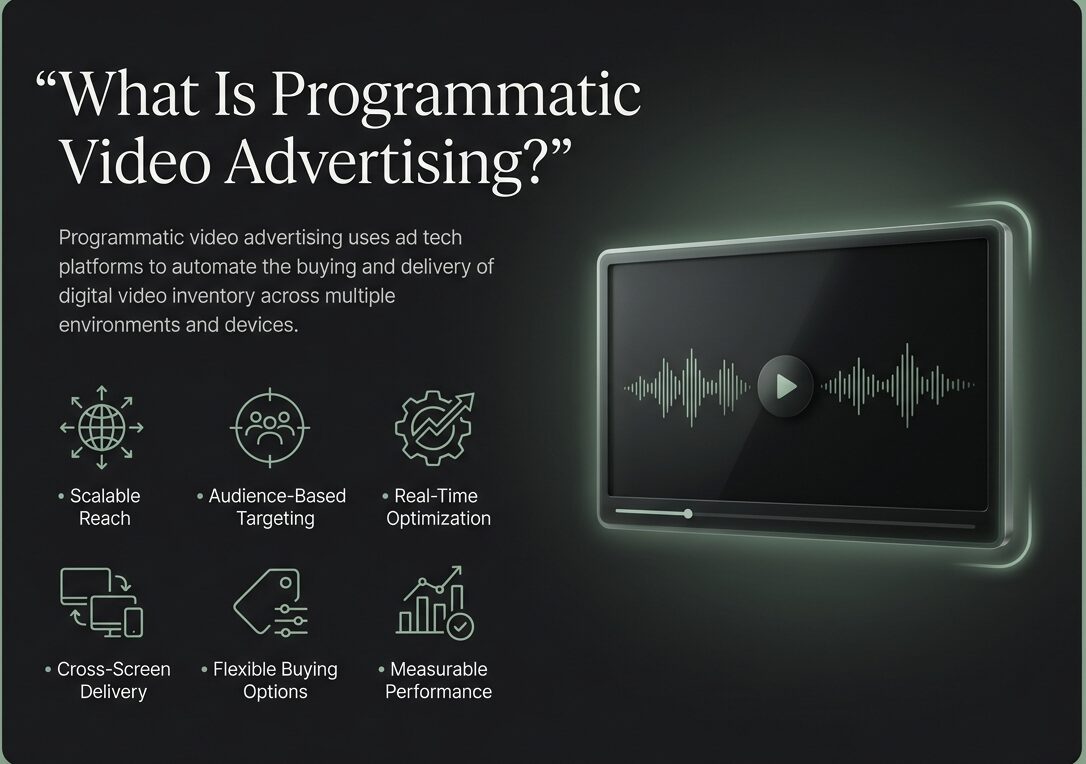
Programmatic video advertising refers to the automated buying and delivery of digital video ad inventory through ad tech platforms rather than manual direct buying. Campaigns can run across websites, apps, mobile devices, desktop environments, streaming video placements, and premium publisher ecosystems depending on the media strategy.
For advertisers, the core value of programmatic video lies in the combination of:
- Scalable reach
- Audience-based targeting
- Real-time optimization
- Cross-screen delivery
- Flexible buying options
- More measurable performance than traditional manual placement buying alone
Programmatic video allows brands to combine storytelling and visual impact with modern digital planning, audience intelligence, and campaign optimization.
Why Programmatic Video Matters
Video remains one of the most effective formats for combining brand storytelling, product education, visual persuasion, and measurable media execution.
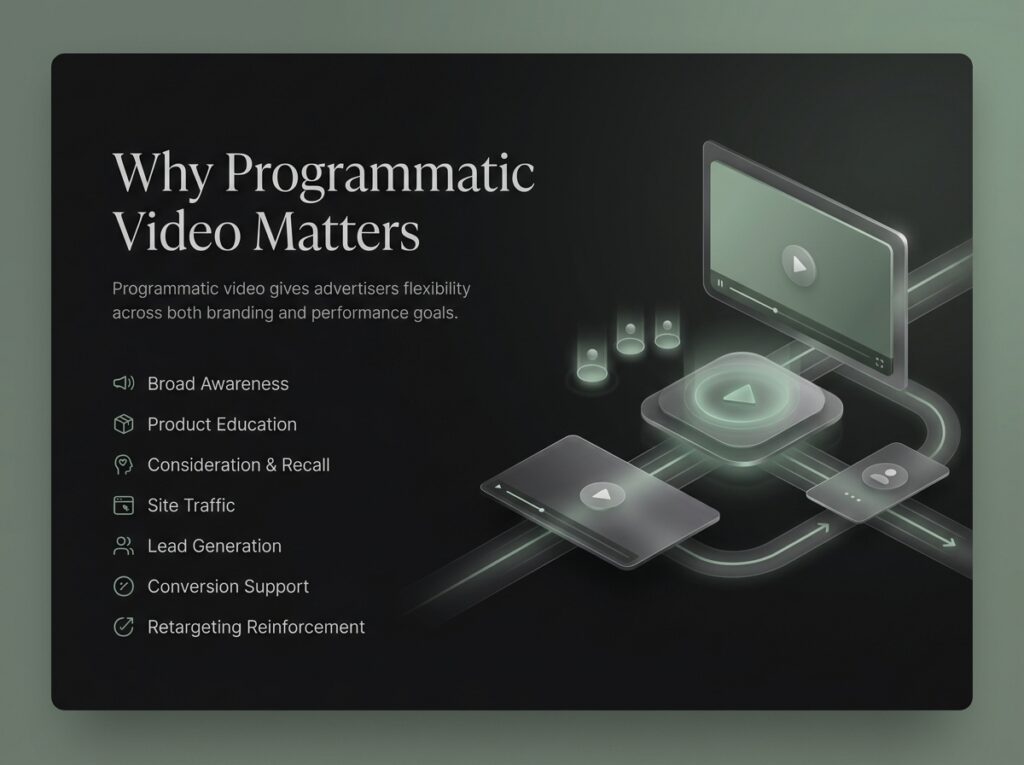
Programmatic video matters because it gives advertisers flexibility across both branding and performance goals. A campaign can be structured to support:
- Broad awareness
- Product education
- Consideration and recall
- Site traffic
- Lead generation
- Conversion support
- Retargeting reinforcement
Why advertisers use programmatic video
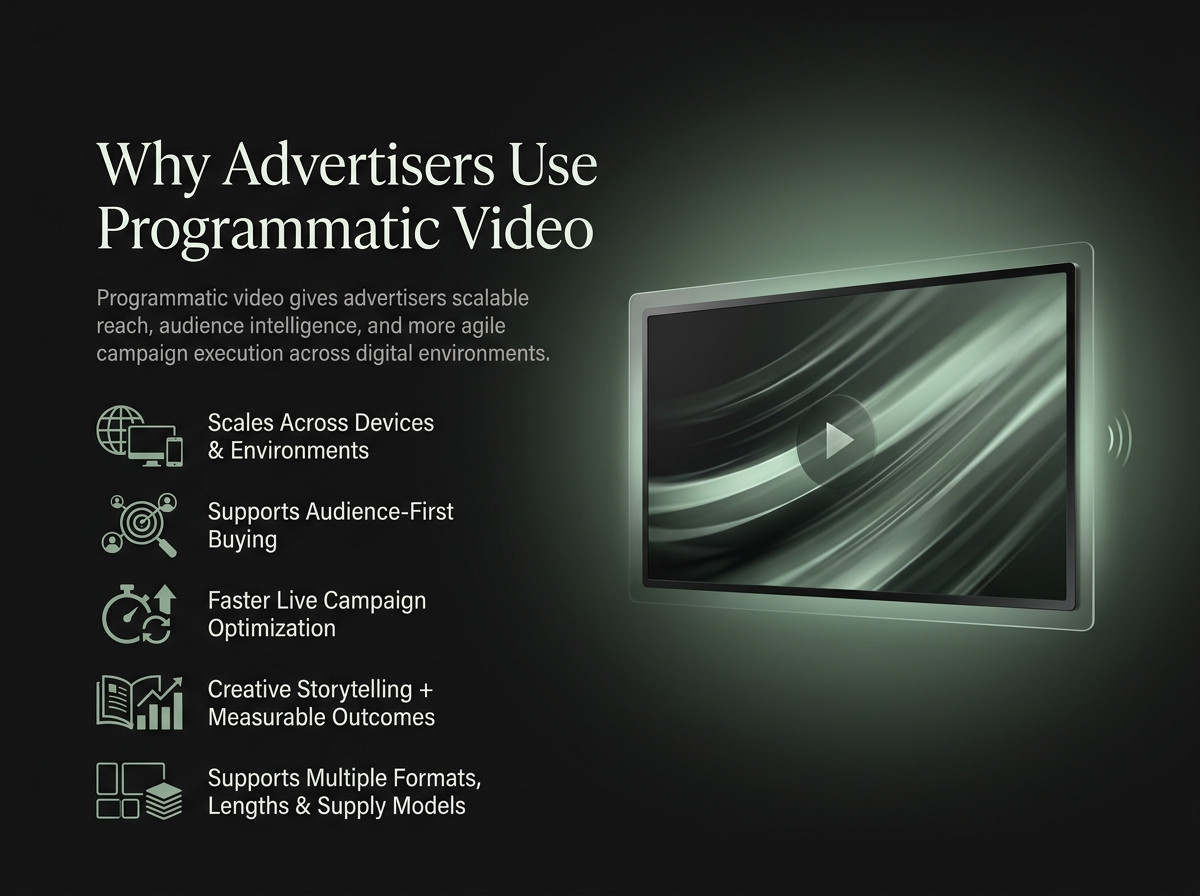
- It can scale across devices and environments
- It supports audience-first buying instead of only placement-first buying
- It allows faster optimization while campaigns are live
- It can connect creative storytelling with measurable downstream behavior
- It supports multiple video formats, lengths, and supply models
For Crosstide Media, programmatic video is valuable because it bridges premium creative delivery with strategic audience targeting and measurable campaign performance.
Why advertisers use programmatic video
- It can scale across devices and environments
- It supports audience-first buying instead of only placement-first buying
- It allows faster optimization while campaigns are live
- It can connect creative storytelling with measurable downstream behavior
- It supports multiple video formats, lengths, and supply models
For Crosstide Media, programmatic video is valuable because it bridges premium creative delivery with strategic audience targeting and measurable campaign performance.
How Programmatic Video Buying Works
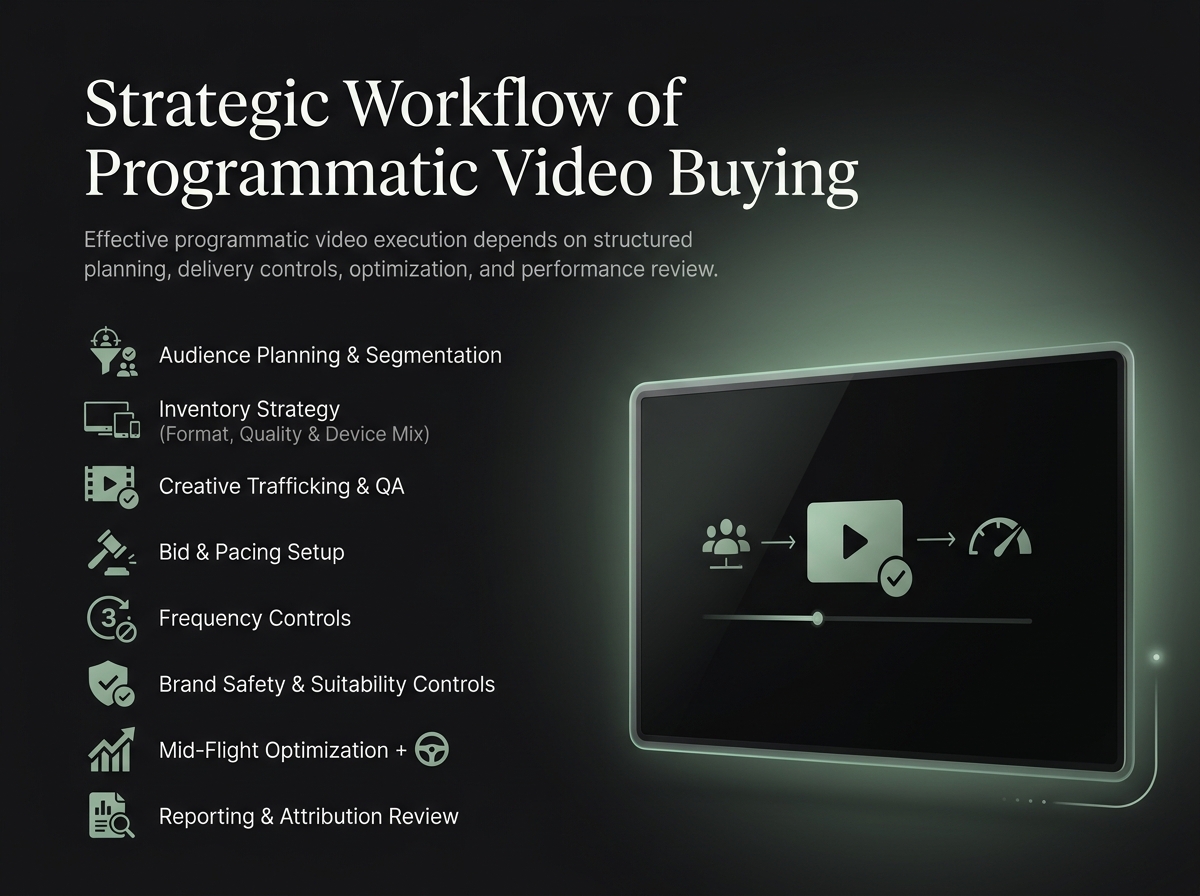
Programmatic video buying is executed through digital media buying platforms that connect advertisers with video inventory made available by publishers, apps, exchanges, and private marketplaces. Campaigns are typically structured around audience targets, inventory preferences, bidding rules, budgets, pacing controls, and approved creative assets.
Strategic Workflow of Programmatic Video Buying
- Audience planning and segmentation
- Inventory strategy by format, publisher quality, and device mix
- Creative trafficking and QA
- Bid and pacing setup
- Frequency controls
- Brand safety and suitability controls
- Mid-flight optimization
- Reporting and attribution review
Why Programmatic Video Buying Matters
Programmatic buying gives advertisers more control over:
- Who sees the ad
- Where the ad runs
- How often it appears
- Which audiences or placements perform best
- How spend shifts while the campaign is live
That makes programmatic video more adaptable than traditional fixed-placement video buying, especially for advertisers who want tighter optimization, cleaner reporting, and better control across multiple environments.
Programmatic Video for Full-Funnel Strategy
Programmatic video is most effective when it is not treated as an isolated awareness tactic. The strongest campaigns often combine upper-funnel reach with mid-funnel reinforcement and lower-funnel retargeting. That structure helps advertisers use video to create stronger audience memory while still supporting site traffic, lead generation, and measurable action.
Programmatic Video Formats & Inventory Types
Programmatic video can run across several major format types, each with different strengths, costs, and use cases.

In-Stream Video
In-stream video ads run before, during, or after video content. These are commonly described as:
- Pre-roll
- Mid-roll
- Post-roll
In-stream video typically appears in a more controlled content environment and is often favored for stronger viewer attention, cleaner context, and higher completion behavior.
Out-Stream Video
Out-stream video ads appear outside traditional video players, often within article pages, feeds, or app environments. They can expand reach efficiently, though viewer behavior and context can differ from in-stream placements.
Programmatic video may run across:
- Mobile
- Desktop
- Tablet
- App inventory
- Streaming inventory
- Large-screen video environments when included in the media mix
Campaigns may also vary by:
- Browser vs app delivery
- Sound-on vs sound-off behavior
- Autoplay behavior
- Viewability dynamics
- Publisher quality tier
- Premium marketplace vs open-market sourcing
The right format mix depends on campaign goals, brand standards, audience behavior, and the performance expectations of each stage in the funnel.
Premium Video Inventory & Supply Strategy
Inventory quality matters in programmatic video because not all impressions deliver the same value. Two campaigns with similar CPMs can perform very differently depending on publisher quality, placement context, supply path, and audience alignment.
Common Supply Types
Programmatic video campaigns may source inventory through:
- Premium publisher relationships
- Private marketplaces
- Programmatic guaranteed deals
- Preferred deals
- Selective open-market buying


Why Premium Supply Matters
Higher-quality inventory can provide:
- Stronger viewer attention
- Better contextual alignment
- Improved brand safety
- Lower fraud exposure
- Better completion behavior
- More reliable campaign consistency
Why Premium Supply Matters
Higher-quality inventory can provide:
- Stronger viewer attention
- Better contextual alignment
- Improved brand safety
- Lower fraud exposure
- Better completion behavior
- More reliable campaign consistency

Supply Path Strategy
A strong supply strategy should focus on:
- Publisher quality
- Placement transparency
- Lower-friction supply paths
- Better cost control
- Lower exposure to low-quality resold inventory
- Performance consistency across environments
For Crosstide Media, supply quality is not just a brand-safety issue. It is also a performance issue.

Advanced Video Targeting Strategy
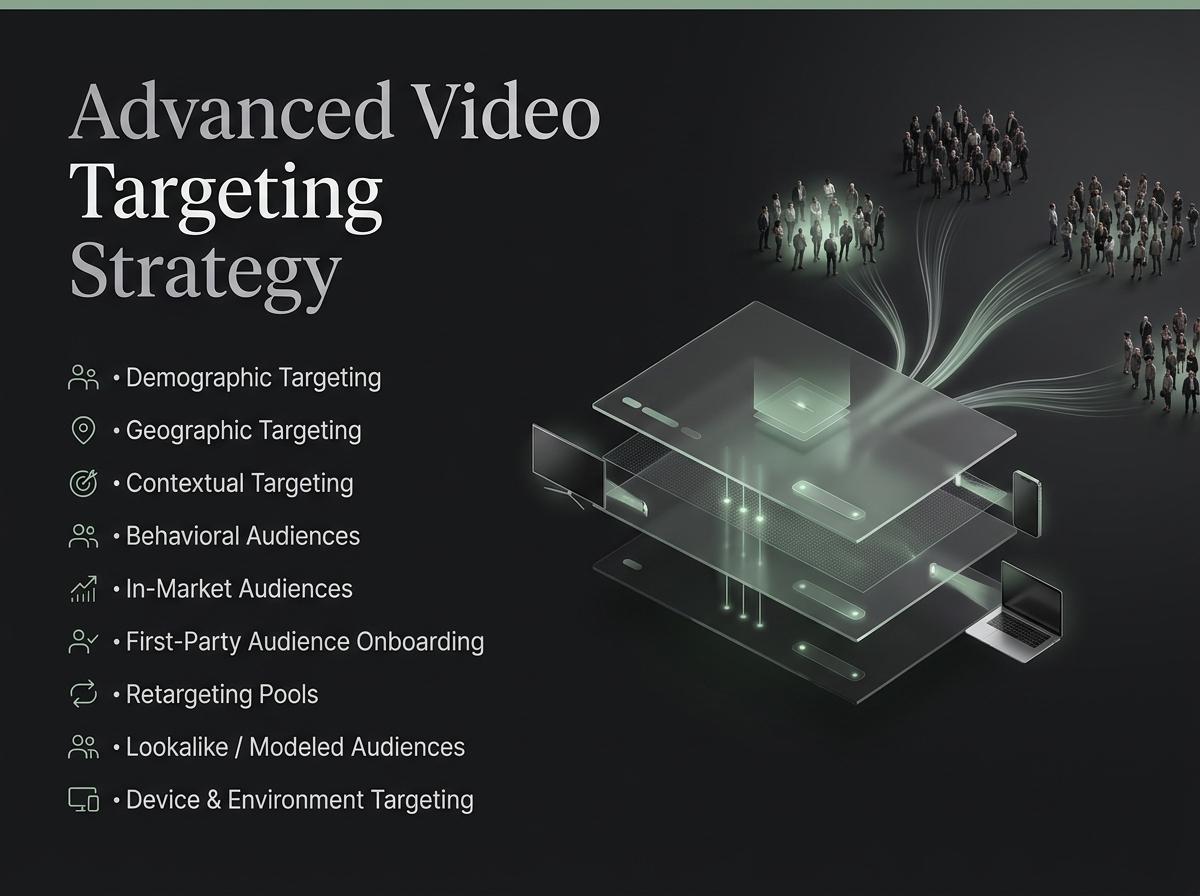
Programmatic video campaigns can be built around a mix of audience, contextual, geographic, and first-party signals.
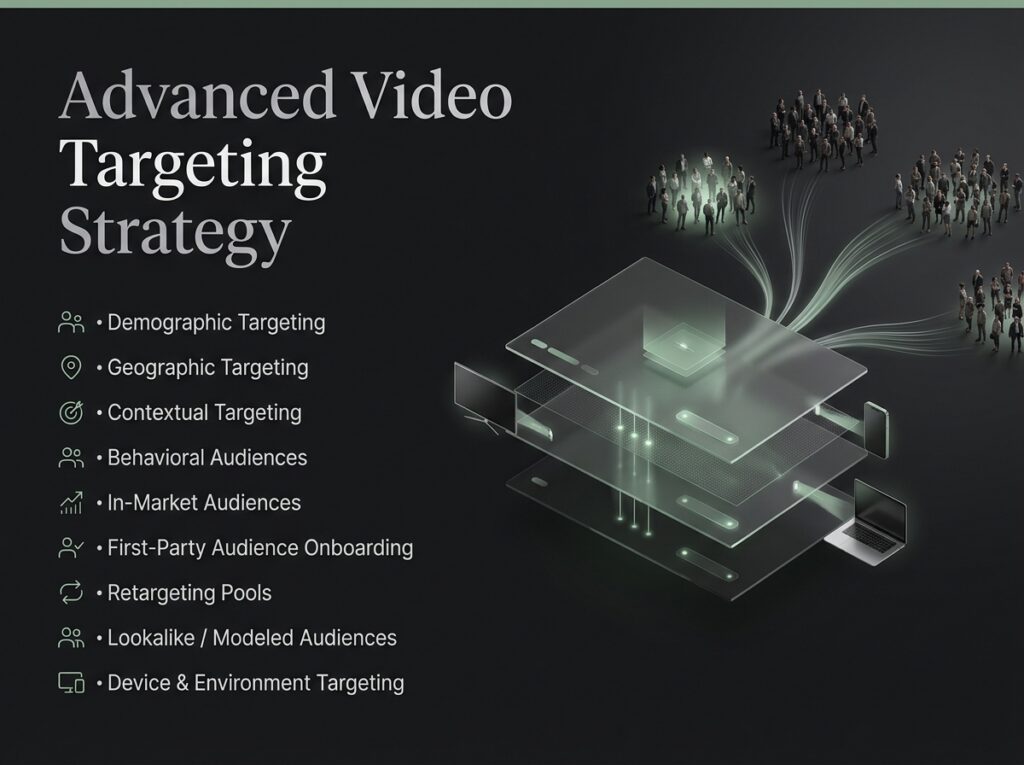
Common Targeting Layers
- Demographic targeting
- Geographic targeting
- Contextual targeting
- Behavioral audiences
- In-market audiences
- First-party audience onboarding
- Retargeting pools
- Lookalike or modeled audiences
- Device and environment targeting
Common Targeting Layers
- Demographic targeting
- Geographic targeting
- Contextual targeting
- Behavioral audiences
- In-market audiences
- First-party audience onboarding
- Retargeting pools
- Lookalike or modeled audiences
- Device and environment targeting
Audience-Based Buying
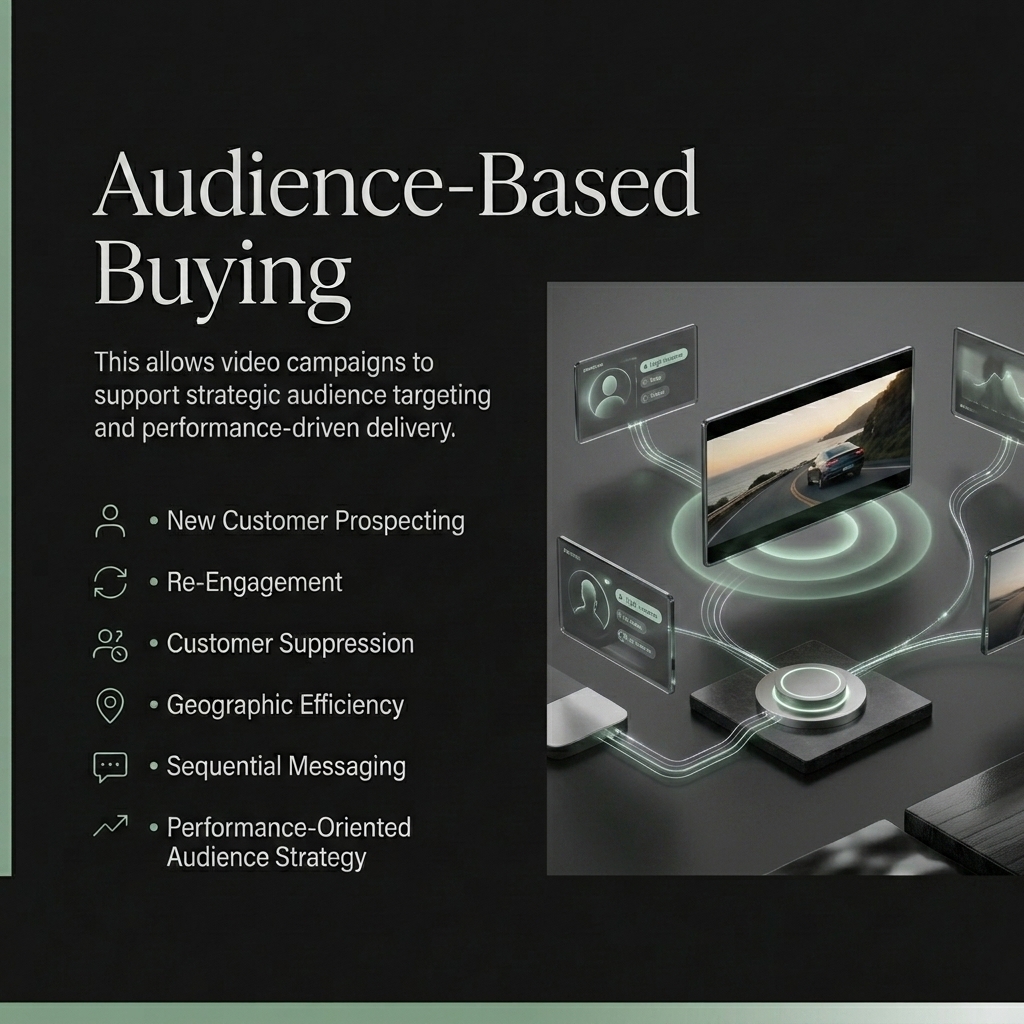
One of the most valuable advantages of programmatic video is the shift from placement-first buying to audience-based buying. Instead of simply choosing sites or apps, advertisers can structure campaigns around the people most likely to matter to the business.
This allows video campaigns to support:
- New customer prospecting
- Re-engagement
- Customer suppression
- Geographic efficiency
- Sequential messaging
- Performance-oriented audience strategy
First-Party Data Strategy
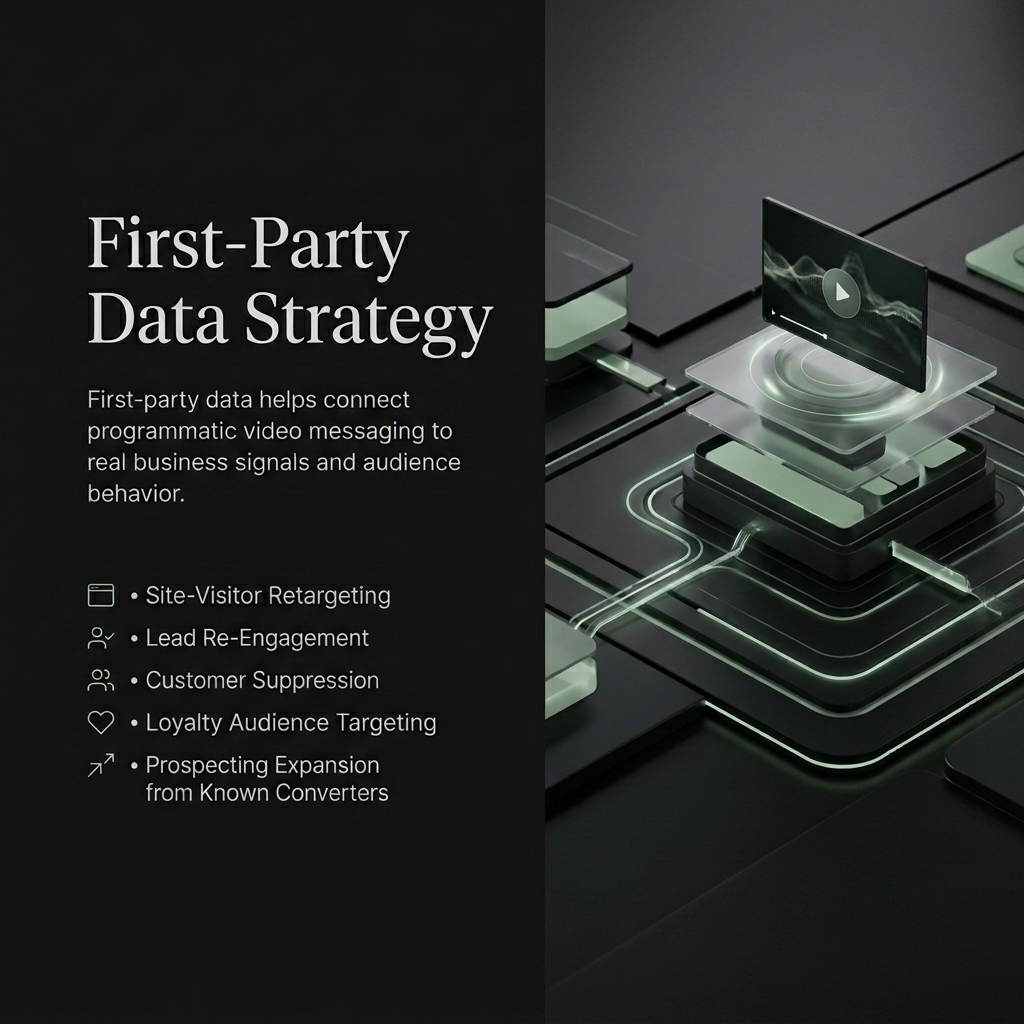
First-party data can be especially valuable in programmatic video because it helps connect creative messaging to real business signals. Depending on campaign objectives, it may support:
- Site-visitor retargeting
- Lead re-engagement
- Customer suppression
- Loyalty audience targeting
- Prospecting expansion from known converters
For Crosstide Media, first-party data should be used strategically based on whether the campaign objective is awareness, acquisition, re-engagement, or efficiency.
First-Party Data Strategy
First-party data can be especially valuable in programmatic video because it helps connect creative messaging to real business signals. Depending on campaign objectives, it may support:
- Site-visitor retargeting
- Lead re-engagement
- Customer suppression
- Loyalty audience targeting
- Prospecting expansion from known converters
For Crosstide Media, first-party data should be used strategically based on whether the campaign objective is awareness, acquisition, re-engagement, or efficiency.

Geographic targeting
Geographic precision may include:
- Country
- State
- DMA
- City
- ZIP code
- Radius targeting
- Lat/long geofencing depending on setup
Targeting best practices
The strongest video campaigns usually avoid over-layering every possible signal. Overly narrow targeting can increase CPM pressure and reduce scale. A stronger structure is to prioritize the highest-value audiences, segment by intent, and optimize using actual performance data rather than assumptions alone.

Creative Strategy & Video Ad Specifications
Creative quality is one of the biggest performance variables in programmatic video because the ad has to work across multiple environments, screen sizes, and levels of viewer attention.
Why Creative Matters in Programmatic Video
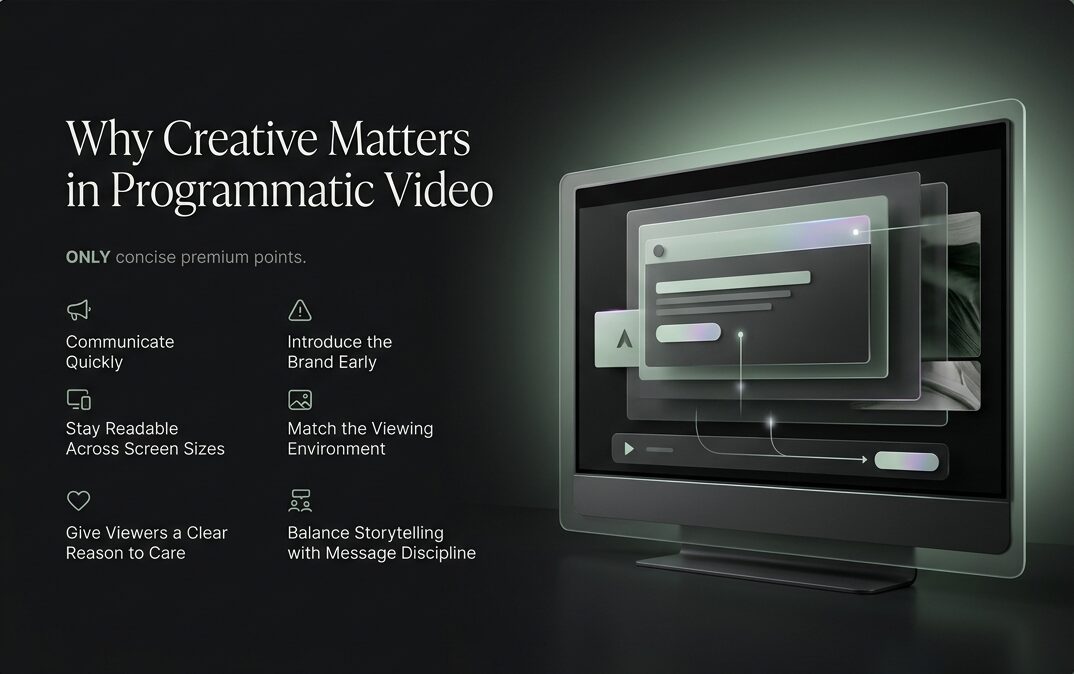
Strong video creative should:
- Communicate quickly
- Introduce the brand early
- Stay readable on smaller and larger screens
- Match the environment it is running in
- Give the viewer a clear reason to care
- Balance storytelling with message discipline
Why Creative Matters in Programmatic Video
Strong video creative should:
- Communicate quickly
- Introduce the brand early
- Stay readable on smaller and larger screens
- Match the environment it is running in
- Give the viewer a clear reason to care
- Balance storytelling with message discipline
Performance-Oriented Creative Strategy
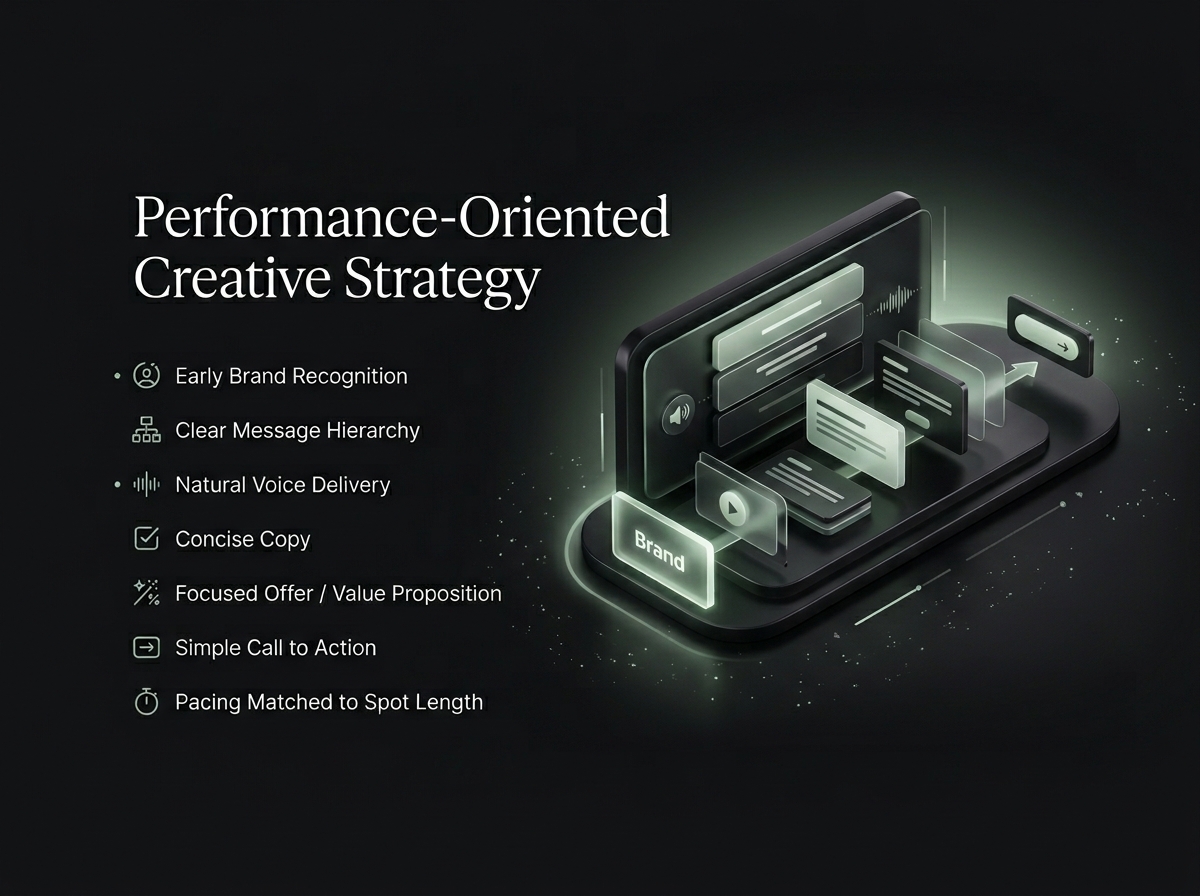
The strongest programmatic video creative usually includes:
- Early brand recognition
- Clear message hierarchy
- Natural voice delivery
- Concise copy
- A focused offer or value proposition
- A simple call to action
- Pacing that matches the spot length
Front-Loaded Messaging Strategy
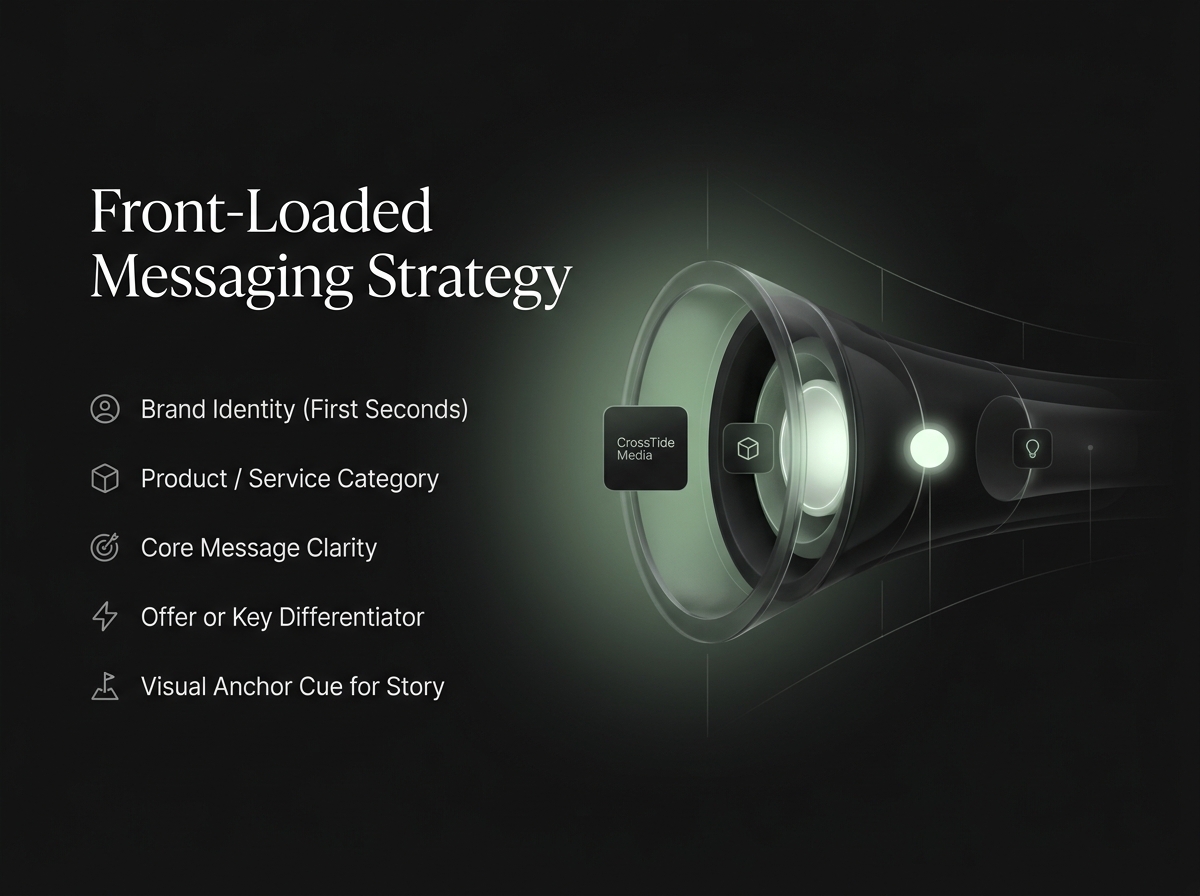
Critical information should appear within the first few seconds:
- Brand identity
- Product or service category
- Core message
- Offer or differentiator
- Visual cue that anchors the story
- Balance storytelling with message discipline
Front-loading matters because viewer attention can vary by environment, device, and placement context.
Front-Loaded Messaging Strategy
Critical information should appear within the first few seconds:
- Brand identity
- Product or service category
- Core message
- Offer or differentiator
- Visual cue that anchors the story
- Balance storytelling with message discipline
Front-loading matters because viewer attention can vary by environment, device, and placement context.
Common Video Lengths
- 6 seconds
- 15 seconds
- 30 seconds
These remain the most common video durations for programmatic campaigns, with each length serving a different role depending on campaign objective, placement type, and audience familiarity.

6-second ads
- Best for reinforcement and retargeting
- Useful for short reminders and frequency support
- Most effective when the message is simple
15-second ads
- Most common digital video format
- Balances efficiency and storytelling
- Strong fit for awareness, reminders, offers, and response-oriented campaigns
30-second ads
- Best for storytelling, launches, product education, and more complex messaging
- Gives more room for narrative pacing and explanation
- Requires stronger creative discipline to maintain attention
Crosstide Media Video Creative Specifications
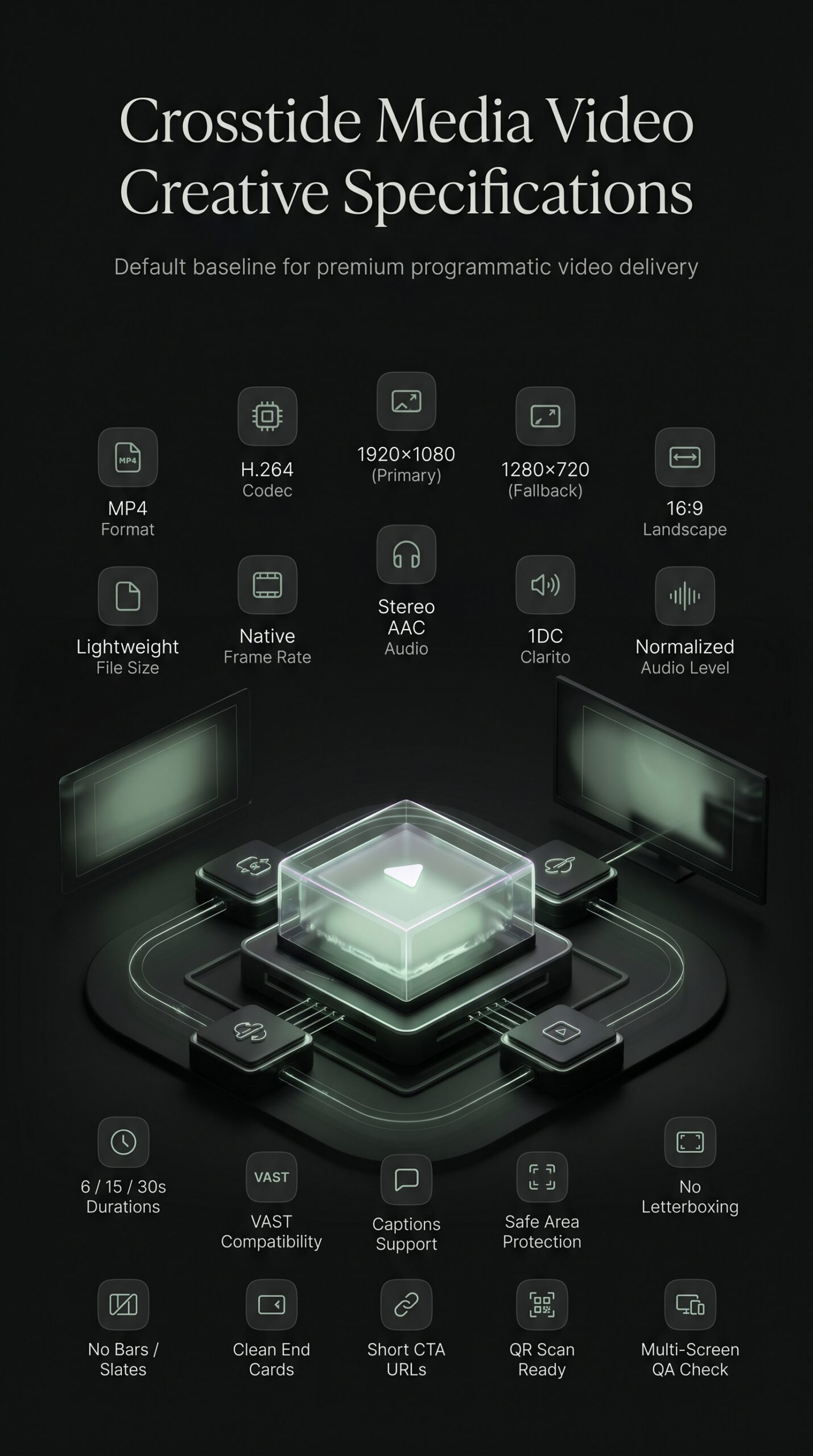
Use the following as the default Crosstide Media baseline for most programmatic video campaigns:
- File format: MP4
- Preferred codec: H.264
- Recommended resolution: 1920 x 1080
- Acceptable resolution in some environments: 1280 x 720, though 1080p is preferred
- Aspect ratio: 16:9
- Orientation: landscape
- Recommended file size: keep files lightweight enough for smooth trafficking and compatibility; under 100 MB is a strong working benchmark when possible
- Frame rate: preserve the native frame rate of the source edit
- Common accepted frame rates: 23.976, 24, 25, 29.97, and 30 fps
- Audio format: stereo AAC is commonly accepted
- Audio level: use properly normalized audio suitable for premium video environments
- Standard durations: 6, 15, and 30 seconds
- Tag compatibility: VAST-compatible delivery is standard for most programmatic video workflows
- Closed captions: include when required by publisher, environment, or campaign setup
- Safe area: keep logos, supers, and calls to action away from the outer edges of frame
- Letterboxing and pillarboxing: avoid unless source material requires it
- Slates, bars, and extra black: do not include unless specifically requested
- End cards: keep clean, readable, and on screen long enough to register
- URLs on screen: keep short, high-contrast, and easy to read
- QR codes: use only if large enough to scan and on screen long enough to act
- Compression review: review the final export on both desktop and large-screen playback before trafficking
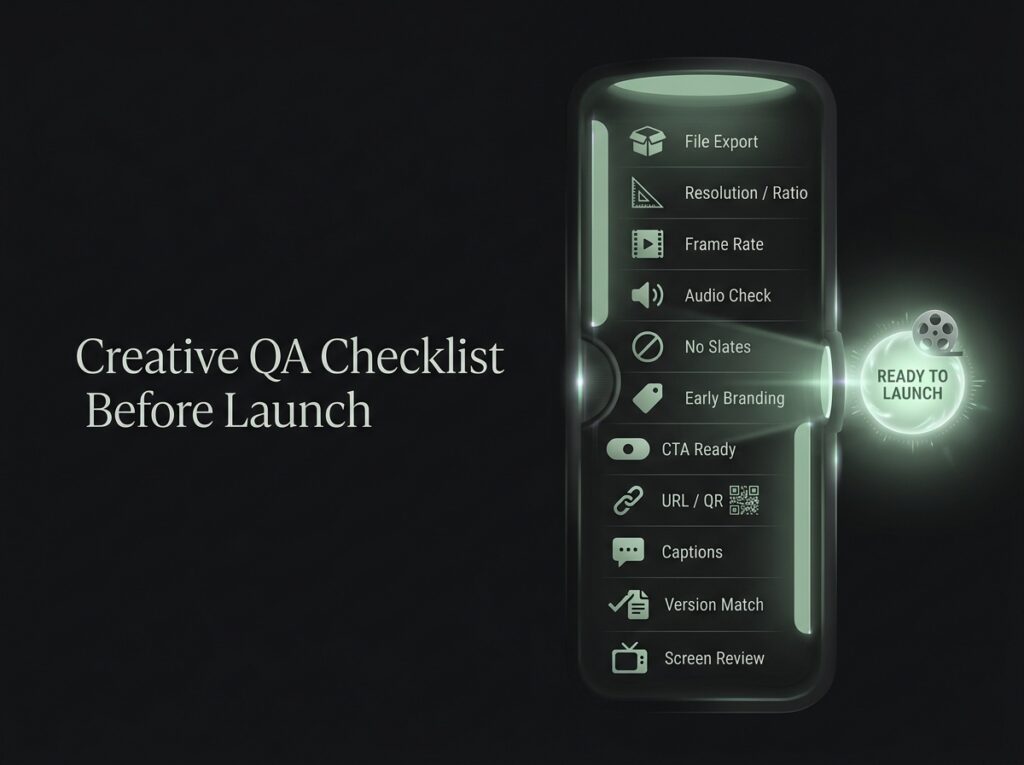
Creative QA Checklist Before Launch
- Final file exported correctly
- Resolution and aspect ratio confirmed
- Frame rate matches source
- Audio checked for clarity and consistency
- No slates, bars, accidental black frames, or padding
- Branding appears early
- CTA is readable
- URL or QR code is usable
- Captions included when required
- Final approved version matches uploaded version
- Creative reviewed on real playback screens before launch
Creative Best Practices by Campaign Goal
Awareness campaigns
- Lead with brand and category clarity
- Use simpler message structure
- Prioritize memorability and visual association
Consideration campaigns
- Highlight product differentiators, proof points, and use cases
- Use stronger audience relevance and message framing
Response-oriented campaigns
- Tighten pacing
- Clarify the offer early
- Make the next step obvious
- Support with retargeting or sequential messaging
Programmatic Video Pricing & CPM Benchmarks
Programmatic video pricing varies widely by format, publisher quality, audience specificity, geography, and deal structure.
Common Pricing Variables
- In-stream vs out-stream environment
- Premium vs open-market inventory
- Audience layering
- Market competition
- Geography
- Brand-safety controls
- Device mix
- Seasonal demand
- Supply path efficiency
- Publisher quality tier
How to Think About Video CPMs
For programmatic video, the better question is not only what the CPM is, but:
- What quality of inventory am I buying?
- How strong is the viewer attention environment?
- What completion behavior am I seeing?
- Is the campaign generating downstream site activity or conversion lift?
- Am I paying for better supply quality or just more expensive supply?
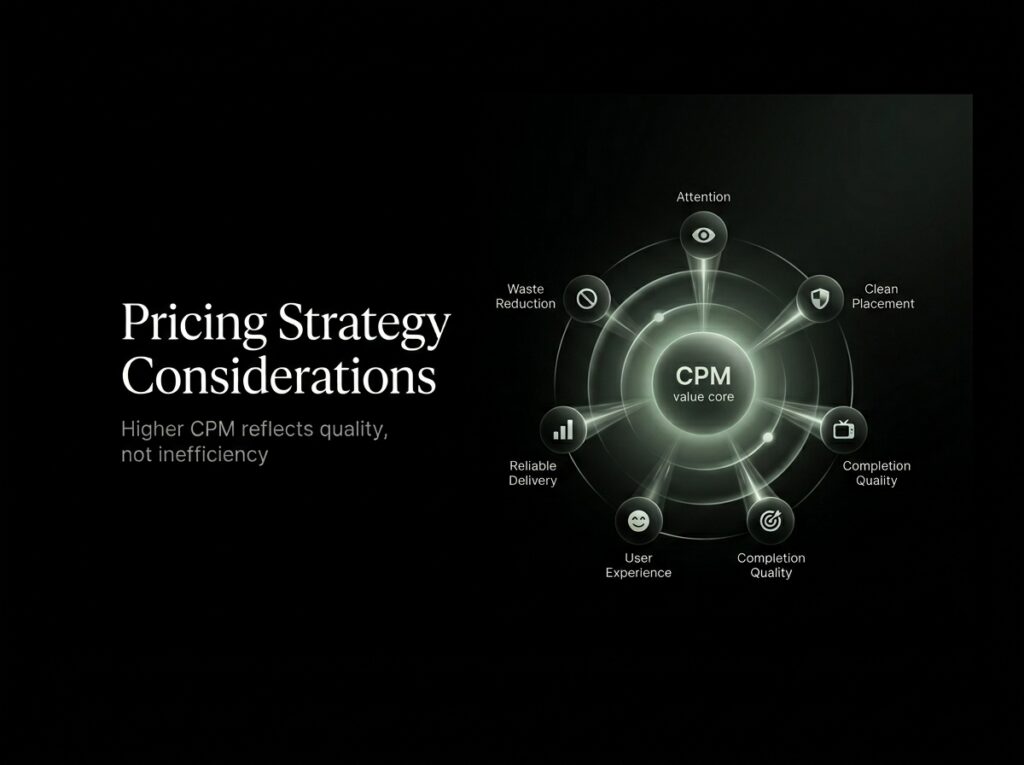
Pricing Strategy Considerations
A higher CPM is not automatically bad. In many cases, higher-quality environments cost more because they offer:
- Better attention
- Better brand safety
- Cleaner placements
- Better completion behavior
- More reliable user experience
- Less waste
The strongest pricing analysis looks at CPM alongside audience quality, reach stability, site activity, conversion behavior, and overall media efficiency.
Budget Planning & Frequency Strategy
Video campaigns need enough budget to generate stable reach, useful learning, and enough delivery to evaluate creative and audience performance.
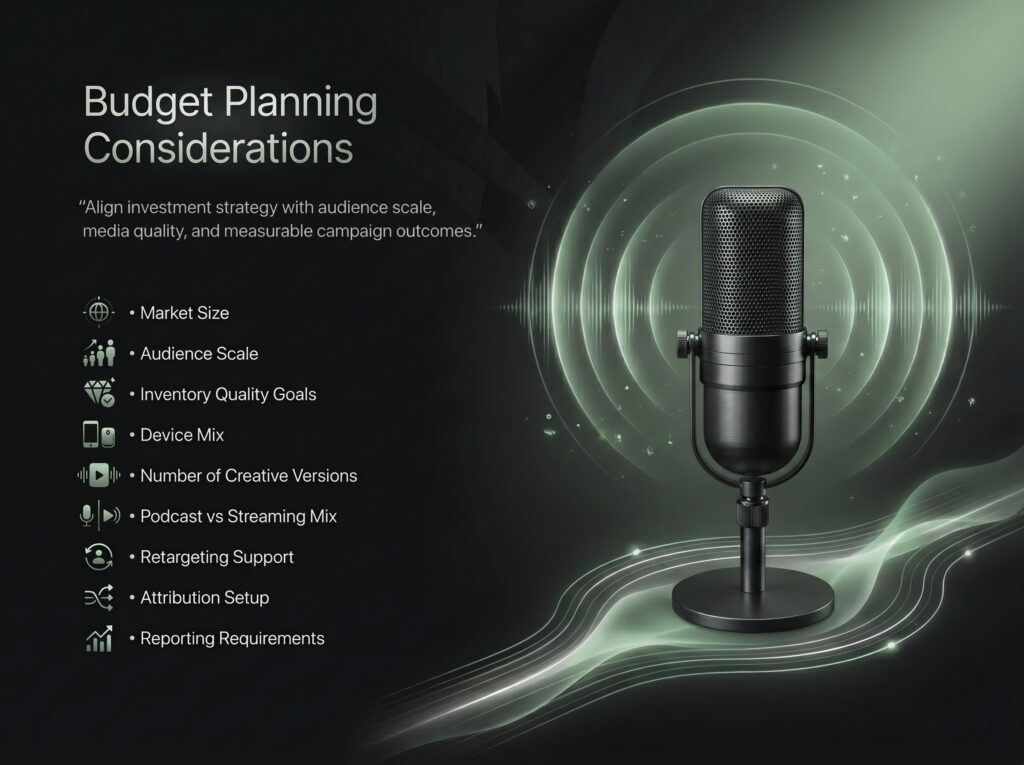
Budget Planning Considerations
- Market size
- Inventory quality goals
- Audience scale
- Device mix
- Creative variations
- Retargeting support
- Testing across formats or geographies
- Attribution setup
- Reporting depth required
A budget that is too small can make it difficult to evaluate creative performance, audience quality, and delivery stability in a meaningful way.
Frequency strategy
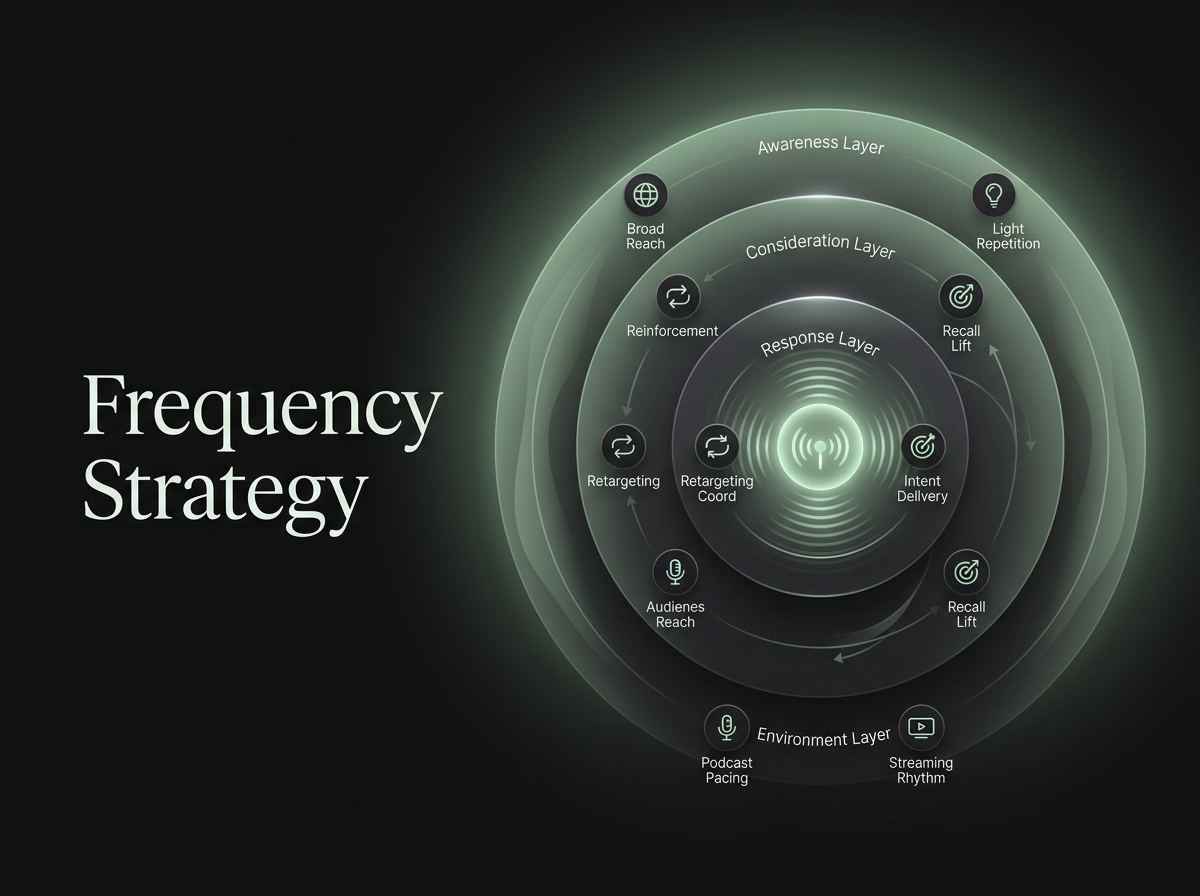
Frequency should be managed differently based on objective:
- Awareness campaigns may tolerate broader reach with lighter repetition
- Consideration campaigns may need reinforcement
- Response-oriented campaigns often benefit from coordinated retargeting rather than only increasing video repetition
- Podcast and streaming environments may require different pacing logic
The best structure usually balances:
- Reach
- Frequency
- Audience quality
- Cost efficiency
- Creative fatigue risk
Frequency strategy
Frequency should be managed differently based on objective:
- Awareness campaigns may tolerate broader reach with lighter repetition
- Consideration campaigns may need reinforcement
- Response-oriented campaigns often benefit from coordinated retargeting rather than only increasing video repetition
- Podcast and streaming environments may require different pacing logic
The best structure usually balances:
- Reach
- Frequency
- Audience quality
- Cost efficiency
- Creative fatigue risk
Measurement & Attribution for Video Campaigns
Programmatic video can be measured across both delivery and business outcomes.
Upper-Funnel Metrics
- Reach
- Impressions
- Frequency
- Video completion rate
- View-through behavior
- Device distribution
- Placement quality
- Delivery pacing
Lower-Funnel Metrics
- Website visits
- Landing-page engagement
- Lead volume
- CPA
- ROAS
- Conversion rate
- Assisted conversions
- Revenue contribution
Advanced measurement approaches
- Cross-device attribution
- Audience-quality analysis
- Incrementality testing
- Time-to-conversion review
- Placement-level performance review
- Format comparison across in-stream, out-stream, and cross-screen inventory
Attribution reality
Video often influences behavior that happens later on another device or channel, so programmatic video should not be judged only through last-click logic. The strongest reporting framework combines delivery metrics, site activity, conversion trends, and incremental impact where possible.
What Strong Video Reporting Should Include
A strong reporting framework should show:
- Delivery by format or inventory grouping
- Reach and frequency by audience or geography
- Completion trends
- Site activity and conversion behavior
- Optimization actions taken during flight
- Key findings and recommended next steps
That makes reporting more useful than a static export. It turns campaign data into a true media decision tool.
Brand Safety & Supply Quality
Brand safety and supply quality matter in programmatic video because not all inventory performs the same way.
Best practices
- Use brand-safety controls
- Prioritize transparent supply paths
- Review placement and app quality
- Separate premium supply from broader exchange supply
- Monitor completion behavior and site outcomes together
- Exclude consistently weak or suspicious inventory
- Review publisher and placement trends regularly
For Crosstide Media, supply quality is not just a risk-control issue. It is also a performance issue.

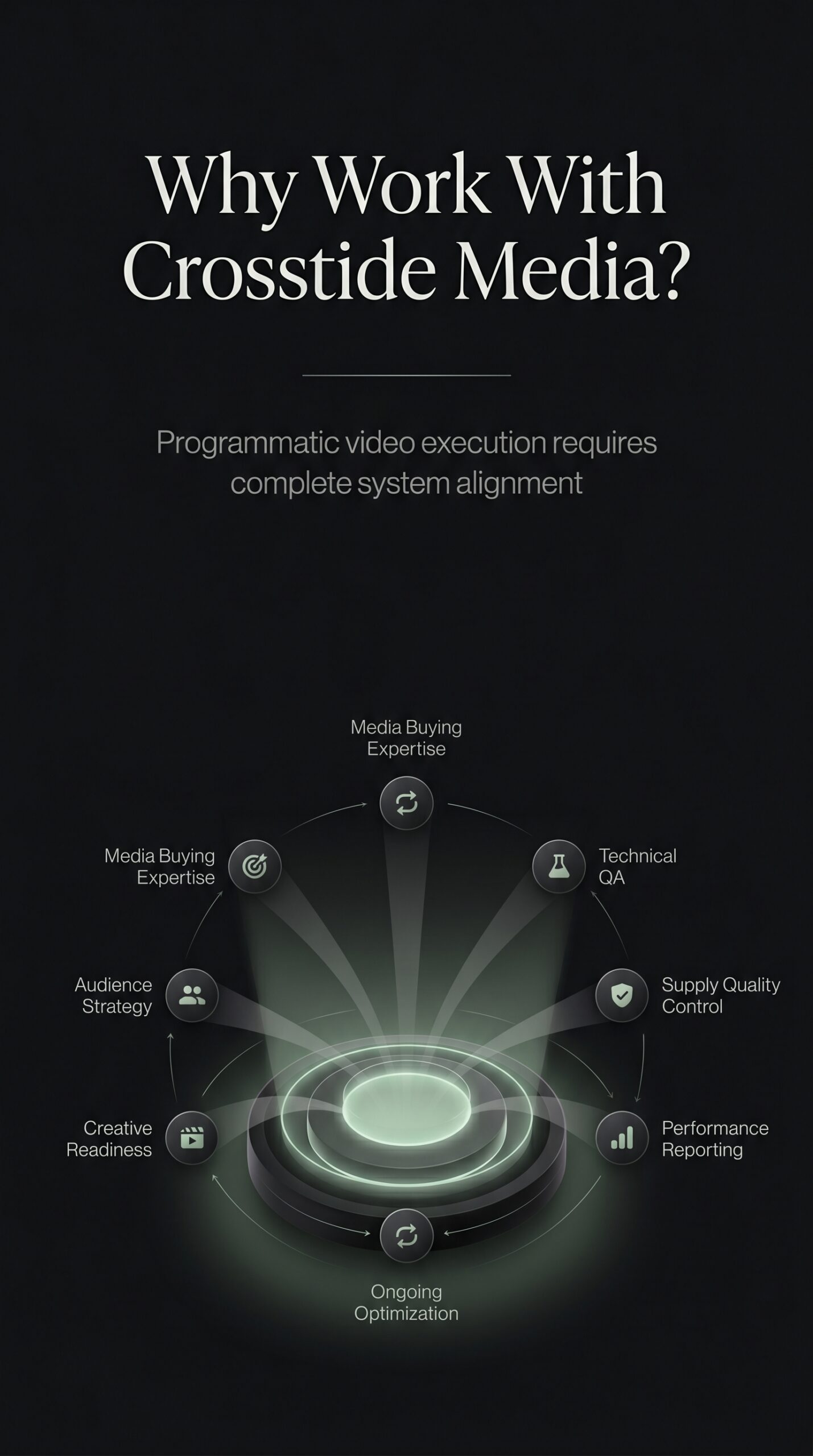
Why Work With Crosstide Media?
Effective programmatic video execution requires:
- Media buying expertise
- Audience strategy
- Creative readiness
- Technical QA
- Supply quality controls
- Performance reporting
- Ongoing optimization
At Crosstide Media, we approach programmatic video as both a storytelling channel and a measurable media investment. Our focus is on building video campaigns that combine clean supply, strong creative, smart targeting, and actionable reporting so brands can scale with more confidence across screens.
Whether the objective is broad awareness, product education, site traffic, lead generation, or performance support, Crosstide Media helps advertisers execute programmatic video campaigns with the technical discipline required for modern media buying.
Why Work With Crosstide Media?
Effective programmatic video execution requires:
- Media buying expertise
- Audience strategy
- Creative readiness
- Technical QA
- Supply quality controls
- Performance reporting
- Ongoing optimization
At Crosstide Media, we approach programmatic video as both a storytelling channel and a measurable media investment. Our focus is on building video campaigns that combine clean supply, strong creative, smart targeting, and actionable reporting so brands can scale with more confidence across screens.
Whether the objective is broad awareness, product education, site traffic, lead generation, or performance support, Crosstide Media helps advertisers execute programmatic video campaigns with the technical discipline required for modern media buying.