
- GROWTH MARKETING
Connected TV (CTV) & OTT Advertising
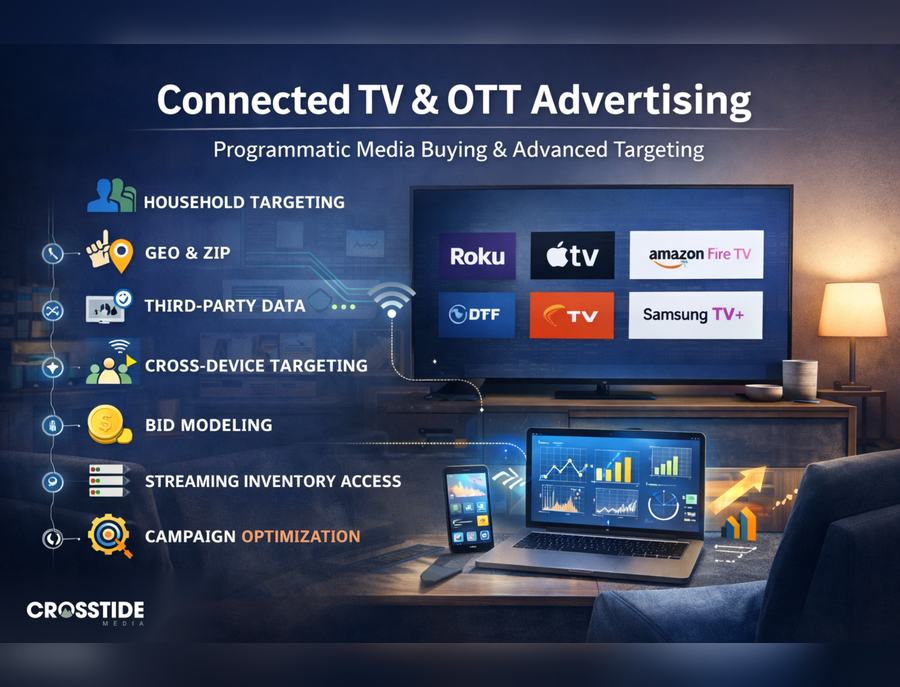
Connected TV (CTV) advertising has rapidly transformed the digital advertising landscape. As consumer viewing behavior shifts from traditional cable and broadcast television toward streaming platforms, advertisers are reallocating budgets into programmatic CTV and OTT advertising strategies that deliver precision targeting, measurable performance, and scalable household reach.
Today, CTV media buying is no longer experimental it is a core component of full funnel marketing strategies for agencies, enterprise brands, mid market advertisers, political campaigns, and performance driven businesses.
Jump To Sections
How OTT advertising differs from CTV
CTV inventory types and supply path optimization
- GROWTH MARKETING
What Is Connected TV (CTV) Advertising?
Connected TV (CTV) advertising refers to video advertisements delivered through internet connected television devices such as Smart TVs, Roku, Amazon Fire TV, Apple TV, Samsung TV Plus, LG Channels, gaming consoles, and other streaming enabled hardware.
Unlike traditional linear television advertising, which relies on broad demographic assumptions and panel based ratings systems, CTV advertising operates through digital programmatic infrastructure. This allows advertisers to target specific households, geographic regions, behavioral segments, and intent based audiences using first party and third-party data integrations.
CTV advertising is often described as streaming TV advertising on the big screen, giving brands the impact of television with the control, flexibility, and optimization capabilities of digital media.
Why Connected TV Advertising Is Strategically Important
The rise of CTV advertising represents the convergence of television’s high-impact format with digital marketing’s targeting precision. Historically, television delivered unmatched brand recall but lacked performance transparency and audience-level control. CTV media buying resolves this gap by enabling:
- Addressable household-level targeting
- ZIP code, city, DMA, and radius targeting
- Lat/long geographic precision
- Cross-device retargeting and identity mapping
- Real-time reporting and campaign optimization
- Deterministic and probabilistic audience modeling
For advertisers searching “what is connected TV advertising” or “CTV advertising benefits,” the core strategic value lies in measurable reach combined with premium content environments.
CTV advertising is particularly powerful for:
- Brand awareness campaigns
- Political and advocacy advertising
- Product launches
- Franchise and regional expansion
- Healthcare and financial services
- Performance marketing with cross device reinforcement
CTV as a Performance TV Channel
Connected TV is no longer treated as an awareness only tactic. It is increasingly used as a performance TV channel that combines premium streaming environments with outcome focused measurement, real time optimization, and audience based buying.
For Crosstide Media, that means building streaming TV campaigns that support both brand lift and business outcomes from qualified traffic and lead generation to conversion efficiency and incremental growth.
What Is OTT Advertising?
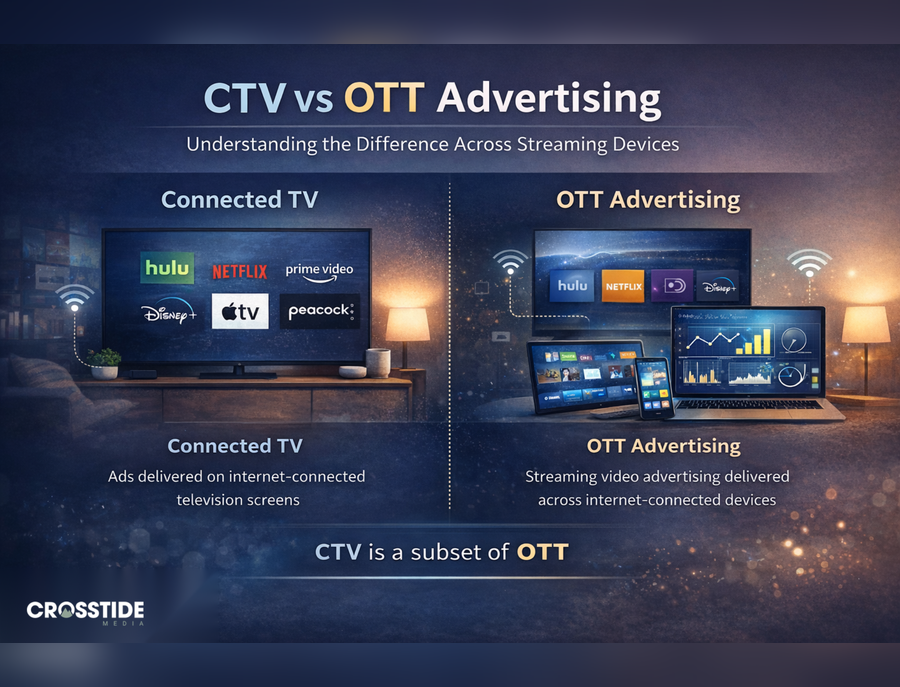
Over The Top (OTT) advertising refers to streaming video content delivered over the internet rather than through traditional cable or satellite infrastructure.
OTT advertising can appear across:
- Connected TV screens
- Mobile devices
- Desktop streaming platforms
- Tablets
While the terms CTV and OTT are often used interchangeably, there is an important distinction:
- CTV refers specifically to ads delivered on television screens
- OTT refers to streaming content delivered via the internet on any device
Strategic Role of OTT in a Cross-Device Media Strategy
OTT advertising expands reach beyond the living room, enabling advertisers to sequence messaging across devices. A typical strategy may include:
- Initial awareness exposure on CTV
- Mobile retargeting for engagement
- Desktop or social reinforcement to drive conversion
OTT plays an important role in cross-screen media strategy because it extends streaming video beyond the television screen alone.
Advertisers searching for “OTT advertising platform” or “CTV vs OTT advertising” are often evaluating device flexibility and scale. A robust streaming strategy leverages both CTV and OTT placements to maximize reach and frequency control across the customer journey.
- Our Branding & Creative Services
Why Advertisers Are Shifting from Linear TV to Programmatic CTV
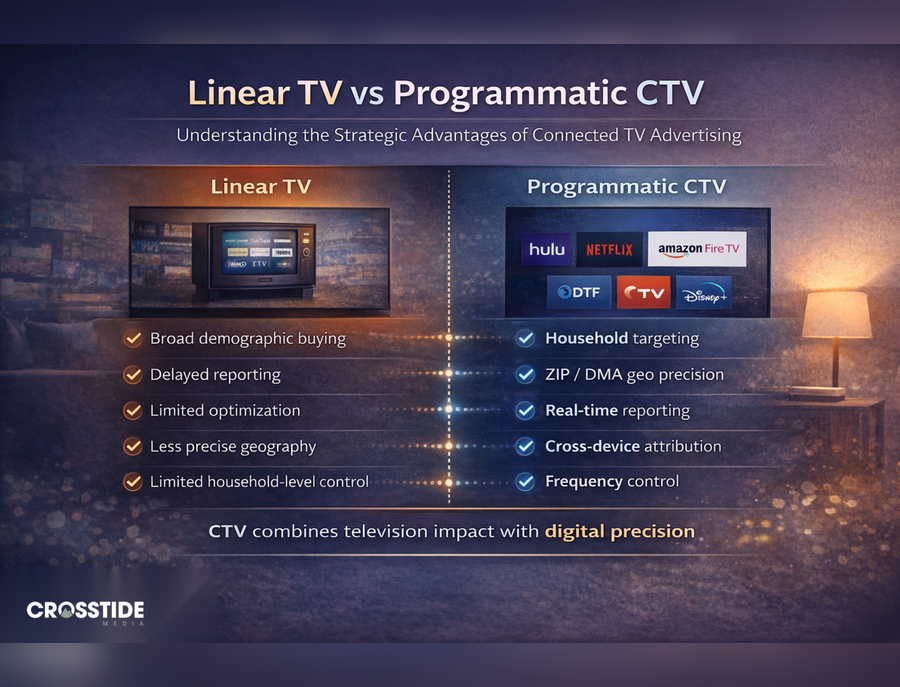
Traditional linear television advertising relies on panel based audience measurement systems, limiting targeting precision and real time optimization capabilities.
Connected TV advertising introduces audience based buying, allowing campaigns to be built around behavioral data rather than age and gender demographics.
Key Strategic Advantages of CTV Over Linear TV
Household level targeting instead of broad demographic assumptions
Real time campaign performance data
Cross device attribution modeling
Geographic targeting down to ZIP code or lat/long
Frequency capping at the household level
Dynamic budget allocation based on performance
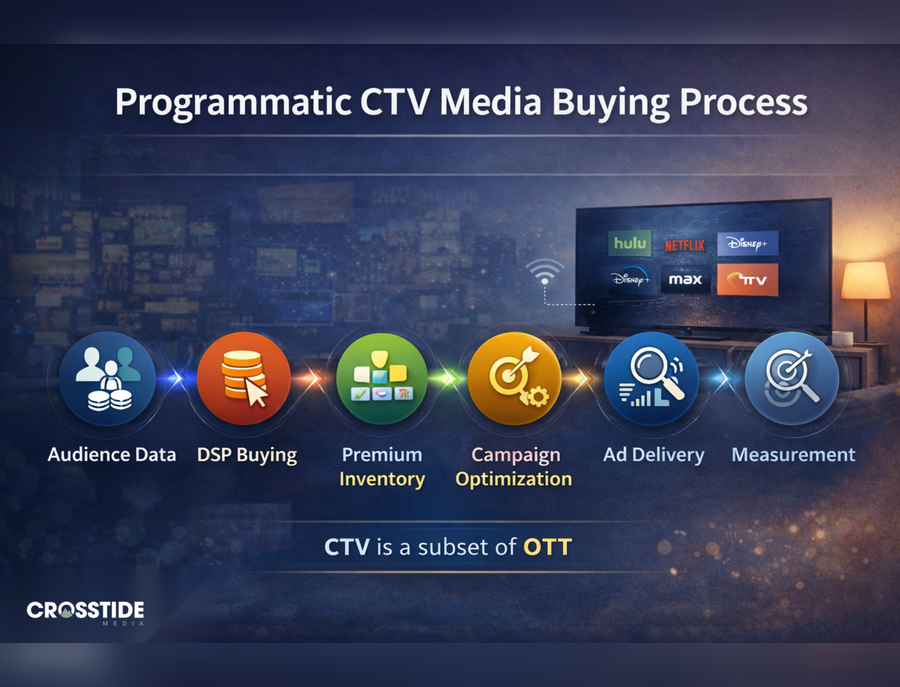
How Programmatic CTV Media Buying Works
Programmatic CTV buying is executed through enterprise demand-side platforms and premium streaming inventory sources that allow advertisers to centralize targeting, bidding, pacing, reporting, and optimization within one campaign framework.
Unlike traditional television buying, programmatic Connected TV campaigns can be built around audience signals, inventory quality, geographic constraints, and business outcomes rather than broad age and gender assumptions. That makes the channel more flexible for advertisers that need both premium video environments and measurable performance.
Strategic Workflow of CTV Media Buying
Effective CTV campaign execution typically includes:
- Audience architecture development using first party, third party, and contextual data
- Inventory tier selection across premium publishers, FAST channels, curated PMPs, and selective open market supply
- Bid modeling based on campaign objective, geography, audience density, and CPM tolerance
- Supply path optimization to reduce unnecessary hops and improve transparency
- Household-level frequency modeling to manage reach and saturation
- Cross device retargeting integration to connect TV exposure with downstream action
- Creative QA and trafficking to ensure technical compliance before launch
- Real time pacing, bid, and delivery adjustments based on live performance signals
- Ongoing optimization toward site visits, conversions, leads, or revenue depending on campaign goals
Why Programmatic CTV Buying Matters
Programmatic CTV buying gives advertisers more control over where impressions run, who sees the message, how often they see it, and how campaign results are evaluated. Instead of buying broad programming blocks and waiting for delayed reporting, advertisers can use active delivery data to refine audience segments, suppress waste, shift spend across inventory tiers, and improve media efficiency while campaigns are still in flight.
Supply Path Optimization in CTV
Supply path optimization is especially important in Connected TV because inventory quality can vary significantly across publishers, apps, exchanges, and reseller paths. A disciplined supply strategy helps advertisers prioritize cleaner inventory, improve bidding efficiency, reduce hidden fees, and lower the risk of low quality delivery. For Crosstide Media, that means inventory selection is not just a buying decision it is a performance decision.
Programmatic CTV for Full-Funnel Strategy
Programmatic CTV is most effective when it is not treated as an isolated awareness tactic. The strongest campaigns often use CTV for high impact household reach, then connect that exposure to follow-up channels such as display, paid social, search, or other retargeting tactics. This creates a more measurable path from impression to action and improves the value of television style creative within a digital media framework.
Premium CTV Publishers & Streaming Inventory Access
Access to premium streaming inventory is critical for brand safety, engagement, and performance outcomes.
Major Premium Streaming Platforms








Broadcast & Network Apps








FAST (Free Ad-Supported Streaming TV)





Strategic Role of Premium Streaming Publishers
Premium inventory provides:
- Higher video completion rates
- Reduced ad clutter
- Elevated brand perception
- Lower fraud exposure
For many advertisers, inventory quality matters as much as targeting.
Most sophisticated CTV strategies blend premium publishers with scalable FAST inventory to balance cost efficiency and quality.

Advanced CTV Targeting Strategy
Connected TV advertising enables highly granular audience segmentation that can support both brand building and performance objectives. Instead of relying primarily on broad demographics, advertisers can build campaigns around households, geographies, behaviors, purchase intent, and first party data signals.
Addressable Household Targeting
Addressable TV advertising allows campaigns to target specific households using:
- Identity graphs
- IP mapping
- CRM onboarding
- Customer suppression
- Lookalike modeling
- Device graph relationships
- Audience extension workflows
This helps reduce wasted impressions and improve cost efficiency by focusing delivery on audiences that are more likely to matter to the advertiser.
Audience-Based Buying for Streaming TV
One of the most important advantages of CTV is the shift from programming based buying to audience based buying. Instead of purchasing broad reach tied only to a show or network, advertisers can activate campaigns against defined household segments, first-party audiences, behavioral profiles, and modeled lookalikes.
This gives streaming TV campaigns more flexibility for:
- Prospecting new audiences
- Suppressing existing customers when needed
- Reaching in market households
- Reinforcing messages across multiple devices
- Aligning TV exposure with business goals rather than only content adjacency
Geographic Targeting Precision
CTV campaigns can support:
- Country level targeting
- State level targeting
- DMA targeting
- City targeting
- ZIP code targeting
- Radius targeting
- Lat/long geofencing
That precision is especially valuable for advertisers with local or regional service areas, franchise footprints, healthcare networks, political districts, dealership groups, retail clusters, or market by market expansion plans.
First-Party Data Strategy
First party data is often one of the most valuable targeting layers in CTV because it allows advertisers to align household delivery with actual business intelligence. Depending on the campaign setup, first party data can support:
- CRM audience onboarding
- Existing customer suppression
- Loyalty or membership targeting
- Lead reengagement
- Site visitor audience creation
- Lookalike expansion from known customer groups
For Crosstide Media, first party data should not simply be layered in because it is available. It should be used strategically based on whether the campaign goal is acquisition, re-engagement, upsell, or geographic efficiency.
Third-Party Behavioral & Intent Data
Audience targeting may also include:
- In market auto buyers
- Retail category shoppers
- Financial service prospects
- Travel planners
- Healthcare seekers
- B2B executives
- Competitor brand interest
- Lifestyle and affinity audiences
Layering behavioral data onto premium inventory can improve efficiency, but the best results usually come from balancing audience specificity with enough scale to deliver clean reach and stable frequency.
Targeting Best Practices
The strongest CTV targeting strategies usually avoid overstacking too many audience filters at once. When campaigns become too narrow, reach declines, frequency becomes unstable, and CPM pressure increases. A better approach is to prioritize the highest-value signals, structure audiences by intent level, and optimize based on actual performance rather than assumptions.
Creative Strategy & CTV Ad Specifications
Creative execution is one of the most important drivers of CTV performance because the ad runs in a full screen, high attention environment where production quality, clarity, and pacing are immediately noticeable.
Why Creative Matters in Connected TV
CTV is not just a larger version of social video or pre roll. It is closer to a premium television viewing experience, but with digital targeting and measurable delivery. That means creative must do two things at once:
- Deliver television grade visual presence
- Support digital style performance outcomes
- High quality creative improves:
- Video completion rate
- Brand recall
- Message retention
- Viewer attention
- Conversion lift
- Response to retargeting sequences
Performance Oriented Creative Strategy
Strong CTV creative should pair storytelling with response discipline. The best performing units usually feature:
- Early brand recognition
- Clear value proposition
- Concise message hierarchy
- Distinct offer or reason to care
- Readable on screen text
- Strong call to action
- Visual framing designed for TV screens, not mobile first layouts
Front Loaded Messaging Strategy
Critical information should appear within the first 3 to 5 seconds:
- Brand identity
- Product or service category
- Core value proposition
- Offer or differentiator
- Visual cue that anchors the message
Even in high completion environments, attention is not perfectly uniform. Front loading key information helps improve recall even if the viewer does not fully engage with every second of the spot.
6-Second vs 15-Second vs 30-Second CTV Ads
6-second ads
- Best for retargeting and reinforcement
- Useful for frequency support and short reminders
- Most effective when the brand is already known or the message is very simple
15-second ads
- Most common CTV format
- Balances efficiency and storytelling
- Strong fit for awareness, local offers, brand reminders, and response oriented campaigns
30-second ads
- Best for launches, storytelling, emotional messaging, and more complex offers
- Gives more room for product explanation and narrative pacing
- Requires stronger pacing and production discipline to stay compelling throughout
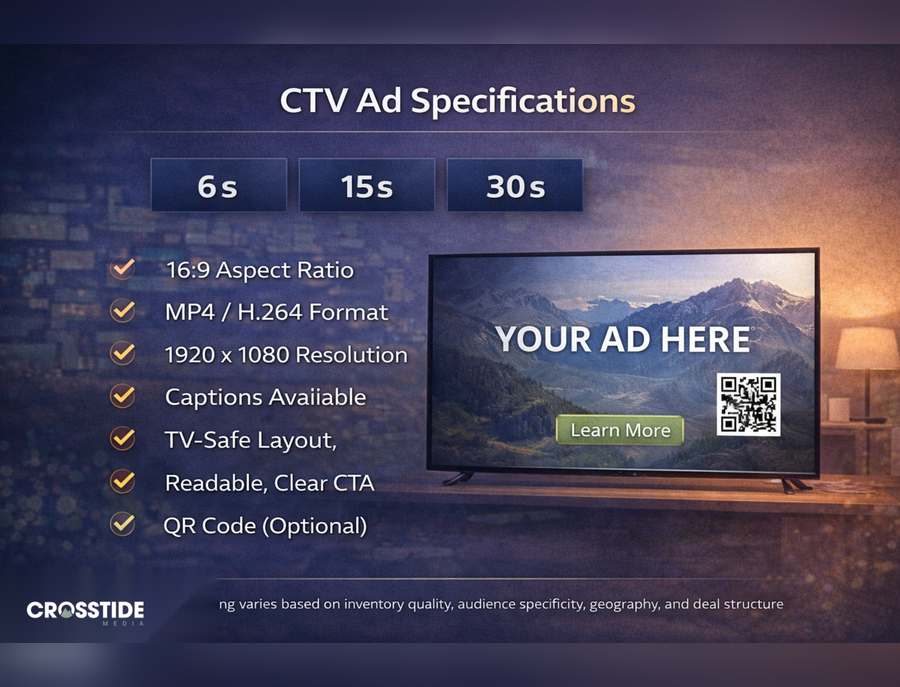
CTV Creative Technical Specifications
Use the following as the default Crosstide Media baseline for most programmatic CTV campaigns:
- File format: MP4
- Preferred codec: H.264
- Recommended resolution: 1920 x 1080
- Acceptable resolution in some environments: 1280 x 720, though 1080p is preferred
- Aspect ratio: 16:9
- Orientation: landscape
- Recommended file size: under 100 MB when possible
- Frame rate: preserve the native source frame rate
- Common accepted frame rates: 23.976, 24, 25, 29.97, or 30 fps
- Audio format: stereo AAC is commonly accepted
- Loudness target: -24 LKFS ±2 where broadcast-style compliance is required
- Standard durations: 6, 15, and 30 seconds
- Tag compatibility: VAST compatible delivery is standard for CTV programmatic buying
- Closed captions: include when required by publisher or deal setup
- Safe area: keep logos, supers, and calls to action away from the outer edges of frame
- Letterboxing and pillarboxing: avoid unless required by source material
- Extra slate, bars, or tone: do not include unless specifically requested
- End cards: keep simple, readable, and long enough to register on a TV screen
- QR codes: use only if large enough to scan and on screen long enough to act
- URLs on screen: keep short, high contrast, and easy to read from distance
- Compression review: check final export on a large screen before launch
Creative QA Checklist Before Launch
- Final file exported correctly
- Resolution and aspect ratio confirmed
- Frame rate matches source
- Audio checked for level and clarity
- No slates, bars, or accidental black frames
- Branding appears early
- CTA is readable on television
- URL or QR code is usable
- Captions included when required
- Upload version matches approved final
- Creative reviewed on a large-format screen before trafficking
Creative Best Practices by Campaign Goal
Awareness campaigns
- Lead with brand and category clarity
- Use simpler message architecture
- Prioritize memorability and brand association
Consideration campaigns
- Highlight differentiators, proof points, and use cases
- Use stronger product framing and audience relevance
Response oriented campaigns
- Tighten pacing
- Clarify the offer early
- Make the next step obvious
- Support with retargeting or cross device follow up
CTV Advertising Cost & CPM Benchmarks
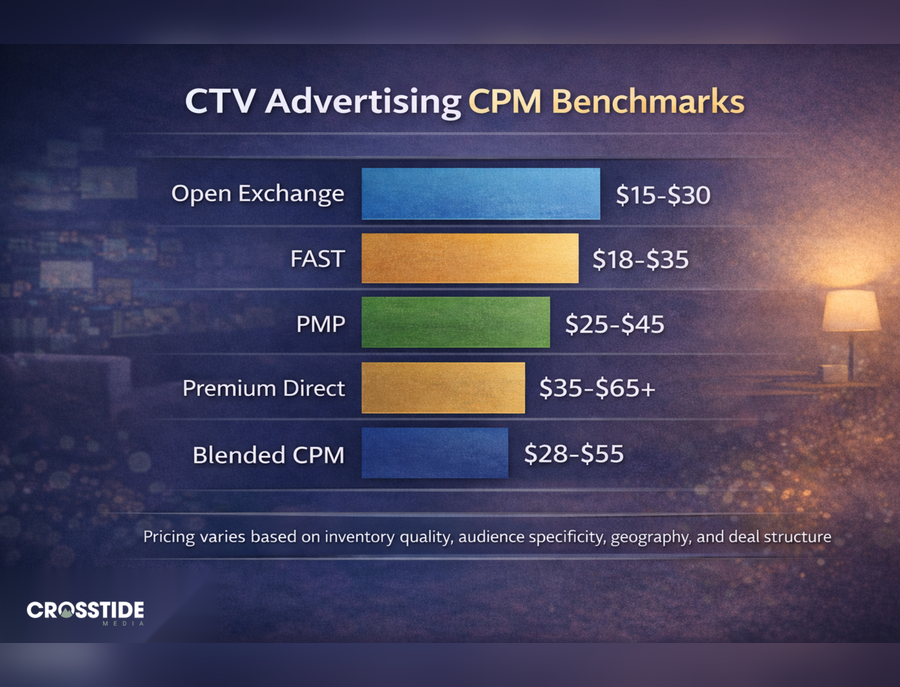
CTV pricing varies based on inventory quality, audience specificity, geography, demand cycles, data overlays, and deal structure.
Typical U.S. CPM ranges often look like this:
- Open Exchange: $15–$30
- FAST: $18–$35
- PMP: $25–$45
- Premium Direct: $35–$65+
Blended CPMs often land in the $28–$55 range depending on campaign structure.
What Drives CTV Pricing
The biggest pricing variables usually include:
- Audience specificity
- Geographic precision
- Market size
- Seasonality
- Political demand cycles
- Publisher quality
- Deal type
- Data overlay costs
- Inventory scarcity during peak periods
Why Higher CPMs Are Not Automatically Bad
A higher CPM does not necessarily mean lower value. In many cases, premium inventory carries a higher price because it offers stronger content environments, better viewer attention, lower fraud risk, and cleaner delivery quality. The right question is not only what the CPM is, but what that CPM is buying in terms of reach quality, brand safety, business outcomes, and waste reduction.
Budget Efficiency Considerations
When evaluating CTV budgets, advertisers should think beyond headline CPMs and look at:
- Household reach quality
- Frequency stability
- Video completion environment
- Site traffic lift
- Assisted conversions
- Incremental impact
- Media waste reduction
That is why CPM should be interpreted alongside reach, performance, attribution, and audience quality rather than as an isolated benchmark.
Creative Best Practices by Campaign Goal
Minimum recommended budget:
$20,000–$30,000 for test campaigns
Optimal performance campaigns:
$50,000+
Frequency recommendations:
3–6 exposures per household per week
Proper frequency modeling prevents oversaturation and improves ROI.
Budget Planning Considerations
When planning a CTV test budget, advertisers should account for more than media spend alone. Budget structure should consider:
- Audience density
- Market size
- Inventory tier mix
- Creative versioning
- Attribution setup
- Retargeting support
- Testing needs across geographies or audience segments
A budget that is too small can make it difficult to generate stable reach and meaningful learning. In many cases, the goal of an initial campaign is not only performance, but also establishing a reliable baseline for future optimization.
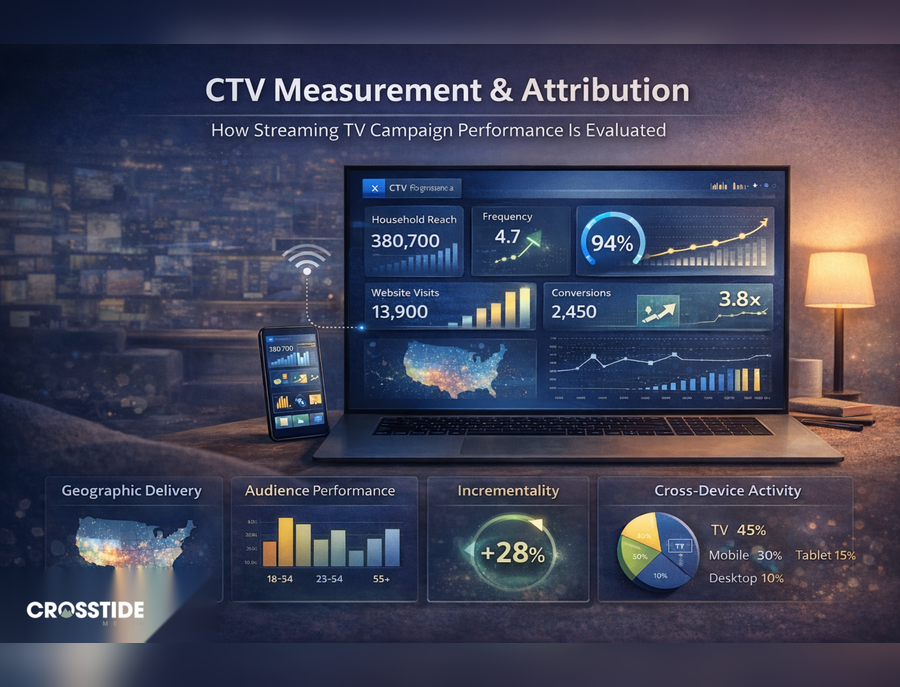
Measurement & Attribution Strategy
Measurement is one of the biggest reasons advertisers continue shifting into Connected TV. Modern CTV campaigns can be evaluated across both upper funnel and lower funnel metrics, allowing brands to understand not just delivery, but business impact.
Upper-Funnel Metrics
Common upper funnel metrics include:
- Reach
- Household reach
- Frequency
- Video completion rate
- Unique household exposure
- Geographic distribution
- Delivery pacing
Lower-Funnel Metrics
Lower funnel evaluation may include:
- Website visits
- Landing page engagement
- CPA
- ROAS
- Lead volume
- Conversion rate
- Revenue contribution
- Assisted conversions
Advanced Measurement Approaches
More advanced CTV measurement can include:
- Cross device identity graphs
- Incrementality testing
- Brand lift studies
- Foot traffic attribution
- Audience quality analysis
- Time to conversion review
- Exposure-to-action modeling
Moving Beyond Delivery Metrics
Sophisticated CTV reporting should go beyond impression count and completion rate alone. Advertisers increasingly want to know:
- Did the campaign drive quality traffic?
- Did exposed households behave differently than unexposed households?
- Did specific audiences outperform others?
- Did premium inventory produce stronger results than lower-tier supply?
- Did the campaign contribute incremental value beyond existing channels?
For Crosstide Media, measurement should be structured to answer not only who saw the ad, but what happened next and whether the campaign changed business outcomes in a meaningful way.
Attribution Reality in CTV
CTV attribution is powerful, but it should still be handled carefully. Not every result is fully attributable in a simple last click model, especially because television exposure often influences behavior that happens later on another device. The best approach is to evaluate CTV through a mix of direct response signals, cross device engagement, conversion analysis, and incrementality where possible.
What Strong CTV Reporting Should Include
A strong reporting framework should show:
- Delivery by inventory tier or publisher grouping
- Reach and frequency by audience or geography
- Video completion and pacing trends
- Site activity and conversion behavior
- Optimization actions taken during flight
- Key findings and recommended next steps
That makes reporting more useful than a static export. It turns campaign data into an actual media decision tool.
Brand Safety & Fraud Mitigation
Best practices include:
- IAS and DoubleVerify verification
- Supply path optimization
- App-level transparency
- MFA blocking
- Frequency caps
Premium CTV environments generally carry lower fraud risk but require active oversight.
Global CTV Campaign Execution
CTV campaigns can be executed across 150+ countries including:
- Canada
- UK
- Europe
- LATAM
- APAC
Global campaigns require localized inventory sourcing and regulatory compliance considerations.
Why Work With Crosstide Media?
Effective CTV execution requires:
- DSP expertise
- Data integration
- Creative compliance management
- Cross device modeling
- Continuous optimization
A strong managed service partner provides:
- Platform agnostic execution
- Premium publisher access
- Advanced targeting integrations
- Transparent reporting
- Global scalability
At Crosstide Media, we approach Connected TV and OTT advertising as both a premium awareness channel and a measurable performance media investment. Our focus is on building streaming TV campaigns that align inventory quality, targeting precision, creative readiness, and attribution strategy so brands can scale with greater confidence.
Whether the objective is broad reach, local market penetration, lead generation, site traffic, or revenue growth, Crosstide Media helps advertisers execute CTV campaigns with the technical discipline required for modern programmatic success.
Frequently Asked Questions About Connected TV (CTV) OTT Advertising
What is Connected TV (CTV) advertising?
Connected TV advertising refers to video ads delivered through internet connected television devices such as Smart TVs, Roku, Amazon Fire TV, and Apple TV. Unlike traditional linear television, CTV advertising allows advertisers to target specific households using digital data, geographic precision, and behavioral audience segments while measuring performance in real time.
What is the difference between CTV and OTT advertising?
How does programmatic CTV buying work?
How much does CTV advertising cost?
What is a typical CPM for CTV advertising?
Is CTV advertising effective for performance marketing?
Can CTV advertising target specific ZIP codes?
What are premium CTV publishers?
What is addressable TV advertising?
What is the best ad length for CTV advertising?
Why is front-loaded messaging important in CTV ads?
What are standard CTV creative specifications?
Do premium streaming environments have stricter creative requirements?
What frame rate should I use for a CTV ad?
What file size should a CTV ad be?
A practical working target is to keep the final asset under 100 MB when possible, especially for smoother trafficking and compatibility. Some platforms support materially larger files, but lighter high quality files are often easier operationally.
