
- Data Partners for Programmatic Advertising
Data Partner Strategy for Audience Intelligence and Smarter Programmatic Advertising Performance
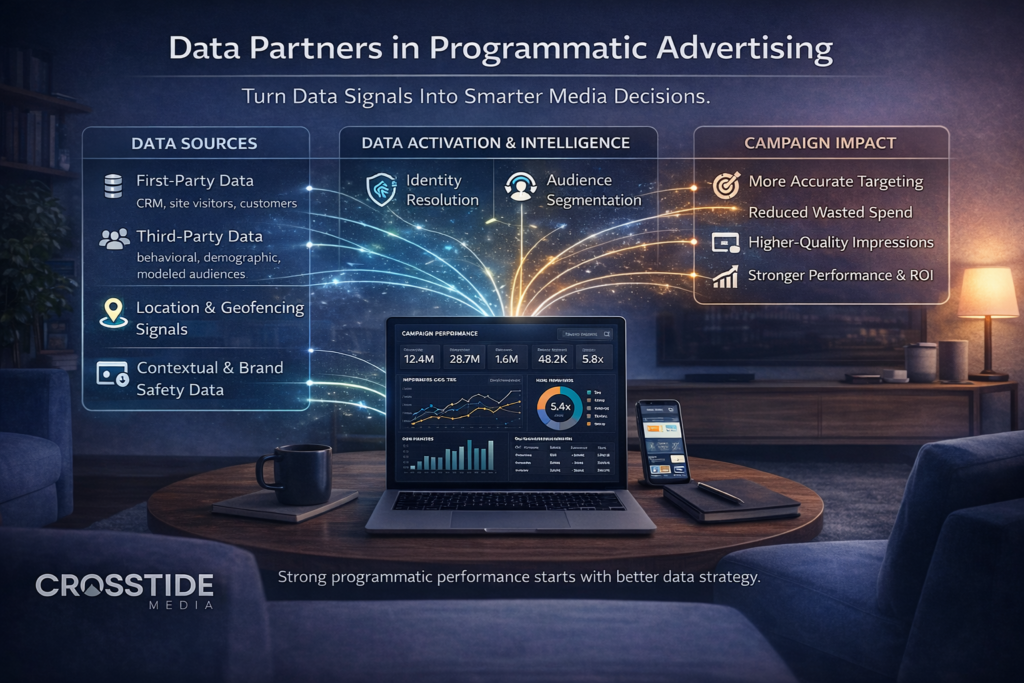
Data partners are one of the most important parts of modern programmatic advertising. They help advertisers move beyond broad demographic targeting and build more intelligent audience strategies based on behavior, household insights, identity resolution, contextual signals, retail patterns, geographic activity, and first-party customer information. In a programmatic environment, strong data strategy often determines whether a campaign reaches the right audience efficiently or simply spends against low-value impressions.
That is why data partners matter so much inside the broader programmatic landscape. Demand-side platforms can buy media at scale, but the quality of the audience strategy depends heavily on the quality of the data feeding the campaign. Some partners help advertisers understand who the audience is. Some help advertisers activate first-party data. Some help improve contextual targeting and brand safety. Some help with measurement, attribution, household-level planning, or geofencing. Used correctly, these partners can make programmatic campaigns sharper, cleaner, and more measurable.
At Crosstide Media, this is not just a technical layer we add after the fact. Data strategy is built into how we plan programmatic media from the beginning. We use first-party data strategy, custom data partnerships, identity solutions, brand-safety partners, contextual tools, location-based audience inputs, and premium inventory access to create more intelligent media plans. What separates strong programmatic execution from average execution is often not just the DSP. It is knowing how to combine the right data sources, activation methods, PMPs, pricing structures, and audience strategies in a way that improves real results.
Jump To
What Are Data Partners in Programmatic Advertising?
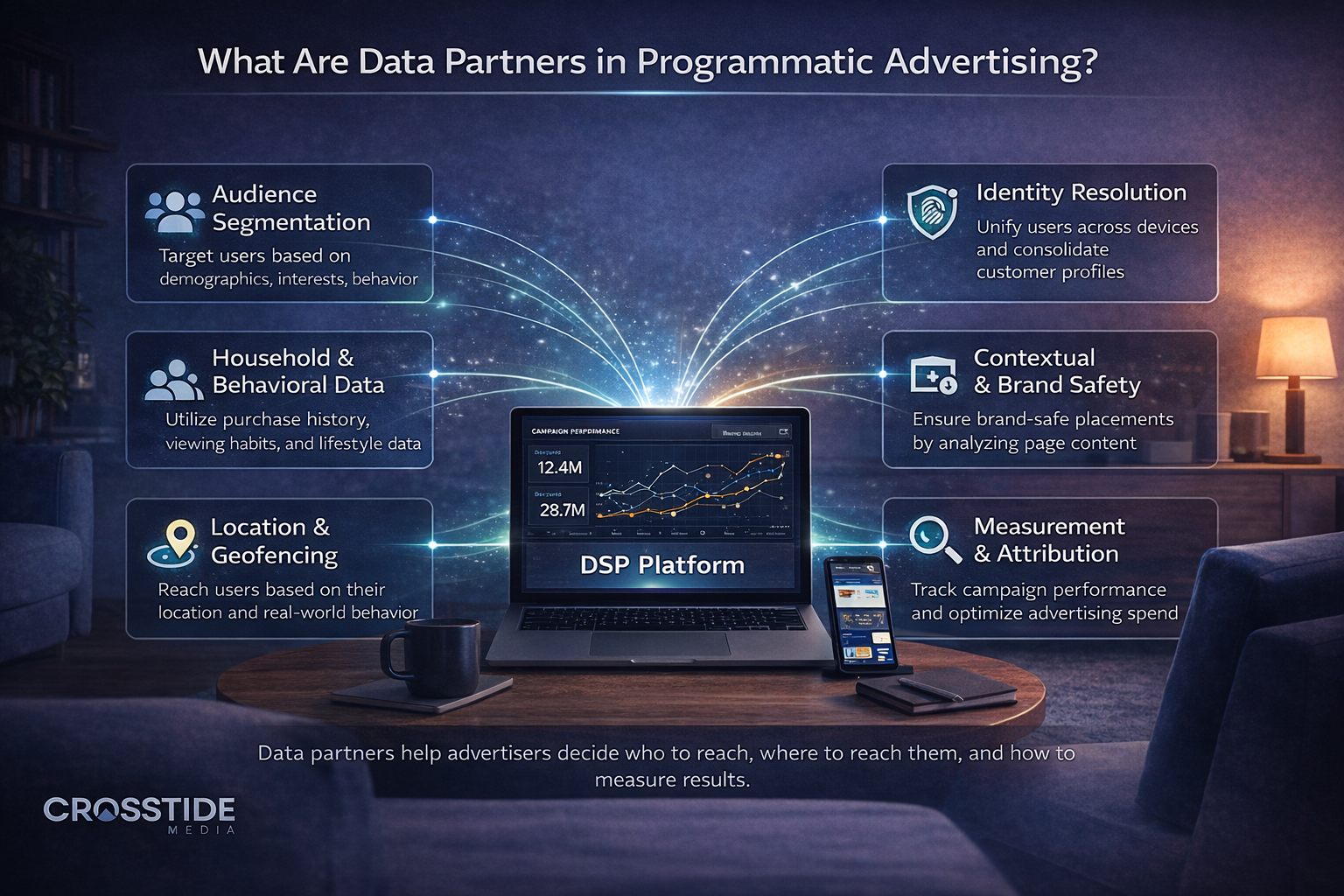
Data partners are companies or platforms that help advertisers improve targeting, audience creation, identity resolution, contextual planning, measurement, or media quality within programmatic advertising. In simple terms, they help advertisers make better decisions about who to reach, where to reach them, when to reach them, and how to measure the result.
Data partners can support:
- audience segmentation
- household targeting
- behavioral targeting
- demographic modeling
- contextual targeting
- brand safety and suitability
- identity resolution
- first-party data onboarding
- location-based audience targeting
- cross-device audience planning
- campaign measurement and verification
This makes data partners a major part of how programmatic advertising actually works in practice.
Why Data Partners Matter
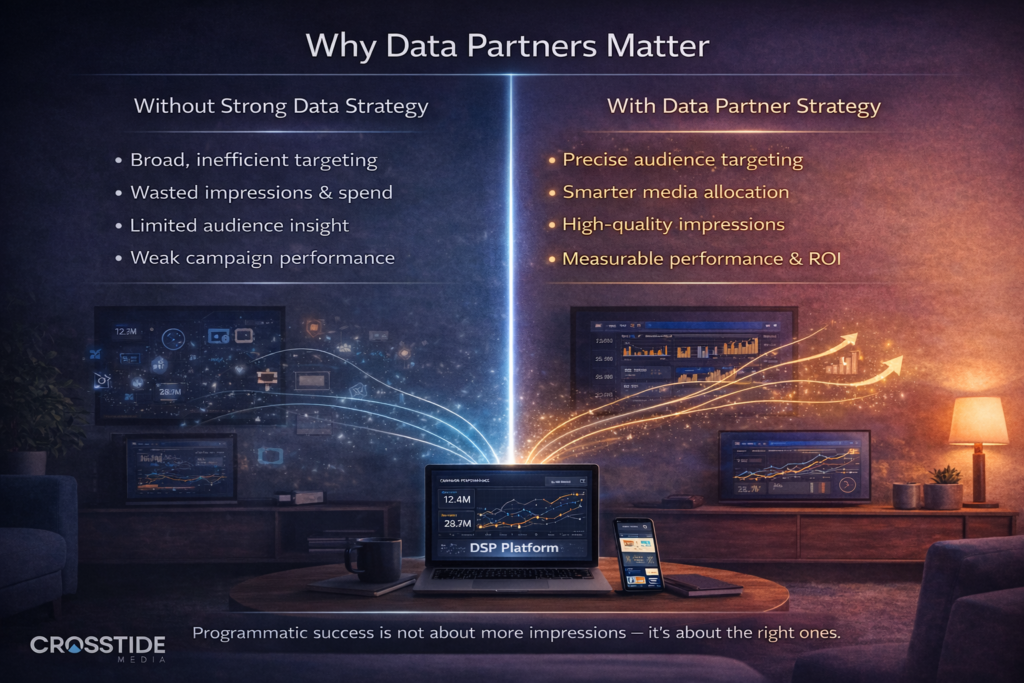
Data partners matter because programmatic advertising is not just about buying impressions. It is about buying the right impressions. Without strong data, campaigns can become overly broad, inefficient, or disconnected from the advertiser’s actual customer strategy.
A strong data partner strategy can help support:
- more accurate audience targeting
- better suppression of existing customers when needed
- stronger prospecting
- cleaner retargeting
- more relevant contextual placements
- better media quality controls
- more advanced measurement
- better alignment between business data and media delivery
For Crosstide Media, strong data strategy is one of the key differences between simply running a DSP campaign and building a smarter programmatic media system.
First-Party Data vs Third-Party Data
One of the most important distinctions in modern programmatic advertising is the difference between first-party data and third-party data.
First-Party Data
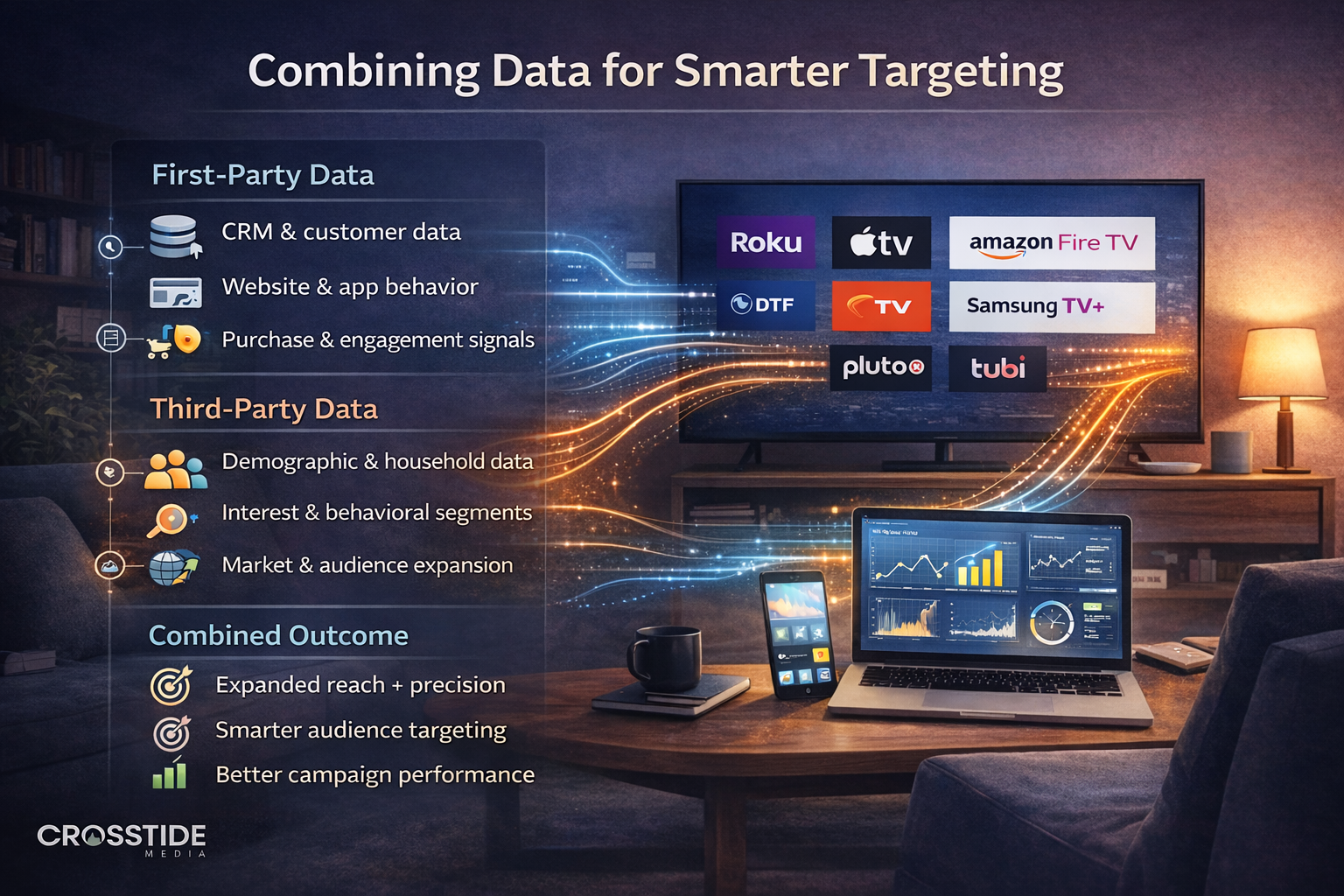
First-party data is data that a business collects directly from its own audience, customers, users, leads, or site visitors. This can include:
- CRM records
- email lists
- website visitors
- lead form activity
- purchase history
- app usage
- customer loyalty data
- internal audience segmentation
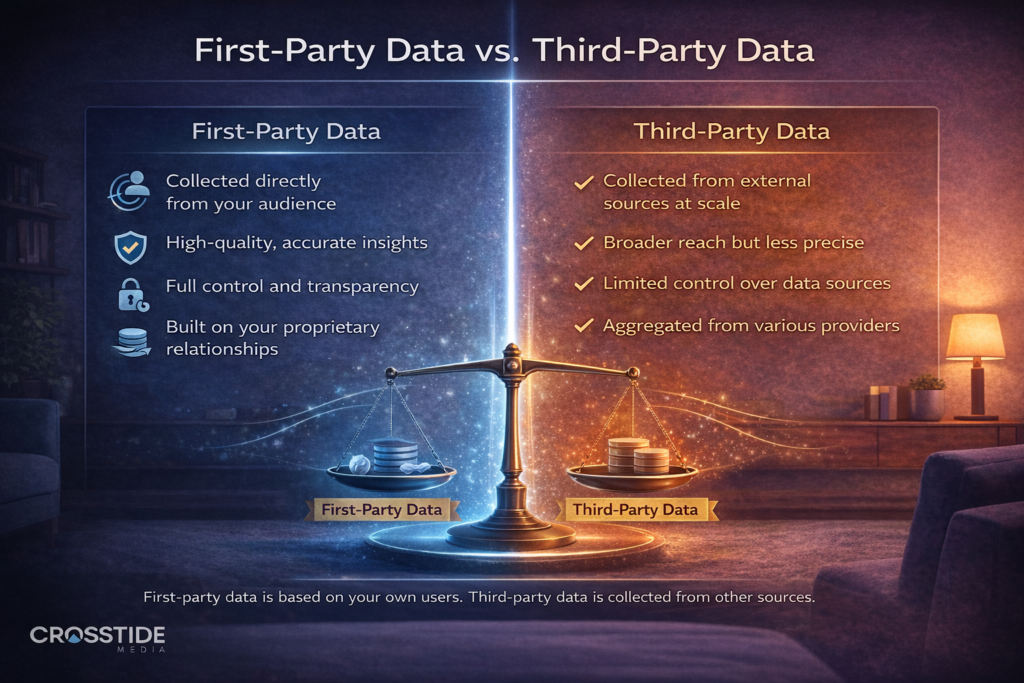
First-party data is often the most valuable kind of data because it comes directly from the advertiser’s own customer relationships and business activity.
Third-Party Data
Third-party data is data collected and packaged by outside providers. It is usually used to help advertisers reach broader audiences based on modeled characteristics, interests, household attributes, purchase signals, media behavior, or other categories.
Third-party data may support:
- broad audience expansion
- household modeling
- behavioral segmentation
- income or homeownership assumptions
- category interest targeting
- audience discovery
- market-level planning
Why the distinction matters
First-party data is usually stronger for precision, retention, suppression, and known-audience planning.
Third-party data is usually stronger for scale, prospecting, and modeled expansion.
The strongest programmatic strategies often use both, but they do so with clear intent and careful planning.
How Data Partners Fit Into the Programmatic Landscape
Data partners sit across multiple parts of the programmatic ecosystem. Some work at the audience layer. Some work at the identity layer. Some work at the contextual and brand-safety layer. Some work at the measurement layer. Some sit closer to activation and onboarding.
Common roles data partners play
- audience provider
- identity partner
- contextual intelligence provider
- brand safety and suitability partner
- audience verification or measurement partner
- location intelligence provider
- first-party data onboarding partner
- marketplace and curation support partner
This is why data strategy in programmatic media can become complex very quickly. The ecosystem is not just one platform or one audience source. It is a network of partners, signals, and activation methods that need to work together.
Addressable Audience Targeting
Addressable audience targeting refers to the ability to reach specific audience groups based on identifiable characteristics, modeled household patterns, or privacy-safe identity links across channels and devices. This is one of the most important advantages of modern programmatic media.
Addressable audience targeting can support:
- household targeting
- customer suppression
- CRM-based targeting
- high-intent audience prospecting
- geographic audience precision
- account-based targeting in B2B use cases
- voter or issue-based audience targeting in political media
- retargeting and sequential messaging
For Crosstide Media, addressable audience targeting is most powerful when it is tied to strong first-party data, disciplined partner selection, and a campaign structure that understands the difference between awareness, consideration, and conversion.

Identity Resolution and First-Party Data Activation
Identity resolution is the process of connecting customer and audience signals across devices, channels, and environments in a way that allows advertisers to activate data more intelligently. It plays a major role in first-party data strategy because raw customer data is not enough on its own. It needs to be translated into usable media audiences.
Identity resolution helps support:
- first-party audience activation
- customer match strategies
- cross-device planning
- privacy-aware audience onboarding
- better suppression logic
- audience expansion from known users
- stronger measurement continuity
This is one reason data strategy is not just about collecting data. It is about making that data operational inside media buying systems

LiveRamp and First-Party Data Strategy
LiveRamp is one of the most recognized names in first-party data activation and identity resolution. In many programmatic strategies, LiveRamp plays a central role in helping advertisers onboard and activate customer data across media platforms and partners.
LiveRamp is often useful for:
- onboarding CRM and customer data
- activating first-party audiences across channels
- privacy-aware identity workflows
- improving customer match strategies
- enabling suppression and retargeting logic
- helping brands make better use of owned data
For Crosstide Media, a partner like LiveRamp can be especially valuable when a client has meaningful first-party data but needs a smarter way to activate it across programmatic environments.
OnSpot and Mobile Geofencing Data
OnSpot is a useful example of how location intelligence and mobile geofencing data can strengthen audience strategy. In the programmatic landscape, geofencing and location-based audience data can help advertisers build audience segments around real-world movement patterns, place-based behavior, and geographic relevance.
Mobile geofencing data can support:
- location-based targeting
- event or venue audience building
- retail visitation strategy
- trade-area audience planning
- competitor location conquesting
- regional awareness
- offline behavior-informed segmentation
For Crosstide Media, a partner like OnSpot can add value when location intelligence is central to the campaign strategy, especially in categories where physical movement, trade areas, or real-world visitation matter.
Contextual and Brand Safety Data Partners
Not all useful data in programmatic media is identity-based. Contextual and brand-safety partners play an equally important role, especially as the industry continues adapting to privacy changes and evolving targeting rules.
These partners help advertisers understand:
- what kind of content the ad is appearing next to
- whether the environment is suitable for the brand
- how to avoid risky or irrelevant placements
- how to align the message with content relevance
- how to optimize toward better media quality
This is especially important in display, video, connected TV, and open internet campaigns where content adjacency and inventory quality matter.
Measurement and Audience Intelligence Partners
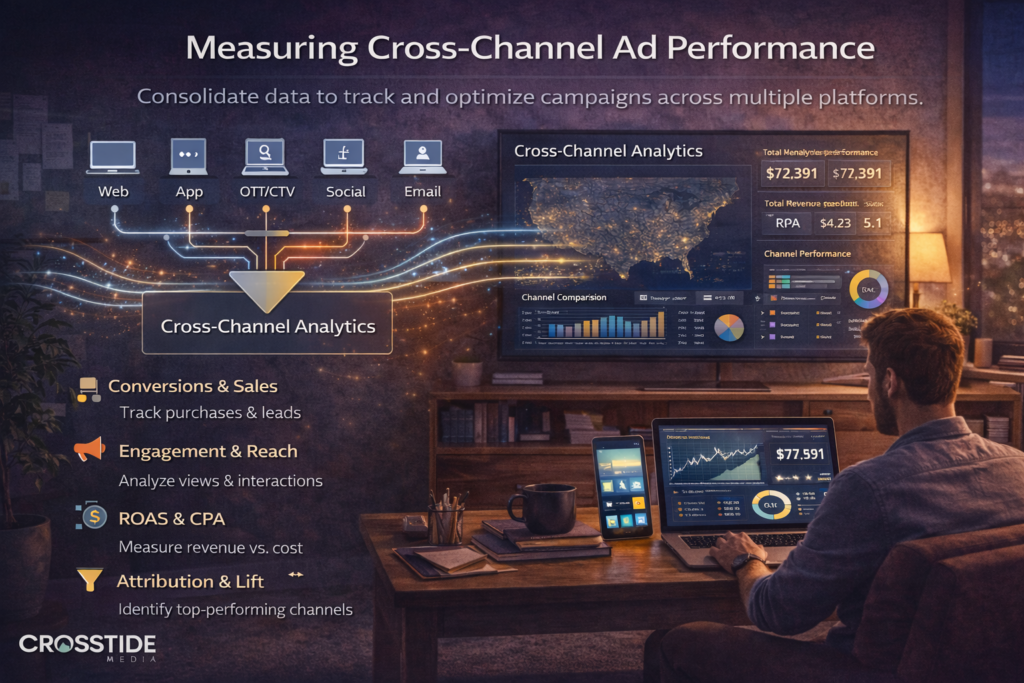
Some data partners are most valuable not because they target the audience directly, but because they help advertisers understand the audience and measure campaign outcomes.
These types of partners may support:
- audience measurement
- media planning insights
- cross-platform reporting
- reach and frequency understanding
- advanced audience modeling
- campaign validation
- attention or suitability analysis
- attribution support
This layer matters because better data is not only about targeting. It is also about making better decisions after the campaign is live.
Major Data Partners in the Market
There are many data partners in programmatic advertising, but several names come up consistently because of their role in audience strategy, contextual targeting, identity, brand safety, or measurement.
Some of the most recognized include:
- Experian
- Nielsen
- Lotame
- Peer39
- Comscore
- DoubleVerify
- LiveRamp
- OnSpot
Each one plays a different role, and not every campaign needs all of them. The real value comes from knowing which ones matter for the campaign objective.
Experian
Experian is often associated with consumer data, household insights, and audience segmentation. In programmatic media, it can be useful when advertisers need more detailed audience understanding around demographics, consumer profiles, household-level characteristics, or modeled audience categories.
Experian can be especially useful for:
- audience enrichment
- household-level planning
- consumer segmentation
- prospecting strategy
- category-specific audience expansion
- demographic and lifestyle modeling
Nielsen
Nielsen is widely associated with audience measurement, media planning, and cross-platform understanding. In a programmatic context, Nielsen can be valuable when advertisers need stronger measurement, advanced audience planning, or a better understanding of how campaigns perform across screens and media types.
Nielsen can be especially useful for:
- audience planning
- media measurement
- cross-platform audience analysis
- advanced audience frameworks
- campaign outcome understanding
broader media strategy alignment
Lotame
Lotame is often discussed in relation to identity, audience data, and addressable audience activation. It can be useful for advertisers that want to connect, enrich, and activate audience data across programmatic channels.
Lotame can be especially useful for:
- identity-informed audience strategy
- audience enrichment
- data collaboration
- addressable audience planning
- custom audience development
- activation across multiple media environments
Peer39
Peer39 is closely associated with contextual targeting, brand suitability, and pre-bid intelligence. It is often valuable for advertisers that want stronger content-level targeting without depending only on identity-based signals.
Peer39 can be especially useful for:
- contextual targeting
- pre-bid data activation
- brand suitability
- content alignment
- cookieless planning support
- connected TV contextual strategy
Comscore
Comscore is often relevant in media measurement, audience understanding, and cross-platform insights. In programmatic strategy, it can support stronger planning and a better understanding of audience and media performance.
Comscore can be especially useful for:
- audience insights
- media planning
- campaign measurement
- cross-channel analysis
- planning support for digital and streaming media
- publisher or inventory understanding
DoubleVerify
DoubleVerify is closely tied to media quality, verification, brand safety, and performance validation. It is often used to help advertisers understand whether impressions are viewable, brand-safe, fraud-free, and aligned to suitability expectations.
DoubleVerify can be especially useful for:
- brand safety
- suitability controls
- viewability measurement
- fraud reduction
- media verification
- campaign quality monitoring
For Crosstide Media, a partner like DoubleVerify can be a critical part of protecting media quality and reducing waste, especially in open-internet programmatic campaigns.
LiveRamp
LiveRamp plays a major role in first-party data activation and identity strategy. It is one of the most important tools in the programmatic landscape when advertisers want to turn owned customer data into usable media audiences.
LiveRamp can be especially useful for:
- first-party data onboarding
- identity resolution
- privacy-aware activation
- CRM audience strategy
- cross-channel customer targeting
- data collaboration support
OnSpot
OnSpot adds value in location intelligence, mobile geofencing, and place-based audience planning. It can be useful when real-world movement, retail visitation, venue-based behavior, or geographic audience precision is important to the campaign.
OnSpot can be especially useful for:
- mobile geofencing
- location-based audience strategy
- visitation-informed segmentation
- trade-area planning
- regional targeting
- real-world behavior overlays in programmatic media
PMP Deals, Data Costs, and Pricing Structure
One of the most misunderstood parts of the data landscape is pricing. Data is rarely just one simple fee. In programmatic media, pricing can be layered and negotiated in different ways depending on the partner, platform, buying method, and campaign objective.
Common pricing considerations in data strategy
These may include:
- CPM data fees
- platform usage costs
- audience segment fees
- onboarding costs
- measurement or verification fees
- premium inventory markups
- private marketplace pricing
- curated deal structures
Why PMP deals matter
Private marketplace deals, or PMPs, are not interchangeable. Every PMP is different based on:
- publisher quality
- inventory type
- audience overlays
- exclusivity
- data usage rights
- floor pricing
- transparency
- negotiation structure
This is one reason programmatic expertise matters. Average buying treats PMPs like interchangeable line items. Strong buying understands that every deal has its own real value, limitations, and negotiation opportunity.
How Crosstide approaches pricing and deal structure
At Crosstide Media, access matters, but deal intelligence matters more. We leverage platform access, data partnerships, first-party activation, pricing leverage, and PMP negotiation to build cleaner media plans. That means thinking carefully about what should run in open exchange, what deserves premium PMP access, what should be layered with data, and where cost actually creates value rather than just higher CPMs.
Why Data Partner Strategy Is Difficult
Data partner strategy sounds simple on paper, but it is one of the most complex parts of programmatic advertising.
The challenge is not just finding data. The challenge is knowing:
- which data actually improves targeting
- which partner is best for the objective
- when first-party data should lead
- when third-party data should expand reach
- when contextual is smarter than identity-based targeting
- how much data cost is worth paying
- which PMPs are truly premium
- how to avoid over-layering
- how to maintain scale without losing quality
Why this requires expertise
Without experience, it is easy to:
- overpay for weak audience segments
- use the wrong data partner for the wrong objective
- create audience overlap
- lose scale through over-targeting
- misread data costs
- misunderstand PMP quality
- underuse first-party data
- misapply geofencing or location signals
- build campaigns that sound sophisticated but perform poorly
For Crosstide Media, this is where premium programmatic knowledge matters. Strong data strategy is not about adding more layers for the sake of complexity. It is about using the right partners in the right way to improve real campaign outcomes.
Why Work With Crosstide Media?
Effective data partner strategy requires more than platform access or a list of audience providers. It takes planning, negotiation, activation knowledge, measurement discipline, and a clear understanding of how each partner fits within the broader programmatic ecosystem.
Crosstide Media helps advertisers execute data-driven programmatic strategies with:
- first-party data activation
- data partner selection
- identity strategy
- audience segmentation
- contextual and brand safety planning
- geofencing and location-informed targeting
- PMP negotiation
- pricing and deal evaluation
- cross-channel activation
- campaign measurement and optimization
We do not treat data as a generic add-on. We treat it as one of the most important strategic layers in programmatic advertising. Our focus is on helping advertisers use data partners in a way that improves audience quality, reduces waste, protects media quality, and creates better campaign performance.
Whether the goal is addressable audience targeting, first-party data activation, premium PMP access, stronger contextual targeting, or more advanced programmatic planning, Crosstide Media helps brands build smarter data partner strategies with the discipline and expertise required for long-term success.
Frequently Asked Questions
What are data partners in programmatic advertising?
Why are data partners important?
What is the difference between first-party data and third-party data?
What is addressable audience targeting?
Why is LiveRamp important in data strategy?
What is mobile geofencing data?
What does OnSpot do in the programmatic landscape?
What is a PMP in programmatic advertising?
Why are PMP deals different from each other?
Why work with a data strategy partner?
Build a Smarter Data Partner Strategy
If your business needs a more advanced programmatic audience strategy, Crosstide Media can help you plan, activate, and optimize campaigns built around stronger data partner selection, better first-party data use, more strategic PMP access, and clearer reporting. Whether your goal is to improve addressable audience targeting, activate first-party data with partners like LiveRamp, strengthen contextual strategy with partners like Peer39, protect media quality with DoubleVerify, or leverage mobile geofencing and location intelligence with partners like OnSpot, we help brands use data in a smarter, more performance-focused way.
Why Brands Choose Crosstide Media
Brands choose Crosstide Media because data strategy in programmatic advertising requires more than adding audience layers. Strong results come from the right mix of first-party data activation, third-party data selection, contextual intelligence, PMP negotiation, pricing discipline, measurement, and real programmatic expertise. Our approach is built to help advertisers improve audience precision, reduce waste, protect media quality, and make better decisions through stronger data strategy and more actionable campaign insights.
Talk to Crosstide Media About Data Partner Strategy
If you are looking for a partner that can help you navigate data partners, first-party activation, PMP strategy, addressable audience targeting, and smarter programmatic execution, Crosstide Media can help. We build data-driven programmatic strategies with the planning, negotiation, platform knowledge, and optimization discipline needed to support stronger long-term performance.
