
Government Advertising
Government Advertising Built for Public Awareness, Community Outreach, and Measurable Engagement
Government advertising campaigns need more than broad reach. They need clear messaging, trusted media environments, community relevance, accessible communication, and a media strategy that helps public organizations reach the right people with the right information.
Crosstide Media helps government agencies, public organizations, civic programs, and public-facing initiatives plan and execute digital advertising campaigns built around awareness, education, outreach, community engagement, CTV, DOOH, program participation, and measurable public response.
Whether the goal is to increase awareness, educate residents, promote a public resource, encourage safer behavior, support program enrollment, drive event participation, or improve community engagement, government advertising works best when audience strategy, media channels, creative messaging, and reporting are built around the public objective.
We help government organizations reach communities with clear, neutral, relevant, and actionable messaging across high-quality digital media environments.
Jump To
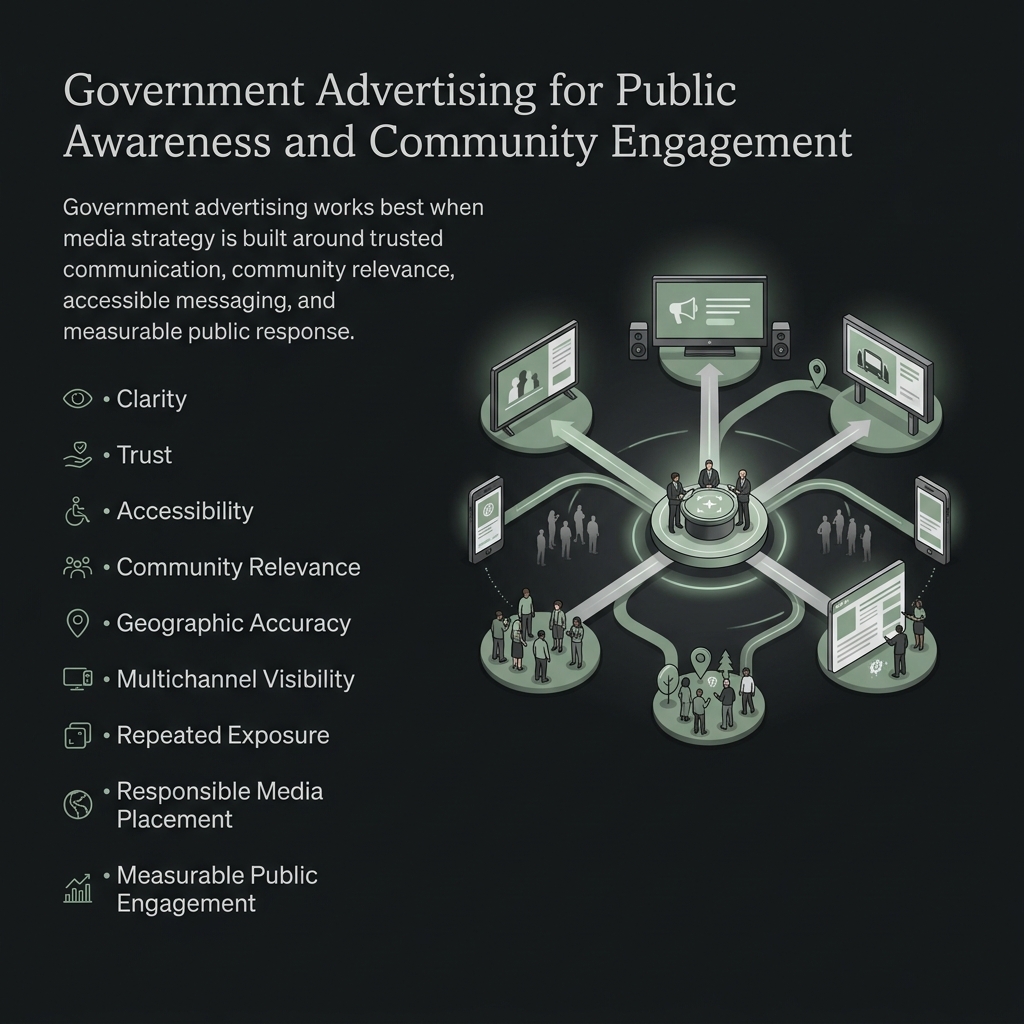
Government Advertising for Public Awareness and Community Engagement
Government campaigns are often designed to inform, educate, and encourage action. These campaigns may support important public programs, civic services, safety initiatives, public health efforts, transportation campaigns, adoption awareness, workforce development, emergency preparedness, or community outreach.
Unlike political campaigns, government advertising is not focused on elections or voter persuasion. Government messaging is usually focused on public service communication.
That means the media strategy should prioritize:
- Clarity
- Trust
- Accessibility
- Community relevance
- Geographic accuracy
- Multichannel visibility
- Repeated exposure
- Responsible media placement
- Measurable public engagement
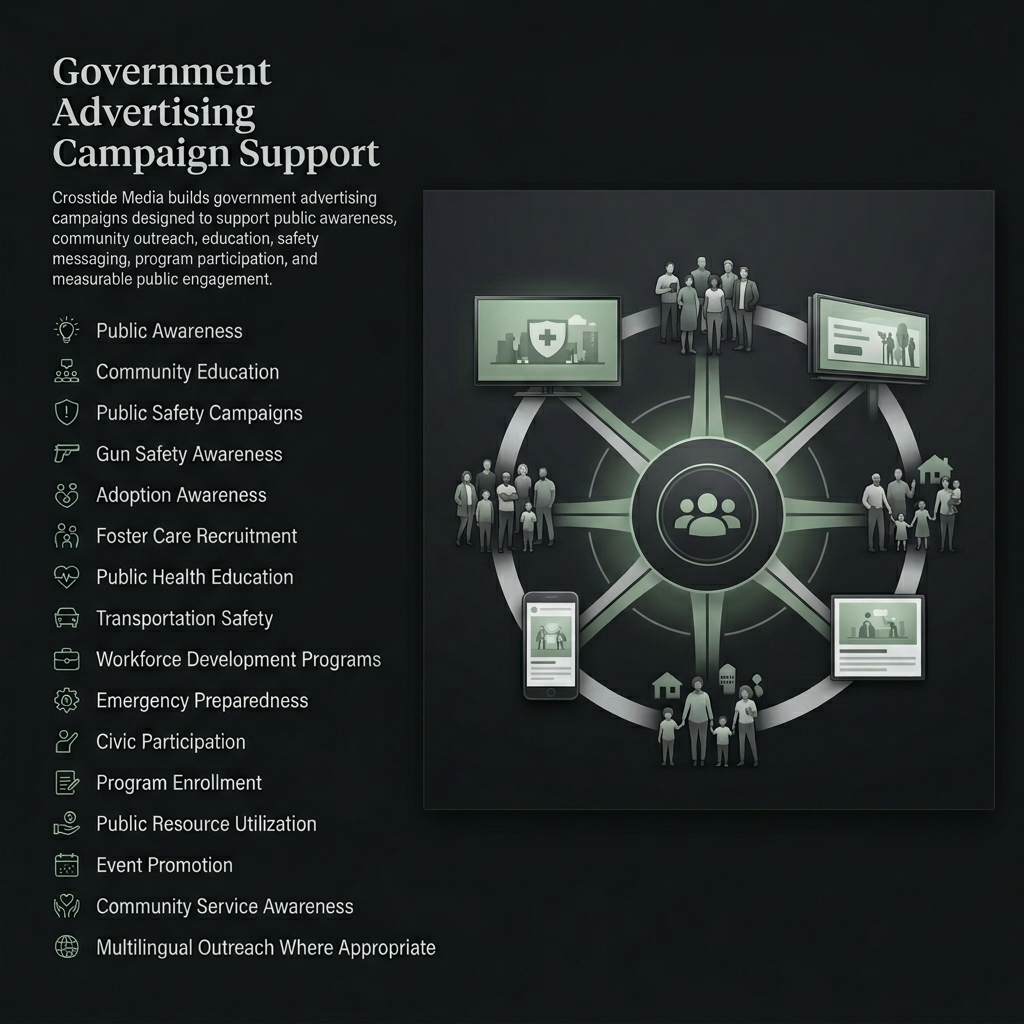
Crosstide Media builds government advertising campaigns designed to support:
- Public awareness
- Community education
- Public safety campaigns
- Gun safety awareness
- Adoption awareness
- Foster care recruitment
- Public health education
- Transportation safety
- Workforce development programs
- Emergency preparedness
- Civic participation
- Program enrollment
- Public resource utilization
- Event promotion
- Community service awareness
- Multilingual outreach where appropriate
Our approach is neutral, data-driven, and objective-focused. We help public organizations deliver useful information to the communities they serve.
What Is Government Advertising?
Government advertising refers to paid media campaigns created by public agencies, civic organizations, municipalities, departments, commissions, public programs, and government-funded initiatives to communicate with residents or defined communities.
Government advertising may be used to:
- Increase public awareness
- Educate residents
- Promote a public program
- Encourage participation
- Drive resource utilization
- Support behavior change
- Improve safety awareness
- Promote public events
- Share emergency or preparedness information
- Recruit families, workers, volunteers, or participants
- Reach underserved or priority communities
Digital government advertising may include:
- Connected TV advertising
- Programmatic display advertising
- Online video advertising
- Mobile advertising
- Streaming audio advertising
- Native advertising
- Programmatic digital out-of-home advertising
- Retargeting
- Contextual targeting
- Geographic targeting
- Addressable household targeting where appropriate
- First-party data activation
- Multilingual campaign delivery
- Community-focused media planning
The best government advertising campaigns are not just broad awareness campaigns. They are structured communication efforts that connect public messages to the people and communities most likely to need, use, or respond to the information.
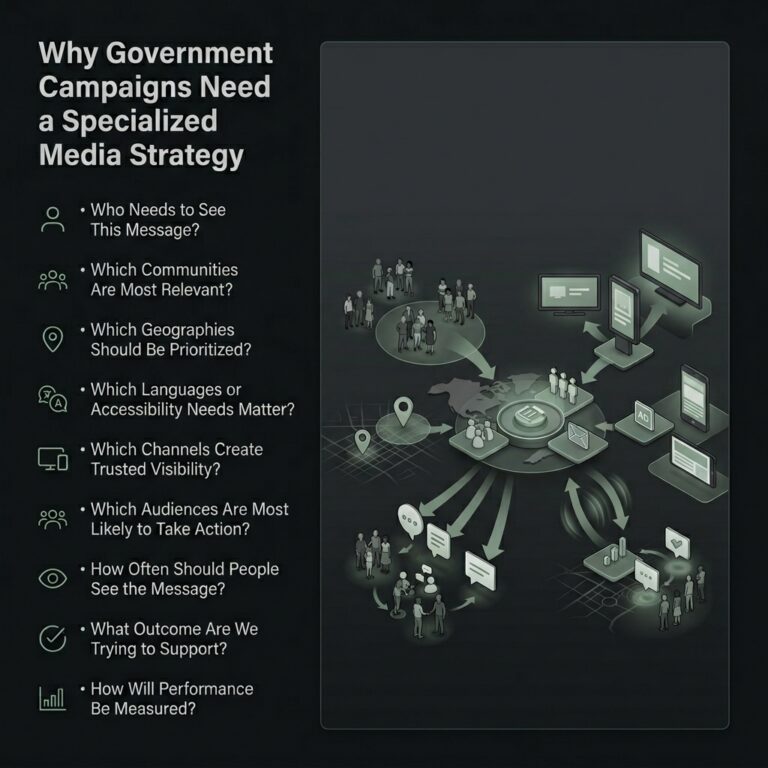
Why Government Campaigns Need a Specialized Media Strategy
Government advertising campaigns often carry high public importance. The message needs to be clear, accurate, responsible, and easy to understand. Media delivery also needs to be efficient, transparent, and aligned with the communities being served.
A strong government media strategy should answer questions such as:
- Who needs to see this message?
- Which communities are most relevant?
- Which geographies should be prioritized?
- Which languages or accessibility needs should be considered?
- Which channels create the most trusted visibility?
- Which audiences are most likely to take action?
- How often should people see the message?
- What action or outcome are we trying to support?
- How will performance be measured?
Government campaigns require more than launching ads into market. They require planning around audience relevance, media quality, message clarity, accessibility, geography, timing, reporting, and optimization.
Crosstide Media helps government organizations build campaigns with the structure needed to communicate clearly and perform efficiently.
Connected TV Government Advertising
Connected TV is one of the most valuable channels for government advertising because it combines the high-impact storytelling of television with digital media targeting and measurement.
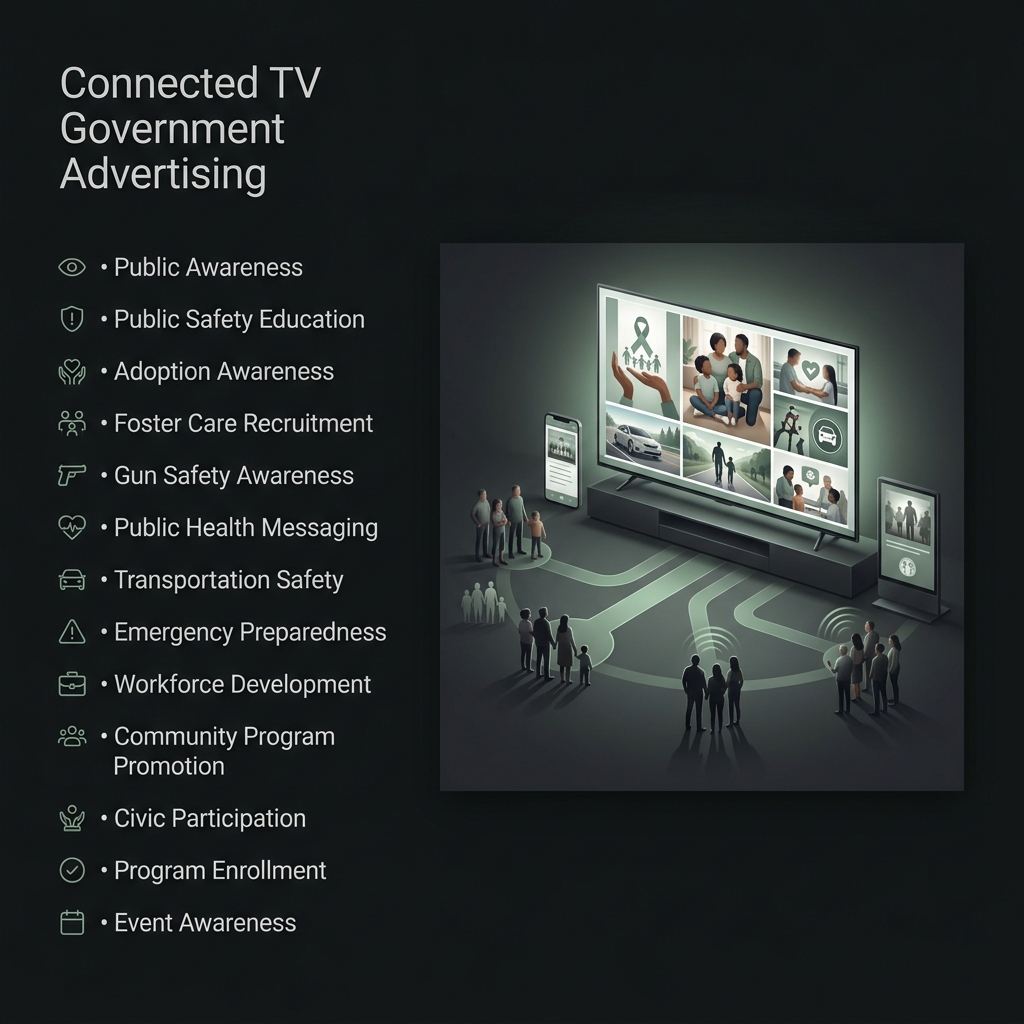
Government agencies and public organizations can use CTV to reach households with public awareness messages in premium streaming environments. This is especially useful when a campaign needs to communicate trust, urgency, education, or emotional relevance.
CTV can support government campaigns focused on:
- Public awareness
- Public safety education
- Adoption awareness
- Foster care recruitment
- Gun safety awareness
- Public health messaging
- Transportation safety
- Emergency preparedness
- Workforce development
- Community program promotion
- Civic participation
- Program enrollment
- Event awareness
CTV is valuable because many government messages need more than a banner ad. They need explanation, tone, trust, and repeated exposure. Video helps communicate the message clearly while CTV helps reach households in a premium environment.
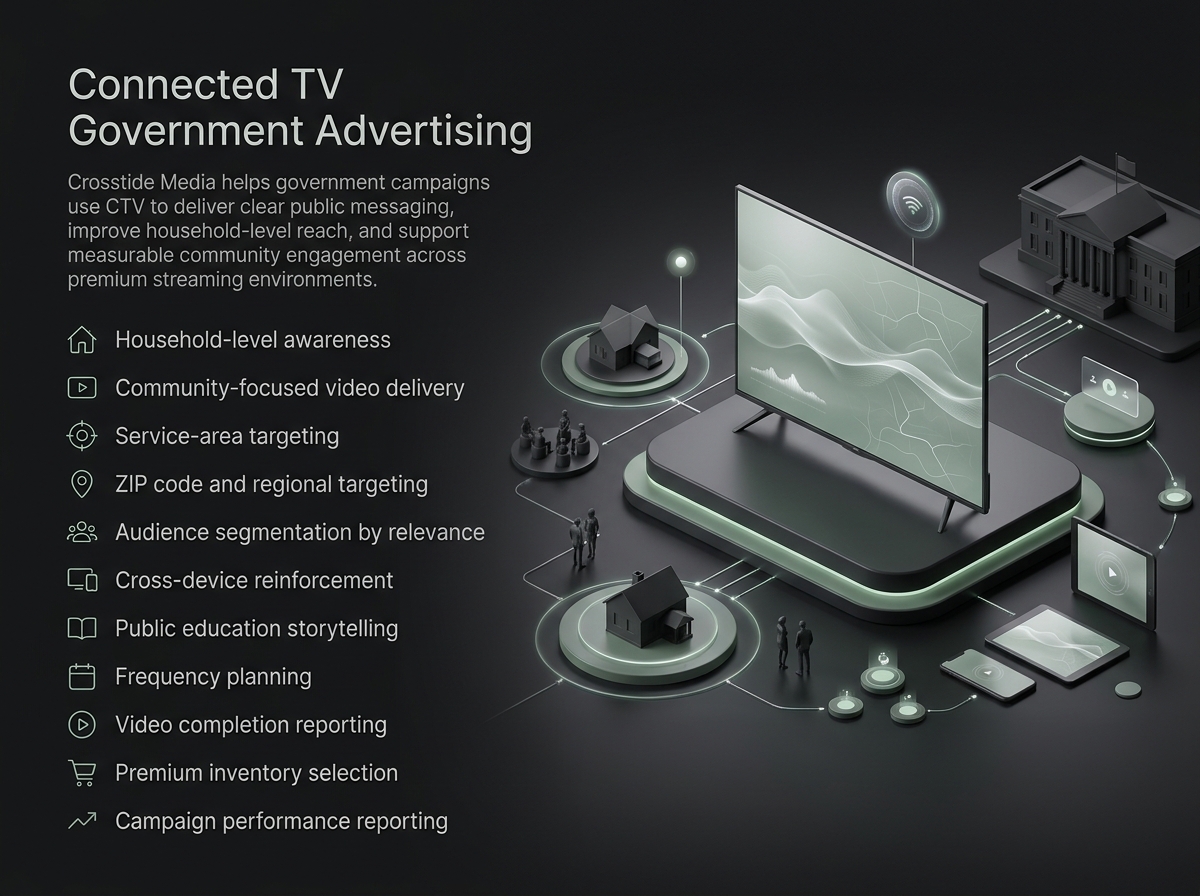
Crosstide Media helps government campaigns use CTV for:
- Household-level awareness
- Community-focused video delivery
- Service-area targeting
- ZIP code and regional targeting
- Audience segmentation by relevance
- Cross-device reinforcement
- Public education storytelling
- Frequency planning
- Video completion reporting
- Premium inventory selection
- Campaign performance reporting
CTV can be especially effective when it serves as the anchor channel for a broader public awareness campaign.
Why CTV Matters for Government Messaging
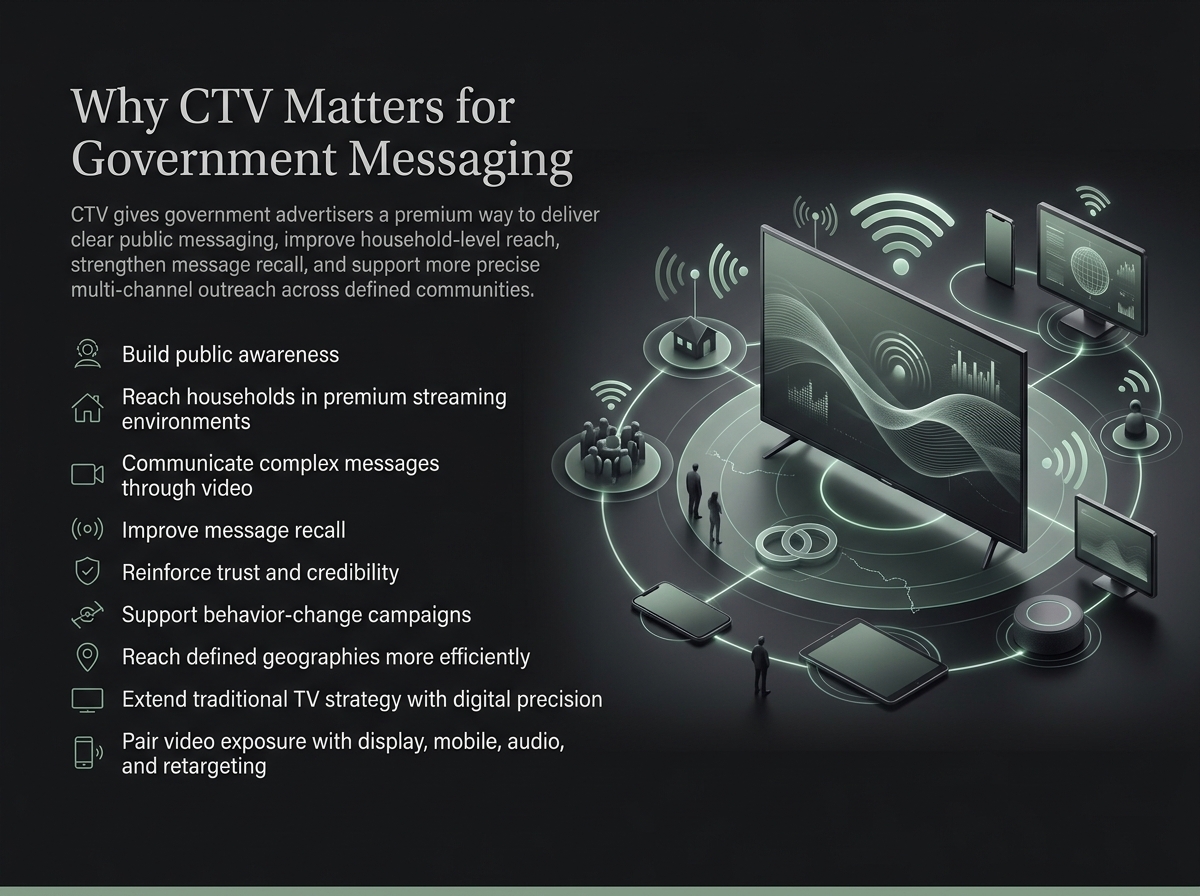
Connected TV gives government campaigns a high-impact way to explain important public messages. A public health campaign, adoption awareness campaign, gun safety campaign, or transportation safety initiative may need to communicate information in a way that feels clear, serious, and trustworthy.
CTV helps government advertisers:
- Build public awareness
- Reach households in premium streaming environments
- Communicate complex messages through video
- Improve message recall
- Reinforce trust and credibility
- Support behavior-change campaigns
- Reach defined geographies more efficiently
- Extend traditional TV strategy with digital precision
- Pair video exposure with display, mobile, audio, and retargeting
CTV is not just a visibility channel. For government campaigns, it can be a public education tool.
A strong CTV campaign may introduce the message to households through video, then reinforce the campaign across display, mobile, streaming audio, native, or DOOH placements.
CTV for Public Awareness Campaigns
Public awareness campaigns often need broad but relevant visibility. CTV helps government organizations reach households with video messaging that can explain the campaign clearly and consistently.
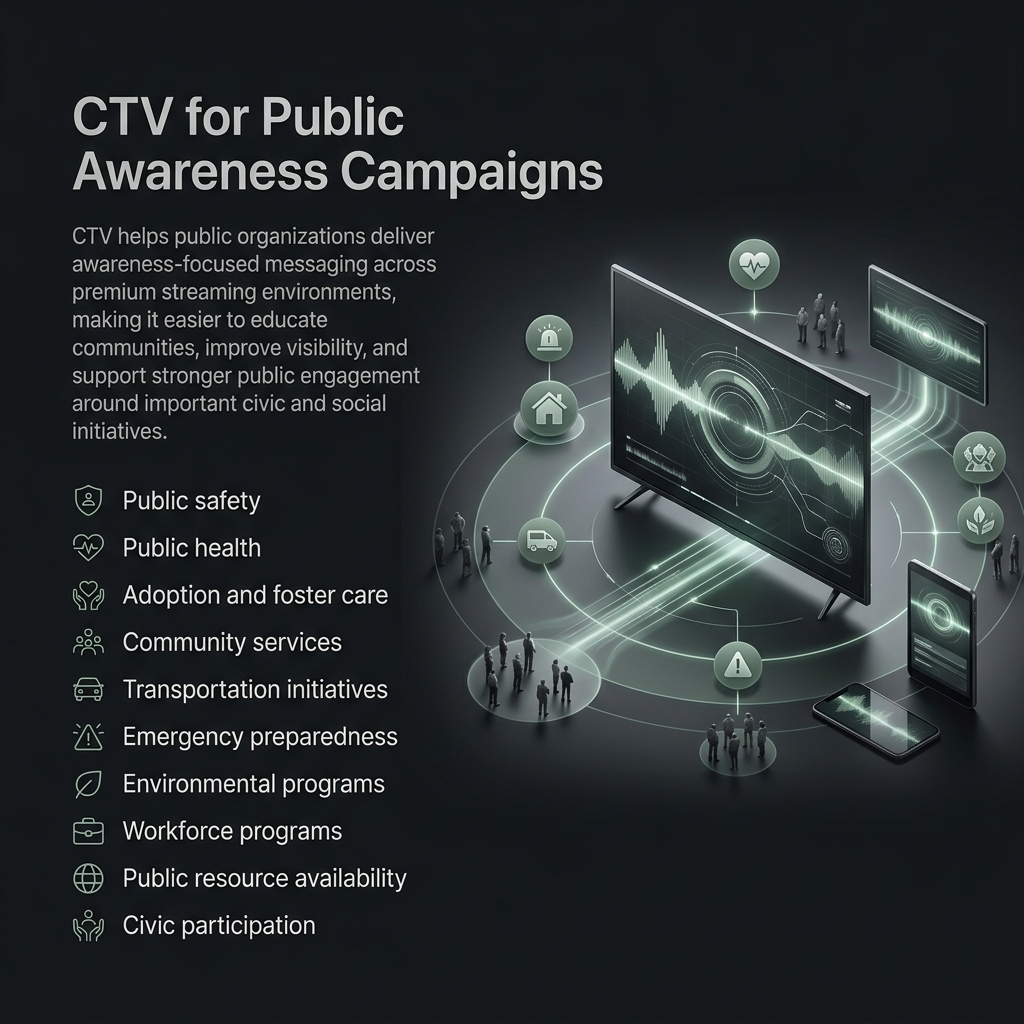
CTV can be used for awareness campaigns related to:
- Public safety
- Public health
- Adoption and foster care
- Community services
- Transportation initiatives
- Emergency preparedness
- Environmental programs
- Workforce programs
- Public resource availability
- Civic participation
The goal is to make the message visible, understandable, and memorable.
CTV for Public Education Campaigns
Some government campaigns need to educate people about an issue, a resource, or a behavior. These campaigns often require more explanation than static ads can provide.
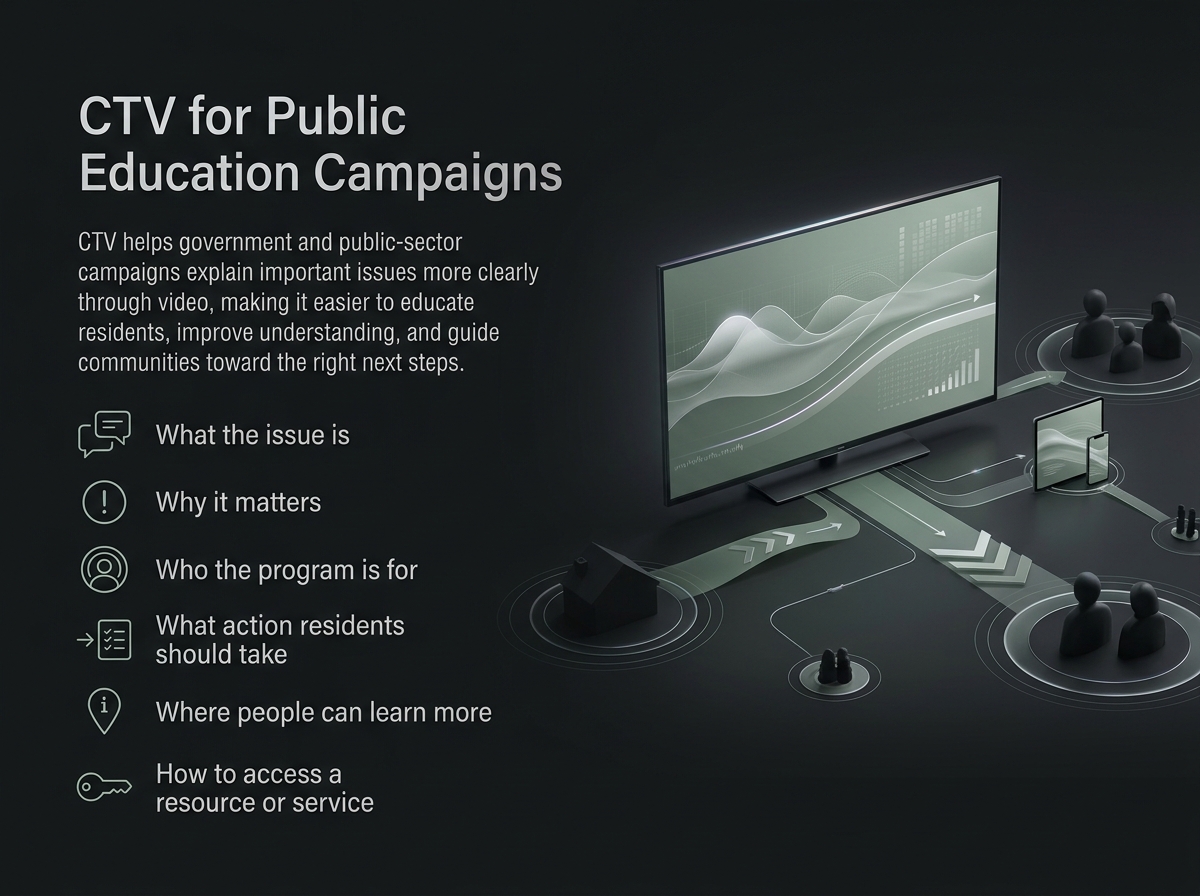
CTV can help explain:
- What the issue is
- Why it matters
- Who the program is for
- What action residents should take
- Where people can learn more
- How to access a resource or service
Video is especially useful when the campaign needs to build understanding before asking for action.
CTV for Behavior-Change Campaigns
Behavior-change campaigns often require repeated exposure, clear messaging, and a trusted media environment.
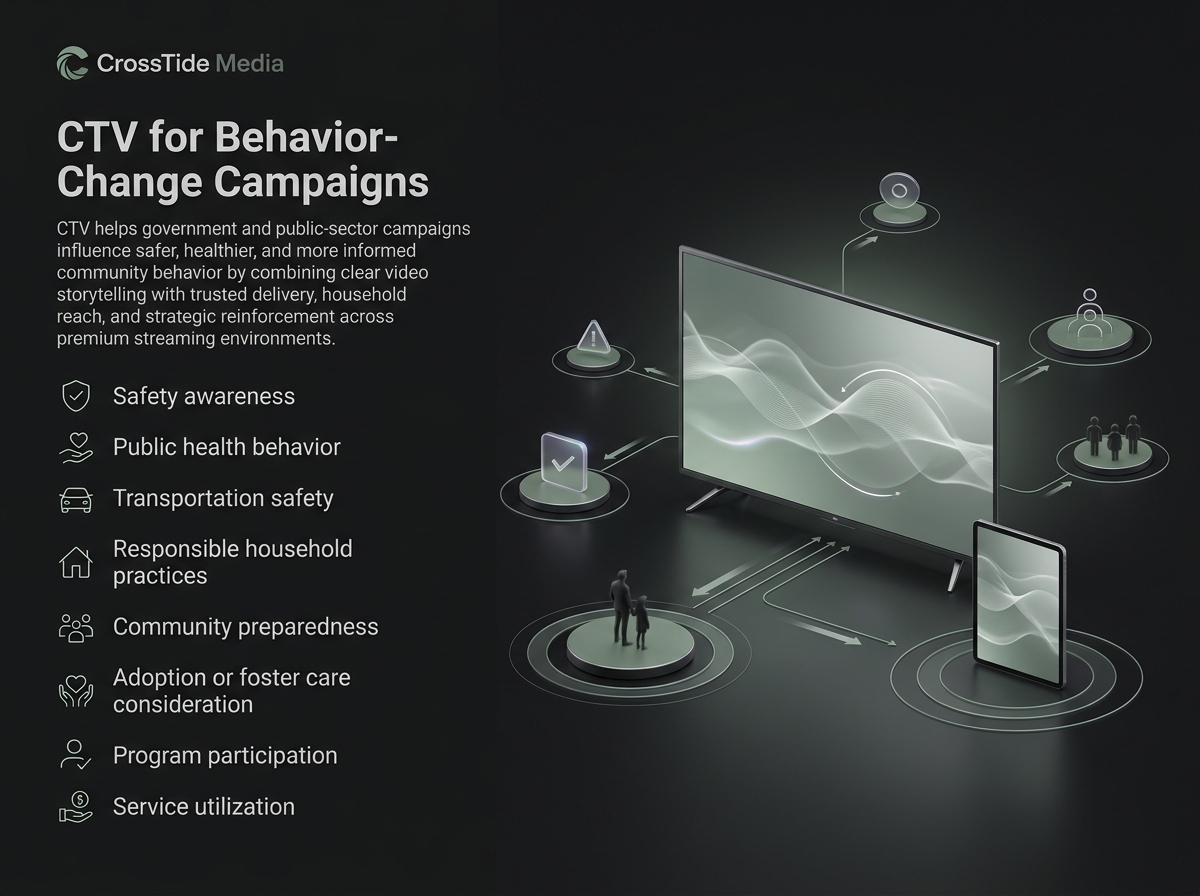
CTV can support campaigns focused on:
- Safety awareness
- Public health behavior
- Transportation safety
- Responsible household practices
- Community preparedness
- Adoption or foster care consideration
- Program participation
- Service utilization
These campaigns usually work best when CTV is paired with other channels that reinforce the message over time.
CTV for Program Enrollment and Resource Utilization
Government agencies may need to increase participation in public programs, drive enrollment, or encourage residents to use available services.
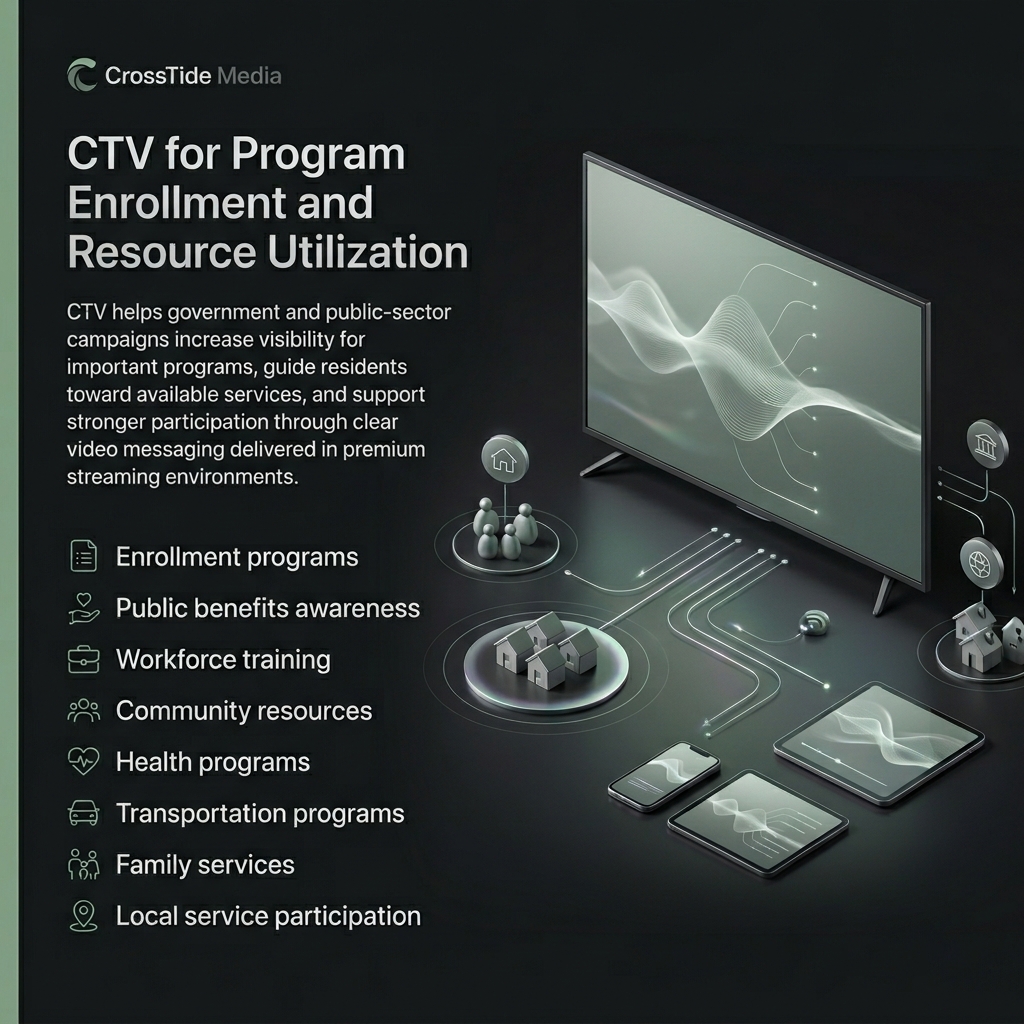
CTV can help build awareness and credibility, while other channels such as display, mobile, native, search-aligned landing pages, or retargeting help move users toward action.
Campaigns may support:
- Enrollment programs
- Public benefits awareness
- Workforce training
- Community resources
- Health programs
- Transportation programs
- Family services
- Local service participation
CTV can help create demand and awareness before lower-funnel channels drive response.
Cross-Device Government Advertising With CTV at the Center
Government messages are often seen across many media moments. A resident may first see a public awareness video on CTV, then later see a display ad on a news site, hear an audio reminder, see a mobile ad, or pass a digital out-of-home screen in a priority community.
Cross-device government advertising helps connect these touchpoints into a more consistent campaign.
Crosstide Media helps government campaigns connect CTV with:
- Display advertising
- Online video
- Mobile advertising
- Streaming audio
- Native advertising
- DOOH
- Retargeting
- First-party audiences where available
- Community and geographic targeting
A sample government campaign journey may look like this:
- A household sees a CTV public awareness message.
- The same community is reinforced with display and mobile ads.
- Residents who visit the campaign landing page are retargeted with additional information.
- DOOH adds public visibility in priority service areas.
- Reporting shows which geographies, messages, and channels are driving engagement.
This approach helps government organizations maintain message consistency while improving reach, frequency, and response.
Government Audience Targeting Strategy
Government audience targeting should be built around public need, community relevance, geography, and campaign objective.
Unlike political targeting, government targeting is not usually centered on voter persuasion. It is centered on reaching the people most likely to need, benefit from, or respond to the public message.
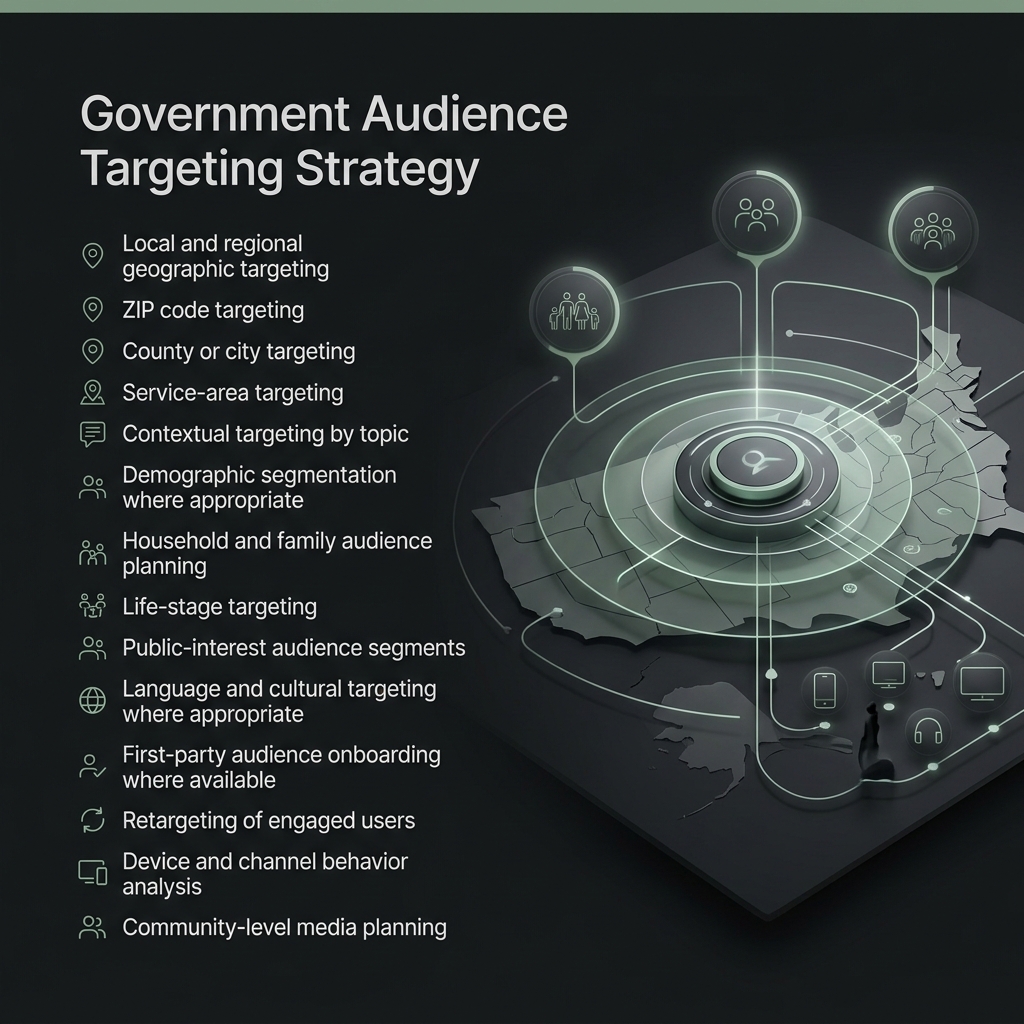
Government targeting strategies may include:
- Local and regional geographic targeting
- ZIP code targeting
- County or city targeting
- Service-area targeting
- Contextual targeting by topic
- Demographic segmentation where appropriate
- Household and family audience planning
- Life-stage targeting
- Public-interest audience segments
- Language and cultural targeting where appropriate
- First-party audience onboarding where available
- Retargeting of engaged users
- Device and channel behavior analysis
- Community-level media planning
The right targeting strategy depends on the campaign goal.
A campaign promoting adoption awareness may prioritize families, caregivers, community-minded audiences, or people engaging with related content. A gun safety awareness campaign may prioritize household audiences, safety-focused content environments, parents, or community education segments depending on the message. A workforce campaign may focus on specific geographies, age ranges, career-interest segments, or training-related content.
The goal is to improve relevance without excluding communities that need the information.
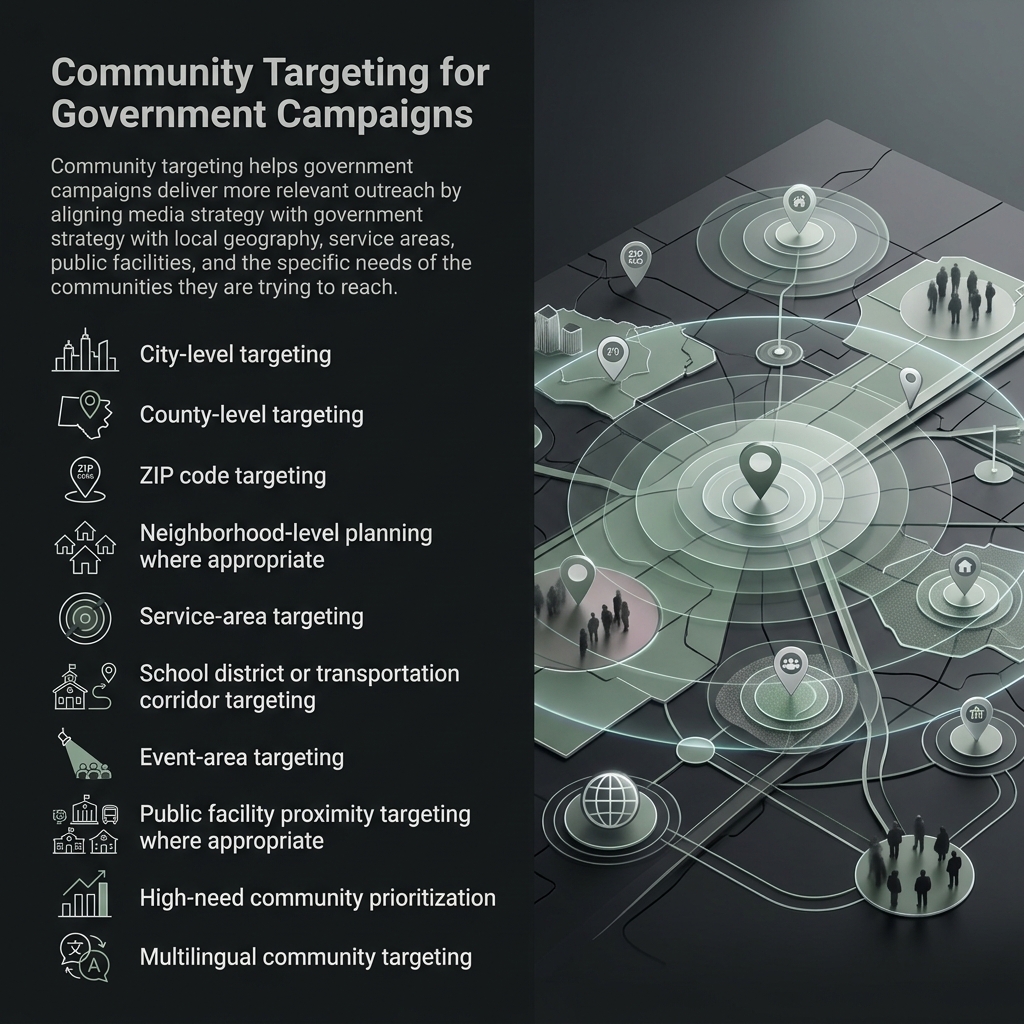
Community Targeting for Government Campaigns
Government campaigns often need to reach specific communities based on geography, need, service availability, or public relevance.
Community targeting may include:
- City-level targeting
- County-level targeting
- ZIP code targeting
- Neighborhood-level planning where appropriate
- Service-area targeting
- School district or transportation corridor targeting
- Event-area targeting
- Public facility proximity targeting where appropriate
- High-need community prioritization
- Multilingual community targeting
Community targeting is especially useful when a campaign is tied to a local program, regional service, public meeting, public safety effort, or community resource.
Crosstide Media helps government advertisers focus spend where the message is most relevant while maintaining responsible reach across the intended service area.
Addressable Household Targeting for Government Campaigns
Addressable household targeting can be useful for government campaigns when the campaign message is relevant at the household level.
For government advertising, household targeting is not about voter persuasion. It is about reaching households that may be more likely to need, use, or respond to a public message.
Household-level planning may be useful for campaigns related to:
- Public safety
- Gun safety awareness
- Adoption awareness
- Foster care recruitment
- Family services
- Public health education
- Transportation safety
- Emergency preparedness
- Home safety
- Community resource awareness
- Program enrollment
Addressable household targeting can help government campaigns improve:
- Message relevance
- Household-level exposure
- Frequency control
- Community reach
- Cross-device reinforcement
- Waste reduction
- Media efficiency
A household may first see a CTV awareness message, then later receive a mobile or display reminder that directs them to a public resource, event, or landing page.
First-Party Data Strategy for Government Campaigns
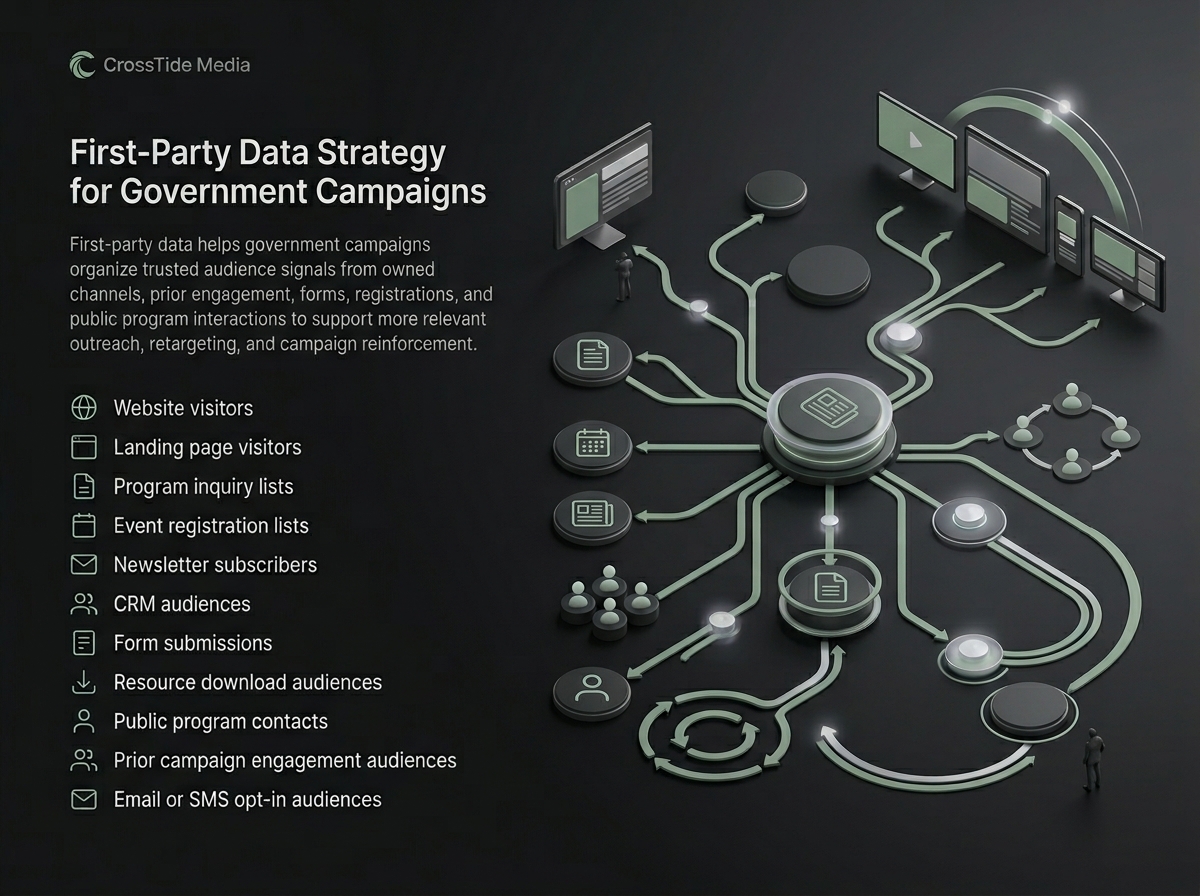
First-party data can help government organizations reach people who have already interacted with a program, website, campaign, or public resource.
Examples of first-party data that may be used where appropriate include:
- Website visitors
- Landing page visitors
- Program inquiry lists
- Event registration lists
- Newsletter subscribers
- CRM audiences
- Form submissions
- Resource download audiences
- Public program contacts
- Prior campaign engagement audiences
- Email or SMS opt-in audiences
First-party data can support several campaign strategies.
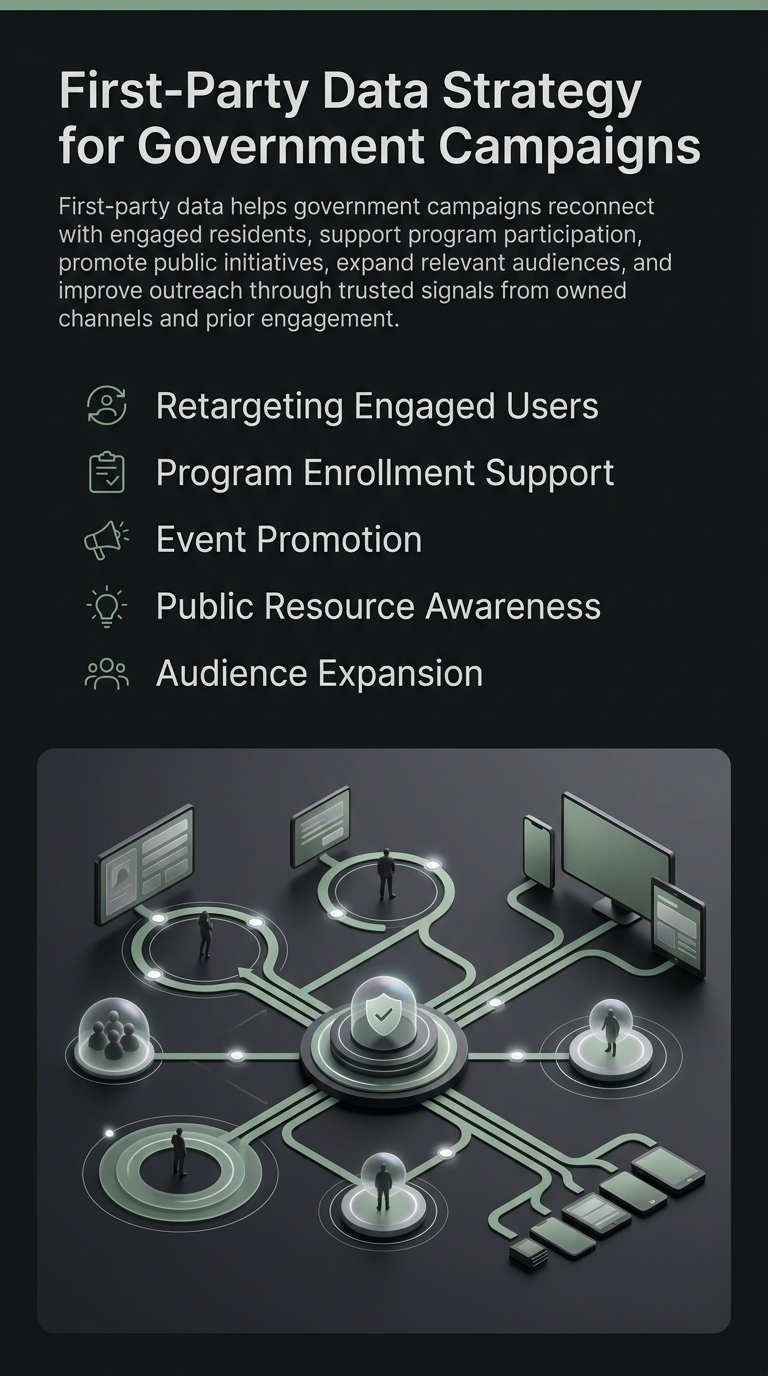
Retargeting Engaged Users
Residents who visit a campaign landing page, program page, or resource page can be retargeted with follow-up messaging.
Program Enrollment Support
People who begin but do not complete a program inquiry or form may be reached with reminder messaging where appropriate.
Event Promotion
Government organizations can reach people who have previously engaged with event information or related resources.
Public Resource Awareness
First-party audiences can be used to remind interested users about available services, deadlines, or next steps.
Audience Expansion
Where appropriate and compliant, first-party engagement data may help inform broader audience modeling or campaign planning. First-party data is most useful when it is organized by campaign objective, user intent, and privacy-conscious activation standards.
Contextual Targeting for Government Advertising
Contextual targeting is especially valuable for government campaigns because it allows ads to appear near content that is relevant to the campaign topic.
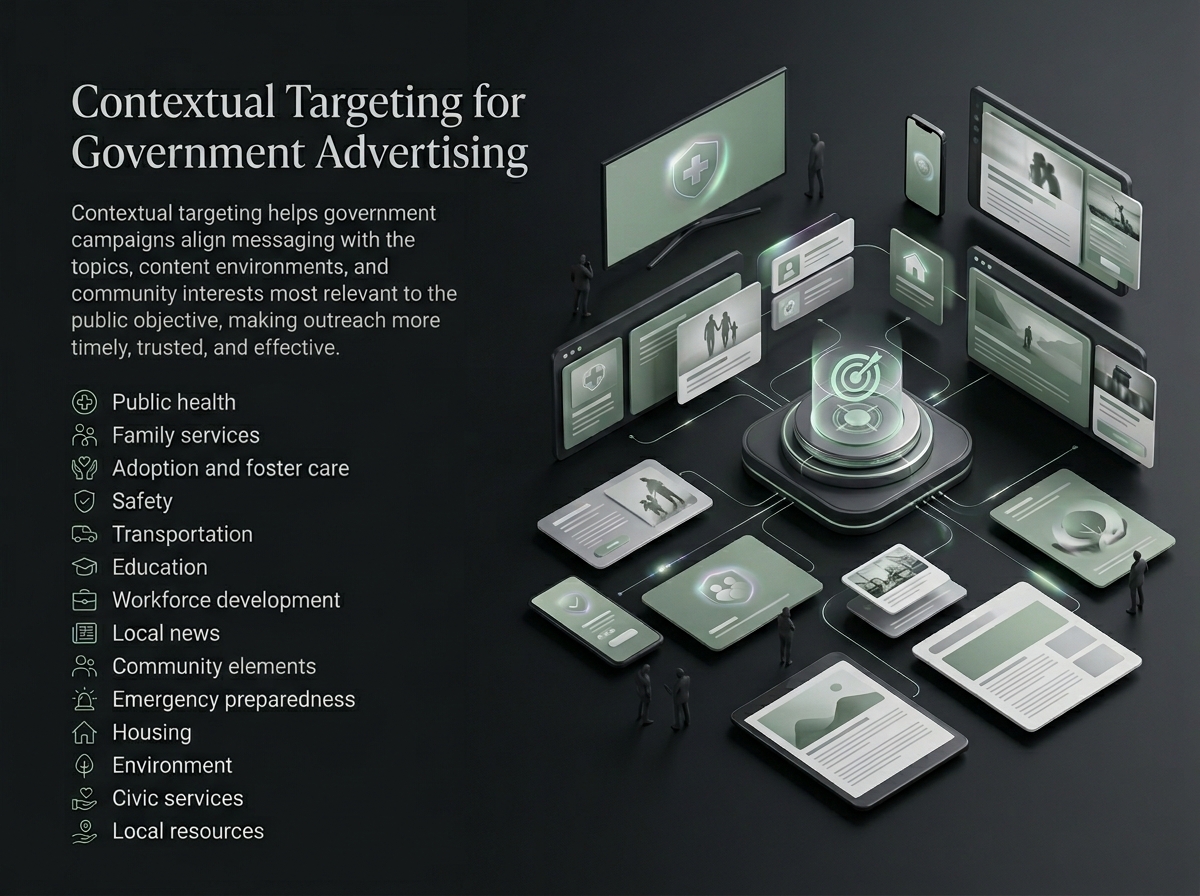
Government contextual targeting may include content related to:
- Public health
- Family services
- Adoption and foster care
- Safety
- Transportation
- Education
- Workforce development
- Local news
- Community events
- Emergency preparedness
- Housing
- Environment
- Civic services
- Local resources
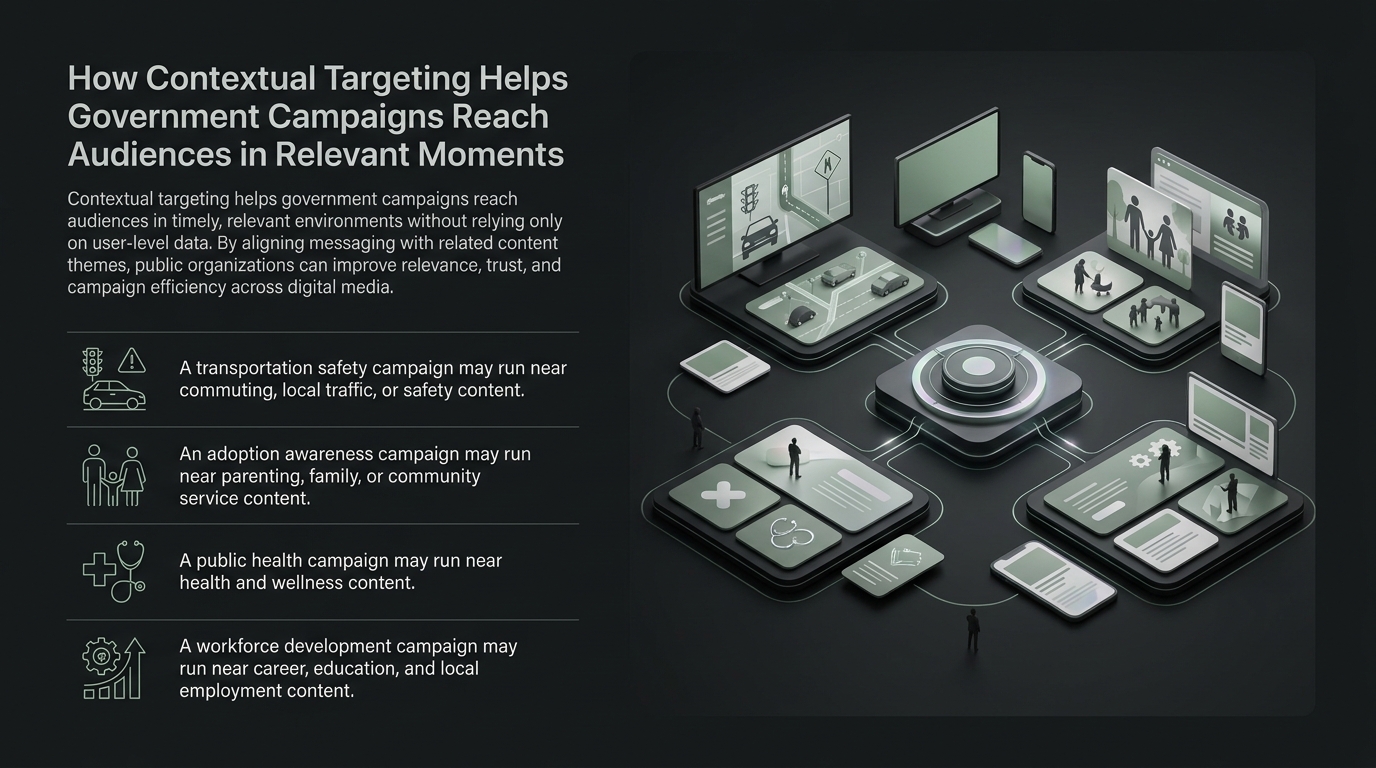
Contextual targeting can help government campaigns reach audiences in relevant moments without relying only on user-level data.
For example:
- A transportation safety campaign may run near commuting, local traffic, or safety content.
- An adoption awareness campaign may run near parenting, family, or community service content.
- A public health campaign may run near health and wellness content.
- A workforce development campaign may run near career, education, and local employment content.
This approach can improve relevance while supporting privacy-conscious media planning.
Programmatic DOOH for Government Campaigns
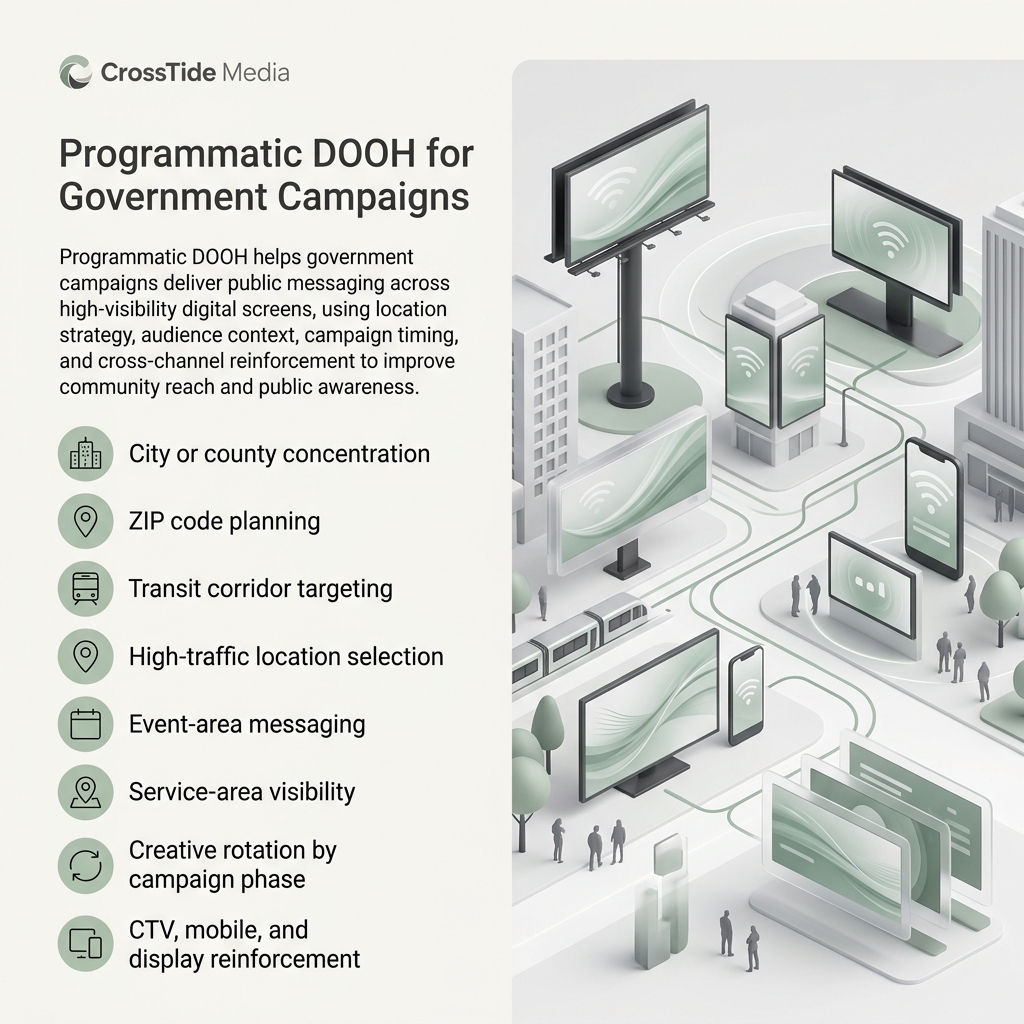
Programmatic digital out-of-home, or DOOH, can be a strong channel for government campaigns when public visibility and geography matter.
DOOH allows government advertisers to place digital messages on screens in public environments such as:
- Roadside digital displays
- Transit stations
- Bus shelters
- Retail locations
- Convenience stores
- Office buildings
- Gyms
- Medical environments where available
- Community venues
- High-traffic public areas
Government DOOH can support campaigns focused on:
- Public safety awareness
- Public health messaging
- Transportation campaigns
- Emergency preparedness
- Adoption awareness
- Workforce programs
- Event promotion
- Local service awareness
- Community resource visibility
- Civic participation
DOOH is especially useful when a campaign needs to create visible community presence in priority geographies.
Government DOOH strategies may include:
- City or county concentration
- ZIP code planning
- Transit corridor targeting
- High-traffic location selection
- Event-area messaging
- Service-area visibility
- Creative rotation by campaign phase
- CTV, mobile, and display reinforcement
DOOH works best when paired with other digital channels. For example, CTV can deliver the story at home, DOOH can reinforce visibility in the community, and mobile or display can guide residents to a landing page or resource.
Government Programmatic Advertising
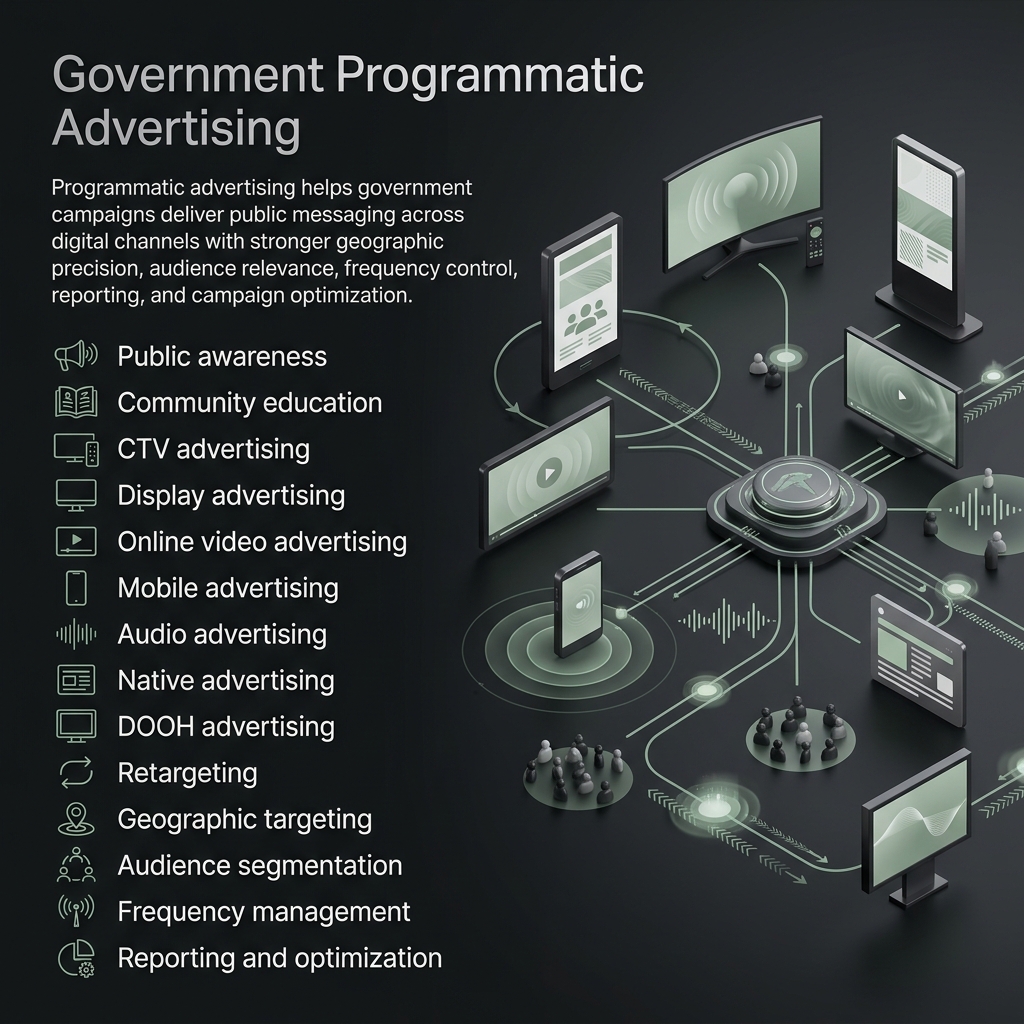
Programmatic advertising allows government organizations to run digital media across a wide range of websites, apps, streaming environments, video platforms, audio platforms, and connected devices using audience data, contextual signals, geography, bidding controls, and real-time optimization.
Government programmatic advertising can support:
- Public awareness
- Community education
- CTV advertising
- Display advertising
- Online video advertising
- Mobile advertising
- Audio advertising
- Native advertising
- DOOH advertising
- Retargeting
- Geographic targeting
- Audience segmentation
- Frequency management
- Reporting and optimization
Programmatic media is especially useful for government campaigns because it allows budgets to shift based on performance, geography, channel delivery, and engagement.
A government campaign may begin with broad community awareness, then increase budget toward geographies, channels, or creative messages showing stronger response.
Government Advertising Channels
Government campaigns perform best when each channel has a clear role. Crosstide Media builds channel strategies based on campaign objective, audience, geography, message complexity, accessibility needs, budget, and reporting goals.
Connected TV
Connected TV can serve as the anchor channel for public awareness and education campaigns. It is useful for storytelling, trust-building, message recall, and household-level visibility. CTV can support public safety, public health, adoption awareness, transportation, workforce, emergency preparedness, and community program campaigns.
Display
Display advertising supports broad visibility, message reinforcement, retargeting, and landing page traffic. Display is useful for promoting public resources, service availability, program enrollment, event awareness, and educational messages.
Online Video
Online video helps government campaigns communicate information through visual storytelling across desktop, mobile, tablet, and premium video environments. It can extend the reach of CTV and help reinforce public education messages.
Mobile
Mobile advertising helps reach residents throughout the day and can support local awareness, event promotion, resource reminders, public safety messaging, and action-oriented campaigns. Mobile is especially useful when the campaign is tied to geography, timing, or a simple next step.
Streaming Audio
Streaming audio helps government organizations reinforce messages during commuting, working, exercising, or daily listening moments. Audio can support awareness, safety messaging, public health reminders, community outreach, and event promotion.
Native
Native advertising is useful when a government campaign needs to explain a topic in more depth. Native can support education, public resource awareness, adoption or foster care information, workforce programs, and longer-form content engagement.
Programmatic DOOH
DOOH helps government campaigns create public visibility in priority geographies. It can support public safety, transportation, emergency preparedness, event promotion, service-area awareness, and community visibility.
Retargeting
Retargeting helps government organizations follow up with users who have already visited a website, landing page, form, or resource page. Retargeting can help move users from awareness to action.
Government Display Advertising
Display advertising is one of the most flexible channels for government campaigns. It can support awareness, education, retargeting, event promotion, and program participation.
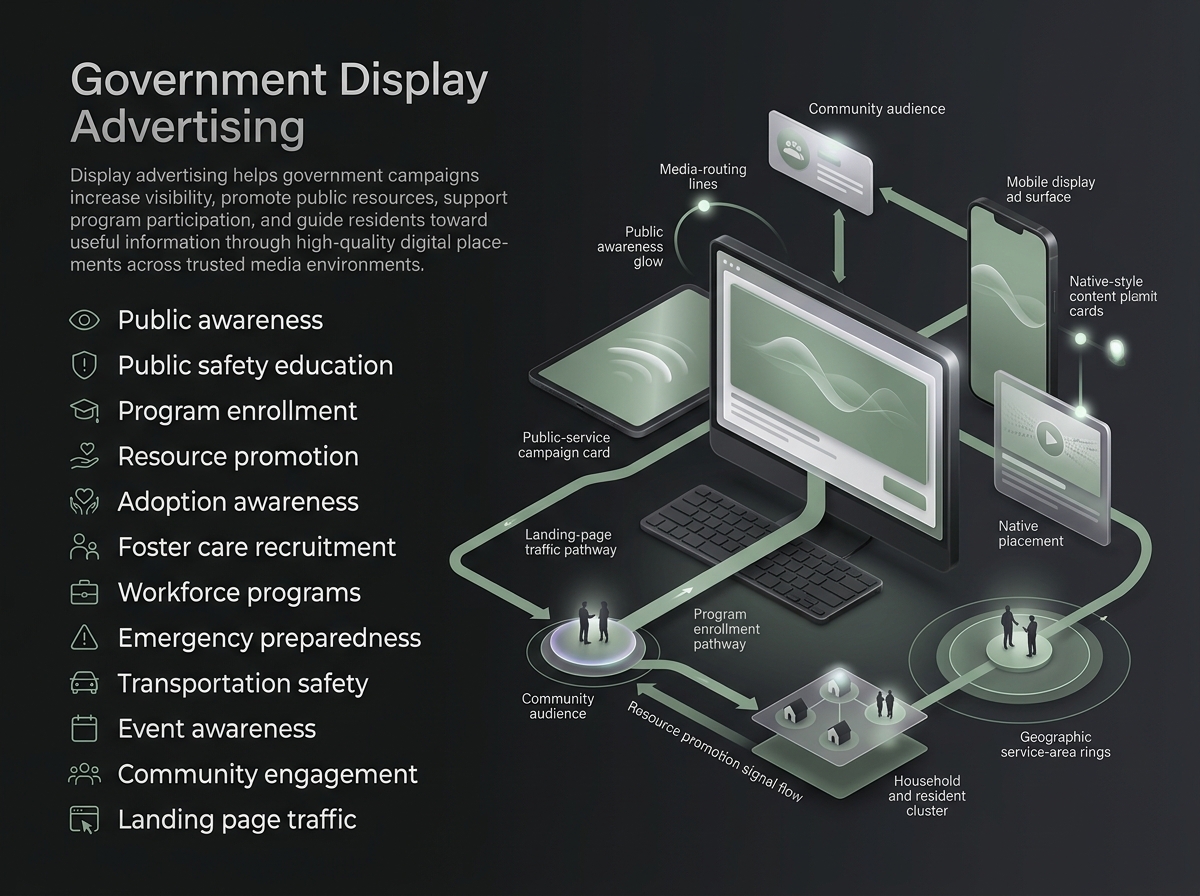
Government display advertising may be used for:
- Public awareness
- Public safety education
- Program enrollment
- Resource promotion
- Adoption awareness
- Foster care recruitment
- Workforce programs
- Emergency preparedness
- Transportation safety
- Event awareness
- Community engagement
- Landing page traffic
Display works well as a reinforcement channel. After a household sees a CTV ad, display can help remind users of the message and guide them to more information.
Government display advertising may be used for:
- Public awareness
- Public safety education
- Program enrollment
- Resource promotion
- Adoption awareness
- Foster care recruitment
- Workforce programs
- Emergency preparedness
- Transportation safety
- Event awareness
- Community engagement
- Landing page traffic
Display works well as a reinforcement channel. After a household sees a CTV ad, display can help remind users of the message and guide them to more information.
Government Video Advertising
Video advertising helps government organizations communicate messages that require explanation, emotion, trust, or demonstration.
Government video advertising can support:
- Public awareness campaigns
- Public health education
- Safety instructions
- Adoption and foster care storytelling
- Transportation safety
- Emergency preparedness
- Community programs
- Workforce development
- Program enrollment
- Civic participation
Video can run across:
- Connected TV
- Online video
- Mobile video
- In-stream video
- Outstream video
- Premium publisher environments
Strong government video creative should be clear, accessible, direct, and aligned with the public objective.
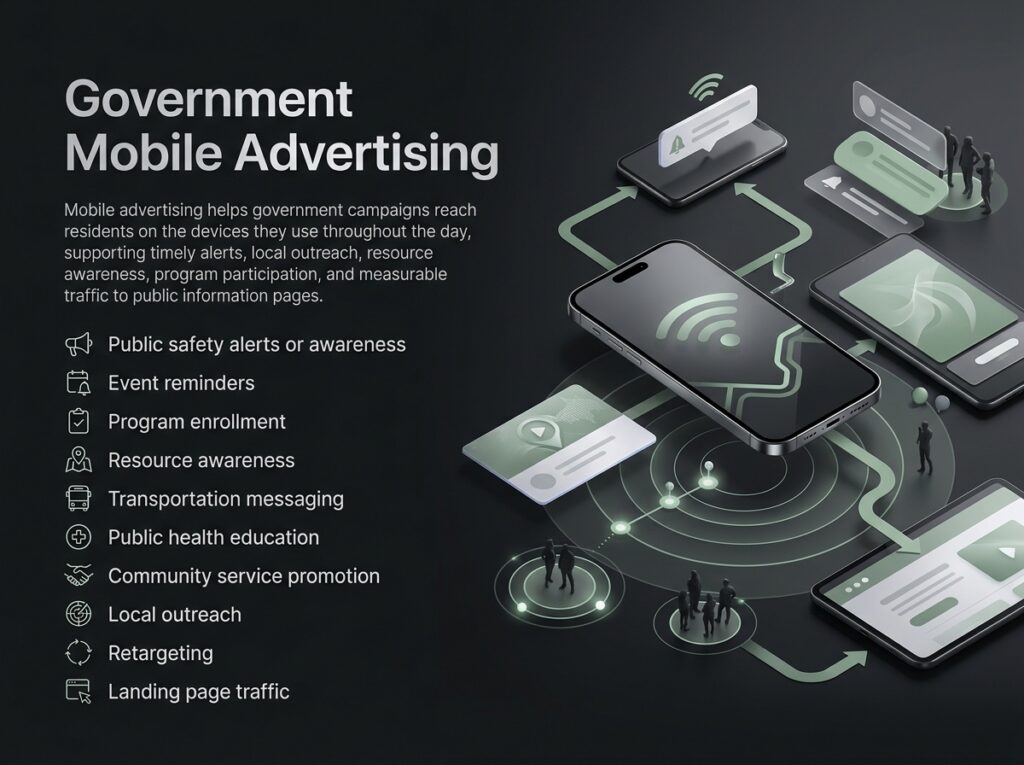
Government Mobile Advertising
Mobile advertising is valuable because residents use mobile devices throughout the day. Mobile can support timely, local, and action-oriented messaging.
Government mobile advertising may be used for:
- Public safety alerts or awareness
- Event reminders
- Program enrollment
- Resource awareness
- Transportation messaging
- Public health education
- Community service promotion
- Local outreach
- Retargeting
- Landing page traffic
Mobile advertising can be especially useful when the call to action is simple, such as learn more, register, attend, apply, call, or find a resource.
Government Audio Advertising
Streaming audio gives government campaigns another way to reinforce important messages without relying only on visual formats.
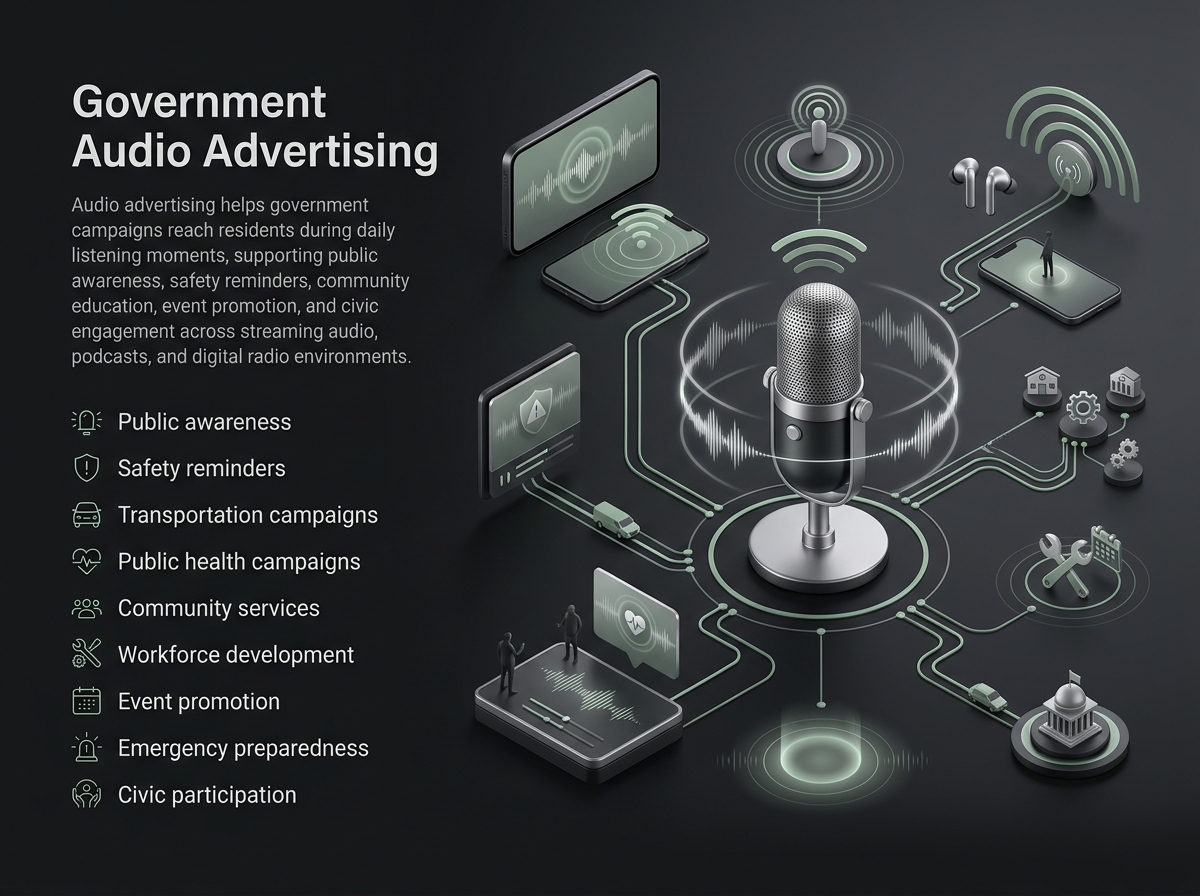
Government audio advertising may support:
- Public awareness
- Safety reminders
- Transportation campaigns
- Public health campaigns
- Community services
- Workforce development
- Event promotion
- Emergency preparedness
- Civic participation
Audio can complement CTV, display, mobile, and DOOH by adding frequency across daily listening moments.
Government audio advertising may support:
- Public awareness
- Safety reminders
- Transportation campaigns
- Public health campaigns
- Community services
- Workforce development
- Event promotion
- Emergency preparedness
- Civic participation
Audio can complement CTV, display, mobile, and DOOH by adding frequency across daily listening moments.
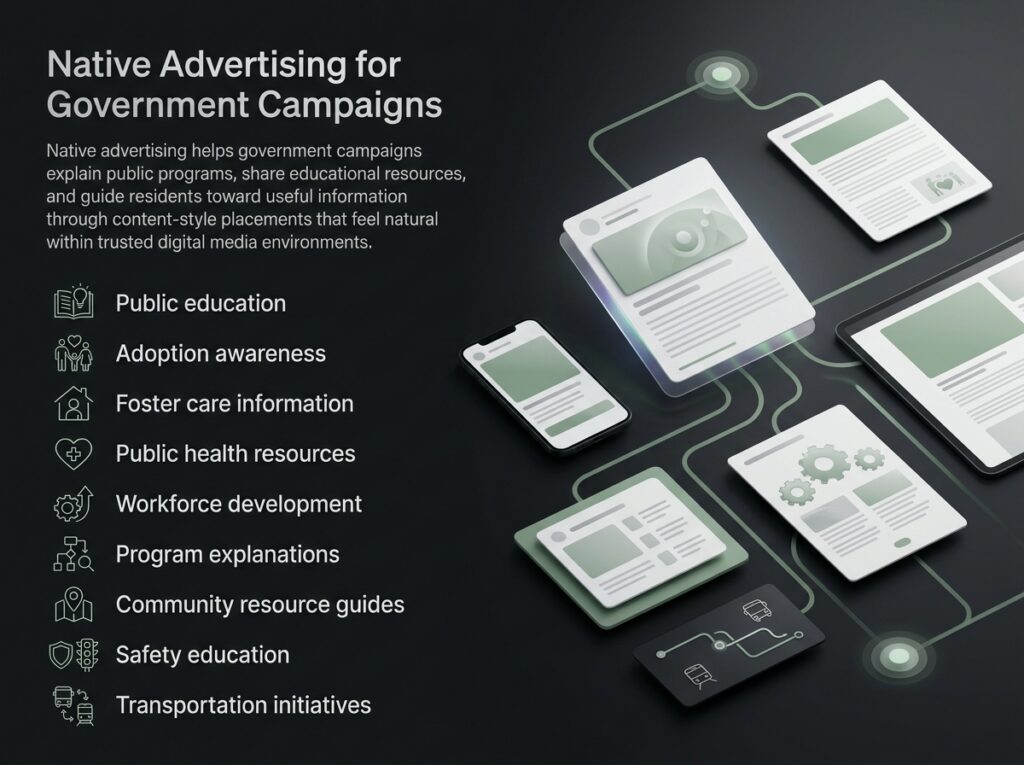
Native Advertising for Government Campaigns
Native advertising can help government campaigns explain a topic in more depth and drive users to educational content.
Native advertising may be useful for:
- Public education
- Adoption awareness
- Foster care information
- Public health resources
- Workforce development
- Program explanations
- Community resource guides
- Safety education
- Transportation initiatives
Native campaigns work best when they connect to a strong landing page, article, resource hub, or program page that gives residents clear information and a simple next step.
Government Retargeting Strategy
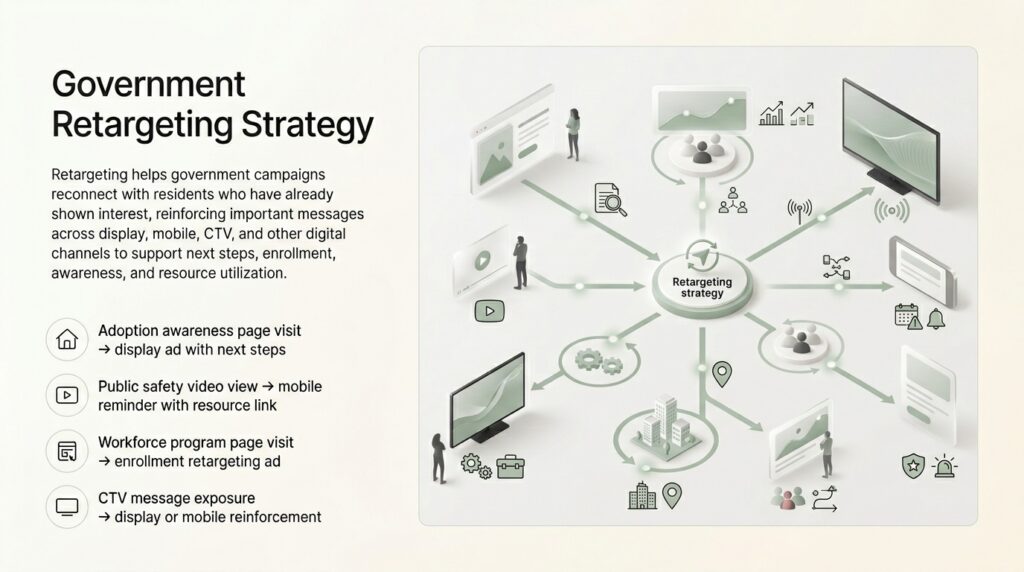
Retargeting allows government campaigns to follow up with users who have already interacted with campaign content.
Retargeting audiences may include:
- Website visitors
- Landing page visitors
- Program page visitors
- Form starters
- Video viewers
- Event page visitors
- Resource page visitors
- Download audiences
- Newsletter or email engagement audiences where available
Government retargeting can support:
- Program enrollment
- Event registration
- Resource utilization
- Form completion
- Education reinforcement
- Public safety reminders
- Follow-up information
For example:
- A resident visits an adoption awareness page and later receives a display ad with next steps.
- A user watches a public safety video and later receives a mobile reminder with a resource link.
- A person visits a workforce program page and later receives a retargeting ad about enrollment.
- A household sees a CTV message and later receives display or mobile reinforcement.
Retargeting helps campaigns support continued engagement after the first exposure.
Government Creative Strategy
Creative strategy is critical for government advertising because the message often needs to be understood quickly, trusted immediately, and acted on easily.
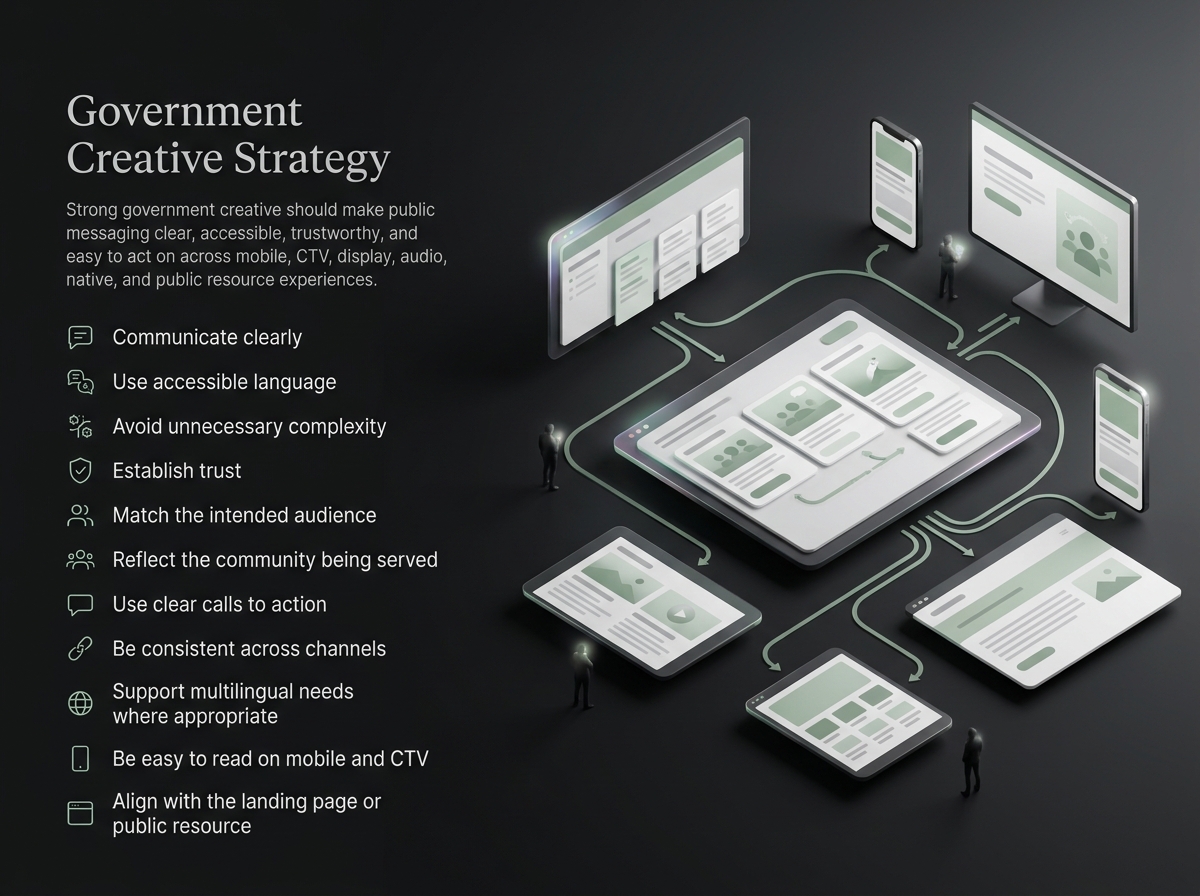
Strong government creative should:
- Communicate clearly
- Use accessible language
- Avoid unnecessary complexity
- Establish trust
- Match the intended audience
- Reflect the community being served
- Use clear calls to action
- Be consistent across channels
- Support multilingual needs where appropriate
- Be easy to read on mobile and CTV
- Align with the landing page or public resource
Creative should be built around the campaign objective.
Strong government creative should:
- Communicate clearly
- Use accessible language
- Avoid unnecessary complexity
- Establish trust
- Match the intended audience
- Reflect the community being served
- Use clear calls to action
- Be consistent across channels
- Support multilingual needs where appropriate
- Be easy to read on mobile and CTV
- Align with the landing page or public resource
Creative should be built around the campaign objective.
Public Awareness Creative
Awareness creative should introduce the message clearly and make the main idea easy to remember.
Examples include:
- Know the resource
- Understand the issue
- Learn what is available
- Recognize a public safety concern
- Become familiar with a program
Public Education Creative
Education creative should explain the issue or resource in simple terms.
Examples include:
- What the program does
- Who the program helps
- Why the issue matters
- Where to learn more
- How to take the next step
Behavior-Change Creative
Behavior-change creative should be clear, repeated, and action-oriented.
Examples include:
- Practice safer behavior
- Prepare for an emergency
- Use a public resource
- Follow safety guidance
- Make a plan
- Share information with a household
Program Enrollment Creative
Enrollment creative should make the action path simple.
Examples include:
- Apply today
- Learn if you qualify
- Register for an event
- Request information
- Find a local resource
- Start the process
CTV Creative
CTV creative should be visually clear and easy to understand. Because it often plays on the largest screen in the home, it should use strong storytelling, clean visuals, readable text, and a clear takeaway.
CTV creative may support:
- Public education
- Community awareness
- Safety messaging
- Program promotion
- Adoption or foster care awareness
- Transportation safety
- Public health outreach
- Emergency preparedness
DOOH Creative
DOOH creative should be extremely simple. People may only see a digital out-of-home message for a few seconds.
Strong DOOH creative should include:
- A short headline
- Clear visual identity
- Simple call to action
- Easy-to-read URL or QR code where appropriate
- Minimal copy
- High contrast
- Location relevance
Government creative should prioritize clarity over complexity.
Landing Page Strategy for Government Campaigns
Government advertising works best when the landing page supports the campaign objective. Sending every user to a general homepage can reduce performance.
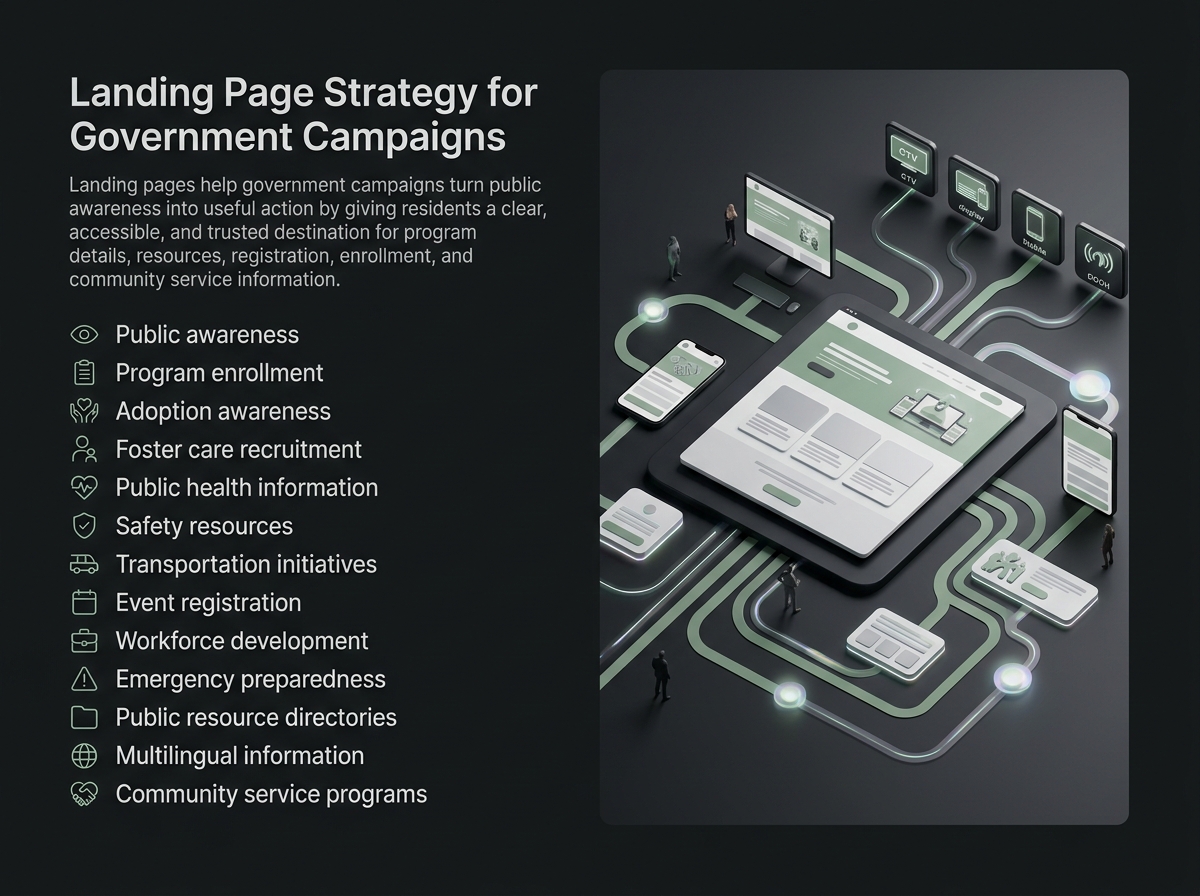
Campaigns may benefit from dedicated landing pages for:
- Public awareness
- Program enrollment
- Adoption awareness
- Foster care recruitment
- Public health information
- Safety resources
- Transportation initiatives
- Event registration
- Workforce development
- Emergency preparedness
- Public resource directories
- Multilingual information
- Community service programs
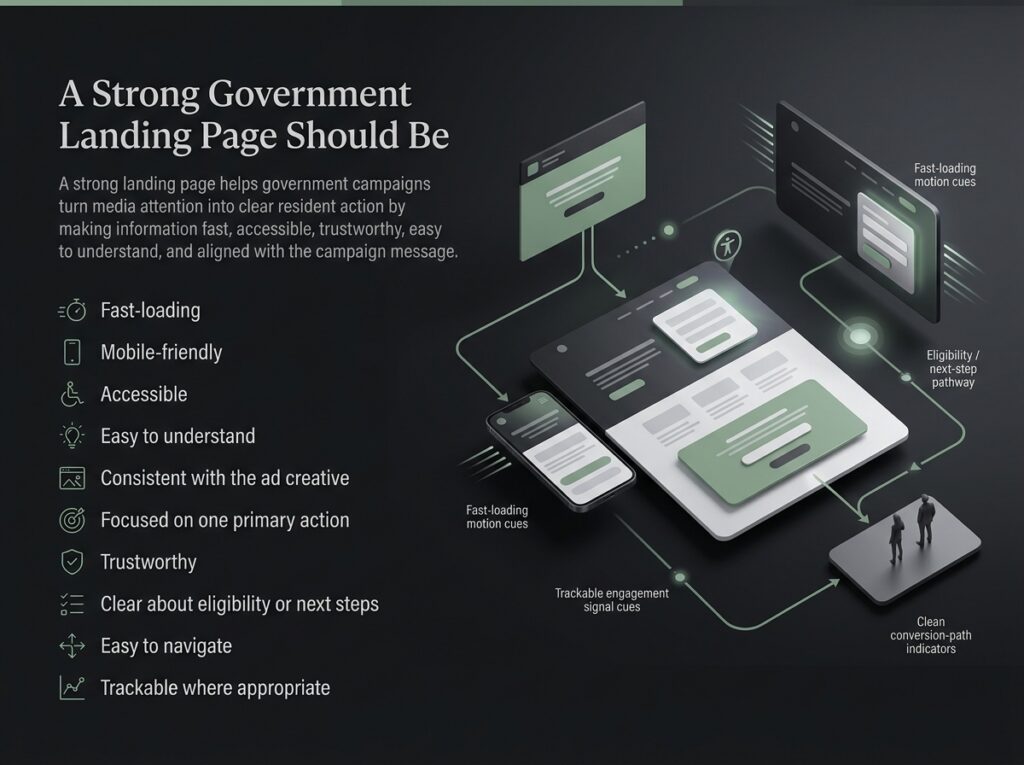
A strong government landing page should be:
- Fast-loading
- Mobile-friendly
- Accessible
- Easy to understand
- Consistent with the ad creative
- Focused on one primary action
- Trustworthy
- Clear about eligibility or next steps
- Easy to navigate
- Trackable where appropriate
Landing page behavior can also inform retargeting and optimization.
Government Measurement, Reporting, and Optimization
Government campaigns need reporting that helps public organizations understand what is working and where improvements can be made.
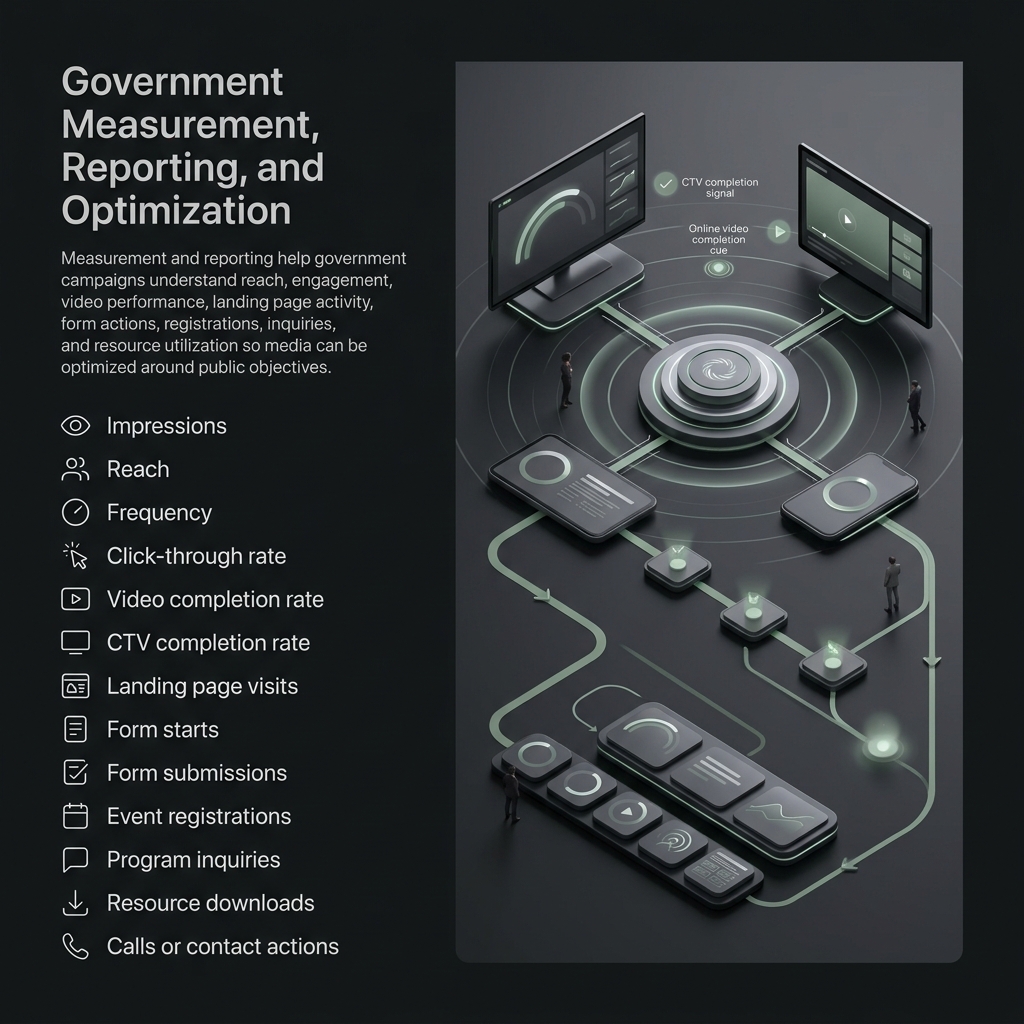
Important government advertising metrics may include:
- Impressions
- Reach
- Frequency
- Click-through rate
- Video completion rate
- CTV completion rate
- Landing page visits
- Form starts
- Form submissions
- Event registrations
- Program inquiries
- Resource downloads
- Calls or contact actions
- Audience performance
- Geography performance
- Device performance
- Creative performance
- Spend pacing
- Household reach
- DOOH delivery by location where available
- Retargeting performance
Government campaigns should not be judged only by last-click performance. A resident may see a CTV ad, later see a display ad, hear an audio message, visit a landing page, and then take action later.
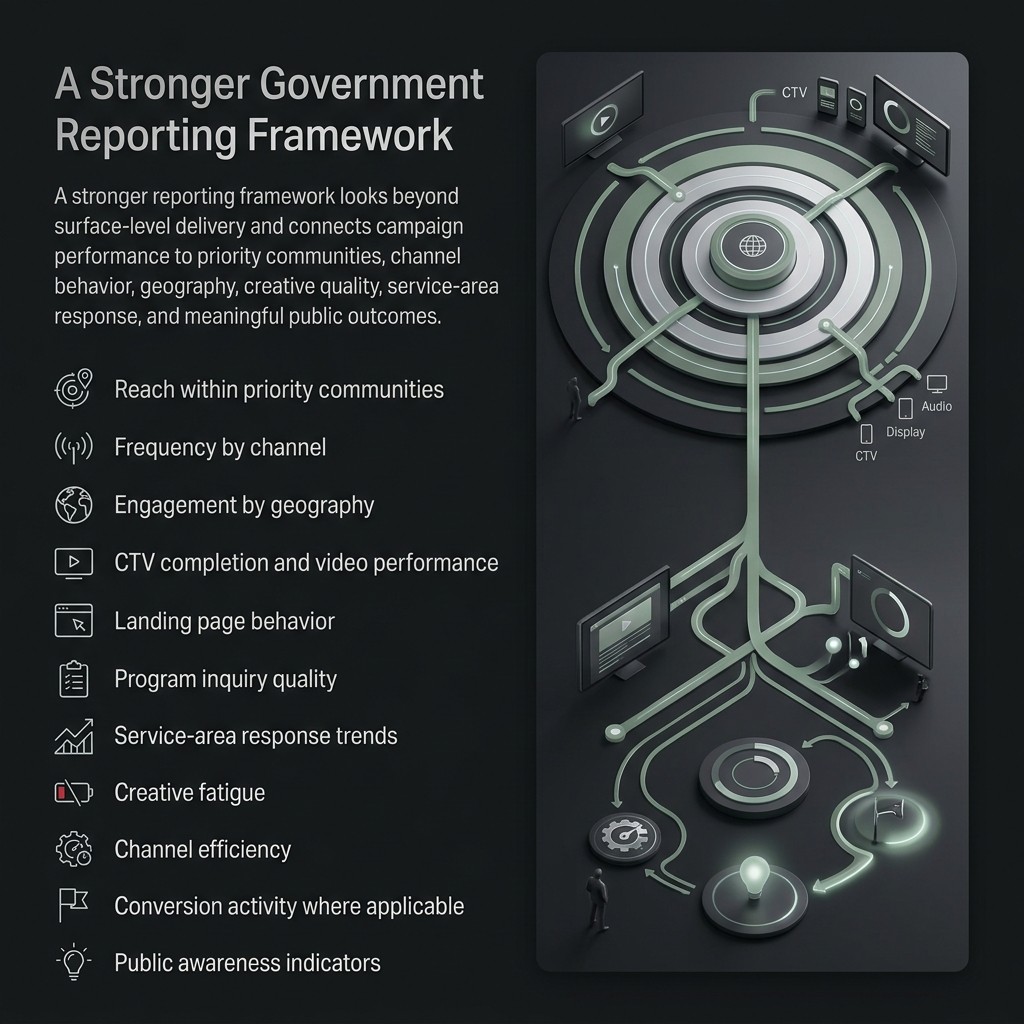
A stronger reporting framework looks at:
- Reach within priority communities
- Frequency by channel
- Engagement by geography
- CTV completion and video performance
- Landing page behavior
- Program inquiry quality
- Service-area response trends
- Creative fatigue
- Channel efficiency
- Conversion activity where applicable
- Public awareness indicators
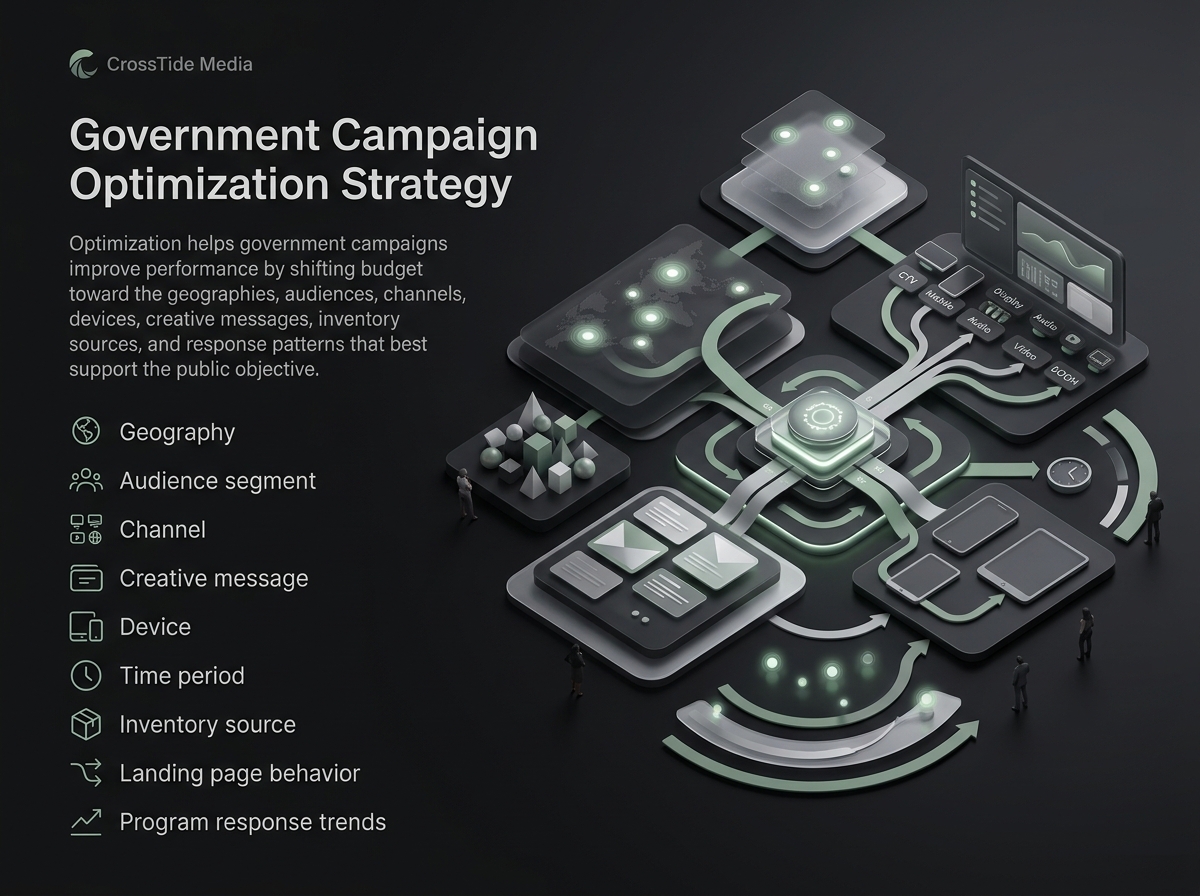
Optimization may include shifting budget by:
- Geography
- Audience segment
- Channel
- Creative message
- Device
- Time period
- Inventory source
- Landing page behavior
- Program response trends
The goal is to improve the campaign while it is live and provide useful reporting after the campaign ends.
Optimization may include shifting budget by:
- Geography
- Audience segment
- Channel
- Creative message
- Device
- Time period
- Inventory source
- Landing page behavior
- Program response trends
The goal is to improve the campaign while it is live and provide useful reporting after the campaign ends.
Government Advertising Budget Strategy
Government advertising budgets vary based on the campaign goal, geography, audience size, channel mix, timeline, creative needs, and desired reach or frequency.
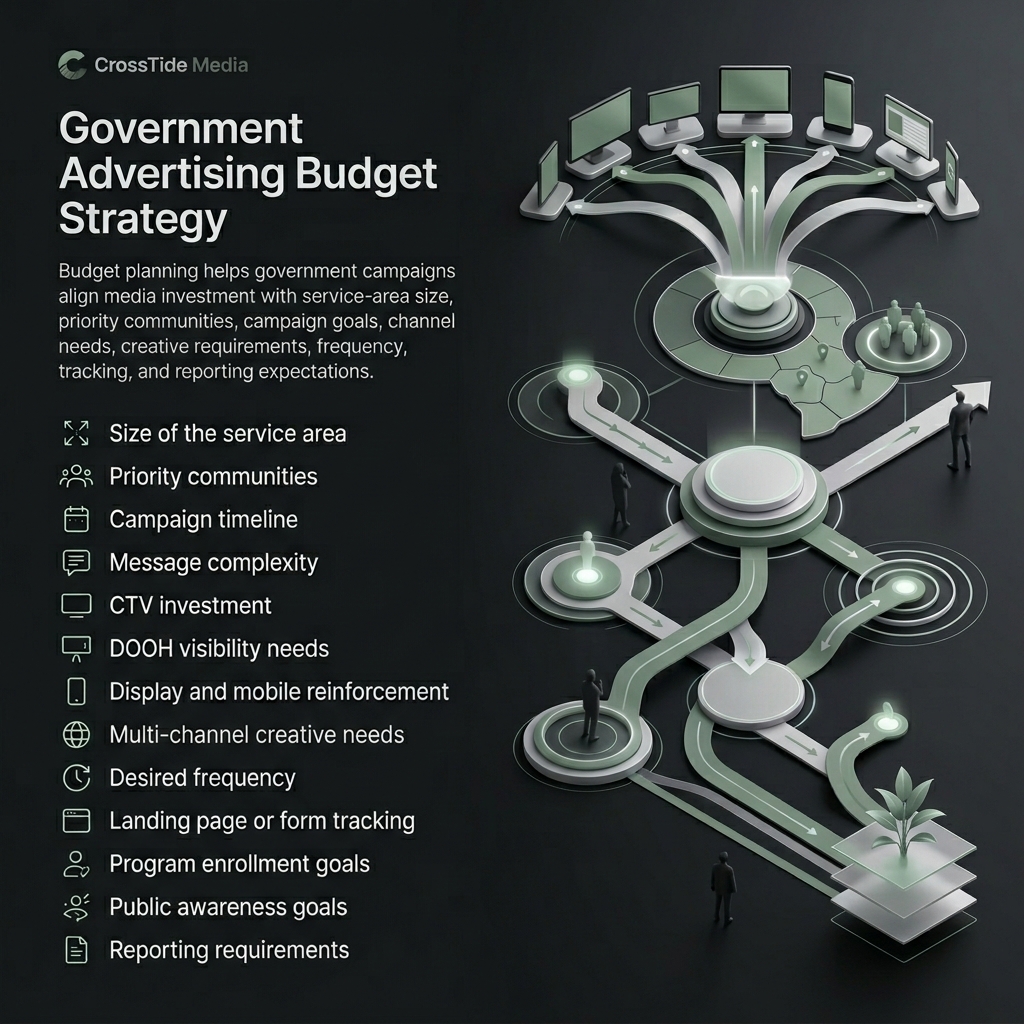
Budget planning should consider:
- Size of the service area
- Priority communities
- Campaign timeline
- Message complexity
- CTV investment
- DOOH visibility needs
- Display and mobile reinforcement
- Multilingual creative needs
- Desired frequency
- Landing page or form tracking
- Program enrollment goals
- Public awareness goals
- Reporting requirements
The most important budgeting question is not simply “How low can the CPM be?”
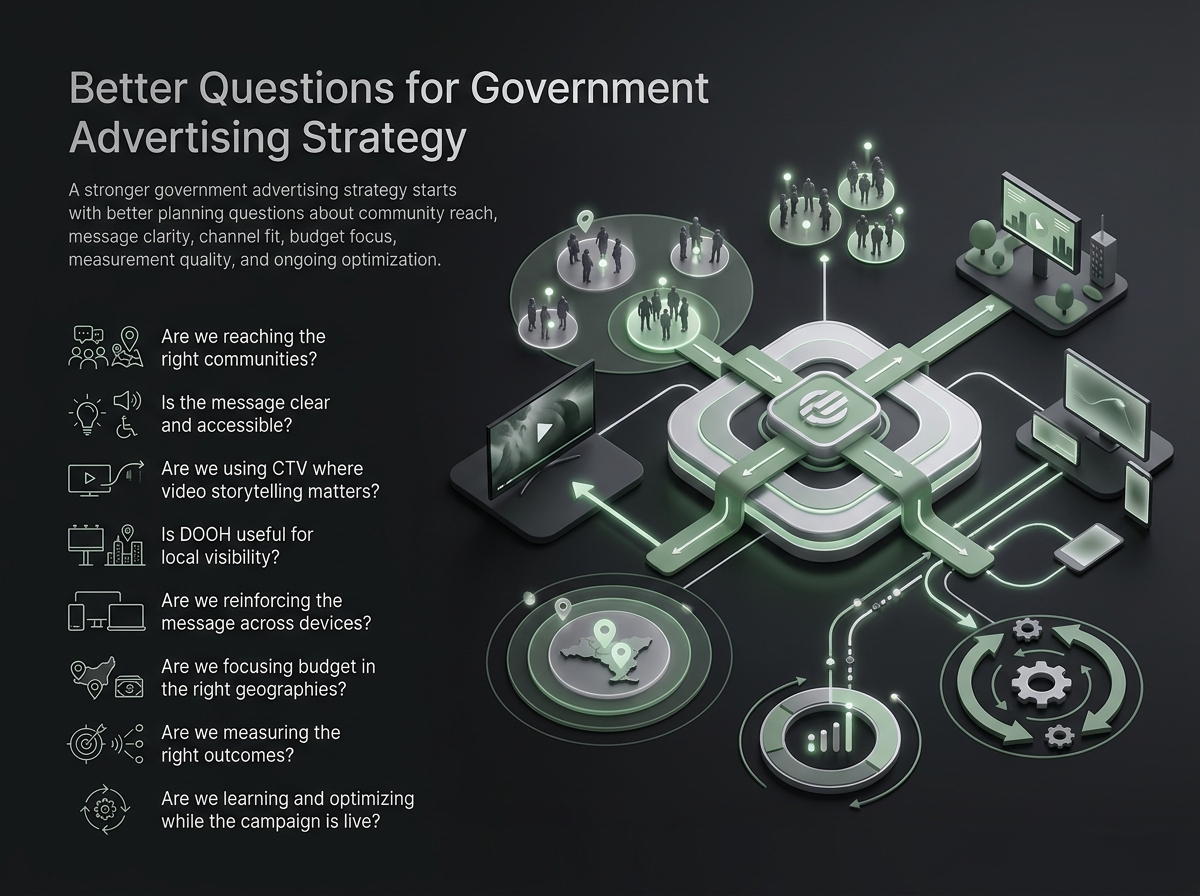
Better questions include:
- Are we reaching the right communities?
- Is the message clear and accessible?
- Are we using CTV where video storytelling matters?
- Is DOOH useful for local visibility?
- Are we reinforcing the message across devices?
- Are we focusing budget in the right geographies?
- Are we measuring the right outcomes?
- Are we learning and optimizing while the campaign is live?
Efficient government advertising is not just about low cost. It is about delivering public messages clearly, responsibly, and effectively.
The most important budgeting question is not simply “How low can the CPM be?”
Better questions include:
- Are we reaching the right communities?
- Is the message clear and accessible?
- Are we using CTV where video storytelling matters?
- Is DOOH useful for local visibility?
- Are we reinforcing the message across devices?
- Are we focusing budget in the right geographies?
- Are we measuring the right outcomes?
- Are we learning and optimizing while the campaign is live?
Efficient government advertising is not just about low cost. It is about delivering public messages clearly, responsibly, and effectively.
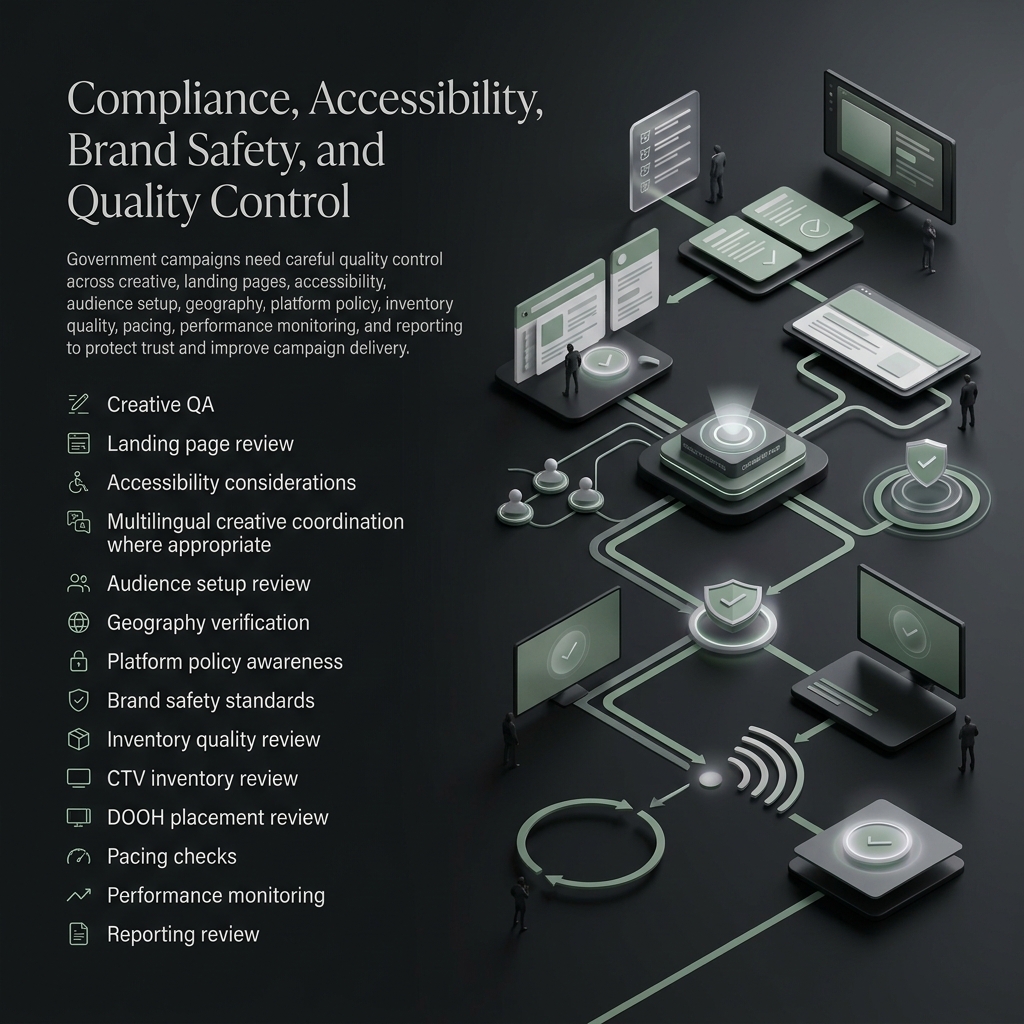
Compliance, Accessibility, Brand Safety, and Quality Control
Government advertising requires strong operational discipline. Public campaigns need to be accurate, accessible, responsible, and delivered in quality media environments.
Crosstide Media helps government advertisers approach campaign execution with quality control, including:
- Creative QA
- Landing page review
- Accessibility considerations
- Multilingual creative coordination where appropriate
- Audience setup review
- Geography verification
- Platform policy awareness
- Brand safety standards
- Inventory quality review
- CTV inventory review
- DOOH placement review
- Pacing checks
- Performance monitoring
- Reporting review
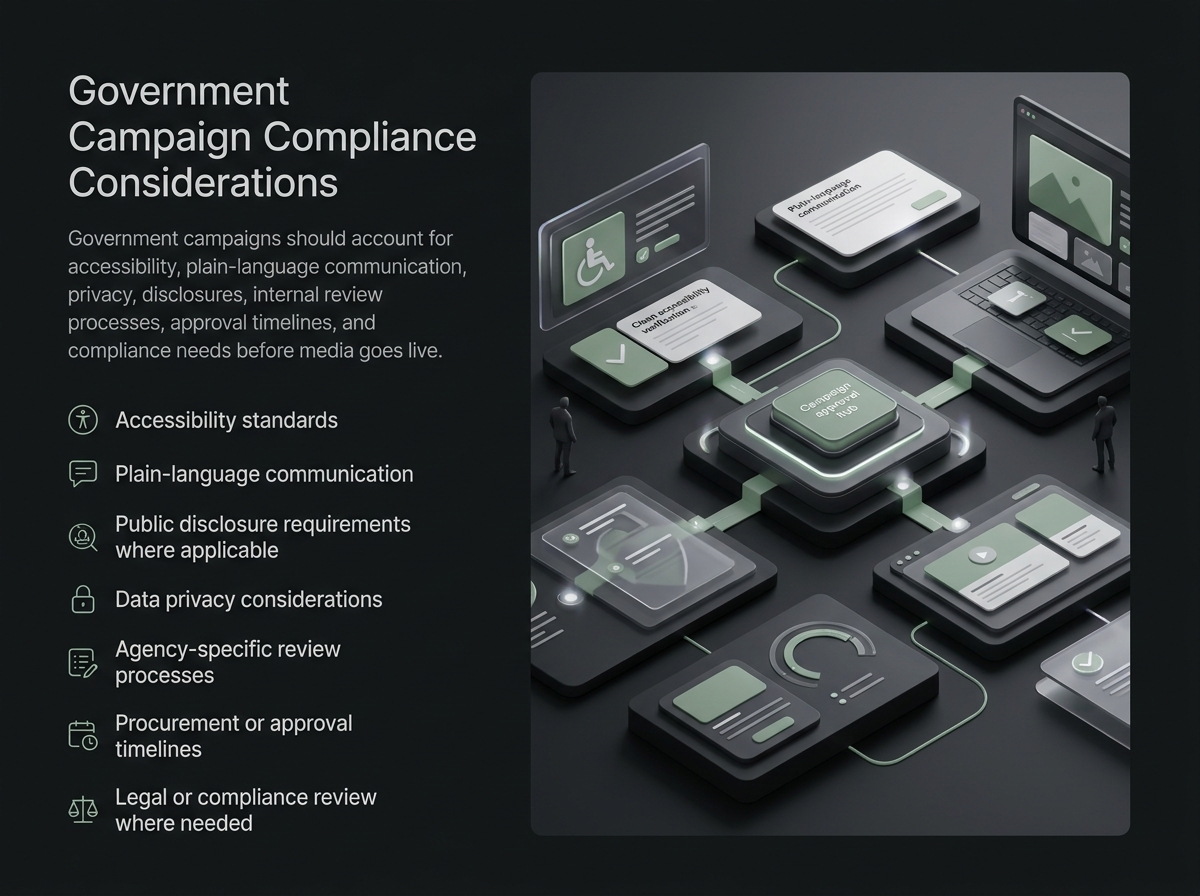
Government campaigns should also consider:
- Accessibility standards
- Plain-language communication
- Public disclosure requirements where applicable
- Data privacy considerations
- Agency-specific review processes
- Procurement or approval timelines
- Legal or compliance review where needed
From a media execution standpoint, quality control matters because government campaigns need public trust, accuracy, and clear delivery.
Government campaigns should also consider:
- Accessibility standards
- Plain-language communication
- Public disclosure requirements where applicable
- Data privacy considerations
- Agency-specific review processes
- Procurement or approval timelines
- Legal or compliance review where needed
From a media execution standpoint, quality control matters because government campaigns need public trust, accuracy, and clear delivery.
Government Advertising Strategies We Support
Crosstide Media can support a wide range of government advertising strategies, including:
Public Awareness Campaigns
Build visibility around public programs, safety initiatives, community resources, or civic priorities.
Connected TV Government Advertising
Use CTV to deliver high-impact public awareness, education, and behavior-change messaging to relevant households and communities.
Public Education Campaigns
Explain important issues, services, programs, or public resources with clear messaging across digital channels.
Community Outreach Campaigns
Reach defined geographies, service areas, neighborhoods, or priority communities with locally relevant messaging.
Program Enrollment Campaigns
Promote applications, registrations, inquiries, or participation in public programs.
Adoption and Foster Care Awareness
Reach families, caregivers, community-minded audiences, and relevant households with clear awareness and recruitment messaging.
Gun Safety Awareness
Promote safety education and public awareness with responsible, neutral, community-focused media strategy.
Public Health Campaigns
Support awareness, education, resource utilization, and behavior-change campaigns tied to health initiatives.
Transportation Safety Campaigns
Promote safer behavior, awareness, and education across CTV, mobile, display, audio, and DOOH.
Workforce Development Campaigns
Reach job seekers, students, workers, employers, or training audiences with program information and enrollment pathways.
Emergency Preparedness Campaigns
Communicate preparedness information, safety steps, deadlines, and public resources to relevant communities.
Programmatic DOOH Government Advertising
Use digital out-of-home to build public visibility in priority locations and reinforce messaging in the community.
Retargeting and Engagement Campaigns
Follow up with users who engage with government websites, landing pages, program information, or resource pages.
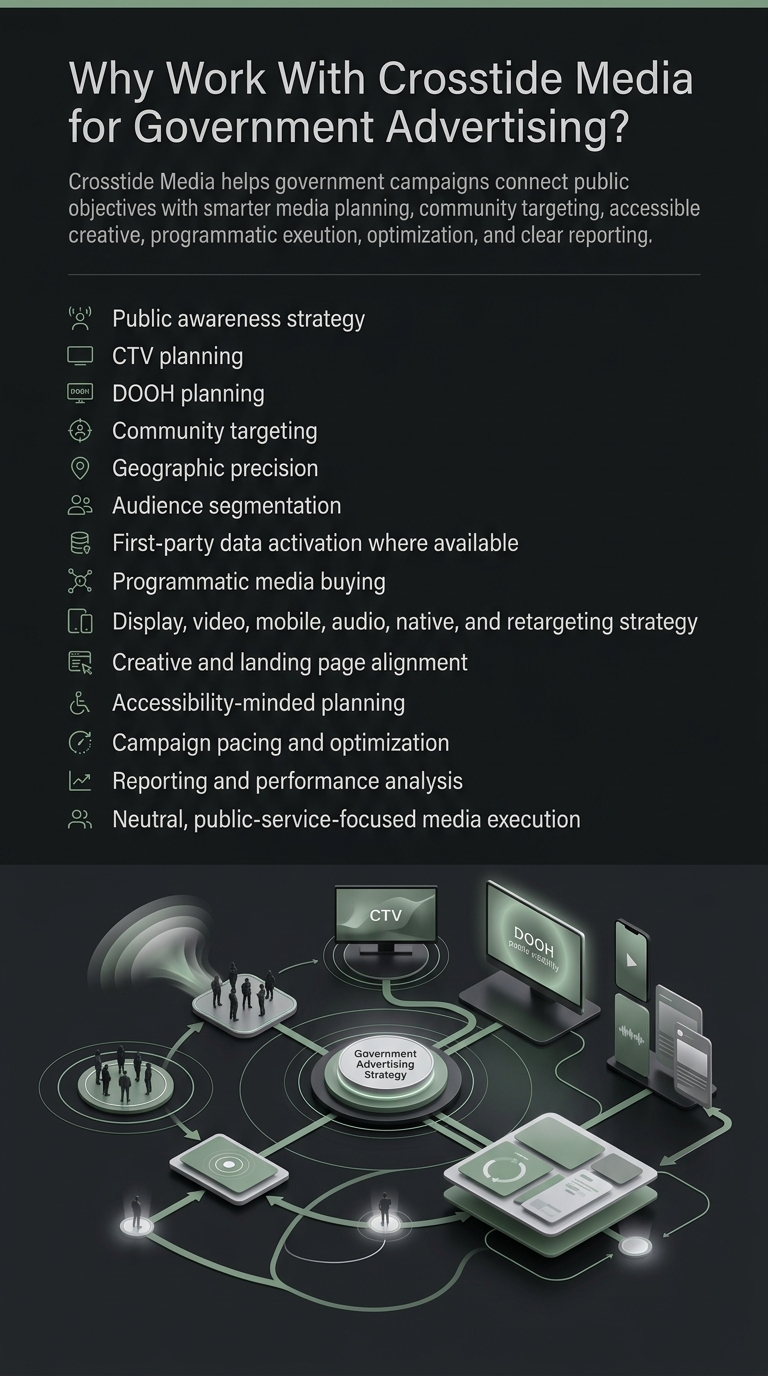
Why Work With Crosstide Media for Government Advertising?
Government advertising requires more than media placement. It requires strategy, clarity, audience planning, channel selection, creative alignment, geographic discipline, reporting, and ongoing optimization.
Crosstide Media helps government organizations build campaigns with:
- Public awareness strategy
- CTV planning
- DOOH planning
- Community targeting
- Geographic precision
- Audience segmentation
- First-party data activation where available
- Programmatic media buying
- Display, video, mobile, audio, native, and retargeting strategy
- Creative and landing page alignment
- Accessibility-minded planning
- Campaign pacing and optimization
- Reporting and performance analysis
- Neutral, public-service-focused media execution
We help public organizations turn communication goals into structured media campaigns.
Whether the objective is public awareness, education, outreach, program enrollment, behavior change, resource utilization, adoption awareness, safety education, or community engagement, Crosstide Media builds government advertising campaigns designed to reach the right communities with clarity and measurable impact.
Why Work With Crosstide Media for Government Advertising?
Government advertising requires more than media placement. It requires strategy, clarity, audience planning, channel selection, creative alignment, geographic discipline, reporting, and ongoing optimization.
Crosstide Media helps government organizations build campaigns with:
- Public awareness strategy
- CTV planning
- DOOH planning
- Community targeting
- Geographic precision
- Audience segmentation
- First-party data activation where available
- Programmatic media buying
- Display, video, mobile, audio, native, and retargeting strategy
- Creative and landing page alignment
- Accessibility-minded planning
- Campaign pacing and optimization
- Reporting and performance analysis
- Neutral, public-service-focused media execution
We help public organizations turn communication goals into structured media campaigns.
Whether the objective is public awareness, education, outreach, program enrollment, behavior change, resource utilization, adoption awareness, safety education, or community engagement, Crosstide Media builds government advertising campaigns designed to reach the right communities with clarity and measurable impact.
Frequently Asked Questions About Government Advertising
What is government advertising?
Government advertising is paid media used by public agencies, civic organizations, municipalities, departments, programs, and government-funded initiatives to communicate with residents or communities.
What is digital government advertising?
Digital government advertising uses channels such as Connected TV, display, online video, mobile, streaming audio, native advertising, DOOH, programmatic media, and retargeting to reach public audiences across digital environments.
Why is Connected TV important for government advertising?
Connected TV is important because it allows government organizations to deliver high-impact public awareness and education messages in premium streaming environments while using digital targeting and reporting.
Can government agencies use DOOH advertising?
Yes. Programmatic DOOH can help government campaigns build public visibility in priority geographies, transit corridors, event areas, retail locations, and high-traffic community environments.
What types of government campaigns can digital advertising support?
Digital advertising can support public awareness, safety education, public health, adoption awareness, foster care recruitment, transportation safety, workforce development, emergency preparedness, program enrollment, event promotion, and community resource campaigns.
How does community targeting work for government campaigns?
Community targeting uses geography, service areas, ZIP codes, contextual relevance, audience segments, language needs, and campaign objectives to reach communities that are most relevant to the public message.
Can government campaigns use first-party data?
Yes, where appropriate. Government campaigns may use first-party data such as website visitors, landing page visitors, program inquiries, event registrants, newsletter subscribers, or CRM audiences to support retargeting and engagement.
What channels work best for government advertising?
The best channels depend on the campaign objective. CTV and video are useful for public awareness and education. Display and mobile support reinforcement and response. Audio adds frequency. Native supports deeper education. DOOH supports public visibility. Retargeting supports follow-up engagement.
How should government advertising be measured?
Government campaigns may measure reach, frequency, CTV completion, video completion, landing page visits, form submissions, event registrations, resource downloads, program inquiries, geography performance, audience performance, and engagement trends.
Is government advertising only for large agencies?
No. Local governments, regional programs, public service initiatives, and smaller departments can benefit from digital advertising when the campaign is geographically focused and clearly structured.
Build a Smarter Government Advertising Campaign
Government campaigns need media strategies that are clear, responsible, measurable, and built around the real public objective. Crosstide Media helps government agencies and public organizations reach communities, educate residents, promote resources, increase program participation, and support behavior-change initiatives through digital advertising strategies built around Connected TV, DOOH, community targeting, geographic precision, cross-device media, programmatic advertising, and measurable campaign performance. If your organization needs a smarter way to communicate with the public, Crosstide Media can help plan, launch, manage, and optimize a government advertising campaign built for clarity, reach, and public impact.
