
political-advertising
Political Advertising Built for Voter Targeting, Addressable Households, and Cross-Device Campaign Strategy
Political campaigns need more than broad digital reach. They need disciplined media strategy, accurate voter targeting, strong geographic control, message consistency, and the ability to reach key audiences across the devices and screens they use every day.
Crosstide Media helps political campaigns, candidates, PACs, advocacy organizations, ballot initiatives, and public affairs efforts execute digital advertising strategies built around voter intelligence, addressable household targeting, first-party data, programmatic media buying, and measurable campaign performance.
Whether the goal is voter persuasion, turnout, fundraising, issue education, name recognition, volunteer recruitment, or supporter activation, political advertising works best when audience strategy, media channels, creative messaging, and optimization are built around the realities of the campaign.
We help campaigns reach the right voters, in the right geographies, with the right message, across the right digital environments.

Jump To
Political Advertising for Modern Campaigns
Political advertising has changed dramatically. Campaigns can no longer rely only on yard signs, mail, linear TV, and broad digital awareness to reach voters effectively. Voters consume media across connected TVs, mobile devices, news websites, streaming audio, social platforms, apps, desktops, tablets, and email-driven landing page journeys.
That creates both an opportunity and a challenge.
The opportunity is that campaigns can reach highly specific voter audiences with more precision than ever before. The challenge is that campaigns need a smart media structure to avoid wasted spend, message overlap, weak targeting, and inefficient delivery.
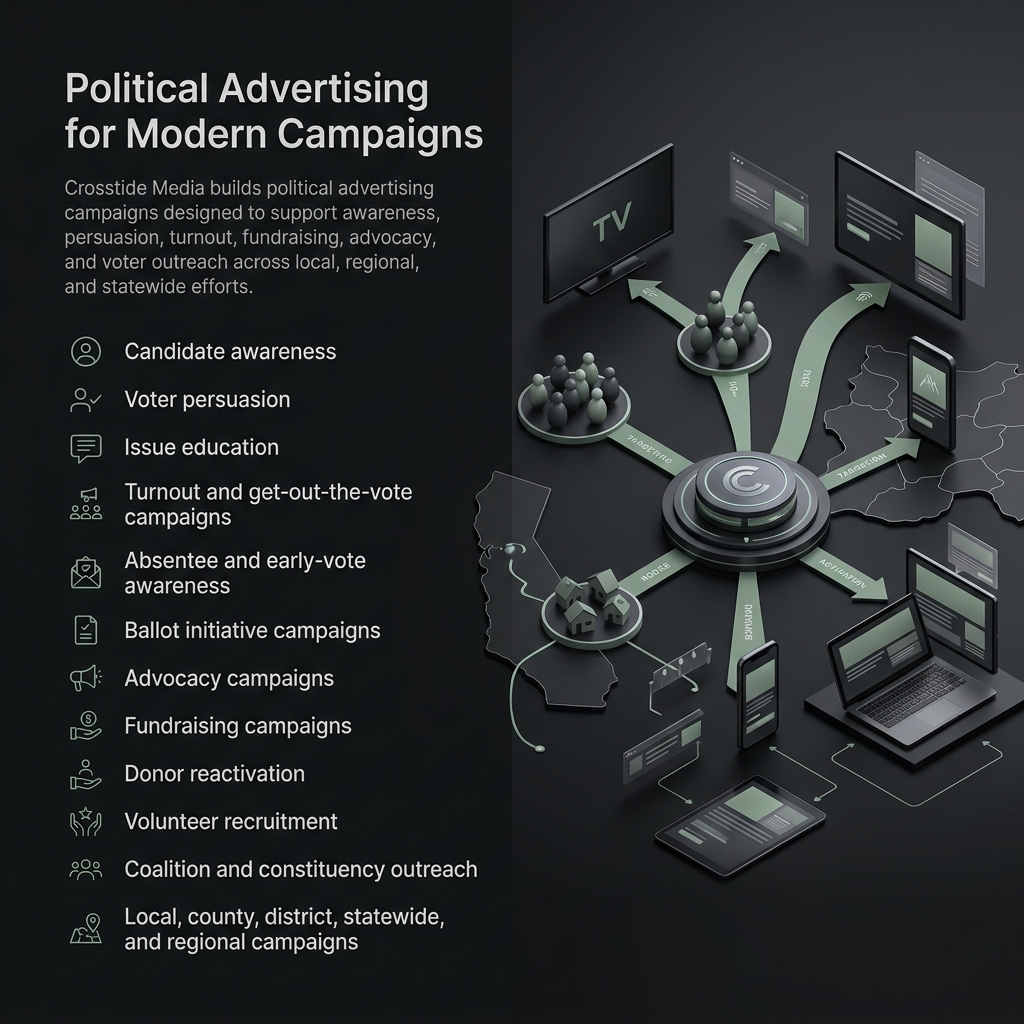
Crosstide Media builds political advertising campaigns designed to support:
- Candidate awareness
- Voter persuasion
- Issue education
- Turnout and get-out-the-vote campaigns
- Absentee and early-vote awareness
- Ballot initiative campaigns
- Advocacy campaigns
- Fundraising campaigns
- Donor reactivation
- Volunteer recruitment
- Coalition and constituency outreach
- Local, county, district, statewide, and regional campaigns
Our political media approach is neutral, data-driven, and campaign-objective focused. We do not build strategy around political ideology. We build strategy around audience relevance, message discipline, geographic accuracy, and measurable media execution.
What Is Political Advertising?
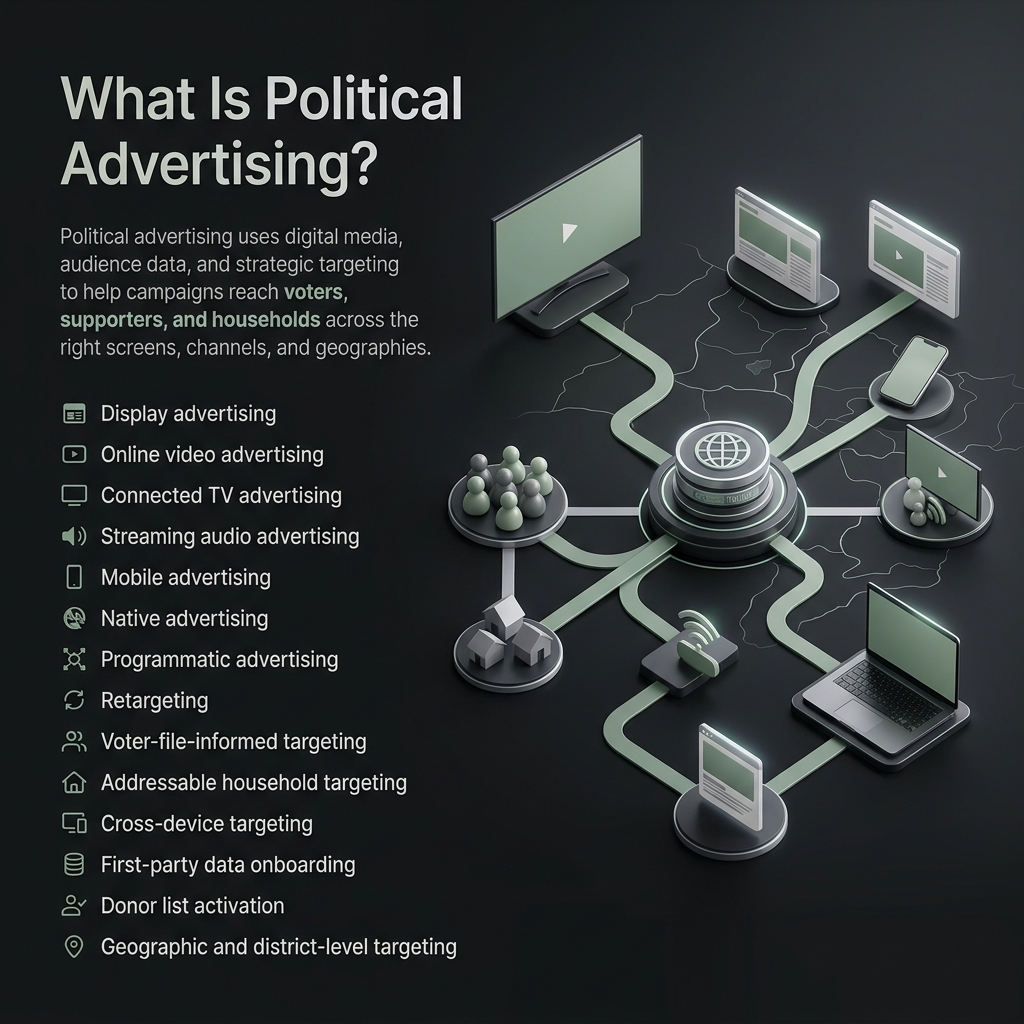
Political advertising refers to paid media campaigns designed to reach voters, supporters, donors, advocacy audiences, or politically relevant communities with campaign messaging.
Digital political advertising may include:
- Display advertising
- Online video advertising
- Connected TV advertising
- Streaming audio advertising
- Mobile advertising
- Native advertising
- Programmatic advertising
- Retargeting
- Voter-file-informed targeting
- Addressable household targeting
- Cross-device targeting
- First-party data onboarding
- Donor list activation
- Geographic and district-level targeting
Political advertising can support many campaign objectives, including persuasion, awareness, fundraising, turnout, and issue education. The most effective campaigns do not use one generic audience or one broad message. They segment voters based on geography, likely behavior, campaign priority, and message relevance.
Why Political Campaigns Need a Specialized Digital Media Strategy
Political campaigns are different from traditional advertising campaigns because the timeline is fixed, the audience universe is limited, and the consequences of inefficient spending can be significant. A retail advertiser can optimize over months or years. A political campaign may need to generate awareness, persuade undecided voters, mobilize supporters, and drive turnout within a compressed election calendar.
That requires a media strategy built around:
- Voter universe development
- Geographic precision
- Household-level relevance
- Message segmentation
- Cross-device reach
- Frequency control
- Budget pacing
- Creative rotation
- Early voting and absentee deadlines
- Rapid optimization
- Compliance and quality control
- Clear reporting
A strong political media plan answers several important questions:
- Who exactly are we trying to reach?
- Which voters are persuadable?
- Which voters are likely supporters?
- Which voters need turnout reminders?
- Which households should receive more message frequency?
- Which geographies matter most?
- Which audiences should be excluded from certain messaging?
- Which channels are best for awareness, persuasion, fundraising, or turnout?
- How should the media plan change as Election Day gets closer?
Crosstide Media helps campaigns answer those questions before media dollars are put into market.
Political Campaign Advertising Strategy
Political campaigns usually perform best when digital advertising is structured around campaign phases. Each phase should have a clear purpose, audience strategy, channel mix, and messaging approach.
Awareness and Introduction Phase
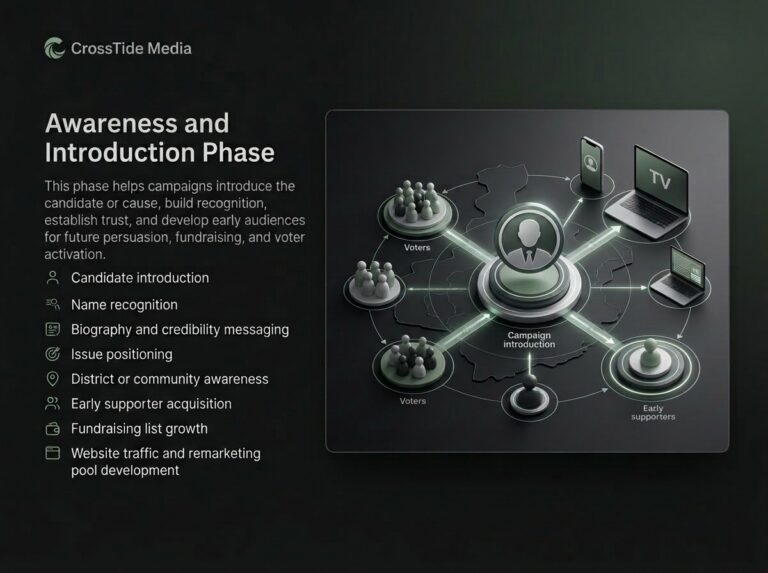
The introduction phase is often focused on building name recognition and establishing the campaign’s core message.
This phase may support:
- Candidate introduction
- Name recognition
- Biography and credibility messaging
- Issue positioning
- District or community awareness
- Early supporter acquisition
- Fundraising list growth
- Website traffic and remarketing pool development

For newer candidates, challengers, local races, or issue campaigns, this phase is critical. Voters cannot be persuaded by a campaign they do not recognize.
Useful channels in this phase may include:
- Connected TV
- Online video
- Display
- Native advertising
- Streaming audio
- Mobile
- Contextual news inventory
The goal is to introduce the campaign clearly and efficiently while building audience pools that can be retargeted later.
Persuasion Phase
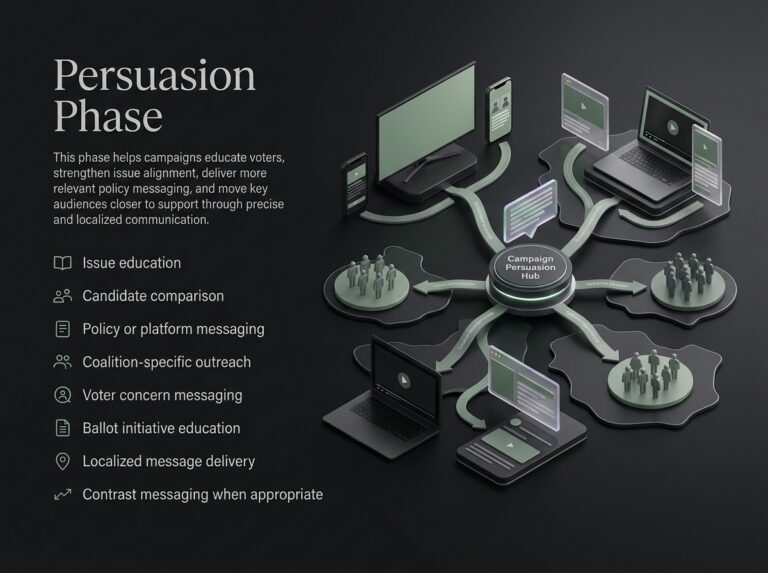
The persuasion phase is focused on reaching voters who may be open to the campaign’s message.
This phase may support:
- Issue education
- Candidate comparison
- Policy or platform messaging
- Coalition-specific outreach
- Voter concern messaging
- Ballot initiative education
- Localized message delivery
- Contrast messaging when appropriate
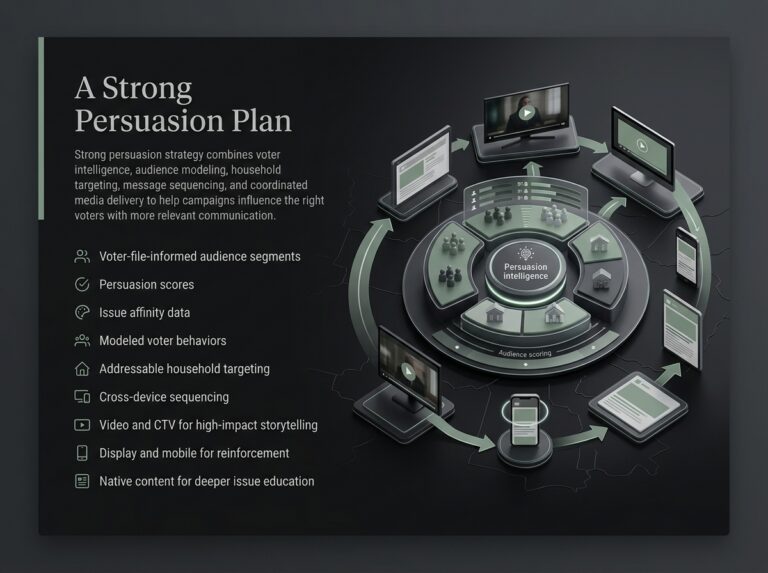
Persuasion campaigns should be carefully segmented. A message that works for one audience may not work for another. For example, a campaign may need one message for suburban swing voters, another for younger voters, another for issue-motivated voters, and another for voters in a specific district or precinct.
A strong persuasion plan may use:
- Voter-file-informed audience segments
- Persuasion scores
- Issue affinity data
- Modeled voter behaviors
- Addressable household targeting
- Cross-device sequencing
- Video and CTV for high-impact storytelling
- Display and mobile for reinforcement
- Native content for deeper issue education
The goal is not simply to reach more people. The goal is to reach the right persuasion universe with message frequency that is strong enough to matter.
Persuasion campaigns should be carefully segmented. A message that works for one audience may not work for another. For example, a campaign may need one message for suburban swing voters, another for younger voters, another for issue-motivated voters, and another for voters in a specific district or precinct.
A strong persuasion plan may use:
- Voter-file-informed audience segments
- Persuasion scores
- Issue affinity data
- Modeled voter behaviors
- Addressable household targeting
- Cross-device sequencing
- Video and CTV for high-impact storytelling
- Display and mobile for reinforcement
- Native content for deeper issue education
The goal is not simply to reach more people. The goal is to reach the right persuasion universe with message frequency that is strong enough to matter.
Turnout and GOTV Phase
The turnout phase is focused on motivating likely supporters and priority voters to take action.
This phase may support:
- Early-vote reminders
- Absentee ballot reminders
- Vote-by-mail education
- Election Day reminders
- Polling location awareness
- Supporter reinforcement
- Low-propensity voter activation
- High-priority household frequency
- Urgency messaging
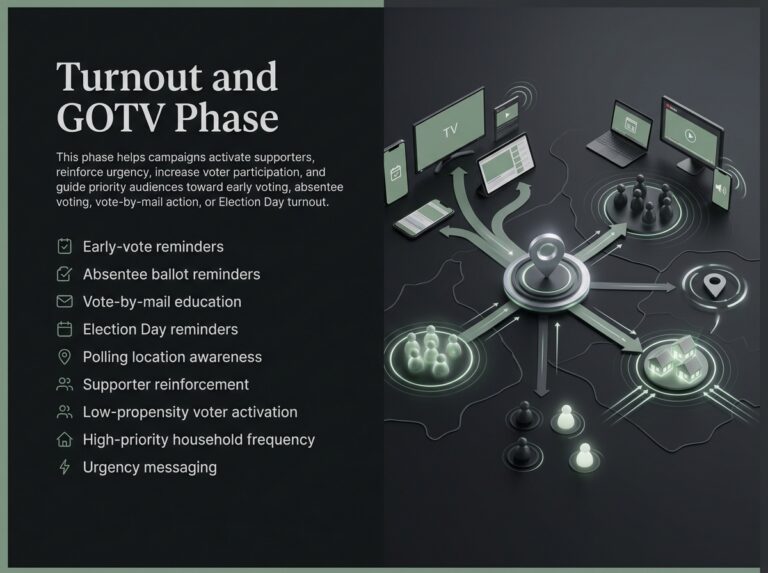
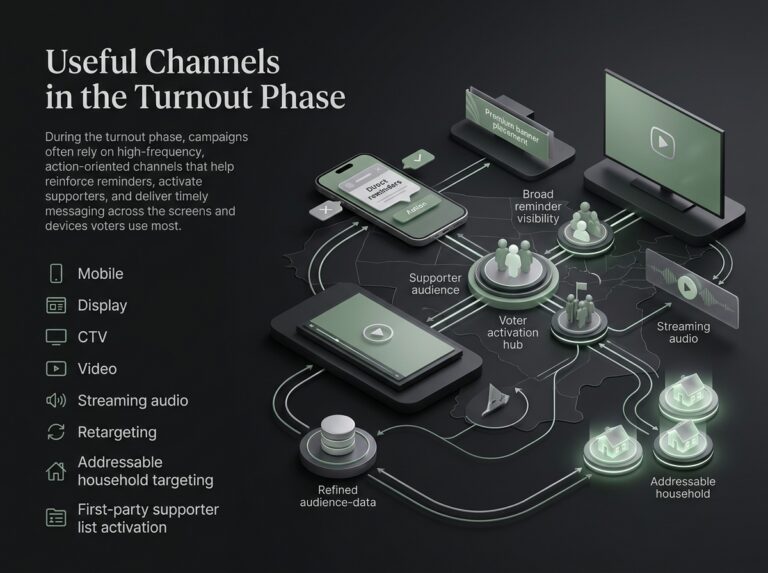
Turnout campaigns should usually be separated from persuasion campaigns. A persuadable voter and a known supporter often need different messages. A supporter may not need another persuasion message. They may need a reminder to vote, a deadline message, or clear instructions on when and how to take action.
Useful channels in the turnout phase may include:
- Mobile
- Display
- CTV
- Video
- Streaming audio
- Retargeting
- Addressable household targeting
- First-party supporter list activation
As Election Day gets closer, campaigns often need tighter pacing, faster creative rotation, stronger frequency control, and more aggressive geographic discipline.
Turnout campaigns should usually be separated from persuasion campaigns. A persuadable voter and a known supporter often need different messages. A supporter may not need another persuasion message. They may need a reminder to vote, a deadline message, or clear instructions on when and how to take action.
Useful channels in the turnout phase may include:
- Mobile
- Display
- CTV
- Video
- Streaming audio
- Retargeting
- Addressable household targeting
- First-party supporter list activation
As Election Day gets closer, campaigns often need tighter pacing, faster creative rotation, stronger frequency control, and more aggressive geographic discipline.
Voter Data Strategy for Political Advertising
Voter data is one of the most important tools in modern political advertising. When used properly, voter data helps campaigns define the right audience universe, segment voters by campaign objective, and avoid spending media dollars on audiences that are unlikely to matter.
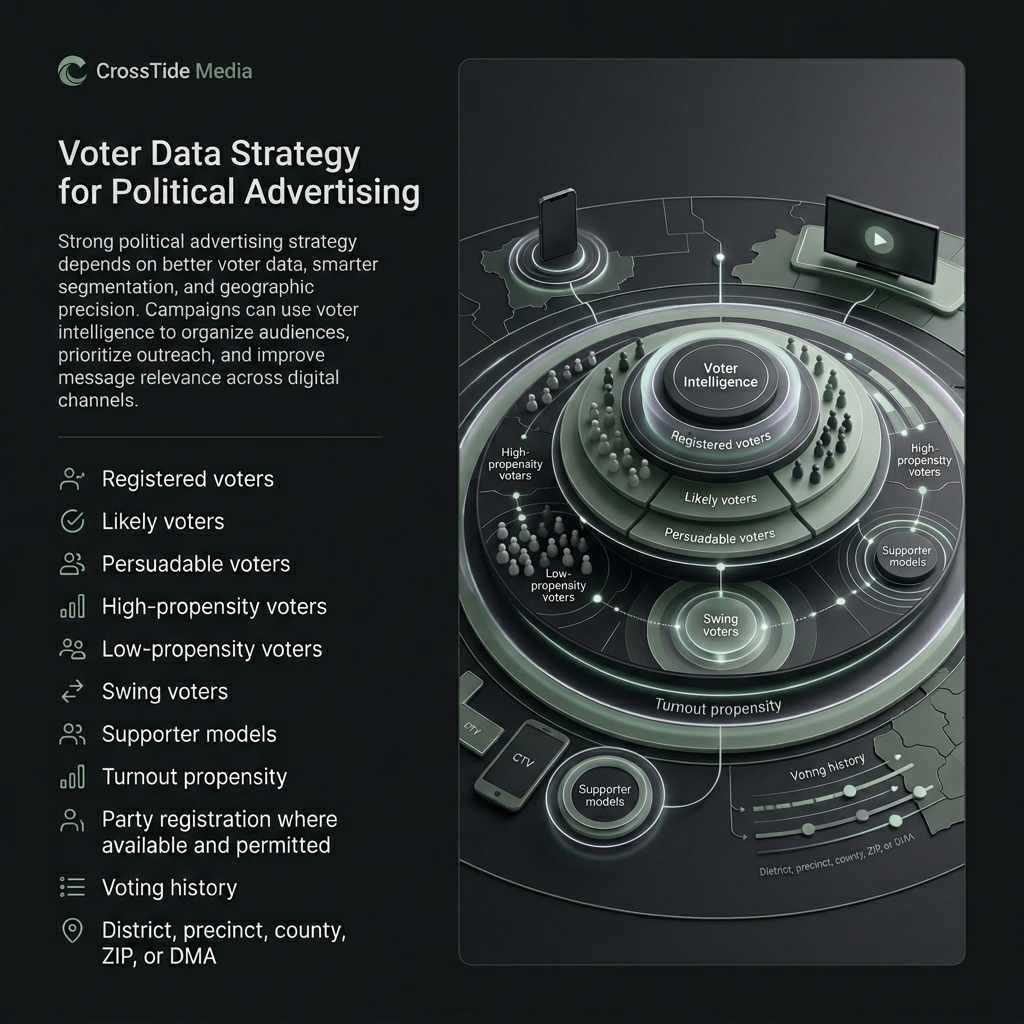
Political campaigns may use voter-file-informed data to build audiences around:
- Registered voters
- Likely voters
- Persuadable voters
- High-propensity voters
- Low-propensity voters
- Swing voters
- Supporter models
- Turnout propensity
- Party registration where available and permitted
- Voting history
- District, precinct, county, ZIP, or DMA
- Issue interests
- Donor history
- Household composition
- Coalition relevance
- Early-vote or absentee segments when available
- Modeled ideology or issue alignment where appropriate
The value of voter data is not just the data itself. The value comes from turning that data into a usable media strategy.
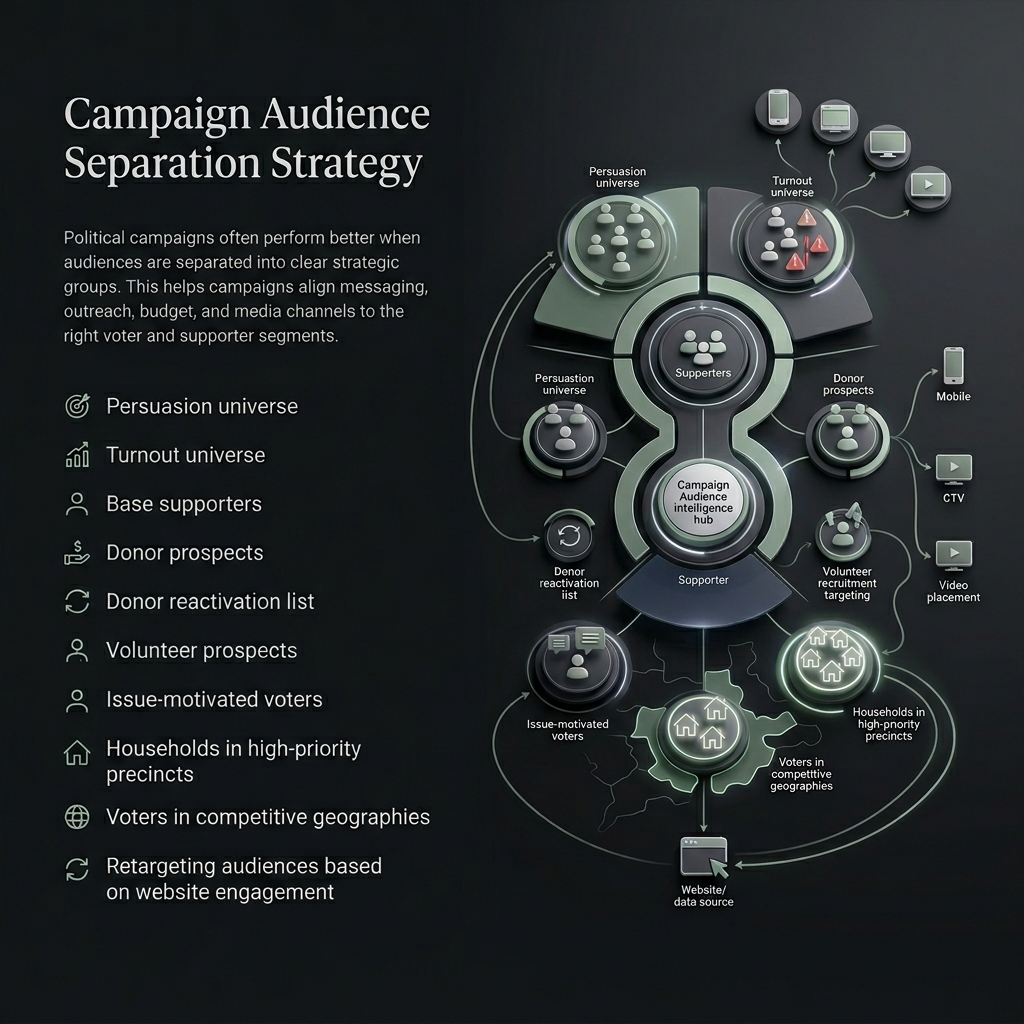
A campaign may need to separate audiences such as:
- Persuasion universe
- Turnout universe
- Base supporters
- Donor prospects
- Donor reactivation list
- Volunteer prospects
- Issue-motivated voters
- Households in high-priority precincts
- Voters in competitive geographies
- Retargeting audiences based on website engagement
Each audience should have a clear role in the campaign.
Voter File Targeting and Voter Matching
Voter file targeting allows campaigns to use voter data to inform digital audience activation. This can include matching voter records or modeled voter segments to digital identifiers that can be used for media delivery.
Voter matching may help campaigns reach specific voter groups across digital channels such as:
- Display
- Mobile
- Online video
- Connected TV
- Streaming audio
- Native placements
- Cross-device programmatic inventory
The matching process typically involves taking a campaign’s voter universe, supporter list, donor file, or other approved data source and securely onboarding that audience into media platforms or data environments where it can be activated.
This can help campaigns improve:
- Audience precision
- Household-level reach
- Message relevance
- Budget efficiency
- Geographic concentration
- Cross-screen delivery
- Retargeting strategy
- Suppression strategy
For example, a campaign may want to reach persuadable voters in a district with CTV and online video while using display and mobile to reinforce the same message across additional devices. Voter matching helps make that kind of strategy more precise.
Addressable Household Targeting for Political Campaigns
Addressable household targeting is one of the most valuable strategies in political advertising because campaigns often need to reach voters at the household level, not just at the broad demographic level.
Addressable household targeting can help campaigns deliver ads to specific households that match campaign-defined audience criteria.
This may be useful for:
- Local candidate campaigns
- City council races
- County races
- School board races
- Judicial races
- Legislative races
- Statewide campaigns
- Ballot initiatives
- Advocacy campaigns
- Issue campaigns
- Turnout campaigns
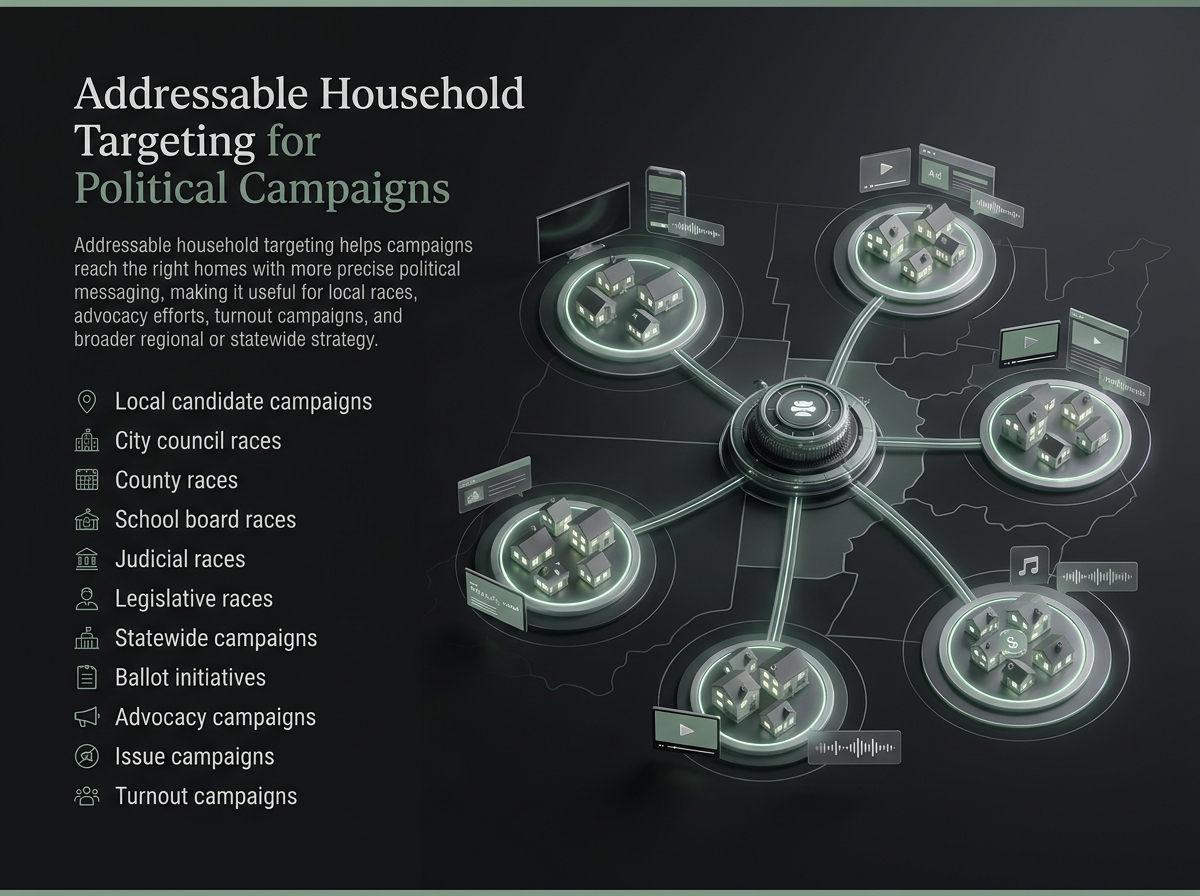
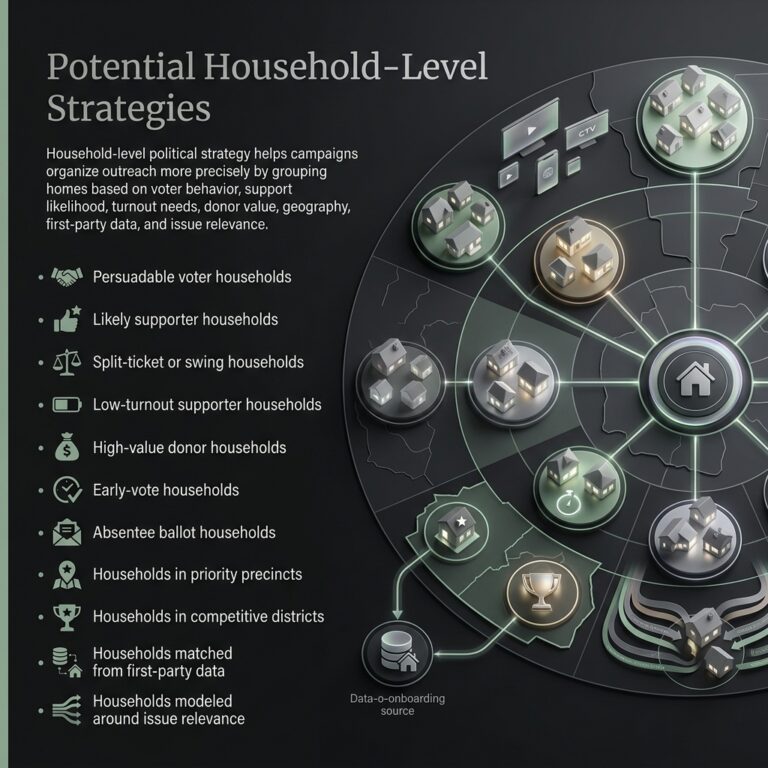
Political campaigns can use addressable household targeting to concentrate spend around households that matter most to the campaign.
Potential household-level strategies include:
- Persuadable voter households
- Likely supporter households
- Split-ticket or swing households
- Low-turnout supporter households
- High-value donor households
- Early-vote households
- Absentee ballot households
- Households in priority precincts
- Households in competitive districts
- Households matched from first-party data
- Households modeled around issue relevance
The benefit is simple: campaigns can reduce waste by focusing media delivery on voter households with higher strategic value.
Cross-Device Political Targeting
Voters do not consume media on one device. A voter may see a CTV ad at home, read local news on a mobile phone, listen to streaming audio in the car, browse a website on a laptop, and later visit a campaign landing page from a tablet.

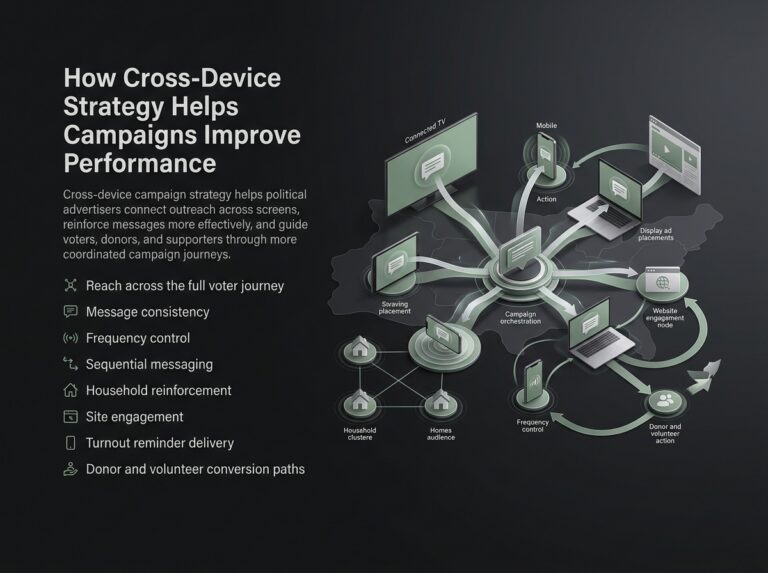
Cross-device targeting helps campaigns create more consistent message delivery across these screens.
A cross-device political campaign may include:
- CTV for household-level awareness
- Online video for persuasive storytelling
- Display for message reinforcement
- Mobile for urgency and turnout reminders
- Audio for frequency and commuter reach
- Native advertising for issue education
- Retargeting for voters who engaged with the campaign website
Cross-device strategy can help campaigns improve:
- Reach across the full voter journey
- Message consistency
- Frequency control
- Sequential messaging
- Household reinforcement
- Site engagement
- Turnout reminder delivery
- Donor and volunteer conversion paths
For example, a voter may first see a candidate introduction ad through CTV, then receive issue-focused display ads, then see a mobile turnout reminder closer to Election Day. That sequence can be more effective than showing the same generic ad in one channel repeatedly.
First-Party Data Strategy for Political Campaigns
First-party data is one of the most valuable assets a campaign can use. This includes data the campaign owns or collects directly.
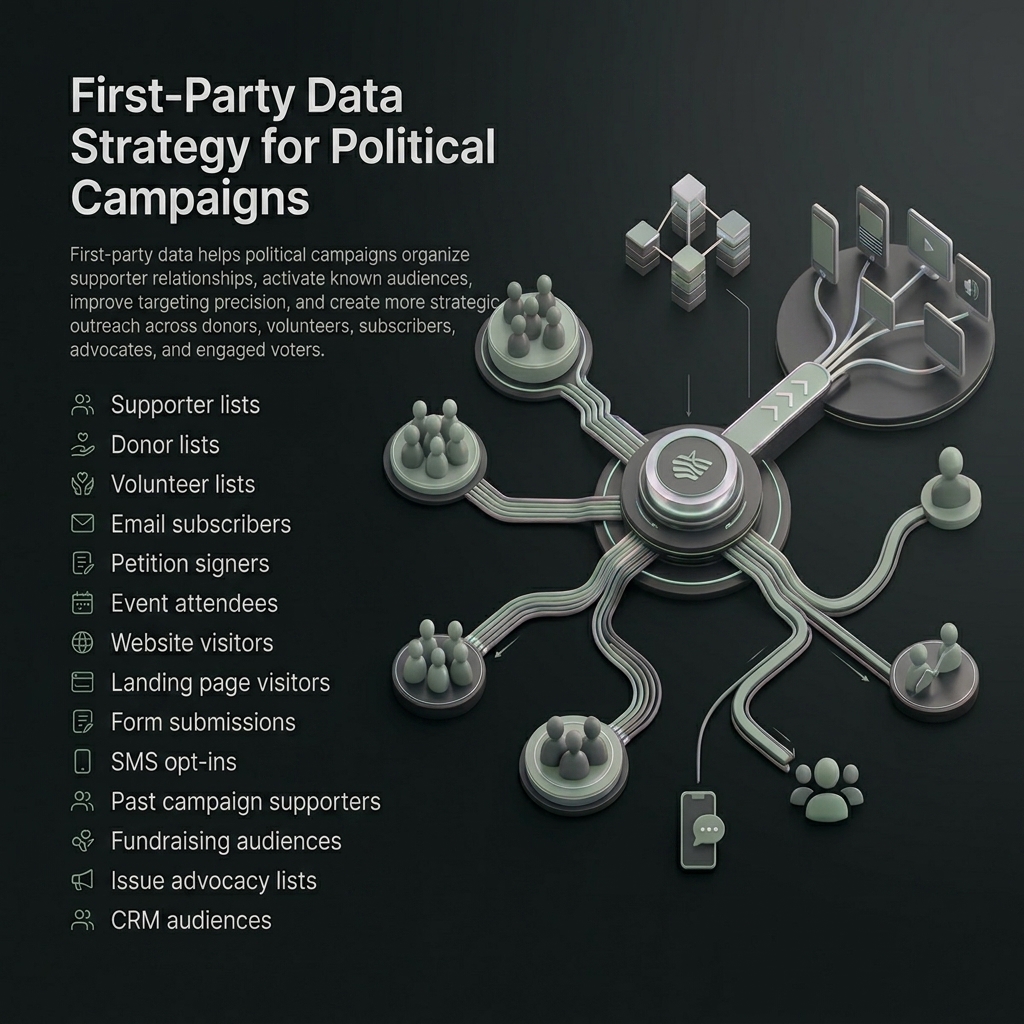
Examples of first-party political campaign data may include:
- Supporter lists
- Donor lists
- Volunteer lists
- Email subscribers
- Petition signers
- Event attendees
- Website visitors
- Landing page visitors
- Form submissions
- SMS opt-ins
- Past campaign supporters
- Fundraising audiences
- Issue advocacy lists
- CRM audiences
First-party data can support several campaign strategies.
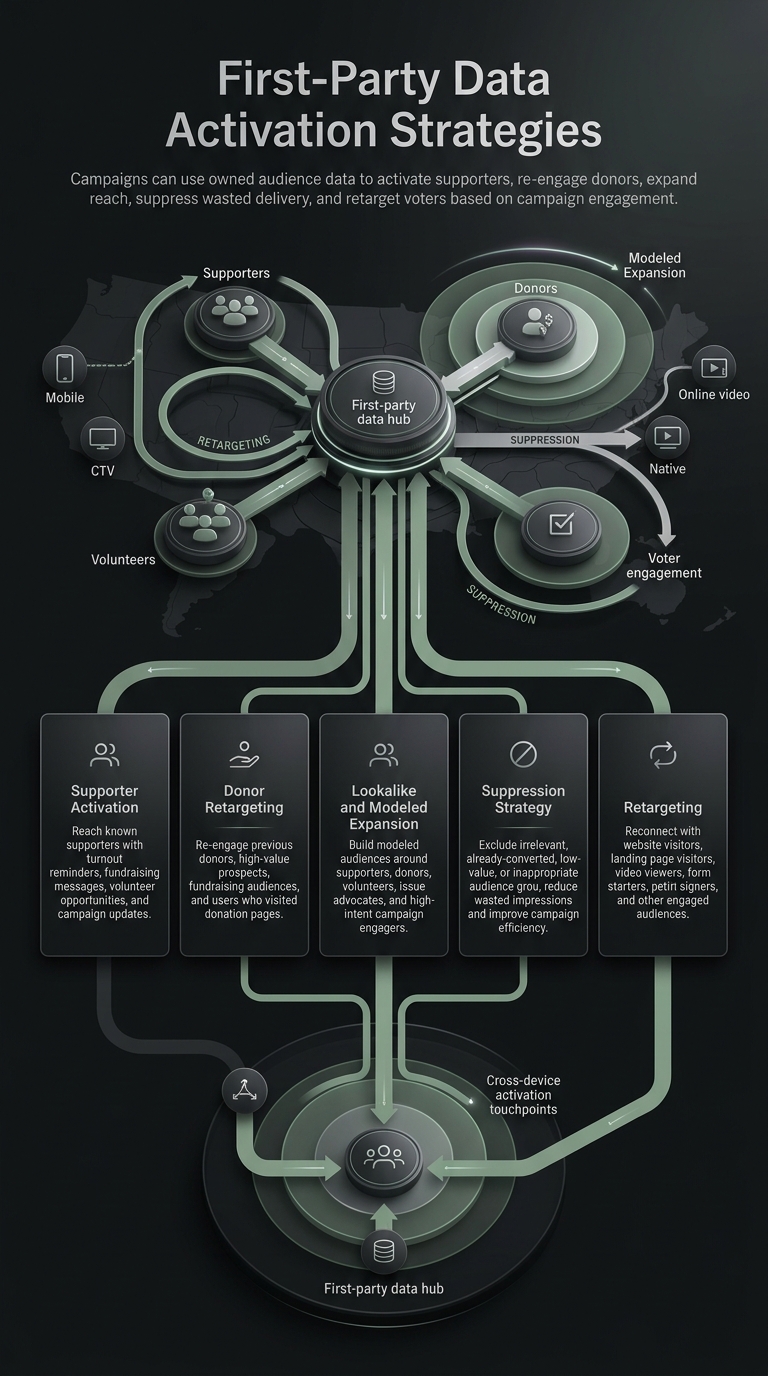
Supporter Activation
Campaigns can use supporter lists to deliver turnout reminders, volunteer asks, donation appeals, event invitations, or early voting information.
Donor Retargeting
Donor lists can be segmented to reach previous donors, high-value donors, lapsed donors, or small-dollar donor prospects with fundraising messages.
Lookalike and Modeled Expansion
Where permitted and appropriate, campaigns may use first-party data to build modeled audiences that resemble known supporters, donors, or engaged users.
Suppression Strategy
First-party data can also be used to avoid wasting persuasion dollars on people who have already donated, signed up, volunteered, or taken another action.
Retargeting
Website visitors and landing page users can be retargeted with follow-up messages based on their behavior. A visitor who viewed a donation page may receive a different message than someone who read an issue page. First-party data works best when campaigns organize it by intent, value, and campaign objective instead of treating every record the same.
Political Audience Segmentation Strategy
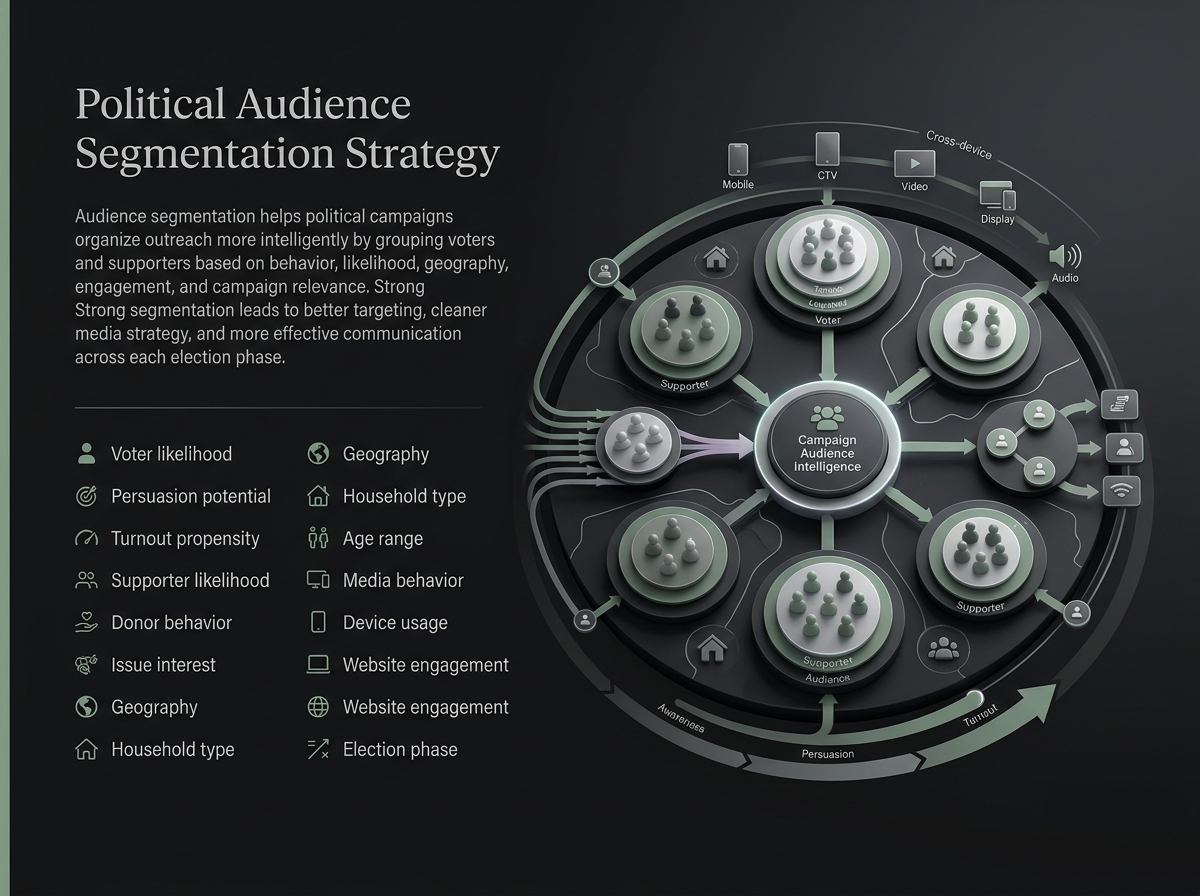
Audience segmentation is one of the biggest drivers of campaign efficiency. Political campaigns should avoid one-size-fits-all media planning whenever possible.
A strong political advertising plan may segment audiences by:
- Voter likelihood
- Persuasion potential
- Turnout propensity
- Supporter likelihood
- Donor behavior
- Issue interest
- Geography
- Household type
- Coalition group
- Age range
- Media behavior
- Device usage
- Website engagement
- Election phase
Common political audience segments include:
Persuadable Voters
These are voters who may be open to the campaign’s message. Persuasion audiences often need issue framing, candidate comparison, biography, values-based messaging, or policy education.
Likely Supporters
These voters may already be favorable to the campaign or aligned with the campaign’s message. They may be better suited for turnout, volunteer, donation, or social proof messaging.
Low-Propensity Supporters
These voters may support the campaign but need additional motivation to participate. They are often important in GOTV strategy.
Swing Households
These households may contain voters who are strategically important because of geography, voting behavior, or modeled persuasion potential.
Donor Prospects
These audiences may be built from first-party donor files, modeled donor behavior, issue interest, or retargeting pools.
Volunteer Prospects
Volunteer recruitment can be targeted to highly engaged supporters, prior campaign participants, advocacy audiences, or local community members.
Issue-Based Voters
Issue-based audiences may respond to messages around specific campaign priorities, ballot measures, advocacy issues, or public policy topics.
Retargeting Audiences
Users who visit the campaign website, donation page, volunteer page, or issue pages may receive follow-up advertising based on their engagement.
Segmentation allows campaigns to align message, channel, and budget with the audience’s role in the campaign.
Geographic Targeting for Political Campaigns
Political geography matters. A campaign may only need to reach voters in a city, county, legislative district, congressional district, school district, judicial district, or specific precincts. Strong geographic targeting can help campaigns avoid wasted impressions outside the relevant voting area.
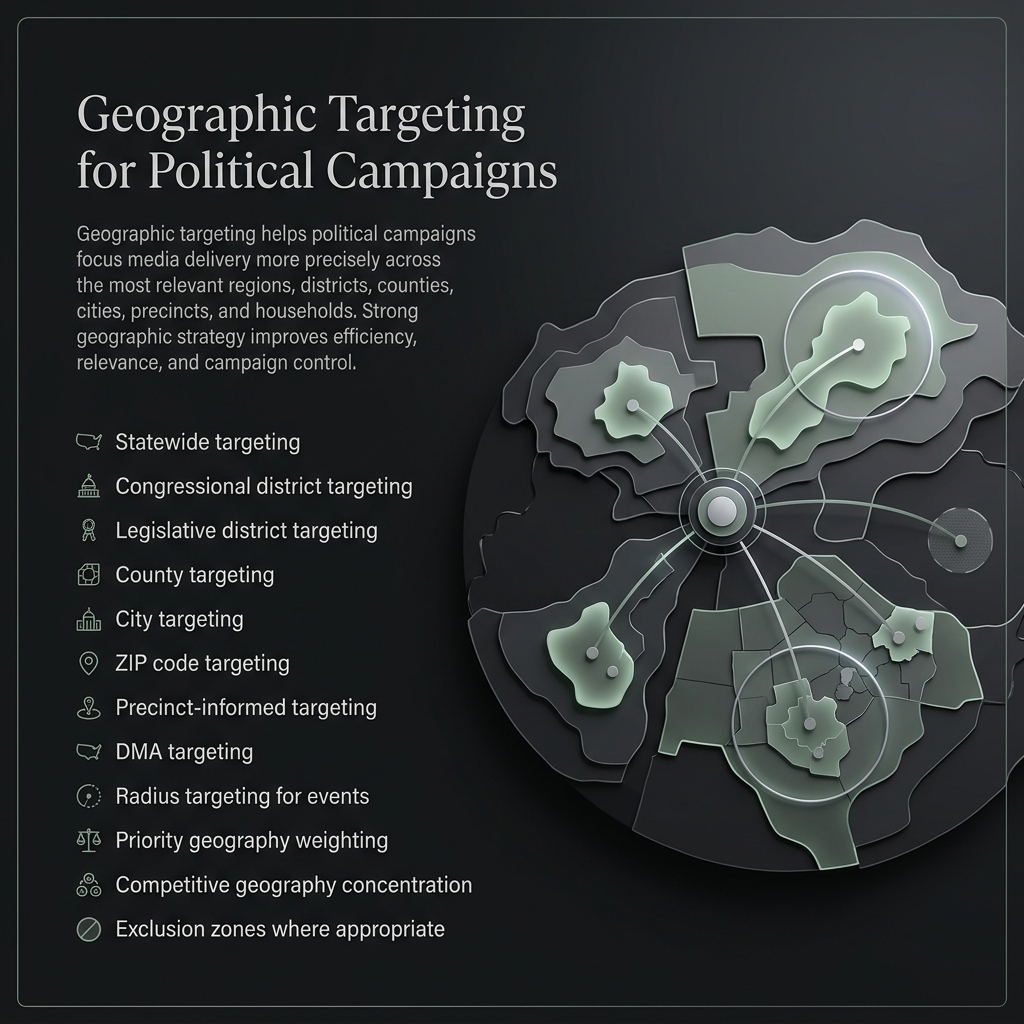
Political geographic strategies may include:
- Statewide targeting
- Congressional district targeting
- Legislative district targeting
- County targeting
- City targeting
- ZIP code targeting
- Precinct-informed targeting
- DMA targeting
- Radius targeting for events
- Priority geography weighting
- Competitive geography concentration
- Exclusion zones where appropriate
Geography can also be used for message segmentation. A campaign may use one message in one part of the district and a different message in another area based on local concerns, community identity, or issue relevance.
For local campaigns, geographic precision is especially important because budgets are often limited. Every impression outside the relevant district can reduce efficiency.
Political Programmatic Advertising
Programmatic advertising allows political campaigns to buy digital media across a wide range of websites, apps, streaming environments, video platforms, and connected devices using audience data, bidding controls, and real-time optimization.
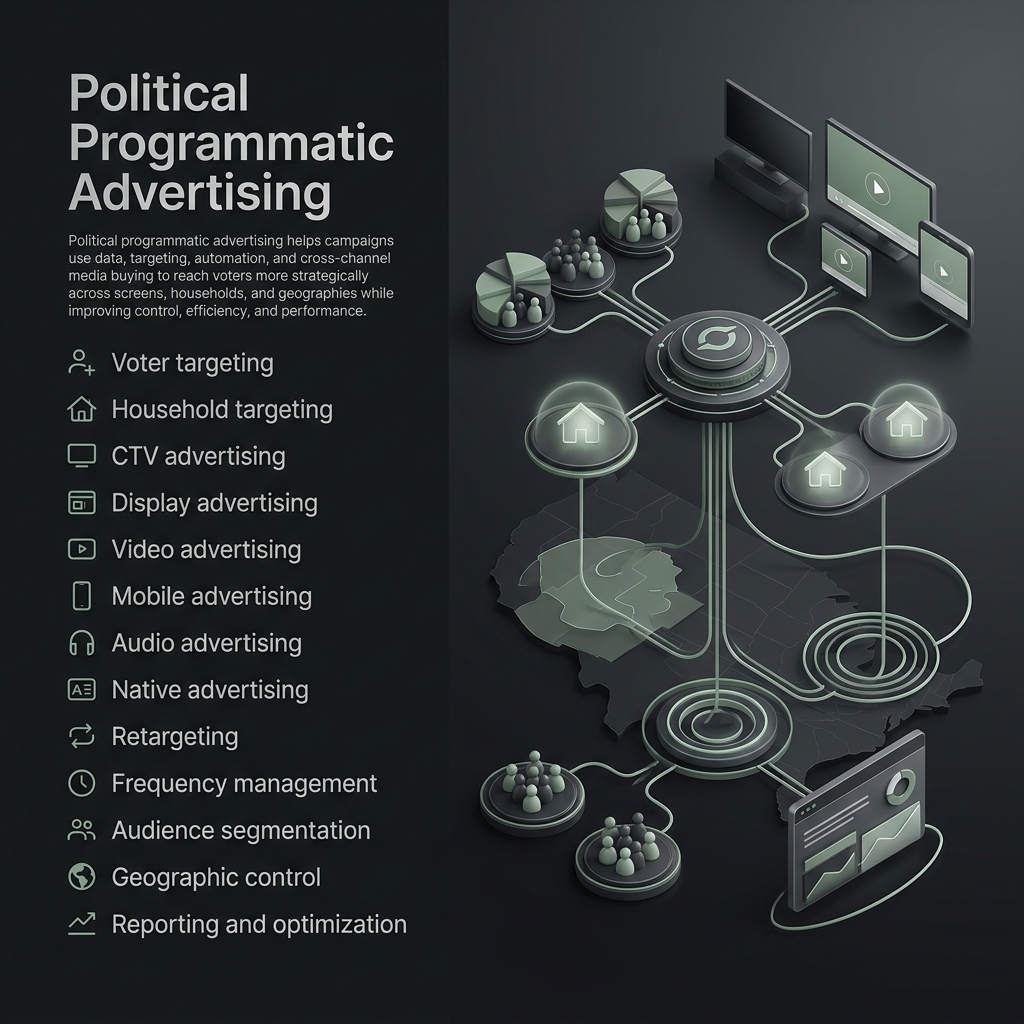
Political programmatic advertising can support:
- Voter targeting
- Household targeting
- CTV advertising
- Display advertising
- Video advertising
- Mobile advertising
- Audio advertising
- Native advertising
- Retargeting
- Frequency management
- Audience segmentation
- Geographic control
- Reporting and optimization
Programmatic media is especially useful for campaigns that need flexibility. Budgets can shift between audiences, channels, geographies, and creatives based on performance and campaign timing.
A programmatic political campaign may begin with broader awareness, shift into persuasion-focused messaging, and then move budget toward turnout audiences as voting begins.
Connected TV Political Advertising
Connected TV is one of the most powerful channels for political campaigns because it combines the visual impact of television with more precise digital targeting. CTV political advertising can help campaigns reach voters in streaming environments across smart TVs and connected devices.
CTV is useful for:
- Candidate introduction
- Persuasion messaging
- Issue education
- Ballot initiative campaigns
- Household-level awareness
- High-impact storytelling
- Local race visibility
- Voter universe penetration
CTV can be paired with voter-file-informed audiences, household targeting, geography, and cross-device reinforcement.
A strong CTV strategy may include:
- Addressable household targeting
- Voter audience matching
- Frequency management
- Premium inventory selection
- Geographic concentration
- Companion display or mobile reinforcement
- Sequential messaging
- Video completion reporting
CTV should not be treated as a standalone tactic. It works best when integrated into a broader political media plan.
Political Display Advertising
Display advertising is one of the most flexible channels in political media. It can support awareness, persuasion, fundraising, turnout, retargeting, and message reinforcement.

Display ads can run across websites, apps, and digital environments where target voters are likely to spend time.
Political display advertising can be used for:
- Candidate awareness
- Issue reinforcement
- Fundraising appeals
- Volunteer recruitment
- Early voting reminders
- Absentee ballot reminders
- Election Day reminders
- Retargeting
- Donor reactivation
- Landing page traffic
Display is especially useful when campaigns need cost-efficient reach and repeated exposure across priority audiences.
Political Video Advertising
Video advertising helps campaigns communicate more complex messages than static display ads. Video is useful for storytelling, persuasion, emotional connection, issue explanation, and candidate introduction.
Political video advertising may be used for:
- Candidate biography
- Issue framing
- Contrast messaging
- Endorsements
- Ballot initiative education
- Local community messaging
- GOTV urgency
- Fundraising appeals
Video can run across:
- Online video inventory
- Connected TV
- In-stream video
- Outstream video
- Mobile video
- Premium publisher environments
Strong political video creative should communicate the main message quickly, identify the campaign clearly, and match the audience segment it is intended to reach.
Political Mobile Advertising
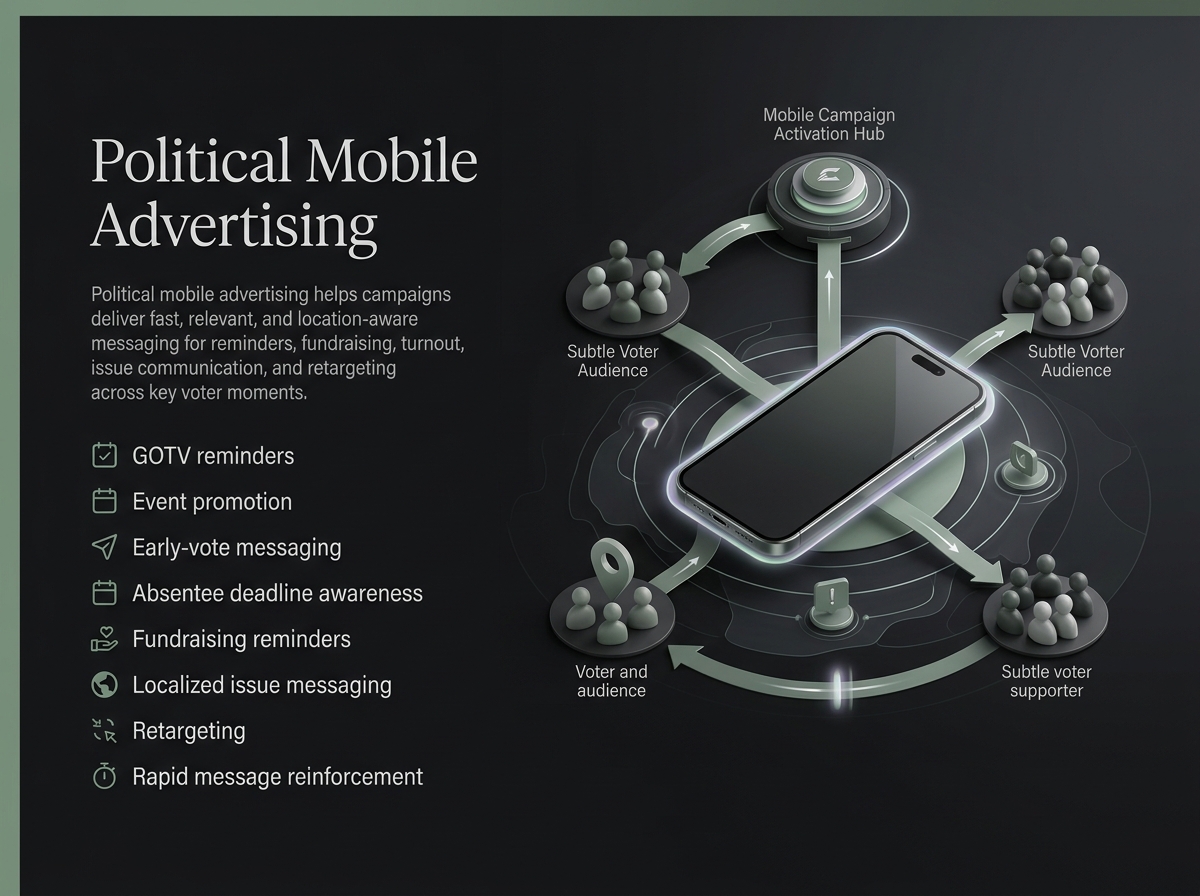
Mobile advertising is valuable because voters spend significant time on phones throughout the day. Mobile can support awareness, persuasion, turnout, and rapid-response messaging.
Political mobile advertising can be used for:
- GOTV reminders
- Event promotion
- Early-vote messaging
- Absentee deadline awareness
- Fundraising reminders
- Localized issue messaging
- Retargeting
- Rapid message reinforcement
Mobile is especially useful late in the campaign when urgency matters. It can help campaigns reach voters with timely messages close to key deadlines.
Political Audio Advertising
Streaming audio can help campaigns reach voters during moments when visual ads may not be available, such as commuting, working, exercising, or listening at home.
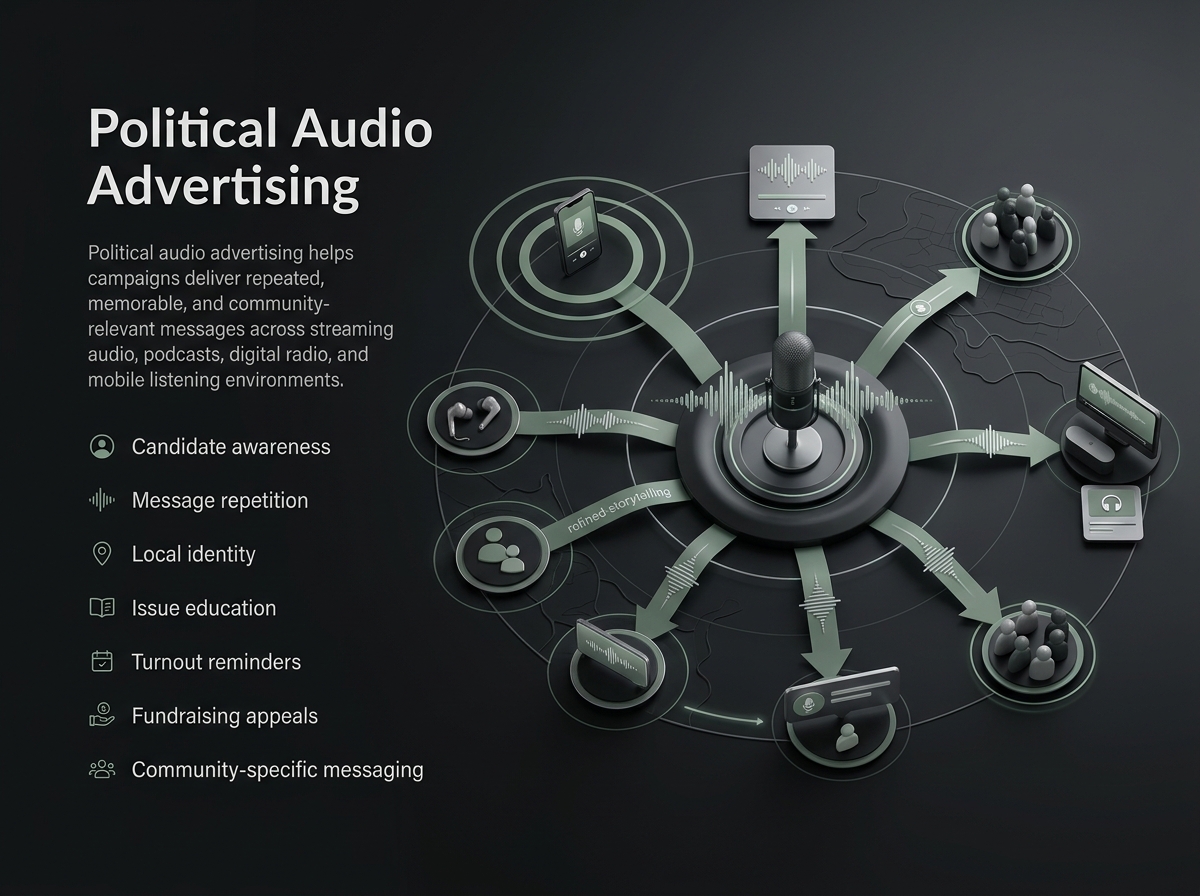
Political audio advertising can support:
- Candidate awareness
- Message repetition
- Local identity
- Issue education
- Turnout reminders
- Fundraising appeals
- Community-specific messaging
Audio can complement CTV, display, and mobile by adding frequency and reinforcing the campaign’s message in additional daily media moments.
Native Political Advertising
Native advertising can support political campaigns that need more room for issue education or message explanation.
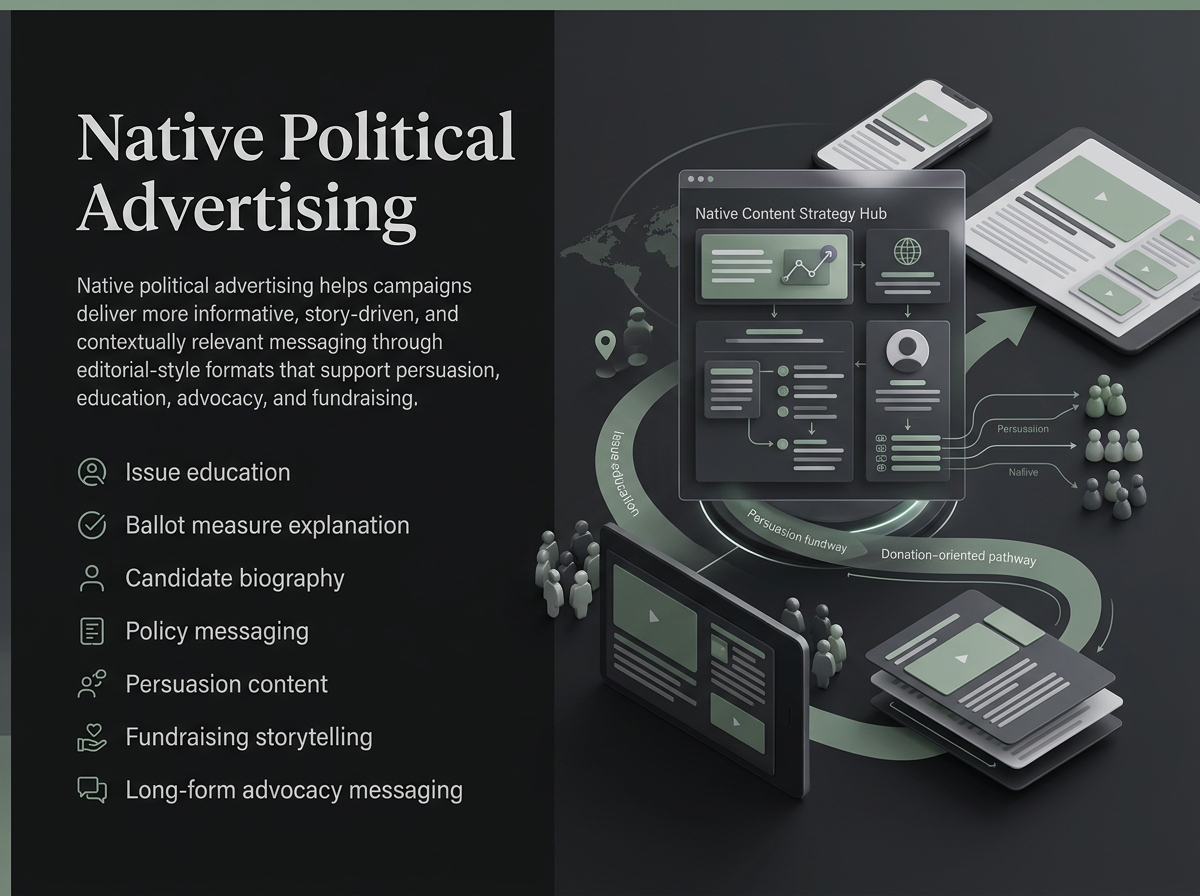
Native ads often appear in content-style placements and can direct users to campaign landing pages, issue pages, candidate information, or advocacy content.
Native advertising may be useful for:
- Issue education
- Ballot measure explanation
- Candidate biography
- Policy messaging
- Persuasion content
- Fundraising storytelling
- Long-form advocacy messaging
Native is best used when the campaign has a strong landing page or content destination that helps voters understand the message in more depth.
Political Retargeting Strategy
Retargeting allows campaigns to follow up with users who have already interacted with campaign content.
Retargeting audiences may include:
- Website visitors
- Donation page visitors
- Volunteer page visitors
- Issue page visitors
- Video viewers
- Landing page visitors
- Email clickers where available
- Event page visitors
- Petition or signup page visitors
Retargeting can help campaigns move users from awareness to action.
Examples include:
- A voter visits a candidate issue page and later receives a video ad about that issue.
- A donor visits a contribution page but does not complete a donation and later receives a fundraising reminder.
- A supporter visits an early voting information page and later receives a GOTV message.
- A volunteer prospect visits a signup page and later receives a recruitment ad.
Retargeting is often one of the most efficient parts of a political media plan because it focuses on users who have already shown interest.
Political Fundraising Advertising
Digital advertising can support political fundraising by reaching both known donors and new donor prospects.
Fundraising campaigns may use:
- First-party donor lists
- Lapsed donor lists
- High-intent website retargeting
- Donation page retargeting
- Lookalike or modeled donor audiences where appropriate
- Issue-based donor prospecting
- Email list reinforcement
- Urgency-based creative
- Deadline-focused messaging
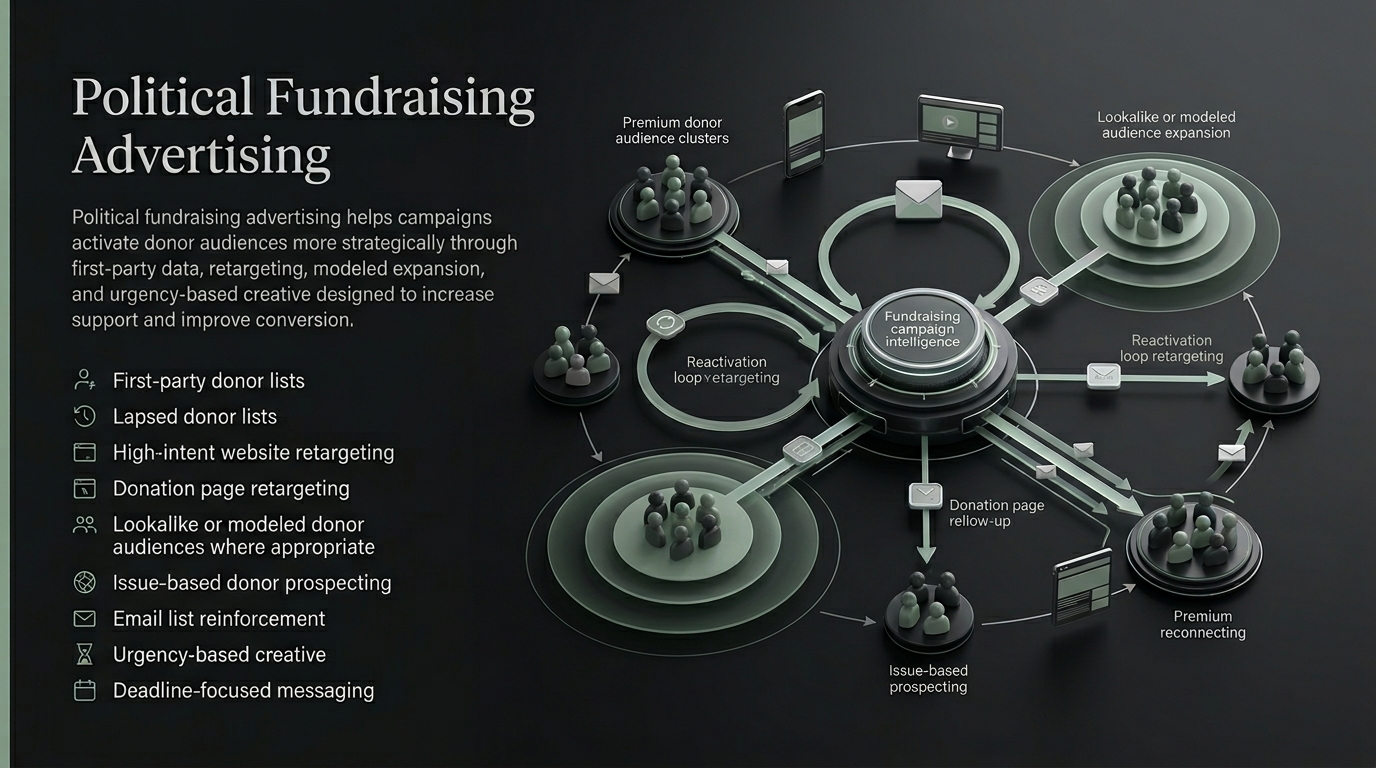
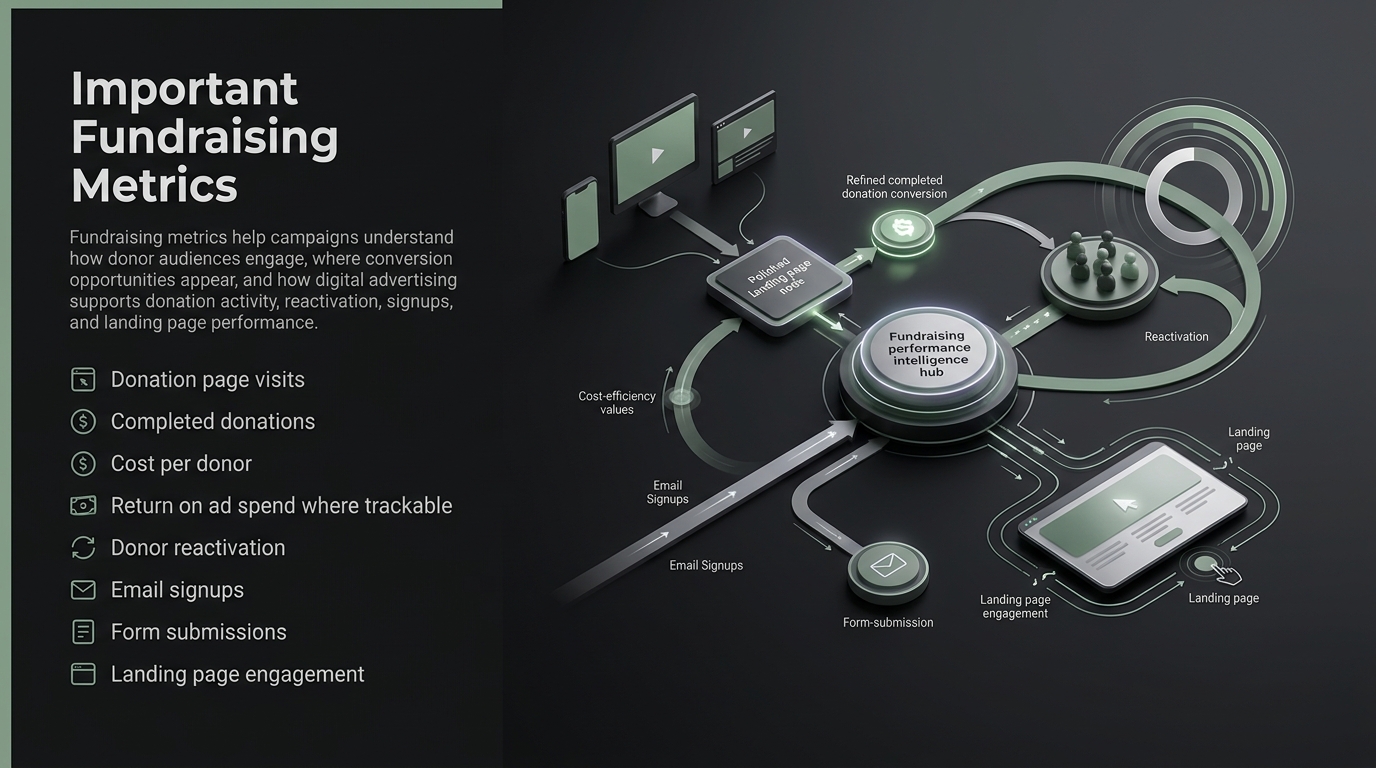
Fundraising creative should usually be direct, clear, and action-oriented. Campaigns should also separate donor audiences from persuasion audiences when possible because the message and success metric are different.
Important fundraising metrics may include:
- Donation page visits
- Completed donations
- Cost per donor
- Return on ad spend where trackable
- Donor reactivation
- Email signups
- Form submissions
- Landing page engagement
Fundraising creative should usually be direct, clear, and action-oriented. Campaigns should also separate donor audiences from persuasion audiences when possible because the message and success metric are different.
Important fundraising metrics may include:
- Donation page visits
- Completed donations
- Cost per donor
- Return on ad spend where trackable
- Donor reactivation
- Email signups
- Form submissions
- Landing page engagement
Political Volunteer Recruitment Advertising
Volunteer recruitment can also benefit from digital media. Campaigns may use advertising to reach likely supporters, issue-engaged users, prior volunteers, event attendees, or local community members.
Volunteer recruitment campaigns may promote:
- Canvassing
- Phone banking
- Text banking
- Event attendance
- Yard sign pickup
- Petition gathering
- Election Day support
- Poll watching where applicable
- Community organizing opportunities
Volunteer recruitment audiences may include:
- First-party supporter lists
- Website visitors
- High-engagement users
- Issue-based audiences
- Local community audiences
- Donor audiences
- Event page visitors
- Retargeting pools
Volunteer campaigns work best when the call to action is simple and the landing page makes signup easy.
Political Creative Strategy
Creative strategy is one of the most important parts of political advertising. Even the best targeting cannot overcome unclear messaging.
Strong political creative should:
- Communicate quickly
- Identify the candidate, campaign, organization, or issue clearly
- Match the audience segment
- Align with the campaign phase
- Include a clear call to action
- Maintain message consistency
- Be formatted correctly for each channel
- Avoid unnecessary complexity
- Stay compliant with applicable requ
Creative should be built around the objective.

Awareness Creative
Awareness creative should introduce the campaign clearly and build recognition. Common awareness messages include:
- Candidate introduction
- Biography
- Local roots
- Key values
- Core issue themes
- Campaign identity
Persuasion Creative
Persuasion creative should focus on a specific argument or issue. It should not try to say everything at once. Common persuasion messages include:
- Issue positions
- Community priorities
- Candidate contrast
- Ballot measure explanation
- Problem and solution framing
- Coalition-specific messaging
Turnout Creative
Turnout creative should be urgent, simple, and action-oriented. Common turnout messages include:
- Vote early
- Return your ballot
- Find your polling place
- Election Day is approaching
- Make a voting plan
- Remind your household to vote
Fundraising Creative
Fundraising creative should be direct and emotionally clear. Common fundraising messages include:
- Deadline reminders
- Goal-based fundraising
- Issue urgency
- Supporter momentum
- Donor reactivation
- Small-dollar donation asks
Each creative message should be connected to the right audience and the right campaign phase.
Landing Page Strategy for Political Campaigns
Political advertising works best when the landing page supports the media objective. Sending every user to the same homepage can reduce performance.
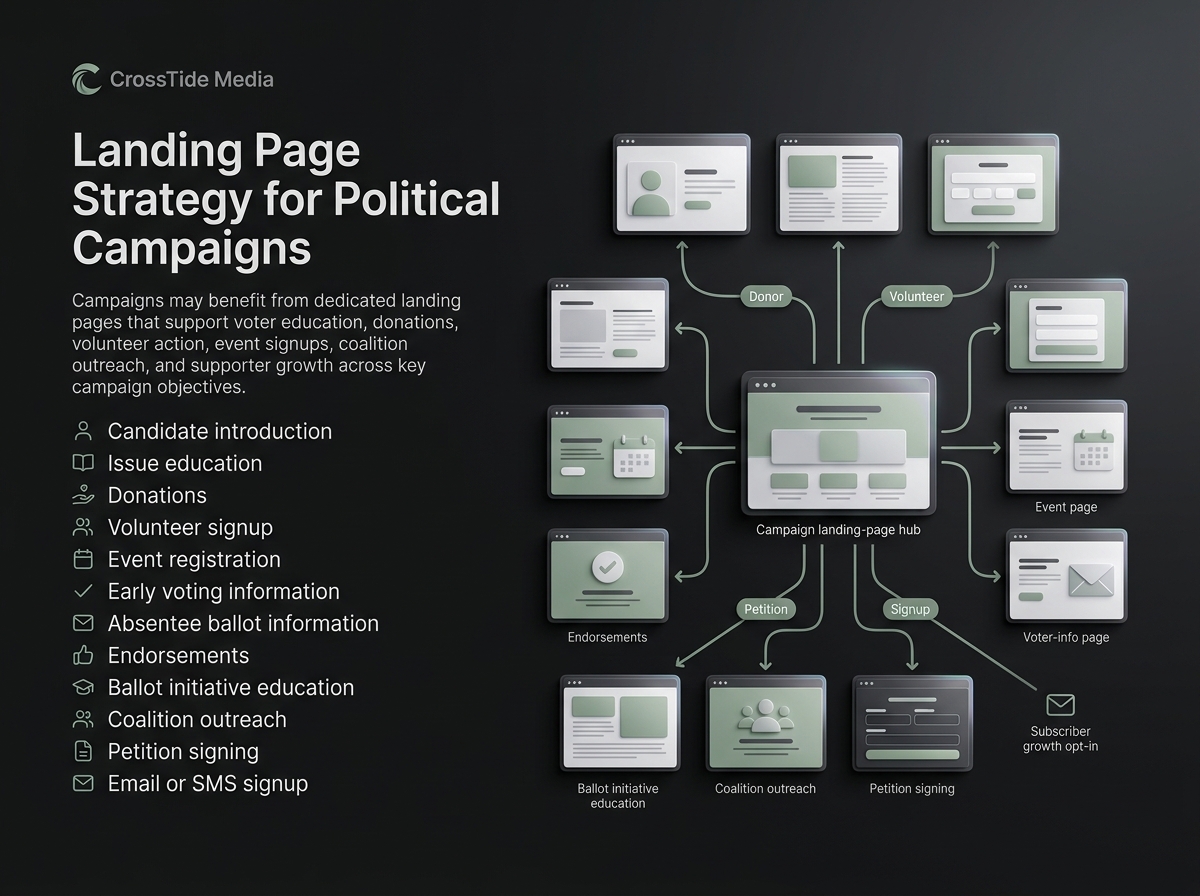
Campaigns may benefit from dedicated landing pages for:
- Candidate introduction
- Issue education
- Donations
- Volunteer signup
- Event registration
- Early voting information
- Absentee ballot information
- Endorsements
- Ballot initiative education
- Coalition outreach
- Petition signing
- Email or SMS signup
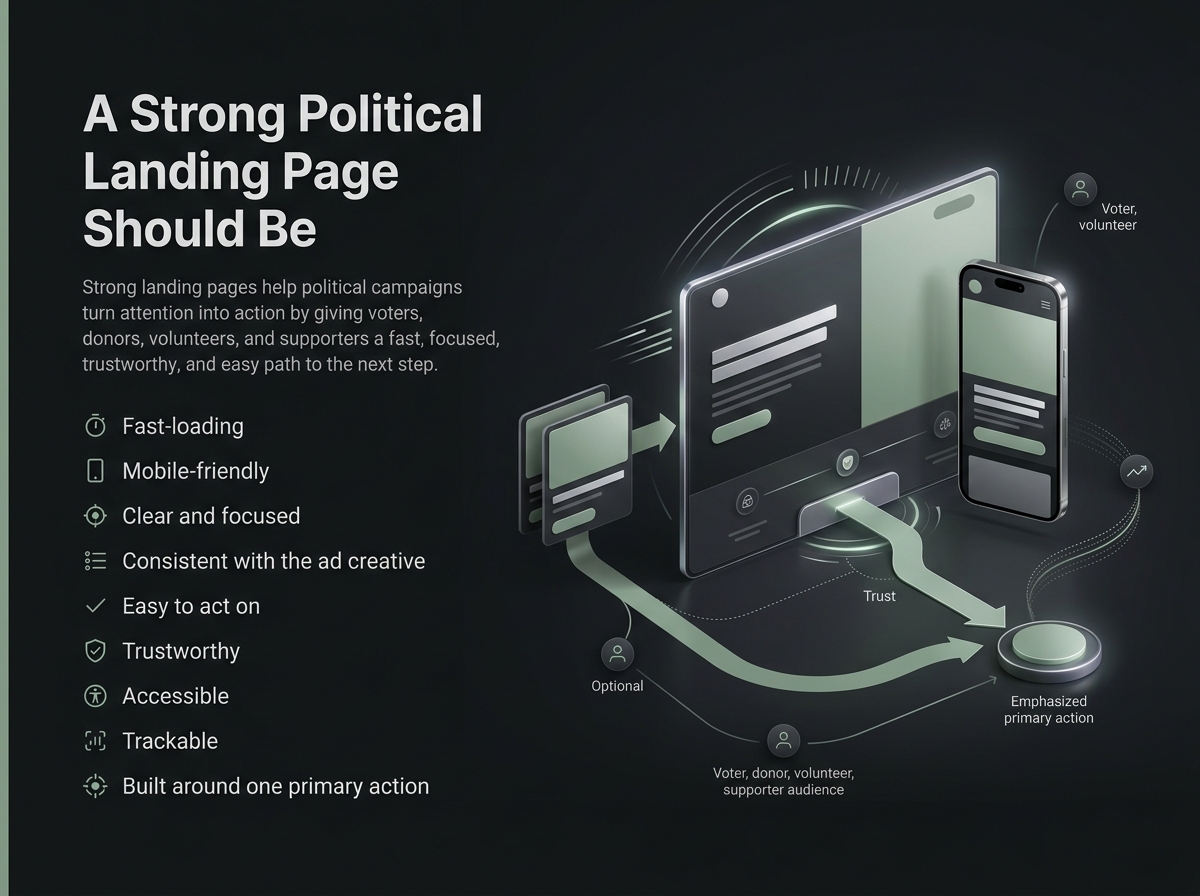
A strong political landing page should be:
- Fast-loading
- Mobile-friendly
- Clear and focused
- Consistent with the ad creative
- Easy to act on
- Trustworthy
- Accessible
- Trackable
- Built around one primary action
Landing page behavior can also inform retargeting and optimization.
Political Measurement, Reporting, and Optimization
Political campaigns need reporting that supports decision-making, not just delivery summaries.
Important political advertising metrics may include:
- Impressions
- Reach
- Frequency
- Click-through rate
- Video completion rate
- CTV completion rate
- Landing page visits
- Donation page visits
- Completed forms
- Volunteer signups
- Donor conversions
- Audience segment performance
- Geography performance
- Device performance
- Creative performance
- Spend pacing
- Household reach
- Voter universe penetration
- Retargeting performance
Political campaigns should not rely only on last-click attribution. A voter may see multiple ads across multiple screens before taking action or making a voting decision.
A stronger measurement framework looks at:
- Audience quality
- Reach within priority voter universes
- Frequency against key households
- Geographic delivery accuracy
- Engagement by segment
- Creative fatigue
- Site behavior
- Conversion activity
- Spend efficiency by objective
- Campaign phase performance
Optimization may include shifting budget by:
- Audience segment
- Geography
- Channel
- Creative
- Device
- Time period
- Inventory source
- Election phase
The goal is to improve the campaign while it is live, not simply report after it is over.

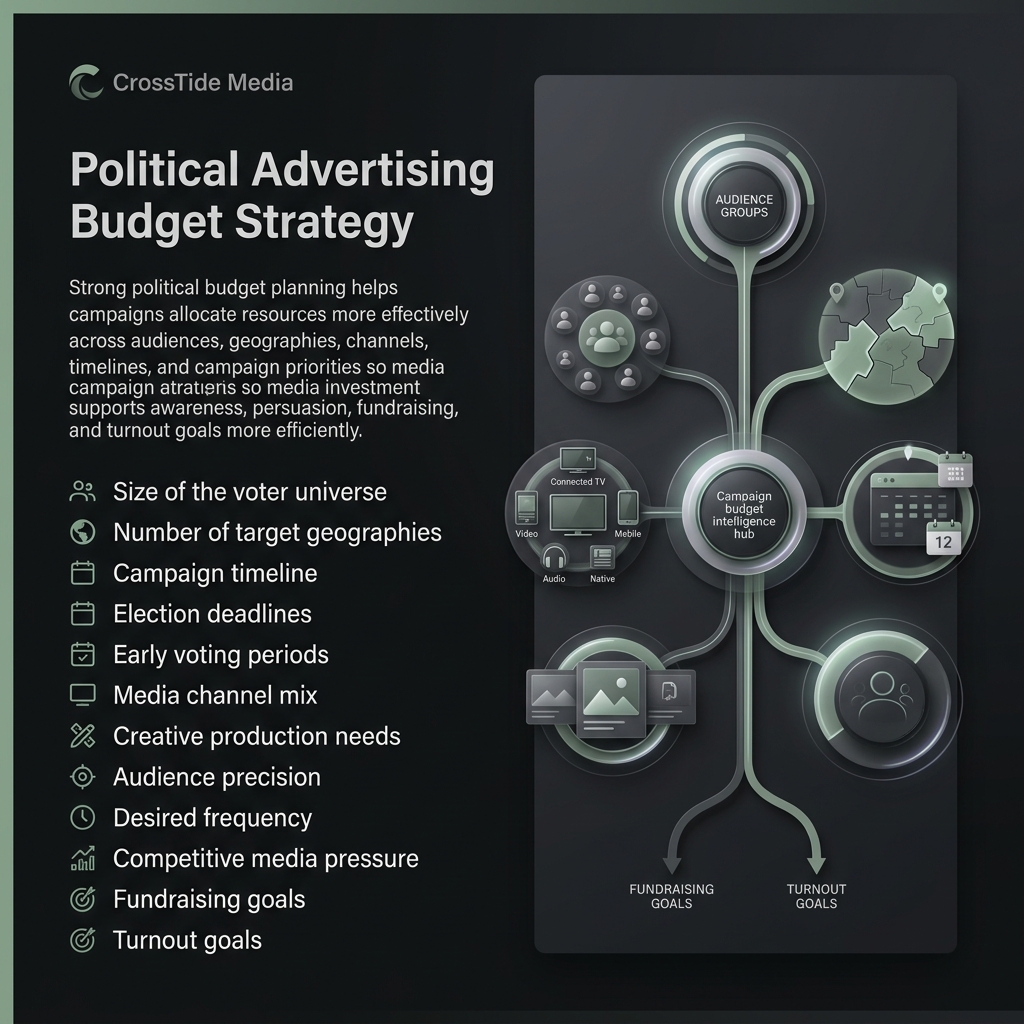
Political Advertising Budget Strategy
Political advertising budgets vary based on the size of the race, geography, audience universe, timeline, channel mix, and competitive environment.
Budget planning should consider:
- Size of the voter universe
- Number of target geographies
- Campaign timeline
- Election deadlines
- Early voting periods
- Media channel mix
- Creative production needs
- Audience precision
- Desired frequency
- Competitive media pressure
- Fundraising goals
- Turnout goals
A small local campaign may need a highly concentrated media plan focused on the most valuable voters. A larger campaign may need a broader funnel that includes awareness, persuasion, fundraising, and turnout across multiple channels.
The most important budgeting question is not simply “How low can the CPM be?”
Better questions include:
- Are we reaching the right voters?
- Are we reaching the right households?
- Are we spending in the right geography?
- Are we using the right channels for the objective?
- Are we separating persuasion, turnout, and fundraising audiences?
- Are we delivering enough frequency to matter?
- Are we reducing waste where possible?
- Are we learning and optimizing while the campaign is live?
Efficient political advertising is not just about low cost. It is about spending media dollars where they can have the greatest campaign value.
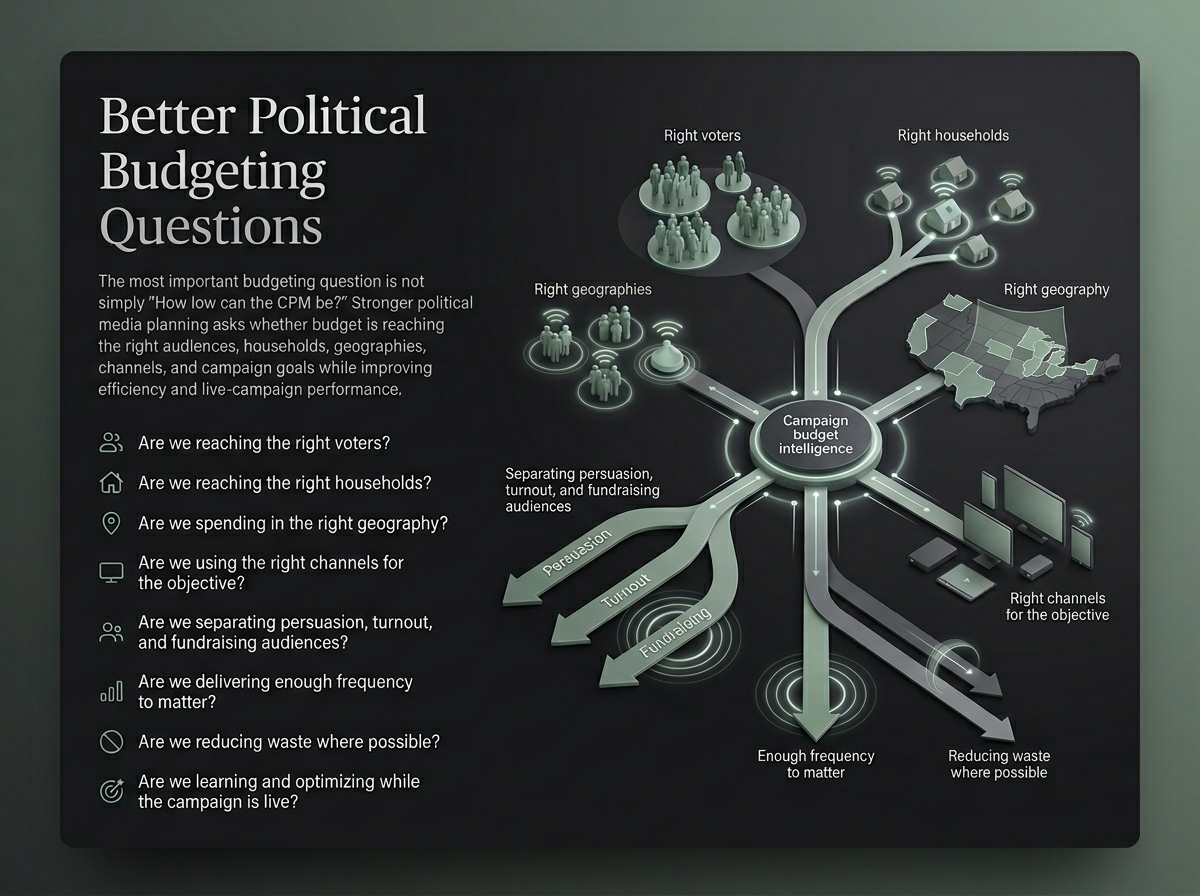
The most important budgeting question is not simply “How low can the CPM be?”
Better questions include:
- Are we reaching the right voters?
- Are we reaching the right households?
- Are we spending in the right geography?
- Are we using the right channels for the objective?
- Are we separating persuasion, turnout, and fundraising audiences?
- Are we delivering enough frequency to matter?
- Are we reducing waste where possible?
- Are we learning and optimizing while the campaign is live?
Efficient political advertising is not just about low cost. It is about spending media dollars where they can have the greatest campaign value.
Compliance, Disclaimers, and Quality Control
Political advertising requires careful attention to platform policies, disclosure requirements, creative standards, data usage rules, and campaign-specific compliance considerations.
Crosstide Media helps campaigns approach political media with operational discipline, including:
- Creative QA
- Landing page review
- Audience setup review
- Geography verification
- Platform policy awareness
- Disclaimer and disclosure coordination where applicable
- Inventory quality control
- Brand safety standards
- Pacing checks
- Performance monitoring
- Reporting review
Political rules and platform requirements can vary by channel, race type, geography, and campaign structure. Campaigns should review all applicable legal and compliance requirements with appropriate counsel or compliance advisors.
From a media execution standpoint, quality control matters because political campaigns need accuracy, consistency, and trust.

Political Advertising Strategies We Support
Crosstide Media can support a wide range of political campaign strategies, including:
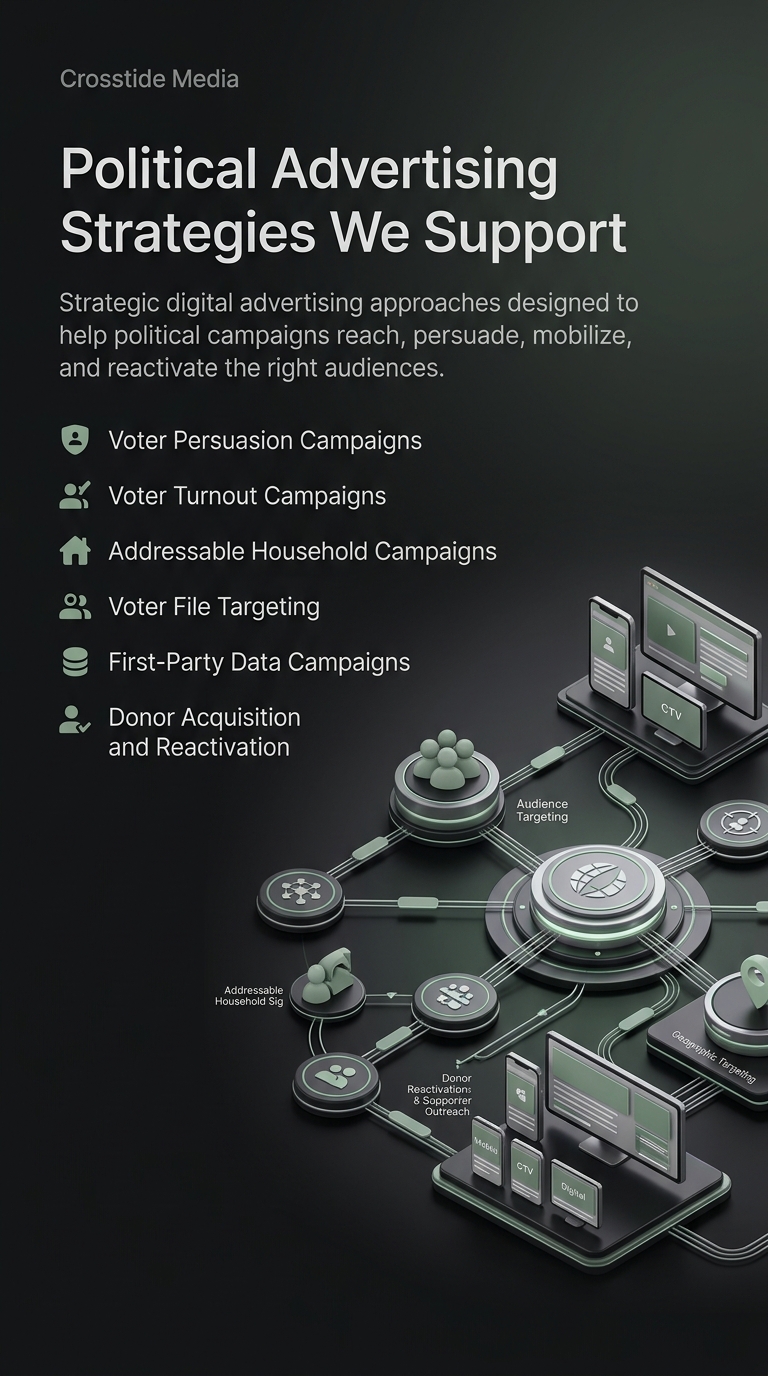
Voter Persuasion Campaigns
Reach persuadable voters with segmented messaging, video, CTV, display, mobile, and cross-device reinforcement.
Voter Turnout Campaigns
Deliver GOTV messaging to likely supporters, low-propensity voters, early-vote audiences, absentee voters, and priority households.
Addressable Household Campaigns
Reach specific voter households through household-level targeting and cross-screen campaign delivery.
Voter File Targeting
Use voter-file-informed audiences to build more accurate campaign targeting strategies.
First-Party Data Campaigns
Activate supporter lists, donor files, volunteer lists, website visitors, and campaign CRM audiences.
Donor Acquisition and Reactivation
Reach new donor prospects, past donors, lapsed donors, and high-intent donation page visitors.
Volunteer Recruitment
Drive volunteer signups, event participation, canvassing support, phone banking, and local campaign involvement.
Ballot Initiative Advertising
Educate voters on ballot measures with clear, issue-focused messaging and audience segmentation.
Advocacy Advertising
Reach policy-relevant audiences, issue-engaged voters, supporters, donors, and community stakeholders.
Advocacy Advertising
Reach policy-relevant audiences, issue-engaged voters, supporters, donors, and community stakeholders.
Local Candidate Advertising
Build efficient digital campaigns for city, county, judicial, school board, legislative, and other local races.
Cross-Device Political Campaigns
Coordinate delivery across CTV, video, display, mobile, native, and audio to improve reach and message consistency.
Frequently Asked Questions About Political Advertising
What is political advertising?
Political advertising is paid media used by candidates, campaigns, PACs, advocacy organizations, ballot initiatives, and public affairs groups to reach voters, supporters, donors, or issue-relevant audiences.
What is digital political advertising?
Digital political advertising uses channels such as display, video, connected TV, mobile, streaming audio, native advertising, programmatic media, and retargeting to reach political audiences online and across connected devices.
What is voter targeting?
Voter targeting uses voter-file-informed data, audience modeling, geography, behavior, and campaign-specific segmentation to reach voters who are most relevant to the campaign’s objective.
What is voter matching?
Voter matching is the process of aligning voter-file-informed audiences with digital identifiers so campaigns can reach relevant voters or households through digital advertising.
What is addressable household targeting in political advertising?
Addressable household targeting allows campaigns to reach specific households based on audience criteria, voter data, geography, or campaign-defined targeting strategy.
How does cross-device targeting help political campaigns?
Cross-device targeting helps campaigns reach voters across multiple screens, including connected TV, mobile, desktop, tablet, video, audio, and display environments.
Can political campaigns use first-party data?
Yes. Campaigns can often use first-party data such as supporter lists, donor lists, volunteer lists, email subscribers, website visitors, and CRM audiences to improve targeting, retargeting, suppression, and fundraising strategy.
What channels work best for political advertising?
The best channels depend on the campaign objective. CTV and video are useful for awareness and persuasion. Display and mobile are useful for reinforcement and turnout. Audio can support frequency. Native can support issue education. Retargeting can help convert engaged users.
How should political campaigns measure digital advertising?
Political campaigns may measure impressions, reach, frequency, video completion, landing page visits, donor activity, volunteer signups, audience performance, geography performance, household reach, and voter universe penetration.
Is political advertising only for large campaigns?
No. Local campaigns can benefit from political advertising when the media strategy is highly focused. Addressable household targeting, voter data, and geographic precision can be especially valuable for smaller campaigns with limited budgets.
Build a Smarter Political Advertising Campaign
Political campaigns need media strategies that are precise, disciplined, and built around the real objective of the race.

Crosstide Media helps campaigns reach persuadable voters, reinforce supporters, activate donors, recruit volunteers, and drive turnout through digital advertising strategies built around voter intelligence, addressable households, first-party data, cross-device targeting, and measurable media execution.
If your campaign needs a smarter way to reach voters, Crosstide Media can help you plan, launch, manage, and optimize a political advertising campaign built for precision.
Is Connected TV and DOOH on this? Really want to emphasize CTV
Yes — Connected TV is included, but I agree it should be emphasized much more. DOOH is not meaningfully built out yet beyond one mention in the original combined page, so I’d add it as an optional political channel while making CTV one of the core pillars of the page.
Here’s the stronger section I’d add near the top, right after “Political Campaign Advertising Strategy” or before “Voter Data Strategy”:
Connected TV Political Advertising
Connected TV is one of the most important channels in modern political advertising because it gives campaigns the impact of television with the precision of digital media. Instead of relying only on broad traditional TV buys, political campaigns can use CTV to reach priority voter households across streaming environments with stronger targeting, better message control, and more efficient media delivery.
CTV is especially valuable for political campaigns because it supports both persuasion and turnout. Campaigns can use connected TV to introduce a candidate, explain an issue, reinforce name recognition, deliver contrast messaging, educate voters on a ballot initiative, or remind likely supporters to vote.
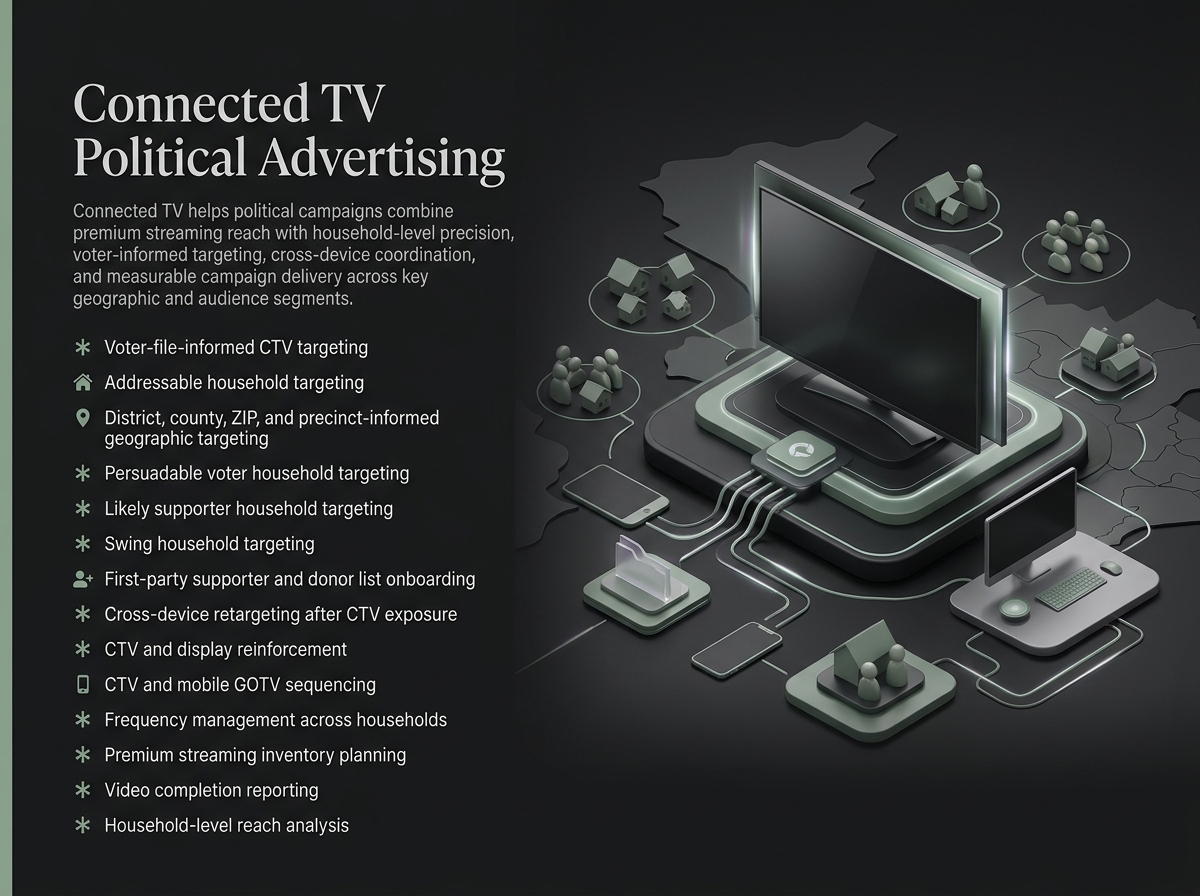
Crosstide Media helps political campaigns use CTV to reach voters through strategies such as:
- Voter-file-informed CTV targeting
- Addressable household targeting
- District, county, ZIP, and precinct-informed geographic targeting
- Persuadable voter household targeting
- Likely supporter household targeting
- Swing household targeting
- First-party supporter and donor list onboarding
- Cross-device retargeting after CTV exposure
- CTV and display reinforcement
- CTV and mobile GOTV sequencing
- Frequency management across households
- Premium streaming inventory planning
- Video completion reporting
- Household-level reach analysis
CTV is not just a branding channel. For political campaigns, it can be used as a precision voter communication tool.
A strong CTV political campaign may reach a voter household with a high-impact video message on the largest screen in the home, then reinforce that same message later across mobile, display, native, or online video. This creates a more consistent voter journey across screens while helping the campaign maintain message discipline.
CTV can support every major phase of a political campaign:
CTV for Candidate Awareness
Campaigns can use connected TV to introduce a candidate, build name recognition, communicate biography, and establish the campaign’s core message. This is especially useful for challengers, first-time candidates, local races, and campaigns entering a market where voter familiarity is low.
CTV for Voter Persuasion
CTV can deliver persuasive video messages to specific voter segments, including persuadable voters, issue-focused audiences, modeled swing voters, or households in high-priority geographies. Video allows campaigns to communicate emotion, credibility, contrast, and issue framing more effectively than static formats alone.
CTV for Ballot Initiative and Issue Education
Ballot measures and advocacy campaigns often require more explanation than a banner ad can provide. CTV gives campaigns the ability to explain an issue clearly while still using voter data, geography, and household-level targeting to improve efficiency.
CTV for Turnout and GOTV
As Election Day approaches, CTV can reinforce urgency among likely supporters and priority voter households. GOTV CTV campaigns may be paired with mobile, display, and audio reminders to increase message repetition across devices.
CTV for Fundraising and Supporter Activation
CTV can also support fundraising and supporter activation when paired with first-party donor lists, retargeting, and cross-device follow-up. A campaign may use CTV to build emotional connection, then use display, mobile, email, or landing page retargeting to drive action.
The strongest CTV strategies are not isolated from the rest of the campaign. They are connected to voter data, household targeting, first-party audiences, creative sequencing, and performance reporting.
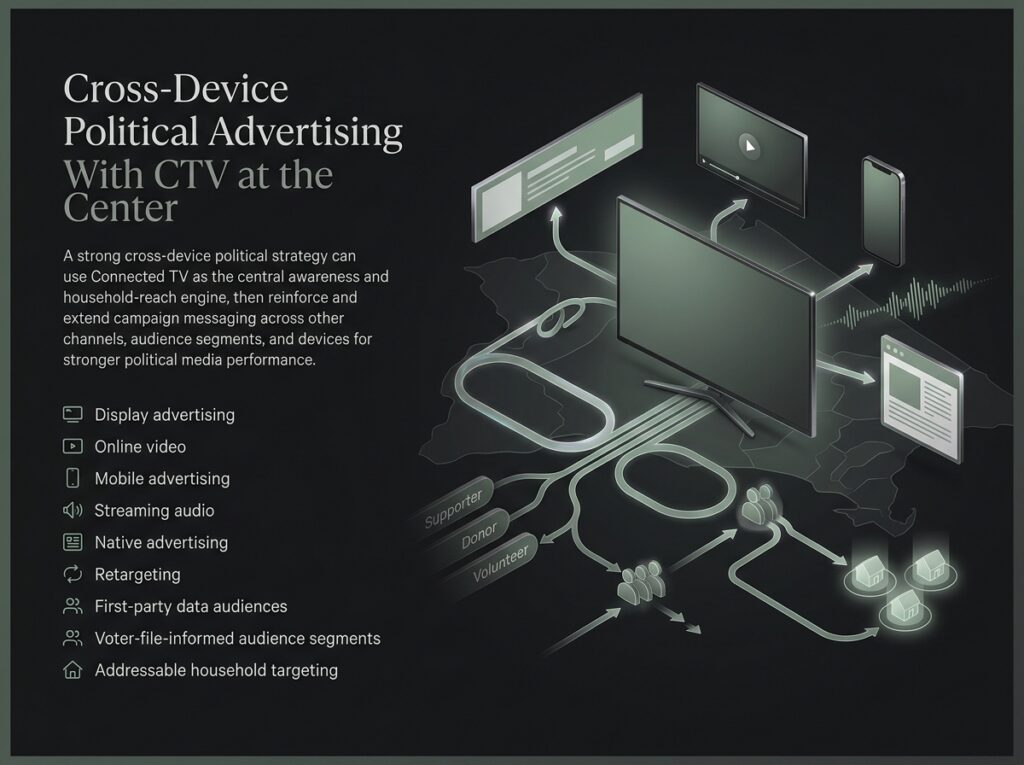
Cross-Device Political Advertising With CTV at the Center
CTV becomes even more powerful when it is connected to a broader cross-device strategy. Voters rarely make decisions after one ad exposure on one screen. They may see a connected TV ad at home, read about the candidate on a mobile device, visit a campaign website, receive a display reminder, and later see a GOTV message before Election Day.
Crosstide Media helps campaigns build cross-device political media plans that connect CTV with:
- Display advertising
- Online video
- Mobile advertising
- Streaming audio
- Native advertising
- Retargeting
- First-party data audiences
- Voter-file-informed audience segments
- Addressable household targeting
This approach helps campaigns improve message consistency, reach voters across more media moments, and reinforce the campaign’s message over time.
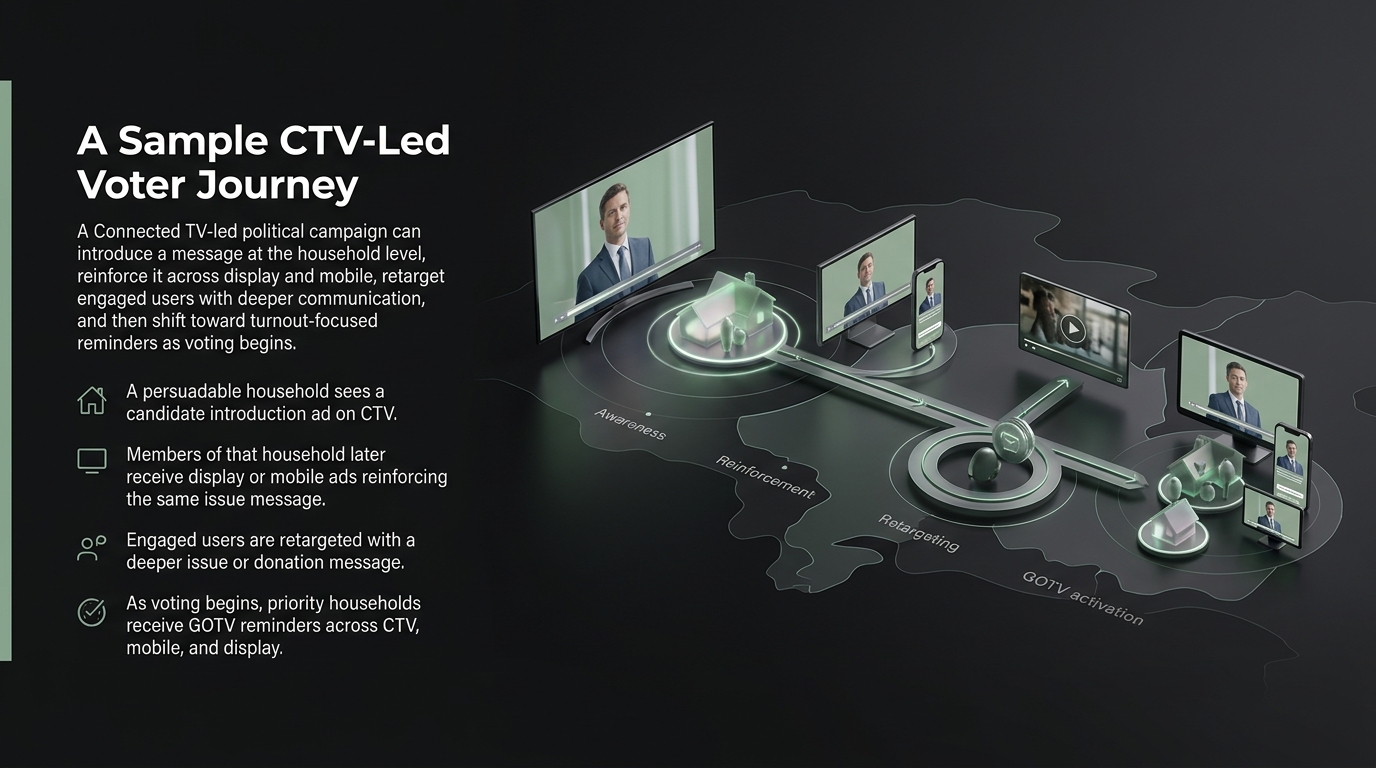
A sample CTV-led voter journey may look like this:
- A persuadable household sees a candidate introduction ad on CTV.
- Members of that household later receive display or mobile ads reinforcing the same issue message.
- Engaged users are retargeted with a deeper issue or donation message.
- As voting begins, priority households receive GOTV reminders across CTV, mobile, and display.
This type of sequencing helps campaigns use CTV as the anchor channel while using other digital formats to reinforce the message and drive action.
Programmatic DOOH for Political Campaigns
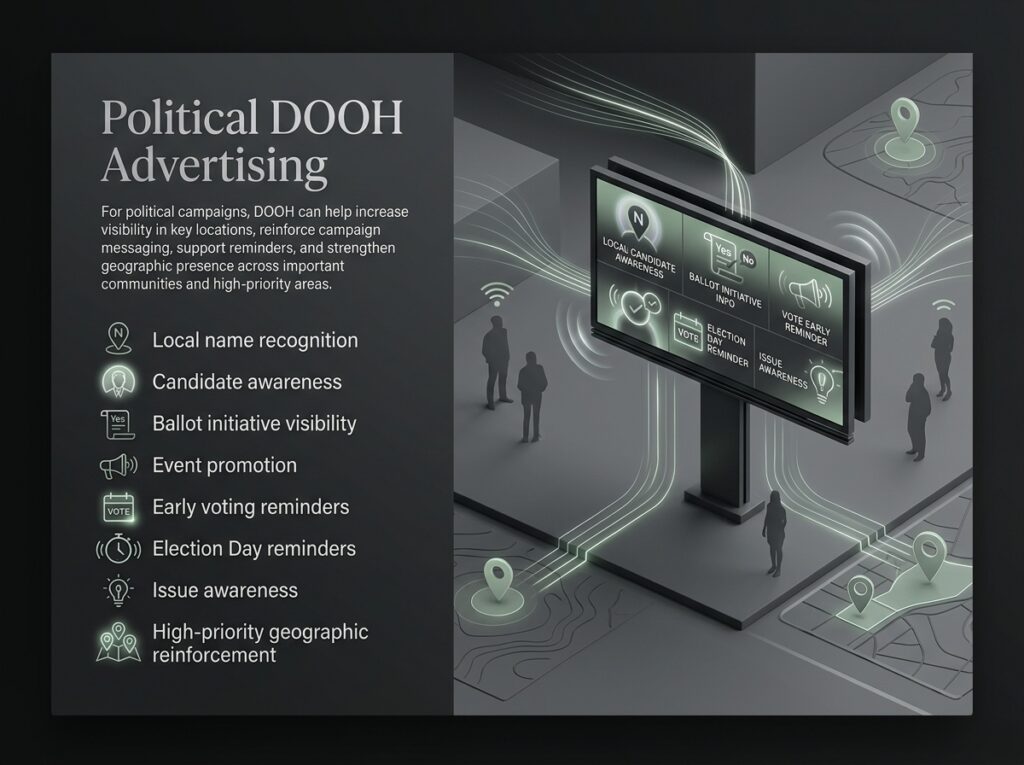
Programmatic digital out-of-home, or DOOH, can also support political campaigns when geography, visibility, and local presence matter. DOOH allows campaigns to place digital messages on screens in public environments such as roadside displays, transit areas, retail locations, office buildings, gyms, convenience stores, and other high-traffic locations where available.
For political campaigns, DOOH can be useful for:
- Local name recognition
- Candidate awareness
- Ballot initiative visibility
- Event promotion
- Early voting reminders
- Election Day reminders
- Issue awareness
- High-priority geographic reinforcement
DOOH works best when used as part of a broader media plan. It is not usually as individually addressable as voter-file or household targeting, but it can provide strong geographic visibility in priority communities.
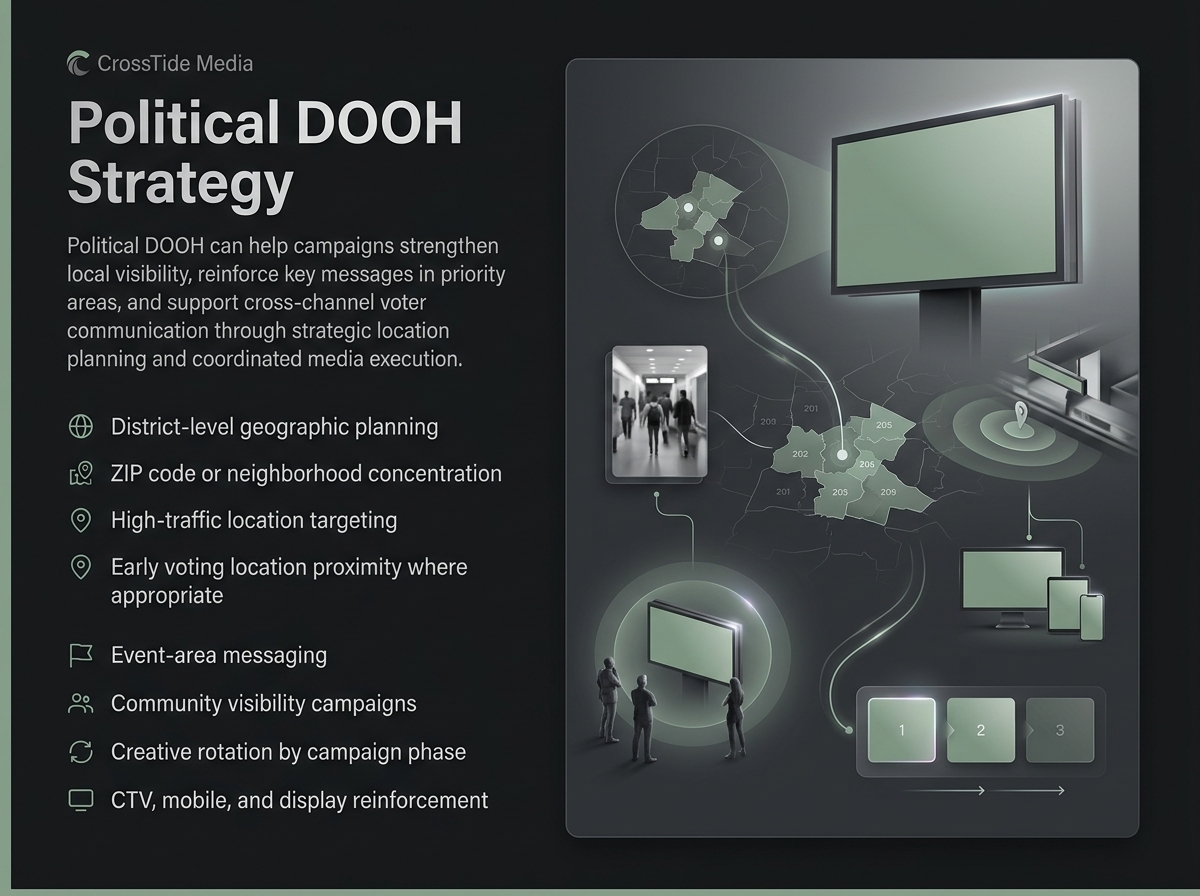
Political DOOH strategies may include:
- District-level geographic planning
- ZIP code or neighborhood concentration
- High-traffic location targeting
- Early voting location proximity where appropriate
- Event-area messaging
- Community visibility campaigns
- Creative rotation by campaign phase
- CTV, mobile, and display reinforcement
For example, a campaign may use CTV to reach priority voter households at home, mobile and display to reinforce the message across personal devices, and DOOH to create visibility in important local areas.
DOOH can be especially valuable for local campaigns, ballot initiatives, and awareness efforts where public visibility and geographic presence are important.
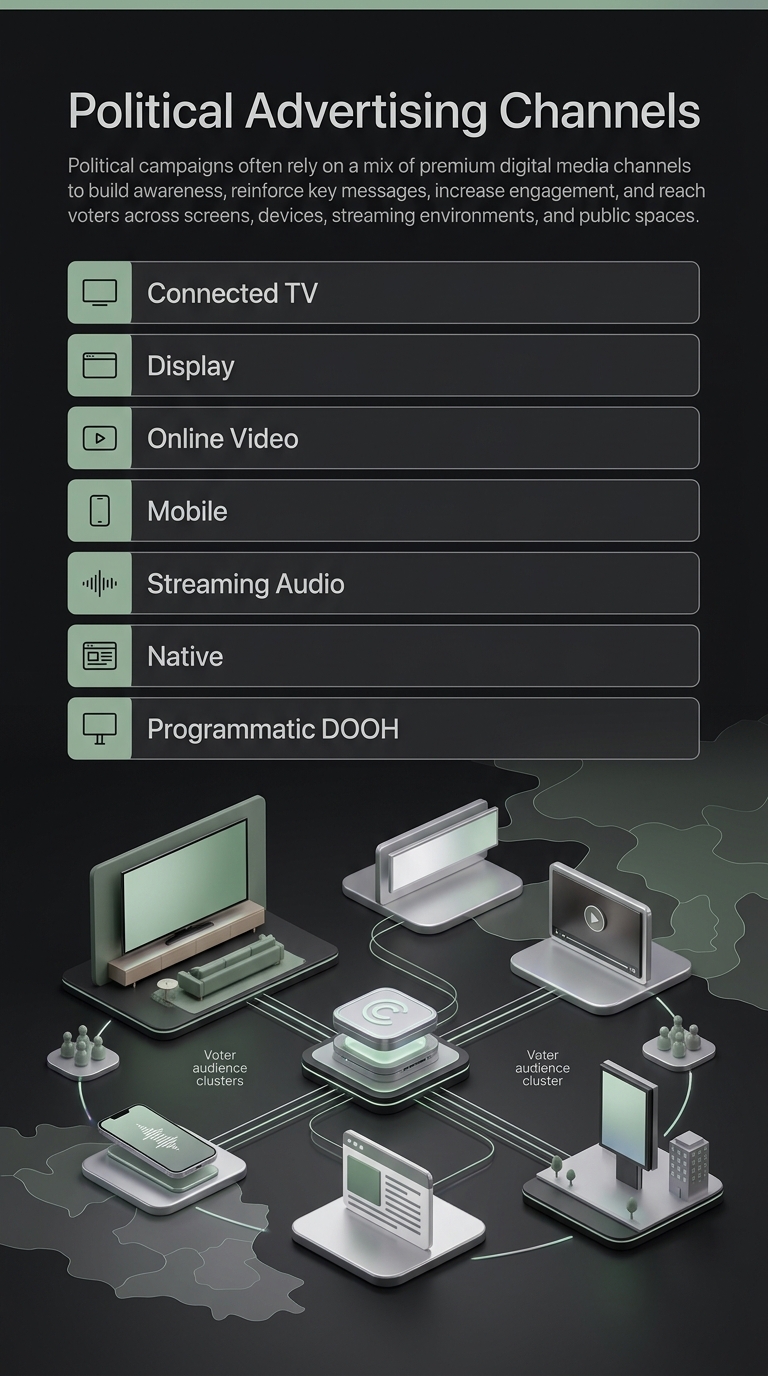
Political Advertising Channels
Political campaigns perform best when each channel has a clear role. Crosstide Media builds channel strategies based on the campaign objective, voter universe, geography, budget, creative assets, and timeline.
Connected TV
Connected TV is often the anchor channel for political advertising because it combines high-impact video storytelling with digital targeting. CTV can support candidate awareness, persuasion, issue education, ballot initiatives, fundraising support, and GOTV messaging.
Display
Display advertising supports message reinforcement, retargeting, fundraising, turnout reminders, and cost-efficient reach across voter audiences.
Online Video
Online video helps campaigns deliver persuasive storytelling across desktop, mobile, tablet, and premium video environments.
Mobile
Mobile advertising is especially useful for urgency, turnout reminders, event promotion, fundraising reminders, and localized voter communication.
Streaming Audio
Audio helps campaigns build frequency and reach voters during moments when visual media is not available.
Native
Native advertising supports issue education, candidate biography, ballot measure explanation, and deeper content engagement.
Programmatic DOOH
DOOH can support local visibility, public awareness, ballot initiative messaging, event promotion, and geographic reinforcement in high-priority areas.
